AI
AIAI for law firms in Saudi Arabia: where it helps, where it stops, and the review every draft needs
Where AI helps a law firm in Saudi Arabia, where the licensed lawyer must take over, and the ten checks every AI draft needs before it reaches a client or a court.


Key takeaways
- Give AI the first draft, the second-language version and the first pass through a long file. Keep facts, requests, deadlines and every cited article with the lawyer.
- Open every cited article on laws.boe.gov.sa in Arabic, read the amendments under it, and check it says what your sentence claims. The English translation can lag.
- Arabic is the official language of Saudi courts, and foreign-language papers need a certified Arabic translation (Law of Procedure before Sharia Courts, Art. 23).
- Courts in Abu Dhabi and Qatar have sanctioned a law firm and a lawyer over non-existent citations. Whoever signs the filing owns every citation in it.
- Agree five house rules: approved tools, lawyer sign-off, AI research as a lead only, a file note of checks, and a position on telling clients.
On this page
- AI for law firms in Saudi Arabia: what has changed, what hasn't
- Using AI in law practice: a task-by-task map
- Where it stops: four failure points in Saudi practice
- What courts and regulators in the Gulf and beyond now expect
- The review every AI draft needs before it leaves the firm
- Five house rules for AI in your firm
- This week: test the checklist on five drafts
AI for law firms in Saudi Arabia is useful for first drafts of contracts, memoranda and letters, for keeping Arabic and English versions aligned, and for a first pass through long files and research. It stops where the work has to be true, current and signed: the facts, the client's requests, deadlines, every cited article, and the Arabic text the court reads. Those stay with the licensed lawyer, whether your team drafts in Riyadh, Dubai or London.
This article is general information, not legal advice. Check your firm's obligations against the current text of the law and its implementing regulations.
AI for law firms in Saudi Arabia: what has changed, what hasn't
Saudi Arabia's General Authority for Statistics (GASTAT) found that 43.9% of establishments in "professional activities" used AI technologies in 2025 [1], up from 39.2% in 2024 [2]. The category covers far more than law firms; GASTAT publishes no law-firm figure.
Litigation has moved online. Saudi courts held more than 2.3 million sessions in 2024, 98% of them remotely through the Ministry of Justice's e-litigation service, which covers exchanging memoranda and submitting documents. Najiz, the Ministry's e-services platform, has a portal for lawyers [3]. When pleadings travel as files, little stands between a draft and the court record except the lawyer's review.
The duties have not moved. The Law of Legal Practice (نظام المحاماة) appears in Arabic, with its amendments, on laws.boe.gov.sa, where the Bureau of Experts at the Council of Ministers publishes the official texts of Saudi laws [4]. It requires a lawyer to practise "in accordance with Sharia and applicable laws" (Article 11) and forbids disclosing client secrets (Article 23) [5]. The Saudi Data & AI Authority (SDAIA) states in its generative AI guideline that "it is users' responsibility to verify the content generated by GenAI" [6, §5.3].
We found no guidance from the Saudi Ministry of Justice or the Saudi Bar Association written specifically for lawyers' use of AI (checked 29 September 2026).
Using AI in law practice: a task-by-task map
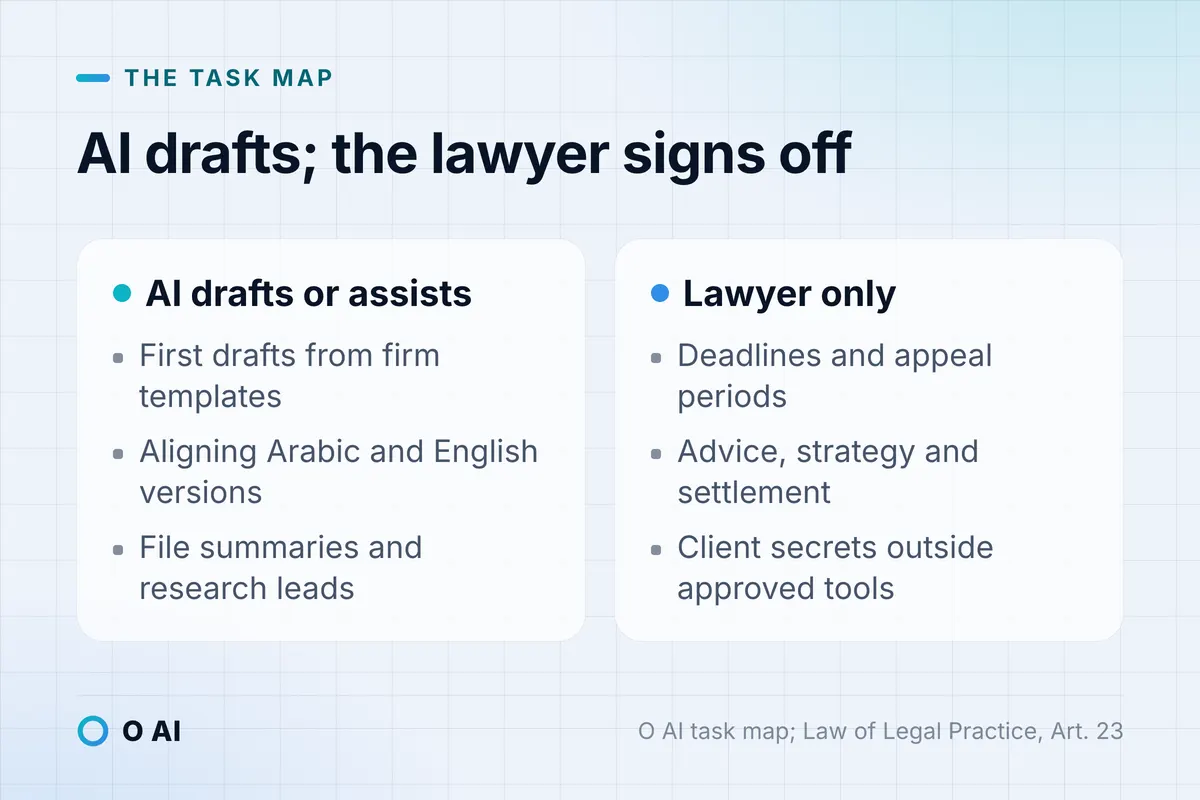
In the table below, Draft means AI writes a first version. Assist means AI reads, lists or summarises, and nothing is quoted from it. Lawyer only means AI stays out.
| Task | AI's role | What the lawyer checks before use |
|---|---|---|
| Contract or agreement from the firm's template | Draft | Parties, commercial terms, governing law, dispute clause, cited articles |
| Memorandum or reply | Draft | Facts against the file; the requests (الطلبات, the relief sought) as instructed; cited articles; the filing deadline |
| Letters, notices and client updates | Draft | Names, dates, amounts; nothing from another matter |
| English version of an Arabic document, or the reverse | Draft | Terms match across versions; which version governs; for court, a certified translation |
| Summary of a long file, judgment or exhibit bundle | Assist | Spot-check against the source; never cite the summary |
| "Which laws might apply?": candidate laws, questions and search terms | Assist | Open every article on laws.boe.gov.sa and read the current Arabic text |
| Research a client brings you, produced with AI | Assist, treated as unverified | Everything, as if it were your own first draft |
| Deadlines, limitation and appeal periods | Lawyer only | Computed by a person and entered in the firm calendar |
| Advice, strategy, settlement position, chances of success | Lawyer only | No AI prediction of outcomes |
| Client secrets outside the firm's approved tools | Lawyer only | Article 23; house rule 1 below |
First drafts of contracts, memoranda and letters
Drafting works best from the firm's own templates and clause library, because the draft inherits a structure the firm already trusts. Give the tool the documents from the file itself, so the draft works from the record. The lawyer's time then moves from typing to the parts that carry risk: the facts, the requests and every citation.
Arabic and English versions of the same document
Many clients, and many foreign parent companies, read English; the court reads Arabic. AI does well at keeping defined terms, names and figures aligned across both versions, and at flagging a clause that appears in only one. It cannot decide which version governs if they differ: the lawyer makes that choice and states it in the document.
Where it stops: four failure points in Saudi practice
Each of these can reach a court file unnoticed unless the review is built to catch it.
1. AI hallucination in legal research: invented and misapplied articles
An AI hallucination is a confident statement that is false. SDAIA warns that models can "over-confidently generate 'facts' that are complete fiction" [6, §5.3].
Specialist tools are not immune. In a study first published in 2024, Stanford RegLab found that legal research tools from LexisNexis and Thomson Reuters "each hallucinate between 17% and 33% of the time" [7]. Those were US tools answering US legal questions; we found no comparable study for Saudi law or for Arabic. The study also counts as a hallucination any response that "falsely asserts that a source supports a statement" [7, §4.3]. That misgrounded citation is the harder error to catch, because the reference opens and looks right.
The AI Hallucination Cases database lists 2,095 decisions by courts and tribunals worldwide (count on 28 September 2026), 241 of them involving a legal norm such as a statute or rule, and 17 a repealed law. None is from Saudi Arabia [8]. That zero most likely reflects which decisions get published and indexed, so it tells you little about Saudi filings. Where most citations are to statutory articles, as in Saudi practice, the risk shifts from invented cases to wrong or outdated articles. An AI hallucination checker may flag a citation that does not exist; an old article quoted in its old wording can still pass it.
2. The amended article
On a laws.boe.gov.sa law page, each article shows its original text first. Amendments follow underneath, under the heading «تعديلات المادة» ("amendments to the article"). A hurried reader, or a tool trained on older copies, takes the first text. SDAIA reminds users that AI outputs can be "inaccurate, outdated, biased, or even deceptive" [6, §5.3].
When we checked the Law of Legal Practice on 29 September 2026, its page alone held three examples [4]. Saudi laws are issued by Royal Decree (numbered M/…) and dated in the Hijri calendar, the Islamic lunar calendar used on official texts:
- Article 18(a), which let any agent, not only a registered lawyer, plead for others in one to three cases, was deleted by Royal Decree M/66 of 15/7/1443H (16 February 2022). The article was amended again, with new wording, by M/21 of 26/1/1447H (21 July 2025).
- Article 25 was repealed by M/191 of 29/11/1444H (18 June 2023).
- Article 26 was amended by M/21 of 26/1/1447H (21 July 2025).
The site's only English translation, The Code of Law Practice, a PDF created in August 2021, still prints all three articles in their old form [5]. An English-first reviewer can "check the official source" and still approve a dead text. Check the Arabic.

3. Client secrets, and where the text goes
Article 23 of the Law of Legal Practice bars a lawyer from disclosing "any confidential information" learned through the profession, even after the power of attorney ends, unless a Sharia requirement dictates otherwise [5]. SDAIA explains the technical risk: GenAI services "use the information received through prompts as training data", which "can then be exposed to third parties" [6, §5.4]. If client personal data is transferred outside the Kingdom, the Personal Data Protection Law (PDPL) sets conditions, including limiting the transfer "to the minimum amount of Personal Data needed" (Article 29) [9]. The law also covers processing from abroad of personal data about people residing in the Kingdom (Article 2) [9], so it can reach a team in Dubai or London.
4. The court reads Arabic
Article 23 of the Law of Procedure before Sharia Courts (نظام المرافعات الشرعية; "Law of Civil Procedure" in the Bureau of Experts' English translation) provides: "Arabic shall be the official language of courts… A certified Arabic translation prepared by a licensed office shall be presented for documents in a foreign language" [10].
So, before these courts, an English AI draft is only a working copy, and a machine translation is not a certified translation. A foreign company's English contract reaches the court as its certified Arabic translation, so have a lawyer review the Arabic before filing.
What courts and regulators in the Gulf and beyond now expect
The same database lists AI hallucination cases from the UAE (two) and Qatar (one) [8]. The table shows how those courts, and others a Gulf firm may appear before, have responded. None of it is Saudi law, and some of it is guidance rather than binding rules, but a firm working across the region may be measured against it.
The ADGM Courts (Abu Dhabi Global Market), the DIFC Courts (Dubai International Financial Centre) and the QFC Court (Qatar Financial Centre, part of the Qatar International Court and Dispute Resolution Centre) serve financial centres. ADGM law "operates on the basis of English common law", so its judge gave the English Ayinde decisions "particular weight" [11, para. 43]. Where precedent carries that weight, invented cases do the damage; in Saudi practice, the statutory article carries the argument (failure point 2).
| Where | Instrument or case | What it says or shows |
|---|---|---|
| Abu Dhabi (ADGM Courts) | Arabyads Holding v Alam [2025] ADGMCFI 0032 (18 December 2025) [11] | A law firm was ordered to pay AED 282,508 in costs on the indemnity basis (the higher scale of costs). Lawyers using AI for research should assume authorities "may not necessarily be accurately summarised… or indeed may not exist" |
| Qatar (QFC Court) | Sheppard v Jillion LLC [2025] QIC (E) 3; Practice Direction No. 1 of 2026 (announced 6 January 2026) [12] | A lawyer was found in contempt over fictitious authorities. The Practice Direction makes lawyers "fully responsible" for accuracy, bars confidential information from public AI tools, and on request requires AI-assisted parts to be identified and their checking explained |
| Dubai (DIFC Courts) | Practical Guidance Note No. 2 of 2023 (effective 21 December 2023) [13] | Guidance: verify AI content through "independent sources such as case law, statutes and credible legal commentary"; declare AI use "at the earliest possible opportunity" |
| UAE (Ministry of Justice) | Guiding Principles for the Use of AI Systems by Law Firms (29 September 2026) [14] | Ten principles. The Minister said AI outputs "must always be subject to careful human review, verification and oversight" |
| England and Wales (High Court) | Ayinde v Haringey; Al-Haroun v Qatar National Bank [2025] EWHC 1383 (Admin) (6 June 2025) [15] | Freely available AI tools "are not capable of conducting reliable legal research"; the duty to check against authoritative sources also covers relying on others' research |
The duty covers research you receive. In Al-Haroun, a solicitor relied on legal research his client had produced with publicly available AI tools and online sources. Of 45 citations put before the court, 18 were to cases that did not exist. The court found it "extraordinary that the lawyer was relying on the client for the accuracy of their legal research" [15].
The person who ran the search carries the fault. In the ADGM judge's words, it "lies not with the research programme used… but with the person responsible for conducting the search" [11].
Practical advice from us, which no rule requires: a firm that appears before several of these forums should adopt one review standard that meets the strictest of them.
The review every AI draft needs before it leaves the firm
Run these ten checks, drawn up for this article, on every AI-assisted draft before it goes to a client, another party or a court. Adapt them to your practice.
| # | Check | How |
|---|---|---|
| 1 | Parties and identifiers | Names exactly as on the ID, commercial registration (CR) or power of attorney; same spelling in both languages |
| 2 | Facts and dates | Against the file, not the prompt; a person redoes every Hijri–Gregorian conversion |
| 3 | The requests (الطلبات) | Match the client's written instructions; nothing added, nothing dropped |
| 4 | Every cited article | Opened on laws.boe.gov.sa (for regulations, the issuer's site); Arabic text; «تعديلات المادة» read; it says what the sentence claims |
| 5 | Judgments and other authorities | Traceable to a published source you opened yourself; if not, delete it |
| 6 | Numbers | Amounts and totals add up; currency and VAT stated where relevant |
| 7 | Deadlines | Computed by a person from the notification date and governing article; entered in the firm calendar |
| 8 | Language | Arabic is the operative text for court; foreign-language papers have a certified Arabic translation; bilingual versions match |
| 9 | Confidentiality and leftovers | Approved tool only; no text from another matter; no prompt fragments or placeholders |
| 10 | Sign-off | A named lawyer approves; the file note records which tool helped and what was checked |
If you cannot open a citation in its official source, take it out before filing.

A worked example: three errors in one AI memo
This is a hypothetical draft, for illustration. An associate receives an AI first draft of a reply memorandum. It objects to the other side's representative, a non-lawyer agent, on the "one to three cases" limit in Article 18(a) of the Law of Legal Practice, quoted word for word from the English translation.
- Check 4 catches the article. Under Article 18 on laws.boe.gov.sa, «تعديلات المادة» shows paragraph (a) deleted in 1443H and the article amended again in 1447H. The objection may still stand under the current text; the deleted paragraph cannot carry it. The fix: cite the current wording if it supports the objection, and drop the objection if it does not.
- Check 1 catches the name. The client company's English name differs from its commercial registration. The fix: copy the name from the CR, in both languages.
- Check 2 catches the date. A Hijri contract date was converted to the wrong Gregorian day. The fix: reconvert it on the Umm al-Qura calendar, Saudi Arabia's official Hijri calendar, and state both dates.
Five house rules for AI in your firm
A starting set, drawn up for this article. It follows SDAIA's guideline, which asks organisations to set rules that prohibit "entering classified information into third-party tools", describe acceptable use and prevent leaks, backed by "oversight and regular reviews" [6, §5.4].
- Approved tools only, by type of data. Public tools get no client names, ID or CR numbers, privileged documents or unfiled pleadings. A firm tool is approved once the vendor answers in writing: where requests are processed, whether content trains models, who can access it, and how it is deleted.
- AI output is a draft until a named lawyer signs it, after the ten checks.
- AI research is a lead, not an authority, including research a client brings.
- Keep a file note of the tool, the purpose and the checks done. If a court or client asks, as the QFC Court now can [12], the answer already exists.
- Decide what you tell clients. Agree the firm's position and put it in the engagement letter. A fair benchmark comes from the CCBE (the Council of Bars and Law Societies of Europe), whose 2025 guide says to be transparent where an informed client would object [16].
Name the partner who owns these rules, and review them every quarter.
This week: test the checklist on five drafts
- Pick the one document type your firm drafts most often.
- Run the ten checks on the next five AI-assisted drafts of that type, and log what each check catches.
- Put the five house rules on the agenda of the next partners' meeting.
For picking and testing a single task, see our guide How can AI help my business? Start with one repetitive task.
Rushd is legal AI built for Saudi firms: a practice-management platform that O AI, a Saudi AI and software company in Al Khobar, builds for law firms. It drafts contracts, agreements and memoranda in Arabic, English or both, grounded in Saudi law and the firm's templates; the licensed lawyer reviews and approves, and Rushd gives no legal advice. Its drafts are first drafts like any other, so run the ten checks on them too. On house rule 1: core hosting (compute, database and files) is on Saudi-based cloud infrastructure inside the Kingdom; AI requests go to a third-party AI provider and may be processed outside it; customer content is not used to train AI models without the firm's explicit consent; access inside the firm is role-based, with an audit log. Ask us about deletion in writing, as you would any vendor.
See how Rushd prepares first drafts in Arabic and English for your lawyers to review and approve.
Frequently asked questions
Can lawyers in Saudi Arabia use AI tools such as ChatGPT?
We found no Saudi law that bans it, and no guidance from the Ministry of Justice or the Saudi Bar Association written specifically for it (checked 29 September 2026). The lawyer's existing duties still apply: practise in accordance with Sharia and the laws, and keep client secrets (Law of Legal Practice, Articles 11 and 23). SDAIA's generative AI guideline puts the duty to verify AI output on the user. This is general information, not legal advice.
Will AI replace lawyers in Saudi Arabia?
It can take over drafting and reading time. Responsibility stays with the lawyer. Only lawyers registered on the roll of practising lawyers may plead for others before the courts, with limited exceptions such as a spouse, an in-law or a relative up to the fourth degree, and a company's legal representative (Law of Legal Practice, Article 18). Courts in Abu Dhabi and Qatar have held a law firm and a lawyer responsible for non-existent authorities in their filings, in cases that turned on the use of AI tools (ADGM Courts, Arabyads v Alam, 2025; QFC Court, Sheppard v Jillion, 2025). Whoever signs the filing answers for every citation in it.
Do AI tools invent Saudi legal articles?
They can. SDAIA's generative AI guideline (section 5.3) warns that models can confidently produce "facts" that are complete fiction. We found no published error rate for Saudi law; the 17–33% figures from Stanford RegLab's study, first published in 2024, describe US tools answering US legal questions. In Saudi practice an equally serious risk is quieter: a real article quoted in its pre-amendment wording, or cited for something it does not say.
Can I paste a client's documents into a public AI tool?
Not without the firm's approval and safeguards. Article 23 of the Law of Legal Practice bars disclosing client secrets, and SDAIA's generative AI guideline (section 5.4) warns that prompts can become training data exposed to third parties. If personal data leaves the Kingdom, the transfer conditions in Article 29 of the Personal Data Protection Law (PDPL) apply. Courts are moving the same way: Qatar's QFC Court (Practice Direction No. 1 of 2026) prohibits lawyers appearing before it from entering confidential or privileged information into public AI tools.
Should we tell the client or the court that AI helped?
We found no Saudi rule requiring it. Elsewhere, the DIFC Courts ask parties to declare AI use at the earliest possible opportunity (Practical Guidance Note No. 2 of 2023), the QFC Court can require lawyers to identify AI-assisted parts of a submission (Practice Direction No. 1 of 2026), and the CCBE's 2025 guide advises transparency where an informed client would object. Agree a firm position, put it in the engagement letter, and record AI use in the file note (house rules 4 and 5).
How do I check an article that an AI tool gave me?
Find the law on laws.boe.gov.sa, the Bureau of Experts' official site, and open the Arabic text. Read the article, then everything under «تعديلات المادة» (amendments to the article) beneath it, and confirm that the current wording says what your sentence claims. For a regulation, use the issuing authority's official publication. Do not rely on an English translation for current wording: the Bureau of Experts' 2021 translation of the Law of Legal Practice still prints articles that have since been deleted or repealed.
We are a firm or company outside Saudi Arabia. Which of this applies to us?
A document filed in a Saudi court meets Saudi procedure: the court works in Arabic, and foreign-language papers need a certified Arabic translation (Law of Procedure before Sharia Courts, Article 23). Only lawyers registered on the Saudi roll of practising lawyers may plead for others, with limited exceptions (Law of Legal Practice, Article 18). If you process personal data of people residing in the Kingdom, the Personal Data Protection Law (PDPL) can apply to you from abroad (Article 2). This is general information, not legal advice.
Sources
- Establishments ICT Access and Usage Statistics 2025 (opens in a new tab)General Authority for Statistics (GASTAT) · stats.gov.sa
- Establishments ICT Access and Usage Statistics 2024 (opens in a new tab)General Authority for Statistics (GASTAT) · stats.gov.sa
- «التقاضي الإلكتروني.. إجراءات متطورة حافظت على الضمانات القضائية» ("E-litigation: advanced procedures that preserved judicial safeguards"; in Arabic, 26 January 2025) (opens in a new tab)Saudi Press Agency (SPA), report on Ministry of Justice figures · spa.gov.sa
- Law of Legal Practice (نظام المحاماة), Royal Decree M/38 of 28/7/1422H; official Arabic text with amendments (opens in a new tab)Bureau of Experts at the Council of Ministers · laws.boe.gov.sa
- The Code of Law Practice (English translation, PDF created August 2021; the Arabic text is the one in force) (opens in a new tab)Bureau of Experts at the Council of Ministers · laws.boe.gov.sa
- Generative Artificial Intelligence Guidelines for Public (May 2025) (opens in a new tab)Saudi Data & AI Authority (SDAIA) · sdaia.gov.sa
- Magesh, Surani, Dahl, Suzgun, Manning and Ho. Hallucination-Free? Assessing the Reliability of Leading AI Legal Research Tools, Journal of Empirical Legal Studies (2025; preprint May 2024) (opens in a new tab)Stanford RegLab · reglab.stanford.edu
- AI Hallucination Cases Database (last updated 28 September 2026) (opens in a new tab)Damien Charlotin · damiencharlotin.com
- Personal Data Protection Law (English translation, as amended by Royal Decree M/148; the Arabic text on laws.boe.gov.sa is the official version) (opens in a new tab)Saudi Data & AI Authority (SDAIA) · sdaia.gov.sa
- Law of Procedure before Sharia Courts (نظام المرافعات الشرعية), Royal Decree M/1 of 22/1/1435H; the Bureau of Experts' English translation, titled "Law of Civil Procedure" (opens in a new tab)Bureau of Experts at the Council of Ministers · laws.boe.gov.sa
- Arabyads Holding Limited v Gulrez Alam Marghoob Alam [2025] ADGMCFI 0032, costs judgment (18 December 2025) (opens in a new tab)ADGM Courts, Court of First Instance · assets.adgm.com
- QICDRC Issues Practice Direction No. 1 of 2026 and Practice Guidance on the Use of Artificial Intelligence in Court Proceedings (6 January 2026) (opens in a new tab)Qatar International Court and Dispute Resolution Centre (QICDRC) · qicdrc.gov.qa
- Practical Guidance Note No. 2 of 2023: Guidelines on the use of large language models and generative AI in proceedings before the DIFC Courts (opens in a new tab)DIFC Courts · difccourts.ae
- UAE Minister of Justice launches Guiding Principles for the Use of Artificial Intelligence Systems by Law Firms at UN Crime Congress (29 September 2026) (opens in a new tab)UAE Ministry of Justice (press release via ZAWYA) · zawya.com
- R (Ayinde) v London Borough of Haringey; Al-Haroun v Qatar National Bank QPSC [2025] EWHC 1383 (Admin) (6 June 2025) (opens in a new tab)High Court of Justice of England and Wales, Divisional Court · judiciary.uk
- CCBE guide on the use of generative AI by lawyers (2 October 2025) (opens in a new tab)Council of Bars and Law Societies of Europe (CCBE) · ccbe.eu
How this article was made: Researched from the sources listed below, opened on 29 September 2026. Drafted with AI assistance, then checked against those sources. It has not been reviewed by a licensed lawyer. Images are AI-generated illustrations.
About the author