AI
AIHow can AI help my business? Start with one repetitive task
How can AI help my business? Start with one repetitive, text-heavy task, keep a person checking the result, and test it for two weeks before you spend.


Key takeaways
- Start with one task that repeats often, is mostly reading or writing, is quick to check, and where a mistake is cheap to catch.
- Before you buy anything, cost today's task: times per month × minutes × hourly cost, plus the cost of mistakes.
- Count saved staff time as cash only if it replaces overtime, temporary staff, outsourced work or a planned hire.
- Pilot for ten working days: five side by side with your team, five with a person approving every output.
- Before switching AI on, get documented consent for WhatsApp promotions with an easy opt-out (PDPL Art. 25), and keep personal or confidential data out of public AI tools.
On this page
- AI for small business in Saudi Arabia: where establishments stand
- The four-question test: how to pick your first AI task
- How can AI help my business? Six Saudi examples
- Is it worth it? A time-and-cost worksheet
- A two-week AI pilot plan
- PDPL checks before you switch AI on
- Common mistakes when starting with AI
- When AI is the wrong tool
- Your next step
AI helps a small company most when it takes one repetitive, text-heavy task off the team, such as reading documents, drafting replies, compiling a report or moving data between systems, while a person checks the result.
So start with one task. Work out what it costs you now, test AI on it for two weeks, and pay for a tool only when the numbers show a real saving.
Inside: a four-question test, six hypothetical Saudi examples, a cost worksheet, a ten-day pilot and the data checks to run first.
AI for small business in Saudi Arabia: where establishments stand
About one in three Saudi establishments already uses AI. The General Authority for Statistics (GASTAT) found that 33.1% of establishments used AI technologies in 2025 [1], up from 27.6% in 2024 [2]. Information and communication leads at 61.1%. The sectors behind this guide's examples sit near the average: wholesale and retail trade at 30.2%, real estate at 31.8%, accommodation and food at 33.5%, and construction at 33.8% [1].
One caution before you repeat these numbers. The survey covers establishments of every size, from micro to large [3], but GASTAT publishes the results by economic activity only, with no breakdown by size. We found no official SME-only figure, so 33.1% describes establishments in general.
Monsha'at sizes a company by full-time employees and annual revenue together. Where the two point to different classes, the higher one applies [4].
| Size | Full-time employees | Annual revenue |
|---|---|---|
| Micro | 1–5 | Up to SAR 3 million |
| Small | 6–49 | Over SAR 3 million, up to SAR 40 million |
| Medium | 50–249 | Over SAR 40 million, up to SAR 200 million |
Size matters in one place in this guide: who does the checking. In a micro company the person checking AI's work may well be the owner, so pick a task whose daily check fits into the owner's day.
In a survey of 814 Saudi citizens aged 18 and over, published on 3 September 2026, the Saudi Center for Opinion Polling (SCOP) found that 64% use AI tools [5]. SCOP asked individuals, so the figure says nothing about companies directly. It does suggest that some of your staff already use these tools, which is reason enough to set data rules before anyone uses one at work.
What is left to decide is which task to start with.
The four-question test: how to pick your first AI task
Your first AI task is usually hiding in one of four places: documents, customer replies, reports, or data spread across several systems. The principle behind this is in SDAIA's AI Adoption Framework, which is written for private companies as well as government bodies: AI initiatives "should be based on actual user needs or existing operational challenges" [6].
List the tasks in those four areas that eat your team's time. Then answer four questions about each one, yes or no.
- Does it happen often, and the same way each time? How to check: count last month's cases in WhatsApp, the inbox or the files. Weekly or more is a good sign.
- Is it mostly reading, writing, sorting or copying information? How to check: text, a scan or a spreadsheet goes in, and text or data comes out.
- Can a person check the result much faster than doing the work? How to check: there is a clear right answer to compare against, such as the price list or the invoice itself.
- Is a mistake cheap to catch before it does harm? How to check: nothing is paid, filed on a government portal or decided about a person until someone has looked at it.
Four yes answers make a strong first candidate. Three means possible, with a tighter review. Two or fewer means it is not your first task, though it may be a later one. If two tasks tie, pick the one that has a clear owner and annoys the team most.
Copy this grid and fill it in with your own tasks:
| Task | Q1: Often, same way? | Q2: Reading or writing? | Q3: Quick to check? | Q4: Mistake cheap to catch? | Yes count |
|---|---|---|---|---|---|
| Example: replying to WhatsApp price questions | Yes | Yes | Yes | Yes | 4 |
| Example: preparing the annual budget | No | Yes | No | No | 1 |
How can AI help my business? Six Saudi examples
Each scenario below shows how to use AI in business operations while people keep the decisions: what AI does, what stays with people, what you would count to know whether it works, and where it can trip up. They are illustrations, not client stories.
1. Customer replies: price questions on WhatsApp
A building-materials trading company in Dammam gets a steady stream of WhatsApp messages asking for prices and stock. Most are in Arabic, often mixed with English product codes, and some arrive as voice notes.

- What AI does: drafts each reply from the approved price list and stock sheet, and flags any item that is not on the list.
- What stays with people: discounts, delivery promises, complaints, and any quote above a limit the owner sets.
- What to measure: time to first reply, the share of drafts sent without edits, messages handed to a person, and wrong prices sent (the target is zero).
- Where it trips up: the same product written three ways: a code, an Arabic name, a photo of the label. Add the common spellings to the price list before week 1.
2. Offers to past customers on WhatsApp
An online perfume and oud shop in Riyadh wants to send its Ramadan or White Friday offer to past buyers.
- What AI does: writes several Arabic versions of the message, and selects recipients only from customers on the consent list.
- What stays with people: approving every broadcast, keeping the consent log, and handling stop requests.
- What to measure: how complete the consent records are (date, channel, what the customer agreed to), stop requests and how quickly they are honoured, and replies.
- Where it trips up: a sales history treated as a consent list. Build the recipient list from the consent log only.
The consent rules for this are in the PDPL checks below.
3. Supplier invoices into the accounts
A fit-out contractor in Jeddah receives supplier invoices as PDFs and phone photos.
- What AI does: reads the supplier name, VAT number, invoice number, amount and due date into the accounting sheet or system, and matches each invoice to its purchase order.
- What stays with people: approving payment, resolving mismatches, and anything the scan could not read.
- What to measure: minutes per invoice, fields corrected per 100 invoices, and late payments.
- Where it trips up: the VAT number confused with the commercial registration number, Arabic-Indic digits (١٢٣) on scans, and totals with and without VAT. Check these three fields in every spot check.
4. Scanned Arabic lease contracts
A property management office in Al Khobar keeps hundreds of older paper leases as scans, and has missed renewal dates more than once.
- What AI does: extracts the tenant, unit, rent, and start and end dates (some leases use the Hijri calendar, some the Gregorian) into a renewals calendar.
- What stays with people: checking every date conversion and any unusual clause, and calling the tenants.
- What to measure: contracts processed per hour, date errors found in spot checks, and renewals missed.
- Where it trips up: Hijri dates converted with the wrong calendar, and day and month swapped in Gregorian dates. Check every converted date against the Umm al-Qura calendar.
5. The weekly branch report
A restaurant group with four branches in Al Khobar and Dammam spends every Sunday morning merging point-of-sale exports, delivery-app statements and the expenses sheet.
- What AI does: compiles one summary with week-on-week changes and lists the questions it raises, such as "food cost at branch 3 jumped; check the invoices".
- What stays with people: checking totals against the source files and deciding what to do.
- What to measure: hours to produce the report, the time it is ready, and corrections needed.
- Where it trips up: net payouts from delivery-app statements mixed with gross sales from the point of sale. Tell it which figure to use, or the week-on-week comparison is wrong.
6. Staff questions about company policy
A facility management company in Riyadh answers the same questions about leave, working hours and expenses again and again, in Arabic and English.
- What AI does: answers only from the approved staff handbook, and says "please ask HR" for anything else.
- What stays with people: anything about one employee's pay, contract, visa or discipline. The assistant does not see personnel files.
- What to measure: HR questions per week, and wrong answers found in weekly spot checks.
- Where it trips up: an out-of-date handbook, because the assistant repeats whatever the handbook says. Set a review date, and update it before working hours change for Ramadan.
In every case, AI does the reading and drafting, and a person keeps the decisions that cost money or affect someone.
Is it worth it? A time-and-cost worksheet
Before you buy anything, work out what the task costs you today. You need a stopwatch and last month's records. Time ten real cases and use the middle value; the fastest case would understate what the task costs you now.

Copy this table into a spreadsheet. Fill in lines A to E and T now, lines B2 and D2 during the pilot, and lines R and S from the supplier's written quote.
| Line | What to write | How to get it |
|---|---|---|
| A | Times the task happens per month | Count last month's chats, invoices or contracts |
| B | Minutes per case today | Time 10 real cases; use the middle value |
| C | Cost per hour of the person doing it | (monthly salary + allowances + other monthly employment costs, such as GOSI contributions and medical insurance) ÷ paid hours per month |
| D | Mistakes per month today | Rework, complaints, corrections |
| E | Cost to fix one mistake | (minutes to fix ÷ 60 × C) + any money lost |
| T | Today's monthly cost | (A × B ÷ 60 × C) + (D × E) |
| B2 | Minutes per case with AI, including the person's check | Measured in week 2 of the pilot, not guessed |
| D2 | Mistakes per month with AI | From the pilot log, scaled to a month |
| R | Monthly running cost of the tool (subscriptions, usage, support) | The supplier's written quote |
| S | One-off setup cost | The supplier's written quote |
| N | New monthly cost | (A × B2 ÷ 60 × C) + (D2 × E) + R |
| T − N | Monthly saving | Subtract line N from line T |
| P | Payback in months | S ÷ (T − N), only if T − N is above zero |
| H | Hours freed per month | A × (B − B2) ÷ 60 |
Then decide. If T − N is zero or less, stop or pick another task. If the payback is longer than you are willing to wait, cut the scope or pick another task. Freed hours are only worth something if you know where they will go, so write that down next to line H.
Split the saving in two. R and S are cash you will pay. The staff-time part of T − N becomes cash only if it replaces overtime, temporary staff, outsourced work or a planned hire; otherwise it is time. In that case, judge the tool by what the team will do with the hours on line H, because the payback figure alone will overstate the gain.
SDAIA's framework asks for the same discipline: each AI initiative should be linked to measurable outputs "such as the number of work hours saved" [6].
A two-week AI pilot plan
The pilot runs for ten working days: long enough to see real cases, short enough that it does not drift into a project. On a Sunday-to-Thursday week that is two calendar weeks; if your shop or branches also open on Saturday, count Saturdays too.
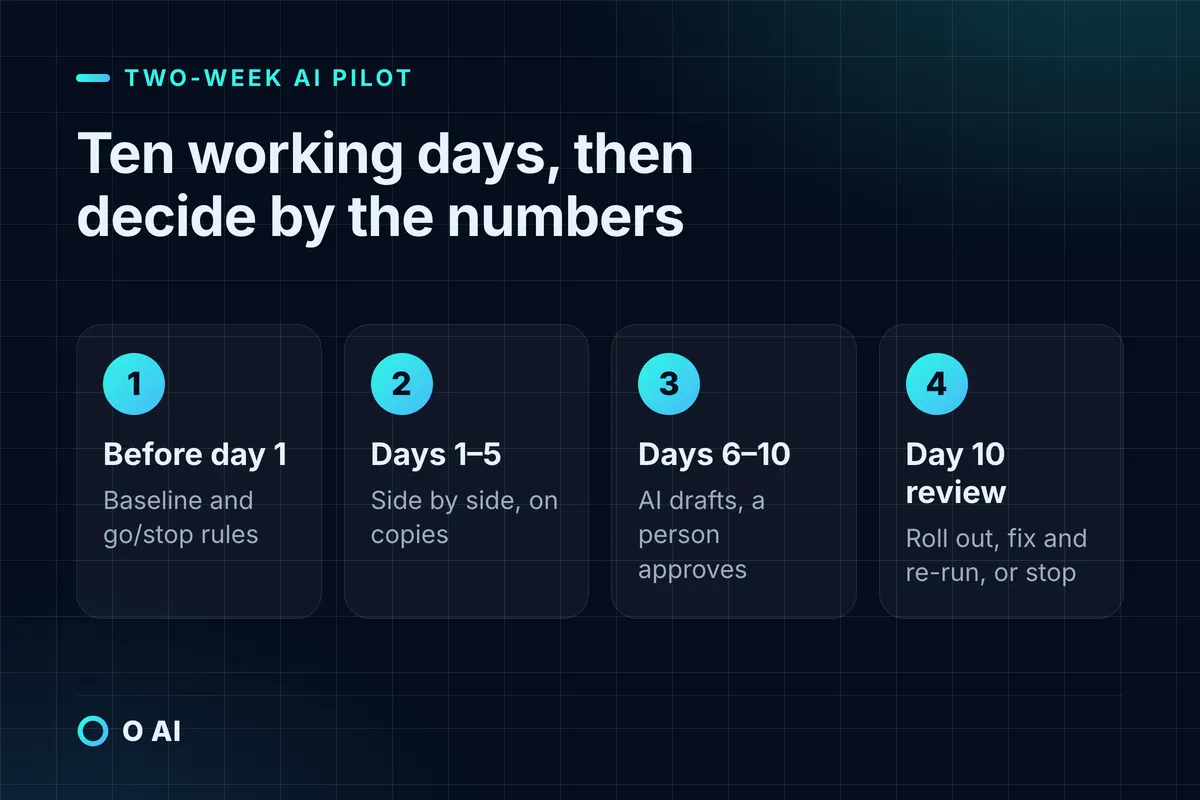
Before day 1
- Name one owner for the pilot.
- Write down what "done right" means for this task.
- Collect 20–30 real past cases, with names and numbers removed where you can.
- Record your baseline for lines A, B and D.
- Write your go and stop thresholds before day 1, so the results cannot move them.
- Decide what data the tool may see (see the PDPL checks below).
- Keep it to one task, one tool and one channel.
What to pilot with. A pilot can run on one of three things: the AI feature already inside a system you use (accounting, point of sale, help desk); a business plan of a general AI assistant with data controls, working on copies; or a small connection built between AI and your own data. Pick the one that needs the least new access to personal data, and put the supplier questions below to whichever you choose.
Week 1, days 1–5: side by side
AI works on copies while the team does the task as usual. Compare the two and log each miss by type: wrong fact or price, wrong tone, missing information, misread scan, wrong date, misread dialect or voice note. Midweek, fix the instructions or the source data once, for example by updating the price list.
Week 2, days 6–10: AI drafts, a person approves
Nothing reaches a customer, supplier or government portal without a person's approval. Time ten cases to get B2, and count edits and mistakes caught to get D2.
Stop rule. If a wrong price or fact reaches a customer, or a data rule is broken, pause, fix the cause and restart that week.
Day 10 review, about 45 minutes
Fill in the worksheet and choose one of three outcomes: roll out, fix and re-run, or stop. Write down which parts of the task stay manual for good. A pilot that ends in a clear decision has done its job, even when the decision is to stop.
PDPL checks before you switch AI on
This article is general information, not legal advice. Check your company's obligations against the current text of the law and its implementing regulations.
Promotions need prior consent
Article 25 of the Personal Data Protection Law (PDPL) bars a company from using a person's personal means of communication to send advertising or awareness material without the recipient's prior consent and a clear way to stop receiving it [7]. It names "the post and email" only as examples, so treat a customer's WhatsApp number as covered too.
The Implementing Regulation adds the detail:
- Article 28 requires consent before advertising material is sent where there has been no prior interaction between your company and the recipient. Consent must be given freely and documented so it can be verified later. Each message must name the sender clearly, stopping must be free of charge and as easy as opting in, and sending must stop immediately on request [8, Art. 28].
- Article 29, on direct marketing, requires consent under Article 11, and sending must stop without undue delay once consent is withdrawn [8, Art. 29].
Both apply "without prejudice to the Telecommunication and Information Technology Act or any other related laws", so telecom rules may apply too. And only Article 28 has the "no prior interaction" wording; Article 25 of the law and Article 29 of the Regulation do not. So even for past buyers, the safer course is documented consent from each person on your list.
In practice, keep a consent log (who, date, channel, what they agreed to), name your company and the way to stop in every broadcast, and make sure the tool excludes everyone on the stop list.
Replying to a question a customer sent you is a different activity from sending advertising, so keep the two separate in your tool, and treat any offer added to a reply as marketing. Replies still involve personal data, so the next check applies to them too.
Know where the data goes
An AI tool may process your data on servers outside the Kingdom. If customer personal data is transferred abroad, PDPL Article 29 allows it for listed purposes, on conditions that include an adequate level of protection and limiting the transfer "to the minimum amount of Personal Data needed" [7].
SDAIA's transfer regulation lists safeguards such as standard contractual clauses, and requires a risk assessment in some cases [9]. PDPL Article 8 also asks you to choose only processors "providing the necessary guarantees" and to monitor their compliance [7].
So ask the supplier six questions, and get the answers in writing:
- Where is our data processed and stored?
- Is it used to train models?
- Who can see it?
- Which other companies process it for you (for example, the AI model provider), and in which country?
- Can we delete it, and how?
- What happens to our data when we cancel?
What not to paste into public AI tools
SDAIA's generative AI guideline warns that GenAI services "use the information received through prompts as training data", which "can then be exposed to third parties", and advises organisations to set policies that stop staff entering classified information into third-party tools [10, §5.4]. It also warns that models can "over-confidently generate 'facts' that are complete fiction", so users must check output against trustworthy sources [10, §5.3].
A never-paste list for staff, drawn up for this article rather than taken from SDAIA:
- national ID and iqama numbers
- bank and card details
- salaries
- passwords and API keys
- contracts under a non-disclosure agreement
- unreleased prices or tender figures
- sensitive data as the PDPL defines it: health data, genetic data, biometric data that identifies a person, racial or ethnic origin, religious, intellectual or political belief, security and criminal data, and data showing that one or both of a person's parents are unknown [7, Art. 1(11)]
Put the list on one page, and give staff a business account with data controls instead of letting them use personal accounts.
Common mistakes when starting with AI
- Buying a tool before choosing the task. The tool then decides what you work on.
- Starting with the biggest, most visible process. It has the most exceptions and the most people to convince.
- Skipping the baseline. Without lines A, B and D, nobody can say whether the pilot worked.
- Feeding the tool an old price list or messy data. You get confident, wrong answers.
- Measuring how much the team "uses AI". Measure time, mistakes and response times instead.
- Adding three more tasks before the first is stable. Problems pile up, and you can't tell which task caused them.
- Testing only with tidy, formal text. Your customers write in Saudi dialect mixed with English and send voice notes, so test with those.
When AI is the wrong tool
- The task is rare, monthly or less. A template or checklist will do.
- The rule is fixed and exact, such as sending a reminder seven days before a due date or applying a fixed rate. Use plain automation, a spreadsheet formula or a setting in the system you already have.
- The process is undefined, or people disagree about the steps. Fix the process first, or AI will copy the confusion.
- A machine would decide about a person on its own, for example by rejecting job applicants automatically. Keep a person deciding. Where decisions are made solely by automated processing of personal data, the Implementing Regulation requires the person's consent to be explicit [8, Art. 11(2)(c)].
- The task runs on sensitive data, such as health or criminal records. That is not a first task.
- Nobody has time to check the output. The review step in every example above then falls away, and so does the safety net.
- Ready-made software already does it. Check what your accounting, point-of-sale or HR system can do before adding anything new.
Your next step
This week, before you speak to any supplier (including us):
- List five tasks that slow your team down.
- Run each through the four questions.
- Time ten real cases of the task with the most yes answers.
- Fill in lines A to E and T of the worksheet.
That gives you a baseline of your own. If you would like help with AI integration for a small business like yours, this is how O AI, a Saudi AI and software company in Al Khobar, works:
A good first step is one slow, repetitive task: documents, customer replies, reports or data spread across systems. O AI studies that task, checks whether AI is worth it, then connects AI to the systems you already use or builds a new one. The first consultation and proposal come with no commitment.
Tell us which task slows your team down and book a free consultation. We reply within one business day.
Frequently asked questions
How do I start using AI in my business?
Pick the task before the tool. List five slow tasks and score each on four questions: does it happen often and the same way, is it mostly reading or writing, is the result quick to check, and is a mistake cheap to catch before it does harm? Time ten real cases of the best candidate and work out what it costs today. Then run a two-week pilot in which a person approves every output, and decide on the numbers.
How much does AI cost for a small company, and is it worth it?
It depends on the task and on whether you use a subscription tool or connect AI to your own systems. We found no verified market price for Saudi SMEs, so be careful with published averages. Ask suppliers for a written quote covering monthly running costs and one-off setup, and compare it with what the task costs you today in staff time and mistakes. If there is no clear saving, it is not worth it yet.
Will AI replace my employees?
Not in the approach described here. AI takes the repetitive part of a task, and a person checks the result and makes the decisions. SDAIA's generative AI guideline places the responsibility for verifying AI output on the people who use it. Before you start, decide where the freed hours will go, such as customer follow-up or collections, so the plan for your team's time is part of the decision.
Is it safe to paste company information into ChatGPT or similar tools?
Not for personal, sensitive or confidential information. SDAIA advises organisations to set policies that stop staff entering classified information into third-party tools, because what is typed into prompts can be used as training data (SDAIA generative AI guideline, section 5.4). If personal data is processed outside the Kingdom, the PDPL's transfer rules apply (PDPL Article 29). Use a business account with data controls and a written never-paste list.
Can I use AI to send WhatsApp offers to my customers?
AI can draft the messages and pick recipients from your consent list. The sending itself must follow the PDPL and its Implementing Regulation: prior, documented consent, a clearly named sender, and a free, easy way to stop, and you must stop when a customer asks (PDPL Article 25; Implementing Regulation Articles 28–29). Keep a consent log, and make sure the tool excludes everyone on the stop list.
Does AI understand Saudi dialect, mixed Arabic and English, and voice notes?
Test it rather than assume it. In week 1 of the pilot, include real messages as your customers write them: Saudi dialect, English product codes, different spellings and voice notes. Log misreadings as their own miss type. If they are still frequent after the midweek fix, keep that channel manual and pilot a different task.
Sources
- Establishments ICT Access and Usage Statistics 2025 (opens in a new tab)General Authority for Statistics (GASTAT) · stats.gov.sa
- Establishments ICT Access and Usage Statistics 2024 (opens in a new tab)General Authority for Statistics (GASTAT) · stats.gov.sa
- Methodology and Quality Report for ICT Access and Usage Statistics for Establishments (opens in a new tab)General Authority for Statistics (GASTAT) · stats.gov.sa
- Enterprises' Classification (opens in a new tab)Monsha'at (General Authority for Small and Medium Enterprises) · monshaat.gov.sa
- AI in Saudi Arabia: Trends & Insights (3 September 2026) (opens in a new tab)Saudi Center for Opinion Polling (SCOP) · scop.sa
- Artificial Intelligence Adoption Framework (May 2025) (opens in a new tab)Saudi Data & AI Authority (SDAIA) · sdaia.gov.sa
- Personal Data Protection Law (English translation, as amended by Royal Decree M/148; the Arabic text on laws.boe.gov.sa is the official version) (opens in a new tab)Saudi Data & AI Authority (SDAIA) · sdaia.gov.sa
- Implementing Regulation of the Personal Data Protection Law (opens in a new tab)Saudi Data & AI Authority (SDAIA) · sdaia.gov.sa
- Regulation on Personal Data Transfer Outside the Kingdom (Version 2.0, August 2024) (opens in a new tab)Saudi Data & AI Authority (SDAIA) · sdaia.gov.sa
- Generative Artificial Intelligence Guidelines for Public (May 2025) (opens in a new tab)Saudi Data & AI Authority (SDAIA) · sdaia.gov.sa
About the author