 AI
AIAI agents for business automation vs RPA and workflow tools: which fits each step
Decide per step: workflow automation or RPA for fixed rules, an AI step for free text, and an AI agent only for judgement calls, with a person approving anything that can't be undone. The guide includes a six-question grid, a worked order process, a permission sheet and vendor questions.


Key takeaways
- Choose the tool per step: workflow automation or RPA for fixed rules, an AI step for free text, an AI agent only where the next step needs judgement, a person for what can't be undone.
- RPA works on screens and breaks when they change; log every run and replace it with an integration when you can.
- Before an agent runs, write down its tools, read or write rights, approvals, limits, hand-off rule, log review and owner.
- Ask vendors what their "agent" decides by itself; Gartner warns that RPA and chatbots are being rebranded as agents.
- Saudi Arabia's data protection law (PDPL) covers Saudi residents' data even when processed abroad, and has specific rules for decisions based on automated processing.
On this page
- Business process automation: four tools, four different jobs
- RPA vs AI agents: the real difference is who decides the next step
- When to use AI agents for business automation, and when not to: six questions for each step
- One order process, four tools: a worked example
- An AI agent's permission sheet: fill it in before it touches live data
- Personal data: Saudi rules that also reach foreign companies
- Seven questions for anyone selling you an "AI agent"
- Try the grid on one process this week
Use classic workflow automation when the data is structured and you can write every rule. Use RPA (robotic process automation) when the rule is fixed but the system only offers a screen. Add an AI step when the input is free text, a scan or a voice note but the path after it stays the same. Use AI agents for business automation only on the steps where the next move depends on judgement.
Many repetitive processes need a mix, chosen step by step, with a person approving anything that can't be undone.
Business process automation: four tools, four different jobs
Classic workflow automation. Systems pass data to each other on fixed rules, through an API or a ready-made connector: a web-form order creates the invoice and a delivery reminder. Check what your ERP (enterprise resource planning system), accounting or help-desk system already does before you buy more; if nothing fits, weigh ready-made software against a system built for you.
RPA. A software robot repeats clicks and keystrokes on screens. A playbook from the US federal RPA Community of Practice, published by the General Services Administration (GSA), says it "can be used to automate repetitive, rules-based tasks" [1].
An AI step inside a fixed workflow. A model reads, classifies, extracts or drafts, and the path after it stays fixed. The Saudi Data & AI Authority (SDAIA), which also issues Saudi Arabia's data protection regulations, has a level for this in the maturity scale of its Arabic report on agentic AI: AI placed at "critical points" of a known workflow to verify, summarise or take sub-decisions, unable to leave the programmed process [2, p. 21].
An AI agent. Saudi Arabia's Digital Government Authority (DGA), in a study written for government entities, defines agents as "autonomous or semiautonomous software entities that perceive their environment, make decisions, and act to achieve predefined goals" [3, p. 5]. In practice: software that picks its own next step and uses tools such as APIs or databases to take it [2, p. 13].
| Compare | Classic workflow automation | RPA | AI step in a workflow | AI agent |
|---|---|---|---|---|
| Who writes the path | You, in advance | You, in advance | You, in advance | The agent, at run time, within limits you set |
| Typical input | Structured data from systems | Structured data shown on screens | Free text, scans, photos, voice notes | Mixed, unclear cases |
| Needs | An API or connector | A screen and a login | A workflow around it and a check on its output | Tools, permissions, an approval step, logs |
| What running cost depends on | Platform or connector fees; fixing failed runs | Bot software; repairs when screens change | Model use per document; checking time | Model use at every step; approval and log-review time |
| Typical break | A connector or field changes; runs fail quietly | A screen, host application or login requirements change [1] | Misreads a field, a dialect or a scan | Takes a wrong step, or follows instructions hidden in an input [4] |
RPA vs AI agents: the real difference is who decides the next step
RPA follows a path a person wrote before the run, as workflow automation does. An AI agent picks its next step during the run, so two runs of one case can differ. That buys flexibility and costs predictability, testing effort, running cost and auditability.
SDAIA's factory example draws the line: checking product dimensions suits rule-based automation; spotting new defect patterns may need something that adapts [2, p. 23].
In June 2025 the research firm Gartner predicted that over 40% of agentic AI projects "will be canceled by the end of 2027, due to escalating costs, unclear business value or inadequate risk controls" [5]. Its analyst's advice: "They can start by using AI agents when decisions are needed, automation for routine workflows and assistants for simple retrieval." [5]
Gartner also warns of "agent washing": "the rebranding of existing products, such as AI assistants, robotic process automation (RPA) and chatbots, without substantial agentic capabilities". It estimated then that "only about 130 of the thousands of agentic AI vendors are real" [5]. Ask what a product decides by itself.
When to use AI agents for business automation, and when not to: six questions for each step
Use an AI agent only where the next move depends on judgement about the case and needs several lookups or tools. Give everything else to a cheaper, more predictable tool, or to a person.
Decide per step, not per process. Write the process as 5 to 10 steps on one page, with each step's input, system and current owner. Mark any step that touches money, a customer message, an official filing or a decision about a person. Then ask six questions:
- Input: structured (form fields, spreadsheets, system data) or unstructured (free text, scans, photos, voice notes)?
- Rules: can you write the rule for every case, exceptions included, on one page? Test: would two experienced staff handle the same case the same way?
- Access: does the system offer an API or official integration, or only a screen?
- Path: is the next step always the same, or does it depend on judgement about this case?
- Impact: if the step goes wrong, can you undo it before it reaches anything you marked?
- Change: how often do the rule, the screen or the input format change? Monthly or more counts against RPA: when a bot breaks, it is "typically due to an update to a host application" [1].
Then read across:
| If the answers are… | Use |
|---|---|
| Structured · rule written · API · same path | Classic workflow automation |
| As above, but screen only, rarely changing | RPA, and ask the system's owner for an integration |
| Unstructured · same path afterwards | An AI step inside the workflow |
| Path depends on judgement · several lookups or tools | An AI agent with limited tools; a person approves high-impact actions |
| "No" to question 5, on any row | A person approves that action, whatever the tool |
| The rule can't be written (people disagree) or the step is rare | Don't automate yet. Fix the process first |
The question 5 row follows SDAIA's AI Ethics Principles: automated AI systems where decisions have an impact that is "irreversible or difficult to reverse" should "trigger human oversight and final determination" [6, p. 23].
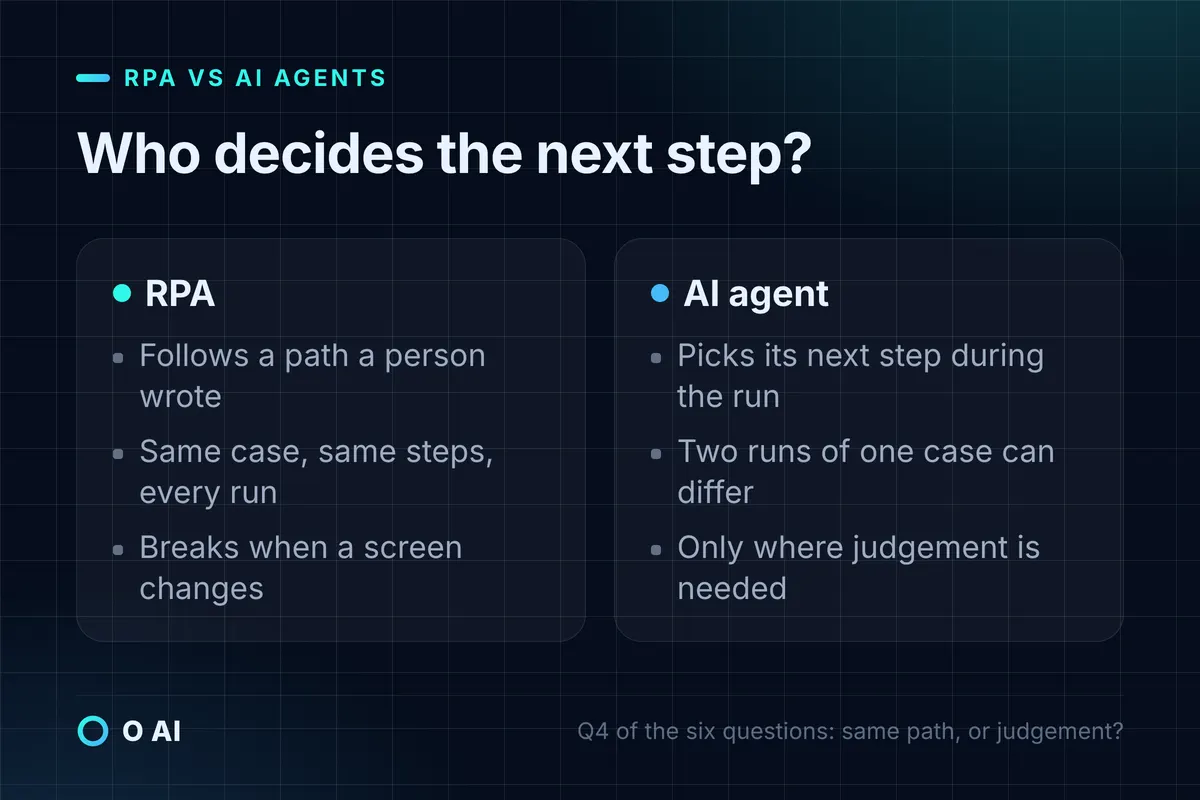
Copy this grid, one row per step. Q1: structured or unstructured input? Q2: rule written for every case? Q3: API or screen only? Q4: same path, or judgement? Q5: can you undo it before harm? Q6: changes rarely, or monthly or more?
| Step | Q1 | Q2 | Q3 | Q4 | Q5 | Q6 | Tool |
|---|---|---|---|---|---|---|---|
| Example: carrier portal statuses into the ERP (forwarder, Jeddah or Dubai) | Structured | Yes | Screen | Same | Yes | Rarely | RPA; ask the carrier for an API |
| Example: sort supplier emails into invoices, queries, complaints | Unstructured | Yes | API | Same | Yes | Rarely | AI step; a person takes the complaints |
| Example: agree a refund after a delivery dispute | Unstructured | No | – | Judgement | No | – | A person; AI summarises the case |
One order process, four tools: a worked example
This is an illustration, not a client story. A spare-parts distributor in Dammam, on Saudi Arabia's east coast, sells to workshops and factories in the Kingdom and ships to customers in Bahrain and the UAE. Orders arrive by web form, email and WhatsApp, in Arabic and English, sometimes as a PDF purchase order or a photo of a part label. A distributor in Dubai or Manama would split the work the same way.

| # | Step | Tool | Why | Where a person steps in |
|---|---|---|---|---|
| 1 | Web-form orders | Workflow automation | Structured, rule complete, the ERP has an API | A weekly check of failed runs |
| 2 | Email and WhatsApp orders, some as PDFs or label photos | AI step: extract item codes and quantities into a draft order | Unstructured input, fixed next step | A coordinator approves every draft at first, later only flagged ones |
| 3 | Check stock and price in the ERP | Workflow automation | Structured, fixed rule | None per order |
| 4 | Reserve stock in an old warehouse system (no API) | RPA | Fixed rule, screen only | A daily run log; the bot has its own account |
| 5 | Unclear requests: unknown or replaced part number, "same as last time" | AI agent: searches catalogue and order history (read-only), proposes a substitute, drafts a question | The path differs every time | A person sends anything that commits a price, substitute or delivery date |
| 6 | Discounts, credit-limit exceptions, cancelling a confirmed order | A person decides; an AI step prepares the summary | Money and the customer relationship; hard to undo | Always |
Step 2. Arabic-Indic digits (١٢٣) and mixed Arabic-Latin part codes are easy to misread, so spot-check quantities and codes against the original. For scans, see Arabic OCR for scanned documents; for the WhatsApp channel, what a WhatsApp chatbot for business can handle.
Step 4. The bot breaks when the warehouse screen or its login requirements change [1]. Check its log daily, and ask the vendor for an integration so the bot can be retired.
Step 5. Customer emails can carry instructions aimed at the agent. The OWASP security project describes an incoming email that tricks an AI assistant into forwarding a user's data; its fix is read-only access and a person who reviews each draft and presses "send" [4].
Of the six steps, only one needed an agent, and a person kept every decision about money.
An AI agent's permission sheet: fill it in before it touches live data
OWASP traces harmful agent actions to three root causes: "excessive functionality; excessive permissions; excessive autonomy" [4]. The sheet below, one per agent, limits all three.

| Field | What to write | Example: the step 5 agent (order exceptions) |
|---|---|---|
| Goal | One sentence; what "done" means | Turn an unclear request into a draft order or one clarifying question |
| Tools | Each tool, marked read or write | Catalogue, order history, list of replaced part numbers (read); message drafts (write) |
| Data it sees | Fields allowed; what is masked | Customer company, items, quantities; no payment or ID data |
| Needs a person's approval | Actions | Sending any message; any price, substitute or delivery date |
| Never allowed | Actions | Changing prices or credit limits, cancelling orders, deleting records |
| Limits | Volume, time, amounts | A cap on drafts per hour; working hours only |
| Hand-off | When it stops, and to whom | Complaints, unknown customers, anything legal: to the sales coordinator |
| Account | Its own login, only these rights | A dedicated service account, never a staff member's login |
| Log and review | What is logged; who reviews; how often | Every tool call and draft; each week, compare 20 cases with a coordinator's decision |
| Owner and off switch | A named person; how to pause; what runs instead | Sales operations manager; one switch; requests return to the team queue |
Why each line is there:
- Fewest tools and rights, enforced by the system. OWASP advises limiting an agent's tools "to only the minimum necessary" and to "Implement authorization in downstream systems rather than relying on an LLM [the AI model] to decide if an action is allowed or not" [4]. A read-only ERP account beats an instruction not to write.
- A person approves high-impact actions. OWASP says to get that approval before the action is taken [4]. The DGA asks government entities for "clearly defined human-in-the-loop checkpoints for every critical workflow, backed by RACI matrices", which name who is Responsible, Accountable, Consulted and Informed [3, p. 15].
- Check each step, keep logs, compare. The DGA recommends "step-level validation with automatic rollback, so each action is verified before the next one begins", and logs complete enough that "engineers and auditors can reconstruct every decision" [3, p. 14]. SDAIA adds clear escalation paths and periodic comparisons of people's decisions with the agent's [2, p. 63].
- Its own account. RPA bots "access systems and data in the same way humans do" [1]; a shared staff login would hide who did what.
Personal data: Saudi rules that also reach foreign companies
This article is general information, not legal advice. Check your company's obligations against the current text of the law and its implementing regulations.
Who is covered
Saudi Arabia's Personal Data Protection Law (PDPL) covers processing in the Kingdom, "including the Processing of Personal Data related to individuals residing in the Kingdom by any means from any party outside the Kingdom" [7, Art. 2(1)]. A workflow run from Dubai, Cairo or Europe on Saudi residents' data is in scope. With customers in several countries, check each country's law too.
Decisions based on automated processing
The PDPL's Implementing Regulation [8] covers them in three places. Articles 4 and 25 apply where the processing is done on a large scale or repeatedly, in the words of the official Arabic text [9]:
- A controller (the organisation that decides how personal data is used) whose activities include "making automated decisions based on Personal Data" must tell people whether "decisions will be made based solely on automated Processing of Personal Data" [8, Art. 4(5)(c)].
- Where consent is the legal basis, it must be explicit for decisions made solely by automated processing [8, Art. 11(2)(c)].
- An impact assessment is required where the controller's activity includes "making decisions based on automated Personal Data Processing" [8, Art. 25(1)(c)].
In practice, keep a person deciding anything about an individual, such as a job applicant, an individual customer's credit limit or blocking an account, and record it in the permission sheet. A person in the decision takes you out of the "solely automated" rules; it does not by itself remove the impact assessment in Article 25. For agents handling personal data, the DGA advises government entities to "mask/redact PII in prompts and logs" (hide what identifies a person) and to run a data protection impact assessment before deployment [3, p. 16].
Who else sees the data
Many agents and AI steps call a model that another company runs. PDPL Article 8 says to choose only processors "providing the necessary guarantees" and to monitor their compliance [7]. Transfers outside the Kingdom have their own conditions in Article 29 [7]; see when personal data leaves Saudi Arabia.
Seven questions for anyone selling you an "AI agent"
Get the answers in writing:
- Which steps does it decide by itself, and which follow rules we set? This is the agent-washing test [5].
- Which of our systems can it write to, and can we start it read-only?
- Which actions can we require a person to approve?
- Can you show us the step log of a case that went wrong?
- What happens when a screen, an API or our price list changes?
- Where is our data processed, which other companies see it (the model provider, for example) [7, Art. 8], and is it used for training?
- How do we switch it off, and what runs instead?
To vet the vendor itself, use the full list of questions to ask a software company.
Try the grid on one process this week
- Pick one repetitive process and write its steps on one page.
- Ask the six questions of each step.
- Automate the steps that need no AI first.
- For the one or two steps that need AI, fill in the permission sheet and run a two-week pilot.
For the pilot plan and a cost worksheet, see our guide How can AI help my business? Start with one repetitive task.
O AI is a Saudi AI and software company in Al Khobar. We connect AI to the systems and channels you already run: documents, customer replies, reports, WhatsApp and email. We work with companies anywhere in Saudi Arabia, remotely in Arabic or English, and we are open to projects from the GCC and internationally.
Send us the process you want to automate and book a free consultation. No commitment — we reply within one business day.
Frequently asked questions
What is agentic AI, in simple terms?
Software that works towards a goal by choosing its own next steps and using tools such as APIs or databases, without a person directing each step (SDAIA report on agentic AI, p. 13). SDAIA's report lists six core capabilities: perception, reasoning, learning, action, communication and autonomy (p. 18). It also separates a single AI agent from an agentic AI system in which several agents work together (p. 4). In business terms, a step is agentic when the software decides what happens next.
Is RPA the same as AI, and will AI agents replace it?
No. On its own, RPA follows recorded rules on screens, the way a person clicks and types (US GSA RPA Program Playbook), and does not interpret content; where an RPA suite adds AI features, judge those as an AI step. Agents suit the steps RPA handles badly, such as complex processes and unexpected cases (SDAIA report on agentic AI, p. 23), so in a typical process the two sit side by side. Some vendors now sell agents that operate screens the way RPA does; judge those like any agent, by their limits, approvals and logs. And check that a product sold as an agent is not RPA with a new label (Gartner, 25 June 2025).
AI agent vs chatbot: what is the difference?
A chatbot answers; an agent acts in other systems, within limits you set. The Digital Government Authority's study for government entities places FAQ chatbots in its "Basic Agent" tier, which "Handles predictable, rule-based tasks in stable settings" (DGA, AI Agents as Government Partners, p. 5). SDAIA gives a calendar example: a simple assistant can show your appointments, while an agentic system can reschedule meetings that clash and coordinate with the people involved (SDAIA report on agentic AI, p. 23). If you only need answers to customer questions, a chatbot is the smaller risk.
What types of AI agents are there?
SDAIA describes five maturity levels (SDAIA report on agentic AI, pp. 20–21): rule-based agents; analysis agents that inform people but take no action; "solver" agents built into a known workflow at critical points; worker agents that act across several systems and choose their next step from earlier results; and executive agents that redesign whole processes, which SDAIA says are still in research and testing. The Digital Government Authority's study for government entities uses three tiers instead: basic, intermediate and advanced (DGA, p. 5). For most business processes, the first three levels are the place to start.
Is it safe to give an AI agent access to our systems and customer data?
Only with limits set in the systems themselves, not just in the agent's instructions. Start with read-only tools, give the agent its own account with only the rights it needs, require a person to approve high-impact actions such as sending, paying or deleting, and log every tool call (OWASP, LLM06:2025 Excessive Agency; US GSA RPA Program Playbook). For personal data, choose processors that give the necessary guarantees and monitor them (PDPL Article 8), and, where automated decisions are made on a large scale or repeatedly, tell people whether they are made solely by automated processing (PDPL Implementing Regulation, Article 4(5)(c)). Review the logs weekly at first, and name an owner who can switch the agent off.
Do we need a special platform to build AI agents?
Not before you have mapped the steps. Many steps need only workflow automation, or the AI features already inside systems you use. Choose a platform only for the step that truly needs an agent, and put the seven vendor questions to every option. SDAIA's roadmap treats weighing build against buy as part of the pilot phase (SDAIA report on agentic AI, p. 71). If no ready-made tool fits, a system built around your process is the other route; compare both against the same written requirements.
How this article was made: Researched from the sources listed below (SDAIA, Saudi Digital Government Authority, PDPL texts, OWASP, Gartner, US GSA), opened on 29 September 2026. Drafted with AI assistance, then checked against those sources. Images are AI-generated illustrations.
Sources
- RPA Program Playbook (Version 1.1, January 2020) (opens in a new tab)U.S. General Services Administration (GSA), Federal RPA Community of Practice · cms.digital.gov
- Agentic AI: Its Technologies and National Applications (our translation of the Arabic title «الذكاء الاصطناعي التوكيلي: تقنياته وتطبيقاته الوطنية»; in Arabic only, July 2025) (opens in a new tab)Saudi Data & AI Authority (SDAIA) · sdaia.gov.sa
- AI Agents as Government Partners (Brief Study, Issue 1.0, December 2025; written for government entities) (opens in a new tab)Digital Government Authority (DGA), Kingdom of Saudi Arabia · dga.gov.sa
- LLM06:2025 Excessive Agency (OWASP Top 10 for LLM Applications 2025) (opens in a new tab)OWASP Gen AI Security Project · genai.owasp.org
- Gartner Predicts Over 40% of Agentic AI Projects Will Be Canceled by End of 2027 (press release, 25 June 2025) (opens in a new tab)Gartner, Inc. · gartner.com
- AI Ethics Principles (2025) (opens in a new tab)Saudi Data & AI Authority (SDAIA) · sdaia.gov.sa
- Personal Data Protection Law (English translation, as amended by Royal Decree M/148; the Arabic text on laws.boe.gov.sa is the official version) (opens in a new tab)Saudi Data & AI Authority (SDAIA) · sdaia.gov.sa
- Implementing Regulation of the Personal Data Protection Law (English translation; the official Arabic text is source 9) (opens in a new tab)Saudi Data & AI Authority (SDAIA) · sdaia.gov.sa
- Implementing Regulation of the Personal Data Protection Law (official Arabic text, «اللائحة التنفيذية لنظام حماية البيانات الشخصية») (opens in a new tab)Saudi Data & AI Authority (SDAIA) · sdaia.gov.sa
About the author