 AI
AIWhatsApp chatbot for business: what AI can answer, what Meta charges and what Saudi Arabia's PDPL expects
For companies in Saudi Arabia and beyond: what a WhatsApp chatbot for business should answer or hand over, what Meta charges since 1 October 2026, and the Saudi PDPL checks.


Key takeaways
- Sort your customer questions into three lanes: the assistant answers, the assistant drafts and staff send, or a person only.
- Meta requires a clear path to a person; plan who replies inside the 24-hour window, weekends included.
- Since 1 October 2026 Meta charges for replies inside the 24-hour window after 1,000 free a month per number, so count messages, not chats, and answer in one message.
- WhatsApp offers need documented consent, a named sender and a free, easy way to stop under Saudi Arabia's data-protection law (PDPL Art. 25; Implementing Regulation Art. 28–29).
- Put Implementing Regulation Art. 17's items in your provider agreement, and ask where chats are stored and whether they train any model.
On this page
- Three ways to run a WhatsApp chatbot for business
- What an AI assistant can answer well
- When the assistant must hand over to a person
- WhatsApp chatbot pricing: how Meta charges since 1 October 2026
- What Saudi Arabia's PDPL expects
- Arabic chatbot testing: what to try before your customers do
- Before you switch it on: a checklist
- Start with one question type and measure it
A WhatsApp chatbot for business works best on the routine questions your team already answers from a price list, a schedule or a written policy. Anything involving money, complaints or judgement should pass to a person inside the same chat.
Since 1 October 2026, Meta also charges for free-form replies inside the 24-hour window once a business number has used its 1,000 free ones for the month [1], so the bill depends on how many messages the assistant sends. This guide is for companies in Saudi Arabia, the wider Gulf and beyond.
Three ways to run a WhatsApp chatbot for business
A WhatsApp chatbot for business is an assistant that answers customers on your company's own number. (Meta AI, built into WhatsApp for personal use, is a separate product.) There are three ways to run one.
| Route | What it does | How Meta charges |
|---|---|---|
| WhatsApp Business app, automatic messages | Greeting and away messages you write yourself [2]; fixed text, no AI | No message charge; app messages "will continue to be free" after the number joins the Platform [3] |
| Meta Business Agent, Meta's own AI agent | Set up in the Business app; learns from your chats, website and price lists; hands sensitive topics to you. "Select markets" only [4]; also usable on the Platform [5] | Per token since 1 August 2026 [5] |
| Your own or a provider's AI assistant on the WhatsApp Business Platform | Answers from your own systems (bookings, orders, stock), usually set up through a solution provider | Per delivered message [1], plus the AI and solution providers' own fees [5] |
When vendors in the Gulf offer "the WhatsApp Business API", they usually mean the third route. A Business app number can often join the Platform and keep using the app ("coexistence") [3]. Meta's terms also restrict AI providers whose AI is the product itself, though a business may hire one as its solution provider [6][7]. The FAQ below covers both.
How to choose: the app's automatic messages cannot answer questions. If answers come from a price list and a few policies, Meta Business Agent may be enough where offered. If they need live data from your own systems, you need the Platform plus integration work; see our guide to ready-made software, integrations or a custom build.
What an AI assistant can answer well
Start with your own chats rather than a vendor's demo. Tag the first message of the last 200–300 chats, or two ordinary weeks, by question type, and count; strip names and numbers from any sample you share. Then give each type a lane:
- Assistant answers: written down and the same for everyone: opening hours, directions, documents needed, delivery areas, listed prices, the return policy.
- Assistant drafts, staff send: depends on the customer's case or on a lookup that can be wrong, such as a custom quote or the reason for a delay. It needs an inbox where staff edit the draft before it goes; without one, treat these as "Person only".
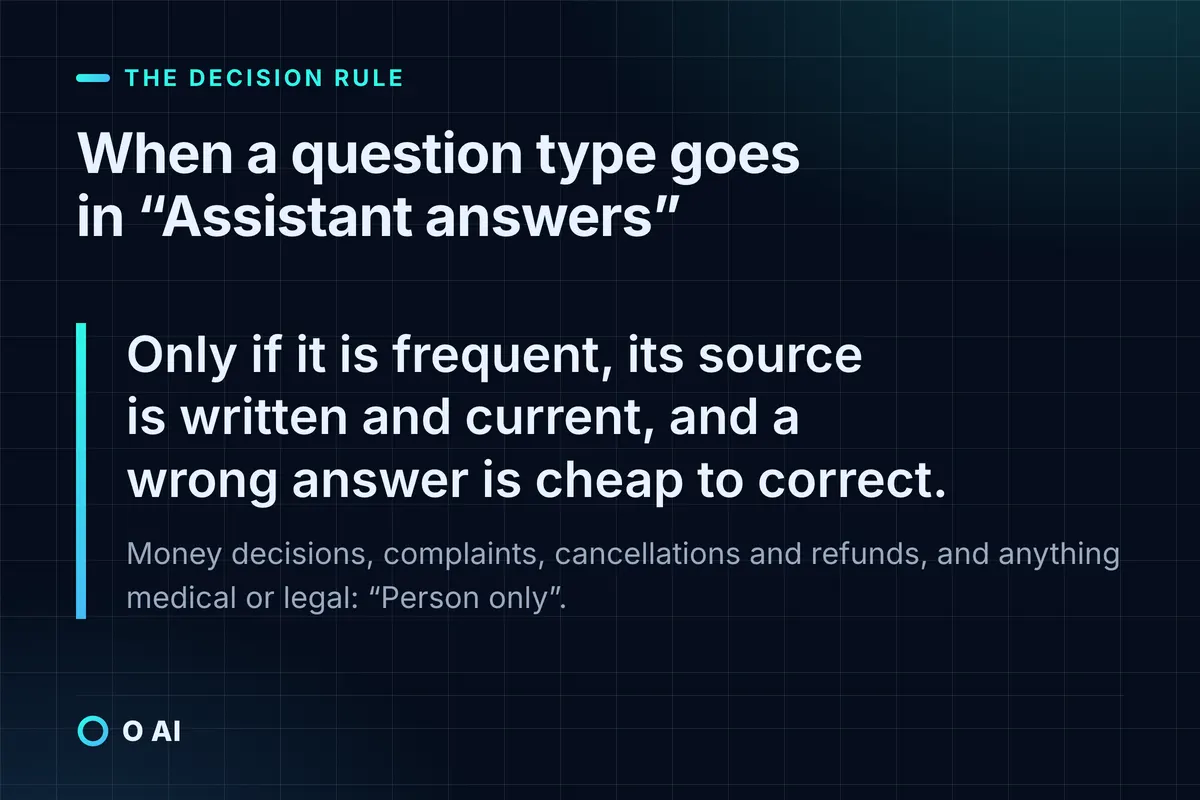
- Person only: money decisions, complaints, cancellations and refunds; anything medical or legal; account questions that need an identity check; distressed customers.
A type goes in "Assistant answers" only if it is frequent, its source is written and current, and a wrong answer is cheap to correct. Copy the grid and add your own types; the filled rows are hypothetical.
| Question type | How often | Where the right answer lives | Cost of a wrong answer | Lane |
|---|---|---|---|---|
| Dental clinic, Riyadh: free appointment times | Many a day | Booking system | Low | Assistant answers |
| Same clinic: "Does my insurance cover this?" | A few a day | Insurer's terms, patient's plan | Medium | Assistant drafts, staff send |
| Same clinic: "My tooth still hurts after the filling" | A few a week | The dentist | High: health | Person only |
| Online store, Jeddah, shipping across the Gulf (GCC): "Where is my order?" | Many a day | Order system, read live | Low, if live | Assistant answers |
| Same store: an item that arrived damaged | A few a week | Customer's photos | High: refund | Person only |
| Car rental, Dubai, with Saudi customers: documents a Saudi licence holder needs | A few a day | Written rental policy | Low | Assistant answers |
When the assistant must hand over to a person
Meta allows automated replies inside the 24-hour window, but you "must also have available prompt, clear, and direct escalation paths", such as transfer to a human agent in the chat, a phone number or email [8].

| Trigger | What the assistant does | Who picks up |
|---|---|---|
| The customer asks for a person («أبي أكلم موظف», "I want to talk to someone") | Hands over at once and says when a person will reply | Customer service |
| Two failed answers in a row | Stops and hands over with a summary | Customer service |
| A complaint or angry wording | Acknowledges it, promises nothing, hands over | A supervisor |
| A refund, a discount or an amount above your limit | Hands over without committing | Sales or accounts |
| Health, legal or other sensitive details, or an ID or card number sent in the chat | Stops collecting, doesn't repeat the details, hands over | The relevant specialist |
| A "Person only" question type | Hands over directly | Depends on the type |
| A question its sources may not cover | Says a colleague will reply instead of guessing | Sales |
The 24-hour window sets the deadline for each pickup. Free-form replies are possible only while the customer service window is open, and each customer message resets it. After it closes, only an approved template, charged by category, can go out through the Platform [1][8].
If a customer writes at 9 p.m. on Thursday and nobody answers by 9 p.m. on Friday, the next working day's reply must be a paid template, unless the customer writes again. So decide who covers the window on each market's weekend, or have the assistant say when a person will reply. On a coexistence number, staff replies from the Business app are not bound by the window and stay free [3].
Whoever picks up should get a two-line summary, the details the assistant collected (name, order number, preferred time: no more than needed) and the reason. Staff must be able to take over any chat, and the assistant must go quiet when they do.
WhatsApp chatbot pricing: how Meta charges since 1 October 2026
Meta charges per delivered message, at a rate set by the message category and the recipient's country [1].
Pricing checked on 29 September 2026 against Meta's published 1 October 2026 changes. Meta may change prices on the first day of any quarter [1]; check the current rate cards before you budget.
Messages you start: templates in three categories
Templates are marketing, utility (order updates, reminders) or authentication (one-time codes), priced by category and by the country calling code of the recipient's number [1]. A Dubai company messaging a +966 number pays the Saudi rate.
A template that mixes an order update with a promotion counts as marketing [9]. Volume tiers lower utility and authentication rates only.
Service messages: replies inside the 24-hour window since 1 October 2026
A service message is any free-form reply written by a person or a third-party AI rather than Meta Business Agent [5]. Since 1 October 2026:
- Service messages cost each market's utility and authentication rate, with no volume tiers [1][5].
- Each business phone number gets 1,000 free delivered service messages a month, shared by all its Platform replies, with no roll-over [1].
- Utility templates sent inside the window, free since July 2025, are now charged [5].
- Without a payment method, Meta stops delivering service messages after the free 1,000 [1], so the assistant can go silent mid-month.
What stays free
- Messages customers send you [1].
- Replies inside a free entry point window. When a customer messages you from a click-to-WhatsApp ad on WhatsApp's Android or iOS app (not desktop or web) and you reply within the customer service window, a window opens that "may remain open for up to 7 days", and every message in it is free [1]. Older Meta pages, and the Arabic pricing page, still say 72 hours.
- Staff messages sent from the Business app on a coexistence number [3].
Meta Business Agent pricing: if the AI is Meta's own
Meta Business Agent replies carry one per-token charge covering the AI and delivery, about 4–5 US cents per message by Meta's estimate. They are charged even inside a free entry point window, and never on top of a service charge [5].
A cost worksheet
Count each line per business number per month, then multiply by the current rate.

| Line | What to count | Rate |
|---|---|---|
| F | Replies to chats from click-to-WhatsApp ads, inside the free window | Free; count them anyway |
| S | Other replies sent through the Platform, minus the 1,000 free | Service rate, by recipient country |
| U | Utility templates, inside or outside the window | Utility rate and volume tier |
| M | Marketing templates, only to customers who opted in | Marketing rate |
| A | Authentication templates, if any | Authentication rate |
| B | Meta Business Agent messages, if used | Per token |
| P | AI provider and solution provider fees | Their written quotes |
| Total | S, U, M and A each × rate, + B + P |
Worked example (hypothetical). A furniture retailer with showrooms in Jeddah and Dubai has one business number. In a month, customers start 1,200 chats, none from ads, and each gets three replies through the Platform: 3,600 service messages. After the 1,000 free, 2,600 are charged: say 1,800 to +966 numbers and 800 to +971. Add 900 order updates (utility) and one offer to 2,000 opted-in customers (marketing). Meta's bill: 1,800 × the Saudi service rate + 800 × the UAE service rate + each template × its recipient country's rate, then providers' fees. Ad-driven chats are left out: we found nothing in Meta's pricing pages saying whether free-window replies use up the 1,000 free messages.
What changes the bill: one complete answer instead of three short bubbles, since each delivered message is charged [5]; no template where a free-form reply will do, and a check of each template's category [9]; ad-driven chats tracked separately.
What Saudi Arabia's PDPL expects
This article is general information, not legal advice. Check your company's obligations against the current text of the law and its implementing regulations.
Saudi Arabia's Personal Data Protection Law (PDPL) applies to processing in the Kingdom and to processing of data about people residing there "by any means from any party outside the Kingdom" [10, Art. 2]. So a company abroad that answers customers living in Saudi Arabia is covered too, alongside its other markets' laws. SDAIA, the Saudi Data & AI Authority, publishes the law's Implementing Regulation.
Offers need consent; answers need a legal basis
Answering a customer's question differs from sending offers. Article 6 lists legal bases other than consent, such as a previous agreement with the customer or, for data that is not sensitive, a legitimate interest assessed and documented first [10][11, Art. 16]. Which fits is a legal question.
Offers need documented consent, a clearly named sender and a free, easy way to stop that is honoured without delay [10, Art. 25][11, Art. 28–29]. Only the Regulation's Article 28 mentions the "absence of a prior interaction"; the law's Article 25 does not, so the safer course is documented consent from everyone you send offers to; our guide to starting with one AI task sets these articles out. Meta's rule applies everywhere: message only people who gave you their number and an opt-in naming your business, and honour every stop request [8][12].
On WhatsApp that means one consent log (who, when, which channel, what they agreed to), an assistant that checks the stop list before any send, both "stop" and «إيقاف» working, and offers only in templates carrying your business name. Treat an offer added to a reply as marketing for consent purposes, even though Meta won't charge it as a template [5].
Tell customers who they are talking to
The PDPL requires a privacy policy and, when you collect data, telling people the legal basis, the purpose, who receives it and whether it will be processed outside the Kingdom [10, Art. 12–13]. The Regulation adds your identity and contact details, the retention period and how to withdraw consent [11, Art. 4]. If your processing with new technologies is continuous or large-scale, also say how data is protected and whether decisions are fully automated [11, Art. 4(5)]; ask counsel whether that covers your assistant.
The first message should name the company, say it is automated (our recommendation, not a quoted legal duty), link the privacy policy and explain how to reach a person:
Welcome to (company name). I'm the automated assistant and can help with appointments, prices and delivery. Privacy policy: (link). To reach a person, type "staff".
Meta also requires accurate contact details in your WhatsApp Business profile and a published privacy policy [8].
Your provider and where the data goes
Choose processors "providing the necessary guarantees" and check that they keep to them [10, Art. 8]. The agreement must cover purpose, data categories, duration, breach notice, whether the processor is subject to other countries' rules, notice of any disclosure Saudi law requires of it, and subcontractors [11, Art. 17].
If chat data leaves the Kingdom, as it may when the AI model runs abroad, the transfer rules apply: minimum data, adequate protection, safeguards such as standard contractual clauses and sometimes a risk assessment [10, Art. 29][13]. If your solution provider is an AI provider, Meta's terms bar letting WhatsApp data be used to "create, develop, train, or improve" AI models, except to fine-tune one "for your exclusive use" [7].
A written impact assessment is required, among other cases, where a company processes personal data with new technologies on a large scale or repeatedly [11, Art. 25(1)(c)]: the official Arabic says «أو», "or", though SDAIA's English translation says "and". A daily customer assistant may qualify; ask counsel.
Ask your provider, in writing:
- Where are chats, voice notes and logs stored and processed, and which AI model provider sees them?
- How long are they kept, and can we delete them?
- Is our WhatsApp data used to train any model not reserved for us?
- Does your service fit Meta's current terms for AI providers?
- Will you report breaches without undue delay, and can we export everything if we leave?
What never to ask for, and how long to keep chats
Meta's policy bars asking customers for, or sharing, full card numbers, financial account numbers, ID card numbers or other sensitive identifiers [8]. Health data is sensitive under the PDPL [10, Art. 1(11)], so a clinic's assistant books appointments and does not collect symptoms. Chat logs are personal data: destroy them once no longer needed, unless a legal basis requires keeping them [10, Art. 18]. Set a retention period and state it in your privacy policy.
Arabic chatbot testing: what to try before your customers do
Build a test set of 30–50 real past messages, names and numbers removed. Include:
- Saudi and Gulf dialect («وش أسعاركم؟», "what are your prices?")
- Arabizi, Arabic typed in Latin letters with digits for some sounds ("3ndkm tawseel?", "do you deliver?")
- English product codes inside Arabic sentences, and typos
- English or other languages, if your customers use them, including mid-sentence switches
- voice notes and dates in the Hijri (Islamic) calendar
- five questions your sources cannot answer
Score each reply: correct, right answer in the wrong tone, wrong, or should have handed over; the last two must be zero before launch. SDAIA's guidance for the public warns that generative models can confidently state invented "facts" [14, §5.3]; the five unanswerable questions show whether the assistant hands over or invents. Re-run the set whenever a price list, policy or model changes.
Before you switch it on: a checklist
Answers
- A lane for every question type
- A written, dated source with an owner for each "Assistant answers" type
Handover
- A person and a pickup time for each trigger
- The 24-hour window covered at weekends too
- The assistant stops when staff step in
Costs
- A payment method on the account [1]
- The worksheet filled with current rates
- A monthly check of messages per chat
Data
- A first message that names the company and links the privacy policy
- Consent log and stop list connected
- Article 17 items in the processor agreement
- Transfer and impact-assessment questions answered
- Log retention set
- No requests for ID or card numbers
Start with one question type and measure it
Run your most frequent "Assistant answers" type for two weeks, then add the next. Track:
- time to first reply
- chats closed without handover
- wrong answers in a daily spot check of 20 chats (target: zero)
- handovers answered inside the window
- messages per chat, which drive the cost
- opt-outs
Still deciding where AI should start in your company? Read our guide on picking one task and costing it.
O AI, a Saudi AI and software company in Al Khobar, connects AI to the channels companies already run, including customer replies and WhatsApp, in Arabic and English. Pick one question your team answers on WhatsApp every day, then book a free consultation to see whether an AI assistant is worth it. No commitment; we reply within one business day.
Frequently asked questions
Is a WhatsApp chatbot free?
Partly. Messages sent from the WhatsApp Business app, including greeting and away messages, carry no Meta message charge, but Meta Business Agent, set up in the same app, has been charged per token since 1 August 2026. On the Platform, each business number gets 1,000 free service replies a month; since 1 October 2026 replies beyond that are charged, and templates are charged by category except inside a free entry point window (Meta's WhatsApp pricing pages). AI and solution providers bill separately.
What is the difference between the WhatsApp Business app and the WhatsApp Business API?
The app suits a small team on one number: greeting and away messages you write, with no Meta message charge, plus Meta Business Agent in select markets (also usable on the Platform), charged per token (WhatsApp Business App and Meta Business Agent pages; Meta's pricing documentation). The Platform, often called the API, connects your own systems and an AI assistant, sends templates and charges per delivered message (Meta for Developers, Pricing on the WhatsApp Business Platform). A number used in the app can often be connected to the Platform and keep using the app (Meta for Developers, Onboard WhatsApp Business app users).
Can we keep using the WhatsApp Business app after connecting our number to the API?
Often, yes; partners call this "coexistence". Chats from the last six months can sync to the Platform, but broadcast lists become read-only and group chats are not synchronised. Messages staff send from the app stay free and are not bound by the 24-hour window; messages sent through the Platform are charged at Platform rates (Meta for Developers, Onboard WhatsApp Business app users). Ask your provider whether it supports coexistence for your number.
Does Meta allow AI chatbots on WhatsApp Business?
For answering your own customers, yes: Meta's policy allows automated replies inside the 24-hour window, with a clear path to a person (WhatsApp Business Messaging Policy). The limit is on AI providers. Since 15 January 2026, Meta's terms have barred them from using the Platform to offer AI, such as general-purpose assistants, where the AI is the main product rather than "incidental or ancillary", unless Meta is legally required to allow it. A business may still retain an AI provider as its solution provider (Meta Terms for WhatsApp Business Platform, section 4.7). Meta decides what counts as the main product, so ask your provider to confirm in writing that its service fits Meta's current terms.
Can a WhatsApp chatbot message customers first?
Only with an approved template, and only to people who gave you their number and opted in to messages from your business (WhatsApp Business Messaging Policy; Meta, Get opt-in for WhatsApp). Free-form replies are possible only inside the 24-hour window that opens when the customer writes. Templates are charged by category and the recipient's country (Meta for Developers, Pricing on the WhatsApp Business Platform), and offers also need the consent described in the Saudi PDPL section of this article.
How much do WhatsApp Business API messages cost in Saudi Arabia?
Meta publishes a rate for each message category and recipient country. We don't quote rates here because Meta can change them each quarter. Open Meta's WhatsApp pricing page on developers.facebook.com, go to "Rate cards and volume tiers" and find Saudi Arabia; you can choose Saudi riyals (SAR) as your billing currency (Meta for Developers, Pricing on the WhatsApp Business Platform). Then count, per number and month: service replies above the free 1,000, utility, marketing and authentication templates, and any Meta Business Agent messages. Add your AI and solution providers' fees. The worksheet in this article lists each line.
Does a WhatsApp chatbot understand Saudi dialect and voice notes?
It depends on the model and on how it is set up, so test it with your own customers' messages before launch: dialects, Arabizi, English product codes, typos and voice notes. A voice note it cannot handle reliably should go to a person, or the assistant should ask the customer to type the question. Re-run the test whenever the model changes.
Do I need customers' consent to use an AI assistant on WhatsApp?
For marketing messages, yes: documented consent, a clearly named sender and a free, easy way to stop (PDPL Article 25; Implementing Regulation Articles 28–29). Meta also requires opt-in before a business contacts anyone on WhatsApp (WhatsApp Business Messaging Policy; Meta, Get opt-in for WhatsApp). For replies to questions customers send you, consent is not the only legal basis: Article 6 also covers, for example, a previous agreement with the customer or, for data that is not sensitive, a legitimate interest assessed and documented first (PDPL Article 6; Implementing Regulation Article 16). Either way, tell customers who you are and link your privacy policy (PDPL Articles 12–13). This is general information, not legal advice.
We are based outside Saudi Arabia. Does the PDPL apply when we reply to customers who live there?
Yes, it can. Article 2 extends the law to processing of personal data of individuals residing in the Kingdom "by any means from any party outside the Kingdom" (PDPL Article 2). So a company in Dubai, London or elsewhere that answers people living in Saudi Arabia on WhatsApp should plan for it, alongside its own country's data-protection law. SDAIA also issues the rules on which controllers must register in the National Register of Controllers (Implementing Regulation Article 34); check whether they cover you. This is general information, not legal advice.
How this article was made: Researched from Meta's WhatsApp Business Platform documentation and the Saudi regulatory texts listed below (SDAIA; the Arabic texts are official), opened on 29 September 2026. Drafted with AI assistance, then checked against those sources. Images are AI-generated illustrations.
Sources
- Pricing on the WhatsApp Business Platform (updated 28 September 2026) (opens in a new tab)Meta for Developers · developers.facebook.com
- WhatsApp Business App (opens in a new tab)WhatsApp for Business · whatsappbusiness.com
- Onboard WhatsApp Business app users (updated 26 June 2026) (opens in a new tab)Meta for Developers · developers.facebook.com
- Meta Business Agent on WhatsApp (opens in a new tab)WhatsApp for Business · whatsappbusiness.com
- Upcoming pricing updates for Meta Business Agent, service and utility messages (updated 28 September 2026) (opens in a new tab)Meta for Developers · developers.facebook.com
- New pricing policy for AI Providers leveraging the WhatsApp Business Platform (updated 1 September 2026) (opens in a new tab)Meta for Developers · developers.facebook.com
- Meta Terms for WhatsApp Business Platform, section 4.7 "AI Providers" (last modified 23 September 2026) (opens in a new tab)Meta · facebook.com
- WhatsApp Business Messaging Policy (opens in a new tab)WhatsApp for Business · whatsappbusiness.com
- Template categorization (updated 15 September 2026) (opens in a new tab)Meta for Developers · developers.facebook.com
- Personal Data Protection Law (English translation, as amended by Royal Decree M/148; the Arabic text on laws.boe.gov.sa is the official version) (opens in a new tab)Saudi Data & AI Authority (SDAIA) · sdaia.gov.sa
- Implementing Regulation of the Personal Data Protection Law (opens in a new tab)Saudi Data & AI Authority (SDAIA) · sdaia.gov.sa
- Get opt-in for WhatsApp (updated 16 June 2026) (opens in a new tab)Meta for Developers · developers.facebook.com
- Regulation on Personal Data Transfer Outside the Kingdom (Version 2.0, August 2024) (opens in a new tab)Saudi Data & AI Authority (SDAIA) · sdaia.gov.sa
- Generative Artificial Intelligence Guidelines for Public (May 2025) (opens in a new tab)Saudi Data & AI Authority (SDAIA) · sdaia.gov.sa
About the author