 AI
AIAppeal deadline in Saudi Arabia: 30 days, 10 in urgent matters, and how your firm keeps track
The appeal deadline in Saudi Arabia is 30 days from the day after a copy of the judgment deed is received or due for collection, or 10 days in urgent matters. Here are the counting rules from the official texts, a worked example in both calendars, a court-by-court table and a deadline routine your firm can copy.


Key takeaways
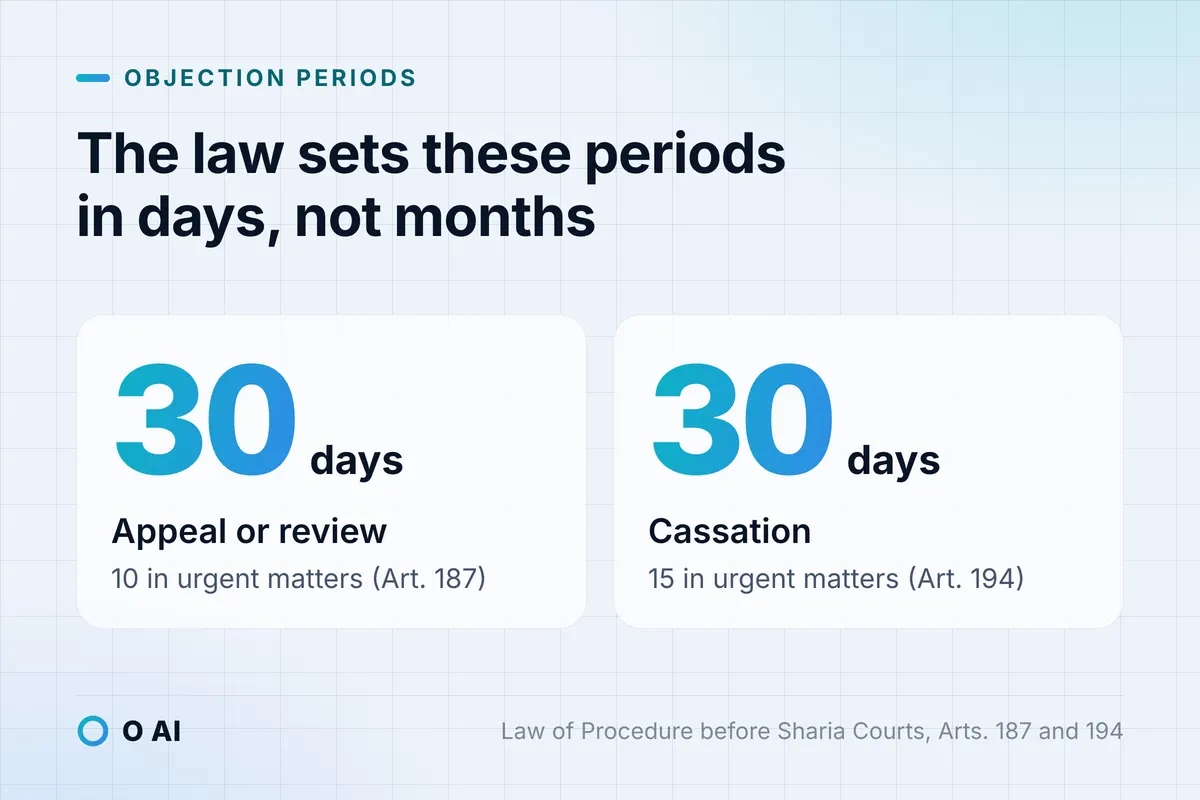
- Saudi appeal deadline: 30 days, or 10 for judgments in urgent matters (Law of Procedure before Sharia Courts, Art. 187). Cassation: 30 days, or 15 if urgent (Art. 194).
- The clock starts the day after you receive the judgment deed (or the date set to collect it), not the hearing day. Count on the Umm al-Qura calendar; a last day on a holiday moves on.
- Commercial, criminal and administrative courts have their own procedure laws: check which one governs your court before you count.
- Don't count on the 60 extra days for parties residing outside the Kingdom (Art. 21) until the lawyer on the case confirms them; a company with a Saudi branch or agent may not qualify.
- Give every deadline a record card, an independent second check, one owner and an internal file-by date two working days early.
On this page
- The short answer: 30 days, or 10 in urgent matters (Article 187)
- When the clock starts (Article 179)
- How to calculate an appeal deadline in Saudi Arabia
- Which law sets your deadline? A court-by-court table
- If the deadline passes: the right lapses and the judgment becomes final
- How to appeal a judgment in Saudi Arabia: the objection memo and filing
- A deadline routine for your firm: record, compute, check, track, close
- Your next step
The appeal deadline in Saudi Arabia's general courts is 30 days from the day after the losing party receives a copy of the judgment deed, or the day after the date set to collect it. Judgments in urgent matters have 10 days. Miss it, and the right to appeal lapses and the judgment becomes final [1, Arts. 179, 187; 2, Art. 7].
These rules come from the Law of Procedure before Sharia Courts (the Law of Civil Procedure in the Bureau of Experts' English translation). It governs the general courts, and the commercial courts apply it wherever their own law is silent [4, Art. 93].
The judgment deed (صك الحكم) is the written, signed judgment the court issues after pronouncing its decision. For a foreign company with a dispute in the Kingdom, local counsel usually sends it over, but the clock runs from the court's delivery or collection date, not the day the scan reached your inbox [1, Art. 179(1)].
Deed already in hand? Go straight to the six counting rules and the worked example.
This article is general information, not legal advice. Check your firm's obligations against the current text of the law and its implementing regulations. If a deadline is already running, speak to the lawyer on the case today.
The short answer: 30 days, or 10 in urgent matters (Article 187)
Article 187 sets the appeal period in the Sharia courts: 30 days to object to a first-instance judgment, and 10 days for judgments in urgent matters [1, Art. 187]. The objection goes to the Saudi court of appeal in one of two forms:
- Appeal with a hearing (مرافعة): the court of appeal hears the parties again.
- Review on the papers (تدقيق, "revision" in the English translation): the court of appeal decides from the file and your memo, unless the other side asks for a hearing. The court can always choose to hold one [1, Art. 185(3)].
You can switch from one form to the other within the objection period. If your memo does not say which one you want, the appeal is heard with a hearing [2, Art. 19].
What counts as urgent
Article 206 lists the urgent (summary) cases: inspection to record a condition, travel bans, preventing interference with possession, recovering possession, stopping new works, receivership, daily workers' wages, and any other case a law treats as urgent [1, Art. 206].
Where one judgment decides several claims with different objection periods, the longest applies, "without prejudice to" the rules on urgent matters [2, Art. 8]. So diary the earlier date internally, and let the supervising lawyer decide which period governs.
Cassation before the Supreme Court: 30 days, or 15 if urgent
A judgment of the court of appeal can be challenged by cassation (نقض; "reversal" in the English translation) before the Supreme Court. The period is 30 days, or 15 in urgent matters, and the memo is filed with the court of appeal that issued or upheld the judgment [1, Arts. 194–195].
If the court of appeal decided on the papers, Article 179 starts the cassation period from the date its judgment is notified to the party or their agent [1, Art. 179(1)]. Ask the lawyer on the case for that date.
| Step | Period | Urgent matters | Article |
|---|---|---|---|
| Appeal or review of a first-instance judgment | 30 days | 10 days | Art. 187 [1] |
| Cassation of a court of appeal judgment | 30 days | 15 days | Art. 194 [1] |
When the clock starts (Article 179)
The period runs from the date the losing party is handed a copy of the judgment deed and signs the record. If they don't attend, it runs from the date set for collection, and the copy is deposited in the case file on that date [1, Art. 179(1)]. The implementing regulation fixes day 1 as the day after receipt, or the day after the date set for it [2, Art. 7].

The hearing date is not the trigger. When the court pronounces its judgment, it tells the parties how, and within what period, they can object [1, Art. 165]. It then has up to 20 days to issue the deed and hand over the copy [1, Art. 166]. So the clock normally starts some days after the hearing.
Counting from the hearing gives away days you are entitled to. Counting from the day someone at the firm first opened the deed is worse: if the court set an earlier collection date, the period started then, whether or not anyone collected the copy [1, Art. 179(1)]. So put both dates on the card and count from the earlier one.
Record each date in both calendars, Hijri (Islamic lunar) first and then Gregorian, the order the regulations use [3, Reg. 8.1].
Default judgments, and absences that don't count as default
For a judgment in absentia (a default judgment), the period runs from the date the judgment is notified to the party or their agent [1, Art. 179(1)]. The absent party can also oppose it before the same court within the objection periods [1, Art. 60(1)].
Missing the hearing does not always make it a default judgment. If the defendant was served with notice of the hearing in person, or through their agent in the same case, filed a defence memo, or attended an earlier hearing and then stopped coming, the judgment is treated as given in their presence [1, Art. 57(2)].
The court then sets a date to collect the copy without sending it, and if the objection period passes with no objection, the judgment becomes final [3, Reg. 57.6]. A client who "never received the judgment" may already be on the ordinary 30-day clock.
For a foreign company with a branch or agent in the Kingdom, notices go to the branch manager or the agent, or someone standing in for them [1, Art. 17(d)]. If your company learns of a judgment given in its absence, first ask your Saudi counsel how and when you were notified. The answer decides whether the judgment counts as given in your presence, and when the clock started.
When the clock stops
The period is suspended if the objecting party dies or loses capacity to litigate, or if the person litigating for them loses that status. It resumes once the judgment is notified to the heirs or representative, or the cause ends [1, Art. 180]. If one of these happens, ask the lawyer on the case and record the answer on the card; until then, keep counting.
How to calculate an appeal deadline in Saudi Arabia
Apply these six rules in order, and write the source next to each result:
- Skip the day of receipt. Day 1 is the next day [1, Art. 22; 2, Art. 7].
- Count 30 days; never write "a month". The law sets the period in days [1, Art. 187], and months vary in length in both calendars.
- Use the Umm al-Qura calendar, and remember that sunset ends the day. Periods follow the Umm al-Qura calendar, Saudi Arabia's official Hijri calendar, and each day ends at sunset [1, Art. 8], using that calendar's sunset time for the city [3, Reg. 8.2]. Don't plan to file on the evening of the last day. A team outside Saudi Arabia should set its reminders in Saudi time (UTC+3), timed to that sunset.
- Holidays at the start or in the middle count. They are not deducted from the period [3, Reg. 22.2].
- A last day that falls on an official holiday moves forward to the first working day after it [1, Art. 22]. The regulations define official holidays as Fridays and Saturdays, the two Eids, and any day the competent authority declares a holiday for all employees [3, Reg. 12.2]. That definition sits in the rules on serving notices, but read with Article 22 it moves a Friday or Saturday last day to Sunday. Confirm that reading with the lawyer on the case, and file by the Thursday anyway.
- A party living outside the Kingdom gets 60 more days. The law adds 60 days to statutory periods, including objection periods, for anyone residing outside Saudi Arabia, and the court may add a similar period if needed [1, Art. 21; 3, Reg. 21.1]. A foreign company served through its Saudi branch or agent (see above) should not assume it qualifies. Diary the 30-day date, and let the lawyer on the case judge whether the extension applies.
A worked example in both calendars
Two illustrative judgments, counted with the six rules. The Hijri dates come from a standard Umm al-Qura conversion, so check any date you rely on against the official calendar.
| Case A | Case B | |
|---|---|---|
| Deed received, or date set to collect it | Sunday 23 Rabi' II 1448 (4 October 2026) | Thursday 4 Jumada I 1448 (15 October 2026) |
| Day 1 | Monday 24 Rabi' II (5 October) | Friday 5 Jumada I (16 October); a holiday at the start still counts |
| Last day if urgent (day 10) | Wednesday 3 Jumada I (14 October) | Sunday 14 Jumada I (25 October) |
| Last day if ordinary (day 30) | Tuesday 23 Jumada I (3 November) | Day 30 is Saturday 4 Jumada II (14 November), an official holiday, so the deadline moves to Sunday 5 Jumada II (15 November) |
| Internal file-by date (suggested: two working days before the last day) | Sunday 21 Jumada I (1 November) | Wednesday 1 Jumada II (11 November) |
In Case A, a diary entry of "one month" from 4 October would read 4 November, one day late, because October has 31 days.
If the losing party in Case A lived outside the Kingdom, day 90 would be Saturday 24 Rajab 1448 (2 January 2027), moving to Sunday 25 Rajab (3 January 2027). Rely on it only with the lawyer's written confirmation.
Which law sets your deadline? A court-by-court table
The Sharia procedure law is the base, but commercial, criminal and administrative courts have their own procedure laws.
| Court or route | Governing text | Period | Urgent matters | Clock starts |
|---|---|---|---|---|
| General courts, and others under the procedure law: appeal or review | Law of Procedure before Sharia Courts, Arts. 179, 187 [1] | 30 days | 10 days | Day after receipt of the deed copy, or after the date set to collect it [2, Art. 7] |
| Supreme Court: cassation | Same law, Arts. 194–195 [1] | 30 days | 15 days | As above; for a judgment given on review on the papers, the date it is notified to the party or their agent [1, Art. 179(1)] |
| Commercial courts | Law of Commercial Courts, Art. 79 [4] | 30 days | 10 days (also for rulings on jurisdiction) | The date specified for delivery of the judgment copy; the civil procedure law fills gaps (Art. 93) [4] |
| Criminal courts | Law of Criminal Procedure, Arts. 193, 194, 199 [5] | 30 days (appeal or review); 30 days (cassation) | Not stated in these articles | A collection date set within 10 days of the judgment; if the party doesn't attend, the copy is deposited in the file and that starts the period (Art. 193) |
| Administrative courts (Board of Grievances) | Law of Procedure before the Board of Grievances, Art. 33 [6] | 30 days | Not stated in this article | Receipt of the judgment copy, or the date set for receipt if the party doesn't attend |
Before you rely on the table:
- Check that the judgment can be appealed at all. Judgments in petty cases set by the Supreme Judicial Council are not appealable [1, Art. 185(1)]. In the commercial courts, neither are judgments in small cases of up to SAR 50,000, as the Council determines [4, Art. 78(1)]. Ask the lawyer on the case which limits apply now.
- Labour and other specialised courts are not covered here. Confirm which text applies before you count.
- Read the contract. Parties may agree, even before a case is filed, that the first-instance judgment will be final; in the general courts the agreement must be in writing [2, Art. 5(1); 4, Art. 74(2)]. Under the appeal regulations, that agreement has to be relied on while the first-instance court is hearing the case [2, Art. 5(2)]. Contracts drafted abroad can carry such a clause unnoticed.
- Don't import habits from another court system. Here the clock follows the deed copy and the Umm al-Qura calendar [1, Arts. 8, 179], whatever the rule where your company is based.
If the deadline passes: the right lapses and the judgment becomes final
If no objection is filed in time, the right to appeal or seek review lapses. The court records this in the case record and marks the deed and its register to show that the judgment has become final [1, Art. 187]. For cassation, a missed date means the objection is not accepted [1, Art. 194; 2, Art. 44].
Article 185(4) makes one exception. Where the losing party is an endowment administrator, trustee, guardian or government agency representative who fails to appeal in time, or is absent and cannot be notified, the court sends the judgment to the court of appeal for review anyway, with two narrow exclusions [1, Art. 185(4)].
A petition for reconsideration (التماس إعادة النظر) is a separate route against final judgments, on narrow grounds such as forged documents, decisive new documents, fraud or a default judgment, with its own 30-day period [1, Arts. 200–201]. It cannot revive a missed appeal.
In the texts cited here we found no general rule for reopening a missed objection period. Before concluding you are late, re-check the start date, the holiday rule, residence abroad and any suspension [1, Arts. 179, 22, 21, 180], and take it to the lawyer on the case the same day.
How to appeal a judgment in Saudi Arabia: the objection memo and filing
The appeal is made with one document, the objection memo (often called the objection plea, لائحة اعتراضية). Check these points before the file-by date:
- The basics: the judgment objected to, its number and date, the grounds, your requests, the signature and the filing date [1, Art. 188(1)].
- Grounds, requests and authority: grounds and requests are mandatory, and a representative must attach proof of authority, such as the power of attorney. Otherwise the court rules the objection inadmissible on its own motion [2, Art. 10].
- Hearing or papers: choose now. You can switch within the period [2, Art. 19].
- Stay of execution: if the client needs the judgment put on hold, request it inside the period, with the reasons and the effects execution would have. It is not accepted afterwards [2, Art. 11(1)].
- Everything in the first memo: on review on the papers, no memo or document is accepted after the period ends, unless the court decides to hold a hearing [2, Art. 30].
- Documents in another language: the court needs a certified Arabic translation from a licensed office [1, Art. 23]. If the grounds rely on English contracts or emails, order the translation the day the client decides to object.
- Cassation memos: name each ground, where it sits in the judgment, how the judgment breaches the rule and what effect that had, and show that the ground was raised on appeal or could not have been [2, Art. 42(1)].
- Filing: requests go through the Ministry of Justice's approved electronic systems [2, Art. 2]. Najiz, the Ministry's e-services platform, has an "Appeal judgment" service (الاعتراض على الحكم) and a separate cassation service, and the application number arrives by SMS [7; 8]. Save it and a PDF of the filed memo in the case file the same day. On who holds Najiz access for a client abroad, see organising e-litigation work on Najiz.
- AI-assisted drafts: if AI helped draft the memo, a lawyer checks every cited article against the official text before filing; see the review every AI draft needs.
A deadline routine for your firm: record, compute, check, track, close
A missed objection date costs the client the right to appeal, so the date should never rest on one person's memory. The five steps below are suggested practice, not a legal requirement.
- Record the trigger the same day. The lawyer who attended, or the case manager, fills in the record card below.
- Compute in writing. Apply the six counting rules, and write the dates in both calendars with the article used.
- Check independently. A second person recomputes from the deed without seeing the first result. If the two dates differ, the supervising partner decides, and both sets of initials go on the card.
- Track it as a task with a reminder ladder, with one owner and one reviewer.
- Close out. Save the application number and the filed memo, and mark the task done. Then diary the next date as soon as it appears: the objector must follow the case dates once the objection is registered [2, Art. 13].

The deadline record card
Copy this into your case file or practice system, one card per judgment.
| Field | Example (Case A) |
|---|---|
| Case number, court and circuit | From the deed |
| Judgment number, and date pronounced | From the deed |
| Date set to collect the deed copy | 23 Rabi' II 1448 / 4 October 2026 |
| Actual receipt or deposit date, and how | Same day, received in person |
| Judgment type: in presence, default, or treated as in presence (Art. 57(2)) | In presence |
| Urgent matter? Which Art. 206 category? | No |
| Several claims with different periods? | No |
| Party resides outside the Kingdom? (Art. 21; lawyer to confirm) | No |
| Route: appeal with a hearing, review on the papers, or cassation | Appeal with a hearing |
| Last legal day, after the holiday check | 23 Jumada I 1448 / 3 November 2026 |
| Internal file-by date | 21 Jumada I 1448 / 1 November 2026 |
| Computed by / checked by (initials, date) | Two different people |
| Stay of execution needed? | Client to decide by day 10 |
| Filed on / application number | Filled in at close-out |
The reminder ladder
| Point | 30-day objection | 10-day urgent objection |
|---|---|---|
| Client decides whether to object | By day 10 | By day 2 |
| Draft memo to the reviewer | 7 days before the file-by date | Day 5 |
| Final memo and power-of-attorney check | 3 days before the file-by date | Day 7 |
| Internal file-by date | 2 working days before the last day | Day 8, or the last working day before it |
| Last legal day | Day 30, after the holiday check | Day 10, after the holiday check |
In Rushd, O AI's practice-management platform for law firms, a firm can keep each objection deadline as a task, in one place with the case and its court sessions, and see upcoming sessions and tasks on the dashboard. Rushd tracks the dates your team enters. It does not pull judgments from Najiz or calculate deadlines, so the second check stays with your people.
Your next step
This week:
- List every judgment your firm received, or whose collection date passed, in the last 30 days.
- Fill in a record card for each one.
- Ask a second person to recompute every date without seeing the first result.
- Set each internal file-by date as a task with one owner and one reviewer.
Keep every judgment-receipt date and objection deadline as a task your whole team can see. See how Rushd works.
Frequently asked questions
When does the 30-day appeal period start?
In the general courts, the appeal deadline in Saudi Arabia runs from the day after you receive a copy of the judgment deed, or from the day after the date the court set for collecting it if nobody attended (Law of Procedure before Sharia Courts, Article 179; Implementing Regulations for Methods of Appealing on Judgments, Article 7). It does not run from the hearing where the judgment was pronounced.
What is the deadline to object to a default judgment?
The same 30 days, or 10 in urgent matters, but they run from the date the judgment is notified to the party or their agent (Law of Procedure before Sharia Courts, Article 179). The absent party may also oppose it before the court that issued it within the objection periods (Article 60). First check that it really is a default judgment: a defendant who was served with notice of the hearing in person or through their agent, filed a defence memo or attended an earlier hearing is treated as present (Article 57(2)).
What happens if you miss the appeal deadline?
The right to appeal or seek review lapses, and the court marks the judgment deed and its register to show that the judgment has become final (Law of Procedure before Sharia Courts, Article 187). The main exception is mandatory review under Article 185(4), for example where the losing party is a guardian or a government agency's representative. A petition for reconsideration is a separate, narrow route (Articles 200–201). Before accepting that you are late, re-check with the lawyer on the case when the clock started, whether the last day was an official holiday, whether the party resides abroad and whether the period was suspended (Articles 179, 22, 21 and 180).
Do weekends and official holidays count?
Yes, if they fall at the start or in the middle of the period (Implementing Regulations of the Law of Procedure before Sharia Courts, paragraph 22.2). If the last day is an official holiday, the deadline moves to the first working day after it (Law of Procedure before Sharia Courts, Article 22). The regulations list Fridays and Saturdays, the two Eids and declared public holidays as official holidays (paragraph 12.2). Confirm the reading with the lawyer on the case, and file earlier anyway.
Do commercial, criminal and administrative courts have different appeal deadlines?
Each court follows its own text. Commercial courts: 30 days, or 10 for urgent cases and rulings on jurisdiction, from the date specified for delivery of the copy (Law of Commercial Courts, Article 79). Criminal courts: 30 days for appeal or review, and 30 for cassation (Law of Criminal Procedure, Articles 194 and 199). Board of Grievances: 30 days (Article 33 of its procedure law). Cassation in the general courts: 30 days, or 15 if urgent (Law of Procedure before Sharia Courts, Article 194). Check which law governs your court first.
Does a party outside Saudi Arabia get more time?
The law adds 60 days to statutory periods, including objection periods, for a person residing outside the Kingdom, and the court may add a similar period if needed (Law of Procedure before Sharia Courts, Article 21; Implementing Regulations of the Law of Procedure before Sharia Courts, paragraph 21.1). Whether that applies to a company with a branch or agent in Saudi Arabia is a question for the lawyer on the case. Until you have a written answer, diary the ordinary 30-day date.
How do I file the objection on Najiz?
Filing starts with a Najiz login through the National Single Sign-On (National Platform, Appeal judgment service), so a company abroad usually files through its Saudi lawyer, with the power of attorney attached (Implementing Regulations for Methods of Appealing on Judgments, Article 10). In Najiz, the "Appeal judgment" service covers a first-instance judgment, and a separate service covers cassation (Najiz e-services list). The application number arrives by SMS. The memo must meet Article 188 of the Law of Procedure before Sharia Courts and Article 10 of the appeal regulations. We don't list click-by-click steps because they change.
How this article was made: Written from the official texts listed below (Bureau of Experts, Ministry of Justice legal portal, Najiz, National Platform), opened on 29 September 2026. Drafted with AI assistance, then checked against those texts by the O AI team. Not reviewed by a lawyer. Images are AI-generated illustrations.
Sources
- Law of Procedure before Sharia Courts (Royal Decree M/1, 22/1/1435H; the Bureau of Experts' English translation is titled "Law of Civil Procedure"; the Arabic text is the official version) (opens in a new tab)Bureau of Experts at the Council of Ministers · laws.boe.gov.sa
- Implementing Regulations for Methods of Appealing on Judgments (Minister of Justice Decision No. 512, 2023) (opens in a new tab)Ministry of Justice, legal portal · laws.moj.gov.sa
- Implementing Regulations of the Law of Procedure before Sharia Courts (Minister of Justice Decision No. 39933, 1435H; the English page says "Law of Civil Procedure") (opens in a new tab)Ministry of Justice, legal portal · laws.moj.gov.sa
- Law of Commercial Courts (Royal Decree M/93, 15/8/1441H) (opens in a new tab)Ministry of Justice, legal portal · laws.moj.gov.sa
- Law of Criminal Procedure (Royal Decree M/2, 22/1/1435H; English translation) (opens in a new tab)Bureau of Experts at the Council of Ministers · laws.boe.gov.sa
- Law of Procedure before the Board of Grievances (Royal Decree M/3, 22/1/1435H; English translation) (opens in a new tab)Bureau of Experts at the Council of Ministers · laws.boe.gov.sa
- الخدمات الإلكترونية (e-services list, Arabic) (opens in a new tab)Najiz (Ministry of Justice) · najiz.sa
- Appeal judgment (Ministry of Justice service) (opens in a new tab)National Platform (my.gov.sa) · my.gov.sa
About the author