 AI
AINajiz remote hearings: how to organise your firm's e-litigation work in Saudi courts
Organise Najiz remote hearings around four things: one owner, a named backup already added to the case, one record per session and a same-day client update. The steps follow the Ministry of Justice's rules, with notes for clients outside Saudi Arabia.


Key takeaways
- In 2024, 98% of more than 2.3 million Saudi court sessions were held remotely through the Ministry of Justice's e-litigation service on Najiz.
- A written session stays open up to 30 days, extendable once; you count as present by writing within the deadline the circuit sets.
- In a video session, join before the start time (you still count as present up to 30 minutes after it), rejoin within 10 minutes if you drop out, and keep the camera on.
- Give every session one owner and a named backup already added to the case in Najiz, keep one record per session, and send the client a four-line update the same day.
- For clients abroad, plan Nafath access, who will plead, certified Arabic translation and interpreters well before the first session.
On this page
- Najiz remote hearings: the rules and where they come from
- Written sessions and video sessions: what changes for your firm
- Who owns what: a role table for remote hearings
- One record per session: the fields to keep
- The day of a video session: a checklist for attending remote hearings
- After the session: record, next step and client update the same day
- E-litigation in Saudi Arabia for clients and counsel abroad
- A weekly e-litigation review for the partner in charge
- Where Rushd fits, and what it does not do
- Set it up before the next notice
In 2024, Saudi courts held more than 2.3 million sessions, and 98% of them took place remotely through the Ministry of Justice's e-litigation service [1]. It runs on Najiz [15], the Ministry's e-services platform, which has four portals: for individuals, businesses, lawyers and government bodies [1].
For a firm, a Najiz remote hearing is either a written session that stays open for up to 30 days, extendable once, or a video session with a fixed start time [2]. Each needs an owner, a backup, a record and a same-day client update. This guide sets out that routine for e-litigation in Saudi Arabia, for local firms and in-house teams, and for counsel in the Gulf and beyond whose clients litigate in Saudi courts.
Use this guide as a checklist: compare the two session types, copy the role table and session record, and run the day-of list before each video hearing.
This article is general information, not legal advice. Check your firm's obligations against the current text of the law and its implementing regulations.
Najiz remote hearings: the rules and where they come from
Remote hearings are the norm in Saudi courts, and their rules are written down. Najiz is also used from outside the Kingdom: the MoJ reported 23 million visits to the platform and its app in the first quarter of 2024, from more than 90 countries [6].
The rules sit in the Ministry of Justice (MoJ) Procedural Guide for the E-Litigation Service, issued by Minister of Justice Decision No. 8056 on 5 Shawwal 1441 AH (28 May 2020) and listed as in force on the MoJ Legal Portal on 29 September 2026 [2].
The guide cites several laws; two matter most here. Article 72 of the Law of Procedure before Sharia Courts (in English, the Law of Civil Procedure; "the Procedure Law" below) gives electronic court records the force of written documents [4]. Article 7 of the Commercial Courts Law allows remote pleading and other electronic procedures [5].
The guide also sets rules that bind every party:
- Every party needs an active account on Nafath (the National Single Sign-On used for Saudi government e-services), or must be able to create one [2].
- Parties can view the whole case file electronically [2], and remote sessions are recorded and archived [7].
- E-litigation runs only through the MoJ's platform or systems it approves; the circuit (the judge or panel hearing the case) may not use other means [2]. If a link or "court" request reaches you only by WhatsApp or email, find it in Najiz before you click or reply. If it is not there, ask the circuit through Najiz or call the MoJ's unified centre on 1950 the same day. Do not ignore it: in commercial cases, a verified email address is one of the lawful notice channels [5, Art. 10].
This covers courts under the MoJ; the Board of Grievances, which runs the administrative courts, holds electronic sessions on its own Moeen platform [14]. The guide dates from 2020 and Najiz screens change, so check the current service page before training staff.
Written sessions and video sessions: what changes for your firm
Every e-litigation session on Najiz is either written or video [2]. The table sets out how they differ under the MoJ guide, and what to watch in each.
| Written session (الجلسة الكتابية) | Video session (الجلسة المرئية) | |
|---|---|---|
| What it is | Memos (written submissions), questions, requests and attachments exchanged with the circuit in writing [2] | A live audio and video hearing in an electronic courtroom [2] |
| How long | Open until the circuit closes it, at most 30 days from opening; one extension of the same length; may pause for a step such as an expert report [2] | A set date and time in working hours; later on working days only up to 5 pm, with approval from the Supreme Judicial Council, which oversees the courts [2] |
| You count as present when | You write in the session within the deadline the circuit set [2] | You join within 30 minutes of the start time; the guide asks you to be in the room before it [2] |
| Judgment | None: no judgment, striking-out or judgment on refusal to take an oath (nukool) [2] | Possible here or in an in-person session; judgments are delivered electronically [2] |
| Risk to watch | Nobody owns the window, and the answer is drafted on the last day | The link sits on one lawyer's phone, and the backup is not on the case |
Written sessions: windows, answers and attachments
Inside the written-session window, give each of these an owner:
- Answer periods. In non-urgent cases, the circuit gives at least five working days to answer its requests or questions [2]. The date in its notice governs; record it the day it arrives.
- Extra time. The circuit may give more time, but not twice for the same reason unless it accepts the excuse [2]. Separately, in commercial cases, a session cannot be adjourned more than once for the same reason [5, Art. 27]. Ask early, once, with a clear reason.
- Filing. Memos go into the fields the service shows. Attach the documents a memo refers to, and never the same documents twice [2].
- Notices. An SMS goes out for every action in a written session [2]. If those reach one lawyer's phone only, one sick day means a missed answer.
To answer in Najiz: sign in with Nafath → all e-services → Judiciary package → "E-litigation (written pleading)" → "New request" → choose the case → Sessions → open the active written session → answer the circuit's question → Send. The remote option appears only if e-litigation is active in that case [8].
Defendants can answer the claim before the first session through Najiz's "First defence memo" service [10]. Filing that memo does not replace attendance: if a defendant who was notified in person or through an agent, or who filed a defence memo, then does not attend, the court rules and the judgment counts as given in the defendant's presence [4, Art. 57]. In commercial courts, Article 30 of the Commercial Courts Law has the same effect [5, Art. 30].
Video sessions: links, timing and conduct
Each party gets an SMS with the link one day before a video session [2]; according to the MoJ, one with the date and link also arrives when a case moves to e-litigation [15]. You can open the link in Najiz too, and Najiz shows whether a session is in court or remote [3].
On timing, the guide is precise:
- It asks parties to enter the electronic room before the start time, with enough time to be ready; you still count as present if you join within 30 minutes of it [2].
- If you drop out and do not rejoin within 10 minutes, the circuit carries on [2].
On entry, type your full name in Arabic exactly as on your national ID, resident ID (iqama) or commercial registration (CR) [2]. If you cannot get in, call the MoJ's unified call centre on 1950 [2]; from abroad, the MoJ lists +966 920001950 [16].
Conduct follows the courtroom: official dress, a suitable place, camera on throughout, microphone muted, speaking only with the presiding judge's permission, and no chat or screen sharing without the circuit's approval [2]. A hearing with one party in the courtroom and the other online is not allowed unless a party is in prison [2].
For claimants: under the Procedure Law, if a claimant misses a session without an excuse the court accepts, the court may strike the case out, and if 60 days then pass without a request to continue, the case is treated as never filed [4, Art. 55]. In commercial courts the rule is stricter: the court may instead decide the case at the defendant's request, and a struck-out claimant has 30 days to ask to continue [5, Art. 31].
Who owns what: a role table for remote hearings
Roles are functions, not job titles; in a small firm one person holds several rows.
| Task | Owner | Backup | When |
|---|---|---|---|
| Watch Najiz and SMS for new sessions, windows and requests | Legal secretary or case coordinator | Lead lawyer | Daily, first thing |
| Open the session record | Legal secretary | Lead lawyer | The day the notice arrives |
| Draft the memo or answer | Lead lawyer | Associate | Internal date: 2 working days before the circuit's date |
| Review and file | Partner in charge or lead lawyer | Named second lawyer | At least 1 working day before the circuit's date |
| Attend the video session | Lead lawyer | Named backup lawyer | In the room 15–20 minutes before the start |
| Outcome, next date and tasks into the record | Whoever attended | Legal secretary | Same day |
| Client update | Lead lawyer | Partner | Same day |
| Weekly review | Partner in charge | Senior associate | Sunday, or the first working day of your week |
The table only works with these rules:
- One owner and one named backup per session, in the record before the day.
- The backup is already on the case. In Najiz's "Add representative" service, the claimant or defendant chooses the case → Requests → New request → "Add representative", enters the details and sends; an SMS gives the request number, and no court visit is needed [9]. Arrange it with the client when you name the backup, not on the morning of the hearing, and check that the backup's power of attorney covers the case. For a client abroad, agree early who holds the Nafath access to do it.
- No notice lives on one phone. Whoever receives an SMS or Najiz notice copies it into the shared record within the hour.
- In-house teams see the same list. Through Najiz Business, the portal for companies, a company's representative can view its cases, including those filed against it [11].
One record per session: the fields to keep
| Field | What to write | Where it comes from |
|---|---|---|
| Case | Court, circuit, case number, client | Najiz |
| Mode | Written, video or in court | Najiz [3] |
| Written session | Opening date; outer closing date (30 days, plus any extension); the circuit's answer date; our internal date; the Gregorian date beside any Hijri one | The circuit's notice [2] |
| Video session | Date and start time in Saudi time (UTC+3); link checked in Najiz; full Arabic names as on the ID, iqama or CR | SMS and Najiz [2][3] |
| People | Owner; named backup; backup added as representative (date); power of attorney covers the case | Firm; Najiz [9] |
| Documents | What is already attached, so nobody attaches it twice | The session [2] |
| Language | Interpreter or certified translation needed | [4, Art. 23][12] |
| Outcome | Two lines; next date and mode; next step, owner and date | Whoever attended |
| Client | Informed (date, time, channel) | Lead lawyer |
| Minutes | Checked against our notes (date) | The case file [2] |
Counting days. Under Article 22 of the Procedure Law, the day of the notice or triggering event is not counted, a period ends at the end of its last day, and one that ends on an official holiday runs to the next working day [4]. For dates the circuit sets, work to its notice, and when in doubt ask the circuit through Najiz.
Illustration (not a client case). A firm acts for a supplier based outside Saudi Arabia. On Sunday 1 November 2026 the circuit opens a written session and asks for delivery records by Tuesday 10 November. That day the record gets:
- the outer closing date, recorded on the safe side as Monday 30 November (30 days if the opening day counts);
- an internal date of Sunday 8 November for the draft, with filing by Monday 9 November;
- two English invoices sent at once for certified Arabic translation [4, Art. 23];
- the owner, and a backup already on the case;
- the client update that evening, in the client's time zone.
The team works to the circuit's 10 November date. Article 21's extra 60 days is written for deadlines prescribed by law [4], so the team does not assume it extends a date the circuit set, and asks the circuit through Najiz if it believes more time is due.
The day of a video session: a checklist for attending remote hearings
Copy this list into the tasks for every video session.
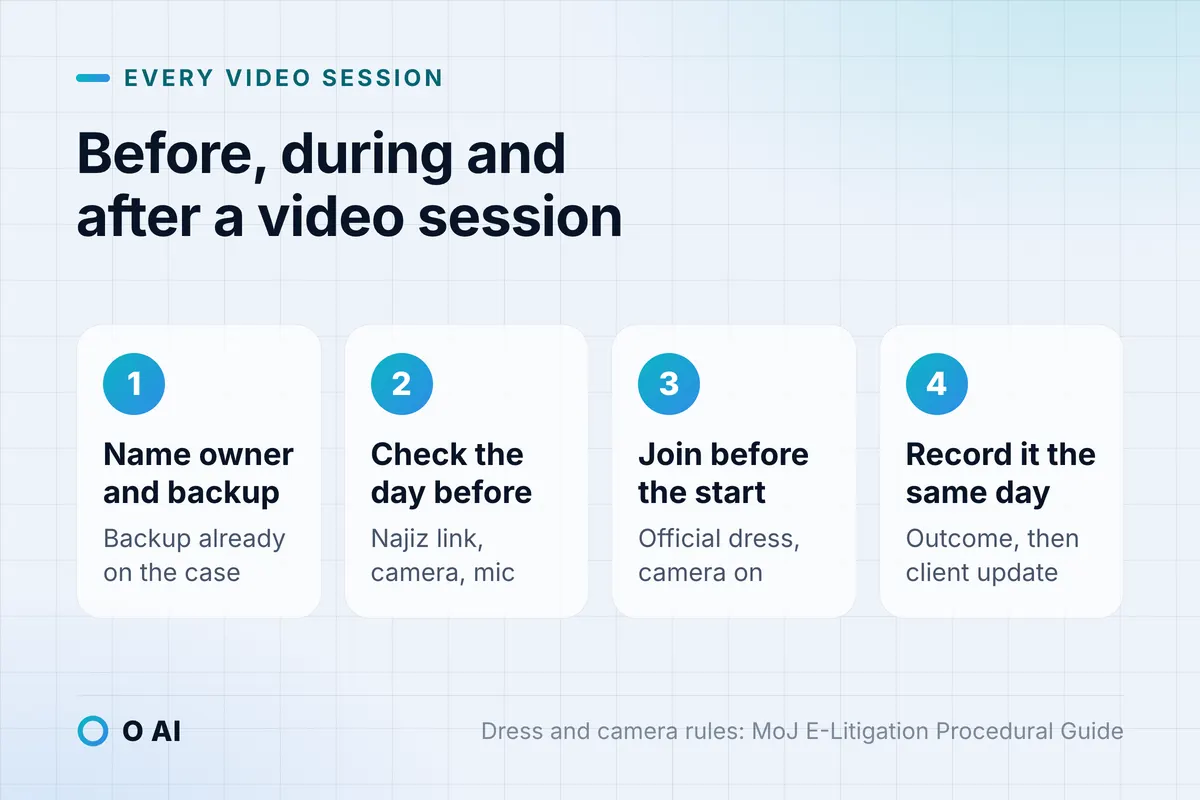
The day before
- Open the link in Najiz, not only in the SMS [3].
- Confirm the owner and backup, and that the backup has the link.
- Check the full Arabic names to be typed on entry [2].
- Prepare documents you may share on screen [2].
- Book a quiet, suitable room; test camera, microphone, power and a backup connection.
- The MoJ lists phone hours of 10:00 to 15:00 Saudi time, Sunday to Thursday, and email replies (1950@moj.gov.sa) within two working days [16]. For a session outside phone hours, fix access problems today.
On the day
- Join before the start time, with time to spare, as the guide asks; the 30-minute presence window is a safety net, not a target. Official dress, camera on, microphone muted [2].
- If you cannot get in, call 1950 (from abroad, +966 920001950) and note the time [2][16].
If something goes wrong
- You drop out: rejoin within 10 minutes [2].
- The court cannot hold or finish the session for its own reasons: you will be notified; record the new date the circuit sets [2].
- The link never arrived: note what did arrive and when, and raise it through Najiz or 1950. Under the guide, legal effects do not apply to a party who was not notified or did not receive the link, and the circuit records both in the minutes [2].
Right after: outcome and next date into the record before you leave the room.
After the session: record, next step and client update the same day
Fill in the outcome and client fields the same day. The court clerk writes minutes for every session, and parties may view the case file electronically [2]; when the minutes are available, check them against your notes.
Then send the client four lines:
- Today: what happened at the session.
- Next: the next date, and whether it is written or video.
- From you: what we need, and by when.
- Contact: who to call with questions.
E-litigation in Saudi Arabia for clients and counsel abroad
When a foreign company has a dispute in a Saudi court, it and its Saudi law firm should settle these points early:
- Access. Every party needs Nafath access (see above) [2]. Decide who acts in Najiz inside the Kingdom for a foreign client, for example its Saudi-licensed lawyer once added to the case [9]. We found no official statement on whether someone without a Saudi ID or iqama can open a Nafath account.
- Who may plead. Only lawyers on the Saudi roll of practising lawyers may plead for others before the courts, with narrow exceptions such as a company's statutory representative [18, Art. 18]. Foreign counsel who are not on that roll work through the Saudi firm: they brief it, review filings and prepare the client, and the Saudi lawyer appears. We found no official statement on foreign counsel watching a video session, so ask the circuit early.
- Language. Arabic is the official language of the courts. The court hears people who do not speak Arabic through an interpreter, and foreign-language papers need a certified Arabic translation from a licensed office [4, Art. 23]. Build translation time into every internal date.
- Interpreters. The MoJ's Unified Translation Centre interprets in hearings in 47 languages plus sign language, including live and remote by audio and video [12]. Since August 2025, translation requests, whether made in the statement of claim or by the circuit, are handled and tracked on the MoJ's electronic platform Taqadi [13]. If your client will need an interpreter, say so in the claim or ask the circuit early.
- Deadlines. Under the Procedure Law, parties residing outside the Kingdom get 60 days added to deadlines prescribed by law, and the court may, when needed, add the same again [4, Art. 21]. Do not assume the same for every court or for dates the circuit sets.
- Addresses for notices. In commercial cases, a foreign party can choose an address in the Kingdom, or its lawyer's address, for notices. If the address it gave in the case changes, it must tell the court within 48 hours, or notice at the old one takes effect [5, Art. 9].
- Time zones. Put Saudi time (UTC+3) and the client's time in every invitation and update.
- Other GCC courts. The same record and role table work there; portals and rules differ.
As of 29 September 2026, we found no official MoJ statement on joining a video session from outside the Kingdom. Ask the circuit through Najiz, or call 1950, well before the date, and have a representative in the Kingdom ready.
A weekly e-litigation review for the partner in charge
Twenty minutes on Sunday morning, or on the first morning of your working week:
- Open written sessions and their outer closing dates [2].
- Answers due this week and next, with their internal dates.
- Video sessions in the next ten working days: owner, backup, and whether the backup is on the case [9].
- Last week's sessions without a same-day record or client update.
- Pending translations and interpreter requests [12][13].
- Cases whose next date is not yet set.

Track two numbers from your own records: sessions with a same-day record, and answers filed after the internal date. When an answer is filed late, find its row in the role table and check that the row has a named owner and backup.
Where Rushd fits, and what it does not do
Rushd, a practice-management platform for law firms built by O AI, a Saudi AI and software company, keeps cases, clients, court sessions and tasks in one place. On its plans page (checked 29 September 2026), Court Sessions, Tasks, Powers of Attorney and Notifications are in the Basic plan; Session Reports, the Client Portal, the Mobile App (on iPhone) and AI Letter Drafting are in Premium.
Rushd does not connect to Najiz, the Ministry of Justice or any court system; your team enters each session from Najiz. It does not file memos or join hearings, and gives no legal advice. Anything its AI drafts is a first draft that a licensed lawyer reviews and approves, as our guide to AI for law firms in Saudi Arabia explains.
Set it up before the next notice
- List every remote session in the next ten working days.
- Name an owner and a backup for each.
- Have any backup who is not yet on the case added in Najiz, under a power of attorney that covers it.
- Hold the first 20-minute weekly review.
Then see how Rushd keeps your cases, court sessions and tasks in one place for the whole team.
Frequently asked questions
How do I get the link for a Najiz video session?
An SMS with the link is sent one day before the session (MoJ e-litigation procedural guide). You can also open the link in Najiz without waiting for the SMS, and Najiz shows whether the session is in court or remote (Saudi Press Agency, 1 November 2020). If you cannot get in, call the MoJ's unified centre on 1950, or +966 920001950 from outside Saudi Arabia (MoJ Contact Us page). If the link never arrives, keep a note: the circuit records in the minutes whether each party was notified and received the link (MoJ e-litigation procedural guide).
What should I do when a case moves to e-litigation?
According to the MoJ, e-litigation sessions need no booking: an SMS with the date and the attendance link arrives when a case moves to the e-litigation track (Saudi Press Agency, 21 June 2020). Open Najiz to confirm the date and whether the session is remote or in court. Open a session record that day, name an owner and a backup who is already added to the case through Najiz's "Add representative" service, and tell the client. Before a video session, the link arrives again by SMS one day ahead (MoJ e-litigation procedural guide).
How do I check my session dates on Najiz?
Use the "View sessions calendar" service on najiz.sa: sign in with Nafath, choose all e-services, then the Judiciary package, open "View sessions calendar", select "New request" and choose to show all sessions. The service is also offered in the Najiz app, in Tawakkalna (the government's services app) and at Najiz service centres, in person (Najiz "View sessions calendar" service page). Copy each date into the firm's record the same day.
What is a Najiz written session, and how long does it stay open?
In a written session, the circuit and the parties exchange memos, questions, requests and documents in writing on Najiz. It stays open until the circuit closes it, at most 30 days from opening, and the circuit may extend it once by the same period. In cases that are not urgent, you get at least five working days to answer. You count as present by writing within the deadline set, and no judgment is issued in a written session (MoJ e-litigation procedural guide).
How long is a video session, and what if I join late or drop out?
The guide sets no fixed length for a video session. It asks parties to be in the electronic room before the start time, and you still count as present if you join within 30 minutes of it. If you drop out and do not rejoin within 10 minutes, the circuit continues the session (MoJ e-litigation procedural guide). Open the link in Najiz the day before, and have a named backup who is already added to the case as a representative (Najiz "Add representative" service page).
Can a client or lawyer outside Saudi Arabia take part in a remote hearing?
Every party needs an active Nafath account or the ability to create one (MoJ e-litigation procedural guide). Only lawyers on the Saudi roll of practising lawyers may plead for others, with narrow exceptions (Law of Legal Practice, Article 18). The court hears people who do not speak Arabic through an interpreter, and foreign-language documents need a certified Arabic translation (Law of Procedure before Sharia Courts, Article 23); the MoJ's translation centre offers live remote interpretation in 47 languages (Saudi Press Agency, 7 August 2024). As of 29 September 2026 we found no official MoJ statement on joining from abroad, so ask the circuit through Najiz or call 1950 early, and keep a representative in the Kingdom ready.
Does Rushd connect to Najiz?
No. Rushd does not connect to Najiz, the Ministry of Justice or any court system. Your team records each session from Najiz in Rushd, where cases, court sessions and tasks sit in one place for the whole firm. Rushd does not file memos or attend hearings, and a licensed lawyer reviews anything its AI drafts.
How this article was made: Researched from the official sources listed below (MoJ procedural guide, Najiz service pages, SPA, Bureau of Experts), opened on 29 September 2026. Drafted with AI assistance, then checked against those sources. Not reviewed by a lawyer. Images are AI-generated illustrations.
Sources
- E-litigation: advanced procedures that preserved judicial safeguards (Arabic, 26 January 2025) (opens in a new tab)Saudi Press Agency (quoting the Ministry of Justice) · spa.gov.sa
- Procedural Guide for the E-Litigation Service (Arabic; Minister of Justice Decision No. 8056, 5 Shawwal 1441 AH / 28 May 2020; listed as in force on the MoJ Legal Portal) (opens in a new tab)Ministry of Justice · laws.moj.gov.sa
- Ministry of Justice enables access to the e-litigation session link through Najiz (Arabic, 1 November 2020) (opens in a new tab)Saudi Press Agency (quoting the Ministry of Justice) · spa.gov.sa
- Law of Procedure before Sharia Courts (Arabic; English title "Law of Civil Procedure"; Royal Decree M/1, 22/1/1435 AH; Article 55 as amended by Royal Decree M/38) (opens in a new tab)Bureau of Experts at the Council of Ministers · laws.boe.gov.sa
- Law of Commercial Courts (Arabic; Royal Decree M/93, 15/8/1441 AH) (opens in a new tab)Bureau of Experts at the Council of Ministers · laws.boe.gov.sa
- Justice Ministry: Najiz Platform Records 23 Million Visits from over 90 Countries in Q1 2024 (23 April 2024) (opens in a new tab)Saudi Press Agency · spa.gov.sa
- e-Litigation (opens in a new tab)Ministry of Justice · moj.gov.sa
- E-litigation (written pleading), service page (Arabic) (opens in a new tab)Najiz · najiz.sa
- Add representative, service page (Arabic) (opens in a new tab)Najiz · najiz.sa
- First defence memo request, service page (Arabic) (opens in a new tab)Najiz · najiz.sa
- View the establishment's cases, service page (Arabic) (opens in a new tab)Najiz · najiz.sa
- The Unified Translation Center at the Ministry of Justice Assists Saudi Judicial Departments (7 August 2024) (opens in a new tab)Saudi Press Agency · spa.gov.sa
- Ministry of Justice launches Unified Translation Centre services on the Taqadi electronic platform (Arabic, 16 August 2025) (opens in a new tab)Saudi Press Agency (quoting the Ministry of Justice) · spa.gov.sa
- Electronic Court Sessions, service page (opens in a new tab)Board of Grievances · bog.gov.sa
- Ministry of Justice issues the user guide for the e-litigation service (Arabic, 21 June 2020) (opens in a new tab)Saudi Press Agency (quoting the Ministry of Justice) · spa.gov.sa
- Contact Us (opens in a new tab)Ministry of Justice · moj.gov.sa
- View sessions calendar, service page (Arabic) (opens in a new tab)Najiz · najiz.sa
- Law of Legal Practice (Arabic; English title on the site "The Code of Law Practice"; Royal Decree M/38, 28/7/1422 AH; Article 18 as amended by Royal Decree M/21, 26/1/1447 AH) (opens in a new tab)Bureau of Experts at the Council of Ministers · laws.boe.gov.sa
About the author