 AI
AIWhat is generative AI? Examples of its models and how they are used
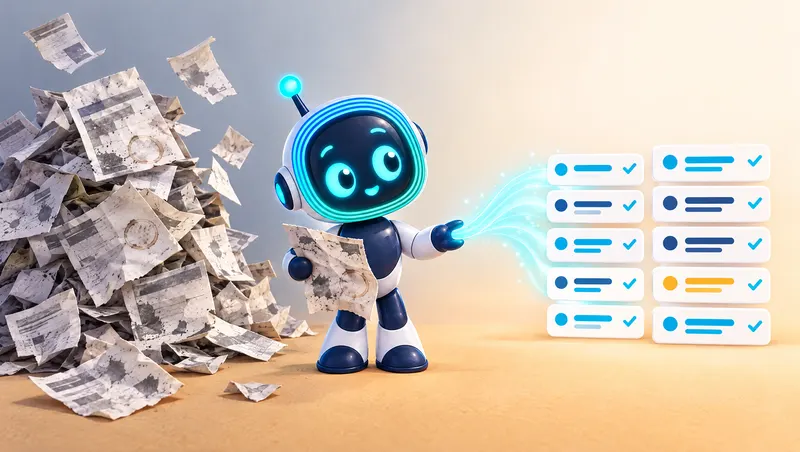
What is generative AI? It is AI that creates new text, images, audio and video from patterns learned in data. This guide explains how the models work, lists examples such as GPT, Gemini, Claude and ALLaM by content type, shows illustrative Saudi uses and gives eight checks before you rely on it.

Key takeaways
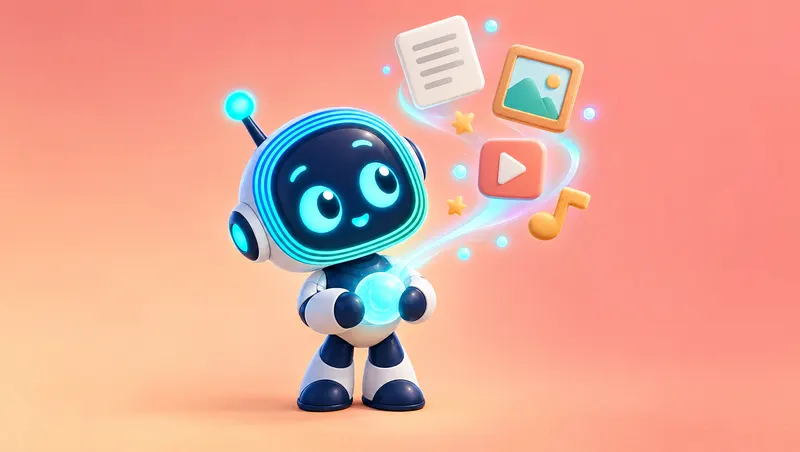
- Generative AI creates new text, images, audio, video or code after learning patterns from large datasets; SDAIA and NIST both define it by this ability to generate new content.
- GPT (the model behind ChatGPT), Gemini, Claude and Saudi-developed ALLaM are examples of generative AI models; GPT-Image, Veo and Lyria cover images, video and music.
- ALLaM was developed by SDAIA's National Center for AI; its 7B version was trained on 5.2 trillion tokens, and HUMAIN Chat runs on ALLaM 34B.
- NIST calls confident false output 'confabulation', and SDAIA makes users responsible for verifying generated content before relying on it.
- SDAIA's government guidelines limit generative AI tools to data classified as public; companies should keep personal and confidential data out of unvetted tools.
On this page
- What is generative AI, and what makes it different?
- How a generative AI model produces text, images and sound
- Examples of generative AI models by type of content
- Is ChatGPT a generative AI model? Apps, models and companies
- Arabic generative AI built in Saudi Arabia
- How Saudi businesses use generative AI: illustrative examples
- Where generative AI goes wrong: confident errors, data leaks and deepfakes
- Eight checks before you rely on generative AI output
- Your next step
Generative AI is the branch of artificial intelligence that creates new content, such as text, images, audio, video or code, after learning patterns from very large amounts of data. One well-known example of a generative AI model is GPT, the family behind ChatGPT; others include Google's Gemini, Anthropic's Claude and ALLaM, developed in Saudi Arabia.
This guide explains what generative AI is, how a model produces a sentence or a picture, which models exist for each type of content, and where a person still has to check the result. Model names were read on the vendors' own pages on 14 October 2026; they change often, so treat versions as a snapshot. O AI is not affiliated with OpenAI or any other company named here.
What is generative AI, and what makes it different?
The Saudi Data and AI Authority (SDAIA) defines a generative model in its 2025 guidelines for the public as a machine learning model that can create new examples similar to the data it was trained on. It describes generative AI as the part of AI that creates new content, including text, images, sounds, icons and videos, and works by interpreting the commands users give it [1].
The US National Institute of Standards and Technology (NIST) uses a close definition in its Generative AI Profile of July 2024: a class of AI models that mimic the structure and characteristics of their input data to generate derived synthetic content, including images, videos, audio and text [2]. SDAIA's AI Adoption Framework places generative AI alongside machine learning, deep learning, language processing, computer vision and speech technology as one branch of AI, and calls it one of the fastest-growing [3].
The key word is new. Most of the AI that businesses used before these tools spread sorted, scored or forecast things. Generative AI writes, draws or speaks something that did not exist a second earlier.
| Predictive AI | Generative AI | |
|---|---|---|
| The question it answers | Which category is this? What number comes next? | Write, draw or say something new |
| What it produces | A label, a score or a forecast | A draft: text, image, audio, video or code |
| Illustrative example in a Saudi company | Flag an invoice as a likely duplicate | Draft an Arabic reply to a customer complaint |
| Typical failure | A wrong label or forecast | A fluent answer that is false |
| How you check it | Compare with past outcomes | A person reviews facts, names, numbers and tone |
How a generative AI model produces text, images and sound
You do not need the mathematics to use these tools well, but three ideas explain most of their strengths and their mistakes.
It learns patterns from huge amounts of data
A model is first trained on a very large collection of examples. The scale is hard to picture: SDAIA's National Center for AI says the 7-billion-parameter version of its ALLaM model was trained on 5.2 trillion tokens, 4 trillion in English followed by 1.2 trillion of mixed Arabic and English [4]. A token is a short piece of text, often part of a word. The model does not store these texts like a library; it learns the patterns in them.
Text models predict the next piece
NIST explains that generative models produce outputs that approximate the statistical distribution of their training data; large language models (LLMs) predict the next token or word in a sentence [2]. Most of today's LLMs build on the Transformer, an architecture introduced in a 2017 research paper that relies on a mechanism called attention to weigh how each word relates to the others [5].
This is why a chatbot can write a polite Arabic letter in seconds, and also why it can invent a regulation number that looks right. It is producing the most likely continuation, not looking up a fact.
Image models remove noise step by step
Many image generators use diffusion models. They start from random noise and clean it up in a sequence of small denoising steps until a picture appears; a 2022 paper made this cheaper by running the process in a compressed "latent" space and by letting text guide each step [6].
Tuning turns a raw model into an assistant
After the first training stage, developers tune the model on examples of good answers and on human preferences. The ALLaM research team reports that extensive alignment with human preferences improved its models' results, even against larger models with weaker alignment [7]. Your instructions, or prompts, then steer the tuned model for each task.
Examples of generative AI models by type of content
The table groups well-known models by what they create. The model families last longer than their version numbers, so the families are what matter when you compare.
| Content | Example models (developer) | Typical business use |
|---|---|---|
| Text and chat | GPT (OpenAI) [8]; Gemini (Google) [9]; Claude (Anthropic) [10]; ALLaM (SDAIA's National Center for AI) [4] | Drafting emails and reports, summaries, translation, answering questions about a document |
| Images | GPT-Image (OpenAI) [8]; Nano Banana, Google's Gemini image model [9] | Product mock-ups, social media visuals, editing photos |
| Video | Veo (Google), which produces clips with audio [9] | Short promotional or training clips |
| Music, speech and audio | Lyria for music and Gemini Audio for speech (Google) [9]; text-to-speech and transcription models (OpenAI) [8] | Voice-overs, phone menus, meeting transcripts |
| Open models you can run yourself | Gemma (Google) [9]; ALLaM 7B, published with an Apache 2.0 licence tag [4] | In-house assistants where data must stay on your own servers |
On 14 October 2026, OpenAI listed its GPT-6 family as its flagship models [8], and Anthropic's current line-up was Claude Fable 5.1, Opus 5.5, Sonnet 5.5 and Haiku 5.5, all accepting text and image input and producing text [10]. Many of these models also write and review code, which is a text task with stricter rules.
Is ChatGPT a generative AI model? Apps, models and companies
Many people meet the question "give one example of a generative AI model" in a course or a quiz. The cleanest answer separates three layers:
| App you open | Model family behind it | Company |
|---|---|---|
| ChatGPT | GPT | OpenAI |
| Gemini app | Gemini | |
| Claude | Claude | Anthropic |
| HUMAIN Chat | ALLaM 34B [11] | HUMAIN |
ChatGPT is an application; the generative AI model inside it is GPT. Either answer is usually accepted, and so are Gemini, Claude, ALLaM or an image model such as GPT-Image. A spam filter or a credit-scoring model is not an example, because it classifies rather than creates.
The distinction also matters when you buy. Two apps can run the same model, and one app can switch models between versions, so the quality you saw in a demo may change. Ask which model and version a product uses, and test it again when that changes.
Arabic generative AI built in Saudi Arabia
Arabic needs models that handle its script, its rich grammar and its dialects well. ALLaM, developed by the National Center for Artificial Intelligence at SDAIA, is a series of models for Arabic and English [4]. Its research paper describes teaching an English-capable model Arabic as a second language, by expanding its vocabulary and training on mixed Arabic and English text, without losing its English; the authors report leading results on several Arabic benchmarks, including Arabic MMLU and Arabic Exams [7].
HUMAIN, a company owned by the Public Investment Fund, launched HUMAIN Chat on 25 August 2025. Saudipedia describes it as an Arabic chat app powered by ALLaM 34B that accepts voice input, supports several Arabic dialects, switches between Arabic and English in one conversation and is hosted on HUMAIN's infrastructure inside the Kingdom [11].
Hosting location matters for companies handling personal data. Our guide to data residency in Saudi Arabia explains what the Personal Data Protection Law asks when an AI tool runs abroad.
How Saudi businesses use generative AI: illustrative examples
SDAIA expects generative AI to raise efficiency by taking on routine work such as summarising complex documents, transcribing text and generating images and videos, and to improve accessibility by producing content that fits local dialects [1]. In a company, that usually means a first draft that a person finishes.
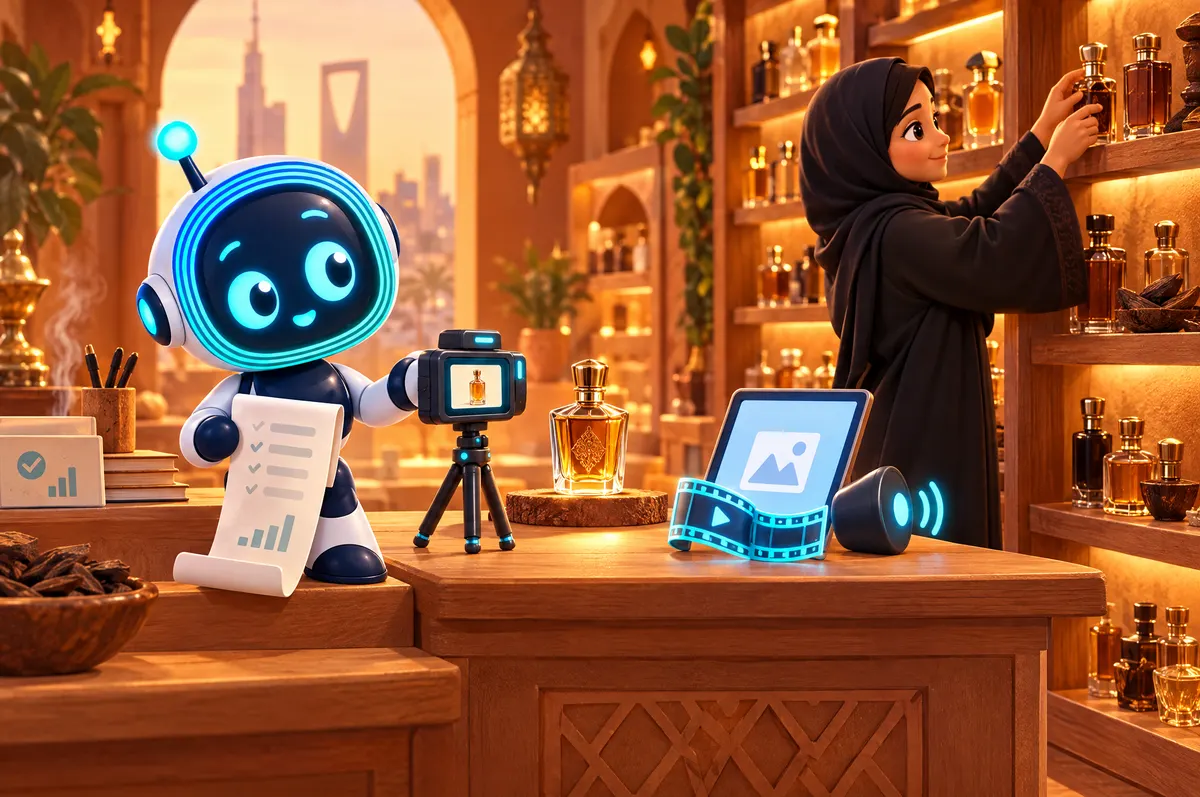
Illustrative examples. The businesses below are hypothetical; they show where the technology fits and what stays with people.
| Business | Task | What generative AI does | What a person keeps |
|---|---|---|---|
| Real-estate office in Riyadh | Listings in Arabic and English | Drafts both descriptions from the property sheet | Area, price and licence details checked against the source |
| Contractor in Dammam | A 120-page tender | Summarises scope, deadlines and penalty clauses | An engineer reads every clause the summary relies on |
| Clinic in Jeddah | A patient FAQ leaflet | Drafts plain-Arabic answers to common questions | A doctor approves the medical content; no patient records go in |
| Online shop in Abha | Product photos and captions | Cleans backgrounds and drafts captions | The owner confirms the image matches the real product |
| Training team in Al Khobar | A recorded Arabic workshop | Transcribes and summarises it | Staff correct names, terms and figures |
The pattern repeats: the model produces a quick first draft of a text-heavy task, and a person who knows the subject checks and finishes it. Our guide on how AI can help your business shows how to pick one such task and measure it in a short trial before you pay for anything.
Where generative AI goes wrong: confident errors, data leaks and deepfakes
NIST lists "confabulation" among the main risks of generative AI: the production of confidently stated but false content, known informally as hallucinations [2]. It notes that this is a natural result of how the models are designed, and that models may also produce invented citations or reasoning that make a wrong answer look justified [2]. A 2025 research paper argues that models guess because their training and evaluation reward guessing over admitting uncertainty [12].
SDAIA's public guidelines add the risks a business meets first [1]:
- Misinformation: users are responsible for verifying generated content against trustworthy sources.
- Data leaks: prompts may be used to train the model further, so sensitive information typed into a tool can be exposed; organisations should ban classified information from third-party tools.
- Deepfakes: realistic fake audio, images and video are used for scams, fraud and blackmail; staff need training to spot them and to confirm requests through a second, trusted channel.
For government entities the line is stricter. SDAIA's guidelines for government tell employees not to enter data classified as restricted or higher, and to limit generative AI tools to data classified as public [13]. NIST also flags performance gaps between languages, possibly caused by non-representative training data [2]. Arabic dialects, names and Hijri dates are where those gaps tend to show.
Eight checks before you rely on generative AI output
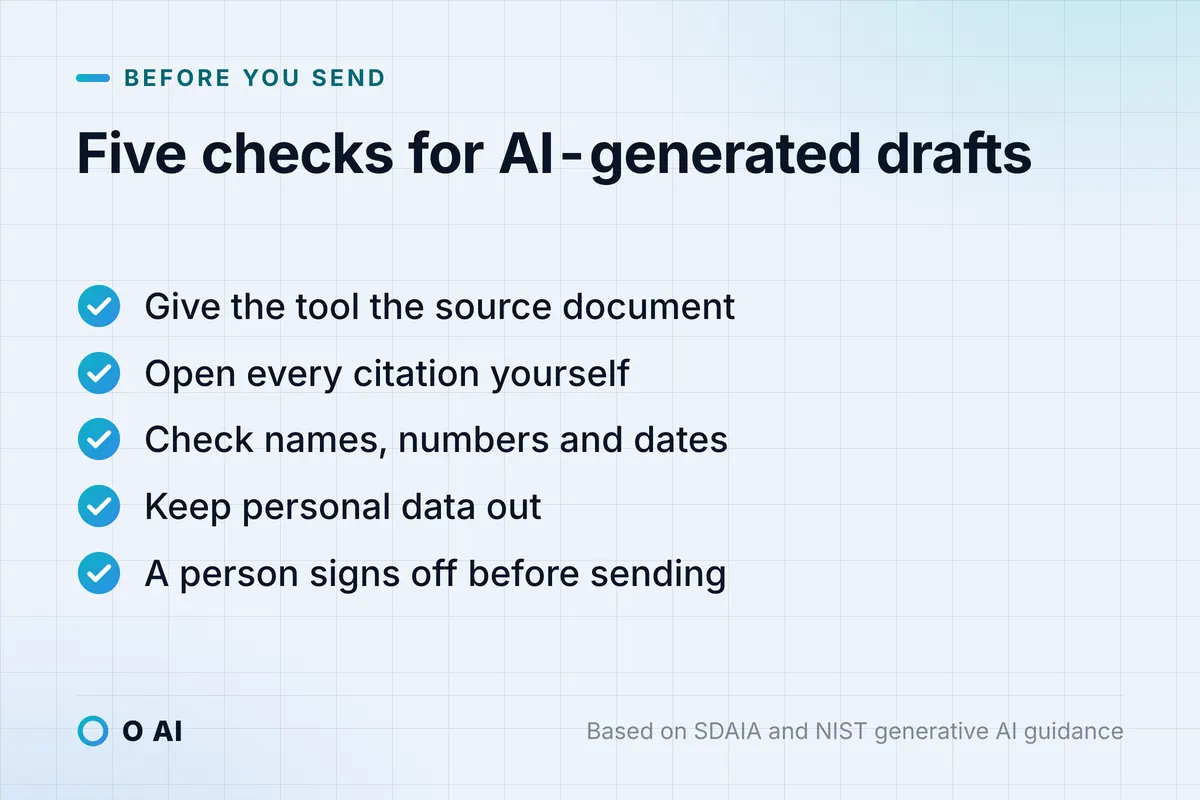
Use this list as-is for any draft that will leave your desk.
- Give it the source. Paste or upload the document you want summarised instead of asking from memory.
- Ask where each claim comes from, then open every link or page it cites yourself.
- Check names, numbers and dates against the original, including Hijri and Gregorian dates.
- Check every legal or regulatory reference on the official portal; never cite an article number the tool supplied without reading it.
- Keep personal and confidential data out of tools whose data terms and location you have not checked.
- Label AI-generated content where readers could mistake it for a person's work; SDAIA's transparency principle asks for this [1].
- Keep a person's sign-off on anything sent to a customer, a court or a government entity.
- Note the tool and model version used for important outputs, so you can repeat or explain them later.
Your next step
Choose one recurring writing or summarising task this week, run the same real example through two generative AI tools your company is allowed to use, and count the corrections each draft needs before it could be sent. That count tells you more about what generative AI can do for you than any ranking. If you later need a model connected to your own documents or systems, that is a software project; you can read about O AI, a software and AI company in Al Khobar, on our home page.
Frequently asked questions
What is generative AI in simple terms?
Generative AI is software that creates something new, such as a paragraph, an image, a voice recording or a piece of code, after learning patterns from very large collections of examples. You describe what you want in plain words, and the model produces a draft. It does not look facts up the way a search engine does; it predicts a likely answer. That makes it fast and fluent, but it also means a person should check the result before relying on it.
What is one example of a generative AI model?
GPT, the model family behind ChatGPT, is the example given most often. Other correct examples are Google's Gemini, Anthropic's Claude and ALLaM, the Arabic and English model developed at SDAIA's National Center for AI. Image models such as GPT-Image, video models such as Google's Veo and music models such as Lyria are generative too. A spam filter or a credit-scoring model is not an example, because it classifies data rather than creating content.
What is the difference between generative AI and traditional AI?
Traditional, or predictive, AI answers questions such as "which category is this?" or "what will sales be next month?" and returns a label, a score or a forecast. Generative AI produces new content, such as a letter, a summary or an image. Many products now combine both: a system may classify an incoming email with predictive AI and then draft the reply with generative AI. The checks differ, too: predictive models are tested against past outcomes, while generated content needs a person to review facts and tone.
Is ChatGPT a generative AI model?
Strictly, ChatGPT is an application and GPT is the generative AI model inside it, built by OpenAI. In everyday use, people call ChatGPT a generative AI tool, and most quizzes accept it as an example. The same layering applies elsewhere: the Gemini app runs Google's Gemini models, and HUMAIN Chat runs the ALLaM 34B model. Knowing the model behind an app helps when you compare products, because one app can change its model over time.
Are there Arabic generative AI models made in Saudi Arabia?
Yes. ALLaM is a series of Arabic and English language models developed by the National Center for Artificial Intelligence at SDAIA, and a 7-billion-parameter version is published openly. HUMAIN, owned by the Public Investment Fund, launched HUMAIN Chat in August 2025 on its ALLaM 34B model, with support for several Arabic dialects and hosting inside the Kingdom according to Saudipedia. International models also support Arabic, so test each one on your own documents and dialect.
Can generative AI give wrong answers?
Yes, and often with confidence. NIST calls this confabulation: content that sounds certain but is false, sometimes with invented sources attached. It happens because the model predicts likely text rather than retrieving verified facts. Reduce the risk by giving the model the source document, asking where each claim comes from, opening every citation yourself and having a person who knows the subject check names, numbers, dates and legal references before anything is sent.
Is it safe to put company data into generative AI tools?
It depends on the tool's terms and where it processes data. SDAIA's guidelines warn that prompts can be used for further training and that organisations should ban classified information from third-party tools. Keep personal data, contracts and financial records out of free or personal accounts, use business plans whose terms you have read, and check the hosting location against the Personal Data Protection Law. For a specific case, consult SDAIA's guidance or a licensed advisor.
How this article was made: Researched from the sources listed below, opened on 14 October 2026. Drafted with AI assistance, then checked against those sources. General information, not professional advice. Images are AI-generated illustrations.
Sources
- Generative Artificial Intelligence Guidelines for Public (2025) (opens in a new tab)Saudi Data and AI Authority (SDAIA) · sdaia.gov.sa
- NIST AI 600-1: Artificial Intelligence Risk Management Framework, Generative Artificial Intelligence Profile (July 2024) (opens in a new tab)National Institute of Standards and Technology (NIST) · nvlpubs.nist.gov
- Artificial Intelligence Adoption Framework (2025) (opens in a new tab)Saudi Data and AI Authority (SDAIA) · sdaia.gov.sa
- ALLaM-7B-Instruct-preview model card (opens in a new tab)National Center for AI at SDAIA, on Hugging Face · huggingface.co
- Attention Is All You Need (2017) (opens in a new tab)Vaswani and others, arXiv · arxiv.org
- High-Resolution Image Synthesis with Latent Diffusion Models (CVPR 2022) (opens in a new tab)Rombach and others, arXiv · arxiv.org
- ALLaM: Large Language Models for Arabic and English (2024) (opens in a new tab)Bari and others, arXiv · arxiv.org
- Models (API documentation) (opens in a new tab)OpenAI · developers.openai.com
- Models (opens in a new tab)Google DeepMind · deepmind.google
- Models overview (opens in a new tab)Anthropic, Claude documentation · platform.claude.com
- HUMAIN Chat application (opens in a new tab)Saudipedia · saudipedia.com
- Why Language Models Hallucinate (2025) (opens in a new tab)Kalai and others, arXiv · arxiv.org
- Generative Artificial Intelligence Guidelines for Government (2025) (opens in a new tab)Saudi Data and AI Authority (SDAIA) · sdaia.gov.sa
About the author