 AI
AIThe importance of cybersecurity for business: breach costs and a 10-point checklist
What a data breach costs in 2026, what Saudi Arabia's Personal Data Protection Law requires within 72 hours, which NCA controls bind small and medium companies, and a 10-point protection checklist with a worked cost example in SAR.


Key takeaways
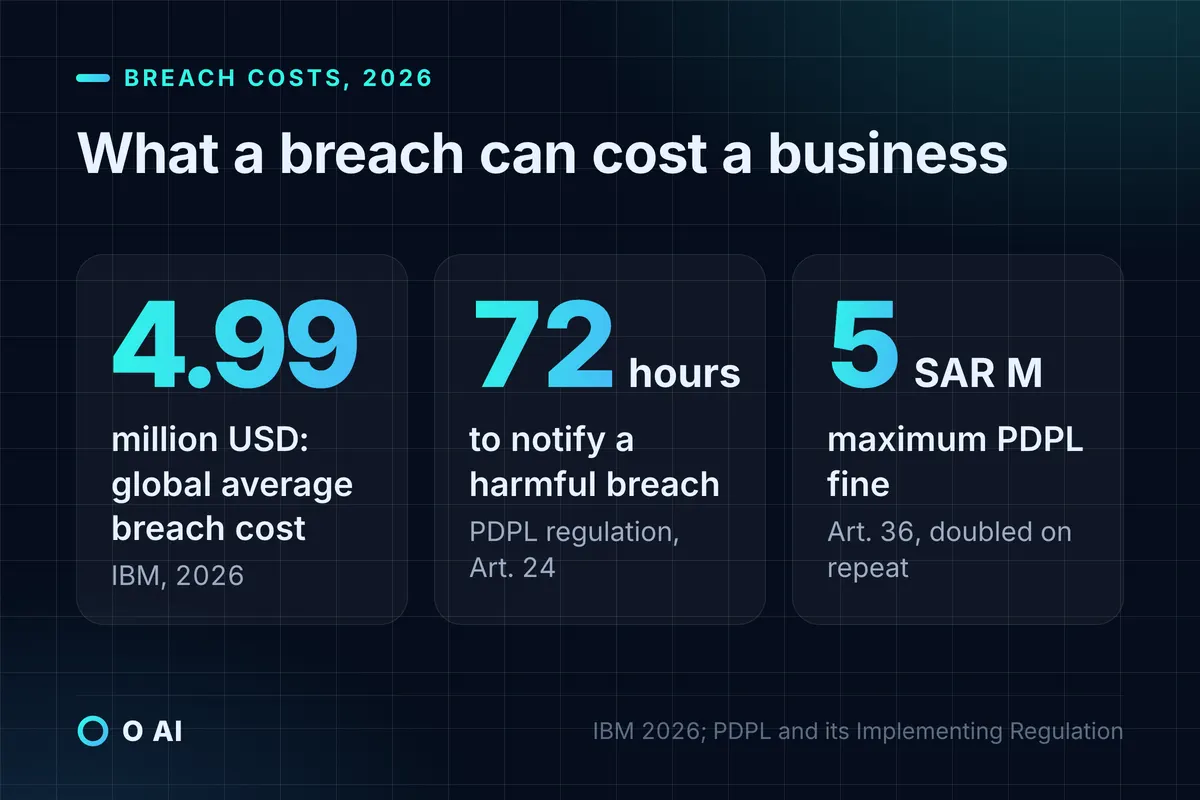
- IBM's 2026 report puts the global average cost of a data breach at $4.99 million, up 12% on the previous year; Verizon finds ransomware in 48% of breaches.
- Under the PDPL Implementing Regulation, a personal data breach that could harm people must be notified to the competent authority within 72 hours.
- PDPL Article 36 allows a warning or a fine of up to SAR 5 million, which may be doubled for a repeat violation; SDAIA committees issued fines in 2026.
- The ECC binds government bodies and CNI operators; NCA's NCNICC-1:2025 binds large, medium and small private companies once NCA notifies them.
- Ten basic controls, from multi-factor authentication and tested backups to SPF, DKIM and DMARC, follow the defence areas NCA set for small and medium firms.
On this page
- Why the importance of cybersecurity for business keeps rising
- What a data breach costs in 2026
- What Saudi law adds: 72 hours, notices and fines
- Illustrative example: three days offline at a Riyadh online store
- Digital security for small companies: what is mandatory and what is advised
- A 10-point protection checklist for small companies
- The first 72 hours after a breach
- Your next step
The importance of cybersecurity for business comes down to cost and continuity. IBM puts the global average cost of a data breach at $4.99 million in 2026 [1], and Saudi rules add a 72-hour notice duty for harmful personal data breaches [5] and fines of up to SAR 5 million [4]. Ten basic controls remove much of that risk.
This guide is written for owners and managers of small and medium companies in Saudi Arabia. It covers what a breach costs, what Saudi rules require once one happens, which official controls apply to a company of your size, and a 10-point checklist you can start this month. It is general information, not legal advice.
Why the importance of cybersecurity for business keeps rising
Most companies now run on a handful of online accounts: email, a cloud drive, an accounting system, a store or booking page, and the banking portal. Whoever controls those accounts controls the business. A single stolen password can stop sales, expose a customer list or redirect a supplier payment.
Saudi companies already treat this as a cost of doing business. The National Cybersecurity Authority (NCA) puts the Kingdom's cybersecurity market at about SAR 16.3 billion in 2025, and private-sector entities spent SAR 11.2 billion of it, or 69% [3]. Government entities accounted for the remaining SAR 5.1 billion [3].
The damage from an attack falls into three groups:
- Money: days without sales, emergency IT work, replaced devices and staff overtime.
- Legal exposure: the Personal Data Protection Law (PDPL) sets notice duties and fines once personal data leaks.
- Trust: customers, banks and larger clients judge you by how you handled the incident.
NCA's own definition is broad. It describes cybersecurity as protecting networks, IT and operational technology systems, their hardware and software, the services they provide and the data they hold from unauthorised penetration, disruption, modification, access, use or exploitation, and says the concept also covers information security and digital security [9].
What a data breach costs in 2026
Two widely used annual studies give a consistent picture.
- Cost: IBM's Cost of a Data Breach Report 2026, produced with the Ponemon Institute, puts the global average cost of a breach at $4.99 million, a 12% increase on the previous year and a record high [1].
- Savings from automation: the same report finds that organisations making extensive use of AI and automation in security saved $1.93 million compared with those using none [1].
- AI-driven attacks: IBM reports a 56% increase in AI-driven attacks, led by deepfake impersonation and AI-enabled malware [1].
- How attackers get in: Verizon's 2026 Data Breach Investigations Report finds that 31% of breaches started with the exploitation of a software vulnerability, overtaking stolen passwords as the top entry point [2].
- Ransomware: Verizon finds ransomware in 48% of all breaches, although ransom payouts are shrinking [2]. Its data covers incidents from 1 November 2024 to 31 October 2025 [2].
These are global figures, weighted towards larger organisations. A small company's bill is smaller in dollars, but it lands on thinner cash reserves and fewer people. The useful question is not the global average but what each cost line would look like in your own company.
| Cost line | What it looks like in a small Saudi company | What reduces it |
|---|---|---|
| Downtime | No orders, bookings or invoices while systems are locked or offline | Tested backups and a written recovery order |
| Recovery work | An outside IT firm working day and night, plus staff overtime | A pre-agreed IT contact and an asset list |
| Replaced equipment | Wiping or replacing infected laptops, phones and servers | Malware protection and timely updates |
| Customer handling | Calls, refunds, goodwill vouchers and messages to affected people | A prepared notice template and one spokesperson |
| Legal exposure | PDPL notices, possible warnings or fines, contract claims | Early detection, the 72-hour routine and records |
| Lost business | Customers and partners who quietly move to a competitor | Fast, honest communication |
What Saudi law adds: 72 hours, notices and fines
Under Article 20 of the PDPL, as amended by Royal Decree M/148 dated 5/9/1444H, a controller must notify the competent authority when it learns of a leak, damage or unlawful access to personal data, and must notify the affected person where the incident could harm their data or conflict with their rights or interests [4].
The Implementing Regulation sets the detail in Article 24 [5]:
- Deadline: notify the competent authority within 72 hours of becoming aware of the incident, if it could harm the personal data or the data subject, or conflict with their rights or interests.
- Content: what happened, when and how, and when you found out; the categories and actual or approximate number of people affected and the types of data; the risks and the measures taken; whether the people affected have been or will be told; and a contact person.
- Late details: information you cannot gather within 72 hours must follow as soon as possible, with the reasons for the delay.
- Records: keep copies of the reports and document the corrective measures taken.
- People affected: tell them without undue delay, in simple and clear language, with advice on how to protect themselves.
- Other duties: the article does not affect any duty to report incidents under NCA rules or other regulations.
SDAIA's National Data Governance Platform offers a "Personal Data Breach Notification" e-service for filing the notice, and it asks for a valid registration certificate from the National Data Management Office [6]. Check that your company is registered before an incident rather than during one.
The penalties are real. Article 36 allows a warning or a fine of up to SAR 5 million for a private person or entity that breaches the law or its regulations, and the fine may be doubled for a repeat violation [4]. Article 35 sets up to two years in prison and a fine of up to SAR 3 million, or either penalty, for disclosing or publishing sensitive data with intent to harm the data subject or for personal gain [4].
Enforcement has started. Okaz reported on 30 June 2026 that SDAIA's violation committees had issued fines and warnings, including for failing to notify a breach within the 72-hour period and for failing to take the measures needed to protect personal data [7]. If your data sits with cloud or AI tools abroad, our guide to data residency in Saudi Arabia covers the transfer conditions. This section is general information; for your specific case, check SDAIA's current regulations or ask a licensed advisor.
Illustrative example: three days offline at a Riyadh online store
Illustrative example. An online store in Riyadh with 18 staff sells about SAR 30,000 a day at a 35% gross margin. Ransomware locks its order system and two laptops for three days. The figures below are assumptions for the example, not survey data.
| Cost line | Calculation | Amount (SAR) |
|---|---|---|
| Lost gross margin | 3 days × SAR 30,000 × 35% | 31,500 |
| Emergency IT recovery | SAR 20,000 + 15% VAT | 23,000 |
| Staff overtime | 6 people × 10 hours × SAR 60 | 3,600 |
| Goodwill vouchers for late orders | 400 orders × SAR 20 | 8,000 |
| Two replacement laptops | 2 × SAR 4,000 + 15% VAT | 9,200 |
| Direct cost | 75,300 |
The table leaves out the hardest costs to price: customers who do not come back and management time over the following weeks. If customer data was also copied, the store faces the 72-hour notice and possible PDPL penalties on top. Several of the ten controls below are settings rather than purchases, such as multi-factor authentication and email authentication, so the comparison usually favours prevention.
Digital security for small companies: what is mandatory and what is advised
Not every NCA document binds every company, and it helps to know where you stand.
- The Essential Cybersecurity Controls (ECC-2:2024) apply to government agencies and their affiliated companies and entities, and to private-sector entities that own, operate or host critical national infrastructure. NCA strongly encourages all other entities to use them as best practice [9].
- The Non-CNI Private Sector Entities Cybersecurity Controls (NCNICC-1:2025), issued by NCA in 2025, cover private companies outside critical infrastructure [8]. Category A, large entities with more than 250 full-time employees or more than SAR 200 million in annual revenue, has 65 essential controls. Category B, small and medium entities with 6 to 249 employees or SAR 3 million to SAR 200 million in revenue, has 26 essential controls in 13 subdomains, all under cybersecurity defence [8].
- Who is bound: the controls are binding on entities in each category that NCA notifies, and NCA may require additional controls where needed; entities outside the scope are responsible for using them as appropriate [8]. A company with fewer than six employees and under SAR 3 million in revenue falls outside both categories.
So unless NCA has notified your company, or a client contract or sector regulator requires it, these controls are a strong reference rather than a legal duty. The PDPL's breach rules, by contrast, apply whenever you process personal data. The checklist below follows the defensive areas NCA chose for small and medium companies, because they are a sensible baseline whatever your legal position.
A 10-point protection checklist for small companies
Use it as-is. Each point ends with a test that tells you it is done.
- Turn on multi-factor authentication. Cover email, remote access, cloud admin panels and the banking portal. NCNICC lists multi-factor authentication for remote access, including email and external applications, among the controls mandatory for Category B [8]. Done when no mailbox or admin account opens with a password alone.
- List what you must protect. Devices, cloud accounts, domain names and key data (customer list, payroll, contracts), each with an owner. Done when one sheet exists and changes whenever someone joins or leaves.
- Patch on a schedule. Switch on automatic updates for operating systems, browsers and your store or website platform, and scan internet-facing applications for vulnerabilities [8]. Done when nothing important is more than a month behind.
- Change default settings. Replace default passwords on routers, cameras, printers and admin panels, and switch off services you do not use [8]. Done when no device still has its factory password.
- Protect every device against malware. Servers, laptops and phones all need current protection [8]. Done when every device on your list shows it active.
- Lock down your email domain. Filter phishing and spam, and publish SPF, DKIM and DMARC records for your domain [8]. Done when your IT provider confirms all three records are live.
- Back up and test the restore. Back up critical systems regularly and test that the backups restore [8]. NCA's guidelines for small e-commerce sellers suggest backing up at least weekly and checking the data on the backups [10]. Done when you have restored one real file from last week's backup.
- Give each person only what they need. Apply least privilege and review access regularly [8], keep admin rights to a few named people, and close a leaver's accounts on their last day. Done when the last review date is written on your asset sheet.
- Train staff to pause and verify. Cover phishing, fake invoices and voice or video requests to change bank details. NCA's free Tahqaq service checks suspicious links, files and QR codes [11]. Done when any change to payment details needs a call-back on a known number.
- Write a one-page incident plan. Name who decides, the IT contact, how to disconnect affected devices, the 72-hour PDPL clock and who talks to customers. Done when it is printed and you have rehearsed it once.
To turn these points into written policies, NCA publishes free templates for policies, standards and procedures that it says are intended for government, private and other entities [12].
The first 72 hours after a breach
If something goes wrong, the order of work matters more than speed alone.
- Contain (first hours). Disconnect affected devices from the network but do not wipe them, because they hold the evidence. Reset passwords and sign out active sessions from a clean device.
- Assess (first day). Establish what was accessed, whose data it was, roughly how many people are affected and when it started. Write down the time you became aware; the 72-hour clock runs from that moment [5].
- Notify (by hour 72). If the incident could harm the people concerned, file the notice through SDAIA's platform [6] and tell those affected in plain language [5]. If NCA has notified your company under NCNICC, reporting incidents to NCA is also mandatory [8].
- Recover and document. Restore from tested backups, fix the entry point, and keep copies of every report and the corrective measures taken, as Article 24 requires [5].

Your next step
This week, do points 1 and 7: turn on multi-factor authentication for every mailbox and admin account, and restore one real file from your backup. Together they make it harder for an attacker to get in and faster for you to recover. If you are commissioning new software, write the checklist into the requirements; our guide to choosing a software development company in Saudi Arabia lists the questions to ask before you sign. You can read more about O AI, a software and AI company in Al Khobar, on our home page. The importance of cybersecurity for business is easiest to see before an incident, not after.
Frequently asked questions
Why is cybersecurity important for small businesses?
Small companies depend on a few online accounts, such as email, cloud storage, an online store and the bank portal, and losing one can stop sales for days. They also hold personal data about customers and staff, so a leak brings duties under Saudi Arabia's Personal Data Protection Law, including notice to SDAIA within 72 hours when the breach could harm people. Many attacks exploit basic weaknesses: Verizon's 2026 report found that 31% of breaches began with the exploitation of a software vulnerability. That makes simple controls such as updates and multi-factor authentication unusually effective.
How much does a data breach cost a company?
IBM's Cost of a Data Breach Report 2026 puts the global average at $4.99 million, a record high and 12% above the previous year. That average is weighted towards large organisations. For a small company, estimate your own figure from lost margin per day of downtime, emergency IT work, replaced devices, staff overtime, customer refunds and any regulatory exposure. In our illustrative example, a three-day outage at an online store costs about SAR 75,000 in direct costs alone.
Do I have to report a data breach in Saudi Arabia?
Yes, when personal data is involved and the incident could harm the people concerned or conflict with their rights. The Implementing Regulation of the Personal Data Protection Law requires the controller to notify the competent authority within 72 hours of becoming aware, through SDAIA's National Data Governance Platform, and to tell the affected people without undue delay. Companies that NCA has notified under its private-sector controls must also report cybersecurity incidents to NCA. Check the current rules or ask a licensed advisor for your case.
Do the NCA Essential Cybersecurity Controls apply to my small company?
Usually not directly. The ECC applies to government agencies, their affiliated companies and private entities that own, operate or host critical national infrastructure. Other private companies fall under NCA's Non-CNI Private Sector Entities Cybersecurity Controls, which bind the large, medium and small entities that NCA notifies. If you have not been notified and no contract requires it, treat both documents as a strong reference rather than a legal duty, and follow the PDPL whenever you handle personal data.
What is the difference between cybersecurity and digital security?
In everyday use the terms overlap. NCA defines cybersecurity as protecting networks, IT and operational technology systems, their hardware and software, services and data from unauthorised penetration, disruption, modification, access, use or exploitation, and says the concept also covers information security and digital security. In practice, "digital security" is often used for individuals' accounts and devices, while cybersecurity covers the company's systems, people and processes as a whole.
What are the first cybersecurity steps for a company with a small budget?
Start with steps that cost time rather than money. Turn on multi-factor authentication for email and admin accounts, switch on automatic updates, change default passwords on routers and cameras, and publish SPF, DKIM and DMARC records for your email domain. Then set up regular backups and test a restore. Train staff to verify any request to change bank details by phone. NCA also offers free policy templates and a free service for checking suspicious links, files and QR codes.
What are the fines for not protecting personal data in Saudi Arabia?
Under Article 36 of the Personal Data Protection Law, a private person or entity that violates the law or its regulations can receive a warning or a fine of up to SAR 5 million, and the fine may be doubled for a repeat violation. Disclosing or publishing sensitive data with intent to harm or for personal gain can bring up to two years in prison and a fine of up to SAR 3 million, or either penalty. SDAIA's committees have already issued fines and warnings, including for late breach notices.
How this article was made: Researched from the sources listed below, opened on 14 October 2026. Drafted with AI assistance, then checked against those sources. General information, not professional advice. Images are AI-generated illustrations.
Sources
- Cost of a Data Breach Report 2026 (opens in a new tab)IBM and Ponemon Institute · ibm.com
- 2026 Data Breach Investigations Report (opens in a new tab)Verizon · verizon.com
- Key economic indicators in the cybersecurity sector in the Kingdom 2026 (in Arabic) (opens in a new tab)National Cybersecurity Authority (NCA) · nca.gov.sa
- Personal Data Protection Law, with amendments (in Arabic) (opens in a new tab)Bureau of Experts at the Council of Ministers · laws.boe.gov.sa
- Implementing Regulation of the Personal Data Protection Law (in Arabic) (opens in a new tab)Saudi Data and AI Authority (SDAIA), National Data Governance Platform · dgp.sdaia.gov.sa
- Personal Data Breach Notification e-service (in Arabic) (opens in a new tab)SDAIA, National Data Governance Platform · dgp.sdaia.gov.sa
- SDAIA penalises entities that violated the Personal Data Protection Law, 30 June 2026 (in Arabic) (opens in a new tab)Okaz · okaz.com.sa
- Non-CNI Private Sector Entities Cybersecurity Controls (NCNICC-1:2025) (in Arabic) (opens in a new tab)National Cybersecurity Authority (NCA) · cdn.nca.gov.sa
- Essential Cybersecurity Controls (ECC-2:2024) (opens in a new tab)National Cybersecurity Authority (NCA) · cdn.nca.gov.sa
- Cybersecurity Guidelines for E-commerce Service Providers (CGESP-1:2019) (opens in a new tab)National Cybersecurity Authority (NCA) · nca.gov.sa
- Tahqaq: a service for checking files and QR codes, 7 October 2026 (in Arabic) (opens in a new tab)National Cybersecurity Authority (NCA) · nca.gov.sa
- Cybersecurity toolkits (in Arabic) (opens in a new tab)National Cybersecurity Authority (NCA) · nca.gov.sa
About the author