 AI
AICustomer service for small businesses: channels, metrics and AI automation
How a small business in Saudi Arabia can run customer service with a few staff: the channels to open, a service promise to publish, five metrics to track, a five-step complaint routine, where AI helps and the PDPL rules for customer data.


Key takeaways
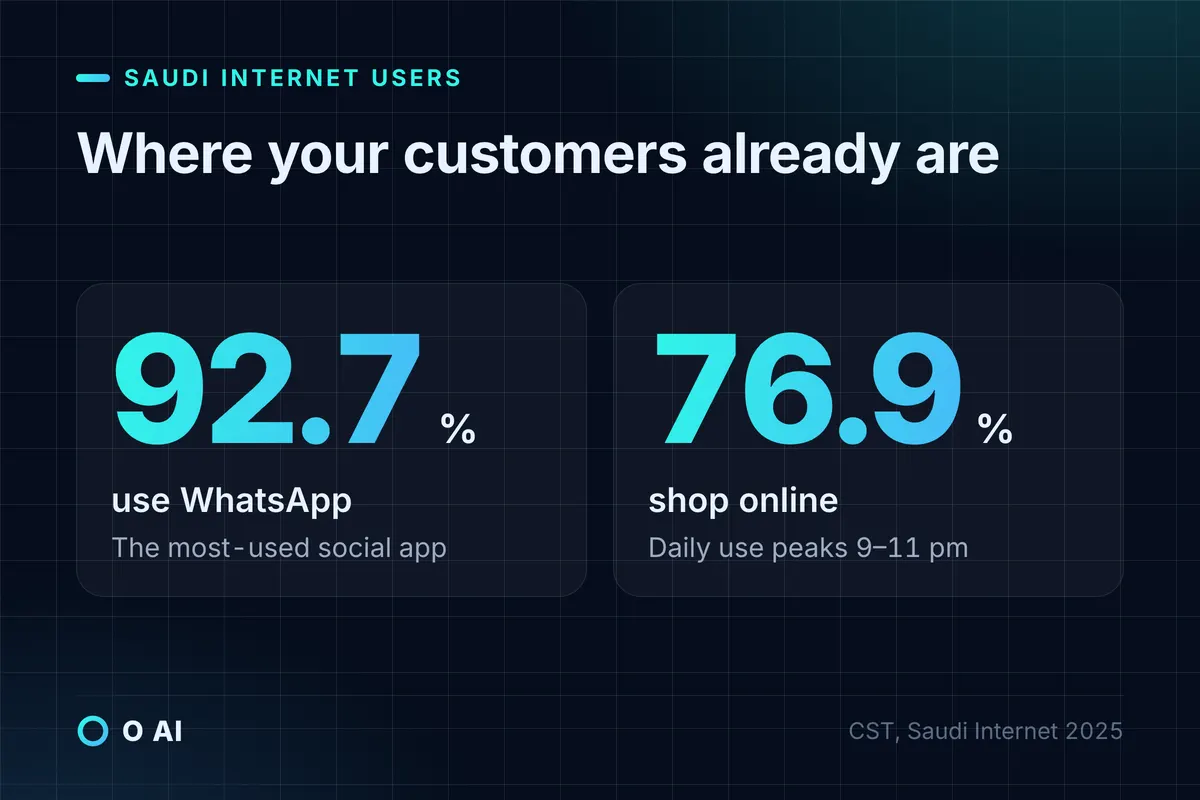
- In CST's Saudi Internet 2025 report, WhatsApp topped social apps at 92.7% and daily internet use peaked between 9 and 11 pm, so cover evenings.
- Track first response time, resolution time and CSAT weekly, first-contact resolution monthly and NPS quarterly, plus the reason for every contact.
- The E-Commerce Law requires online sellers to publish contact details and to tell customers about expected delays that materially affect delivery.
- Let AI answer frequent, written-down questions, say it is automated, and hand complaints, refunds and sensitive cases to a named person.
- Under the PDPL, offers sent to a customer's own number or email need consent and a free, easy way to stop.
On this page
- What customer service has to cover in a small business
- Which customer service channels should a small business offer?
- A service promise you can keep: hours, response times and owners
- Customer service metrics that matter for a small team
- Handling customer complaints: a five-step routine
- Customer service automation with AI: what to hand over and what to keep
- Customer data: what the PDPL expects from your service team
- A 30-day plan to set up customer service
- Your next step
Good customer service for small businesses comes down to three decisions. Answer on the two or three channels your customers already use. Publish response times you can keep, and measure them every week. Let AI take only the repeat questions, while a named person owns complaints, refunds and anything sensitive.
This guide is written for shops, clinics, online stores and service firms in Saudi Arabia with one to twenty people handling customers. It covers which channels to open, the service promise to publish, the few metrics worth tracking, how to handle complaints, where AI helps, and the customer-data rules your team should know. The rules described here were checked on official sources on 14 October 2026.
What customer service has to cover in a small business
Customer service is everything that happens when a customer asks, waits or complains: before the sale (questions, prices, availability), during it (orders, bookings, payment) and after it (delivery, returns, faults). A small business rarely loses customers on price alone; it loses them when a message goes unanswered or a problem bounces between staff.
Some of this is already a legal duty for anyone selling online. Saudi Arabia's E-Commerce Law requires a service provider to show its contact details on its online store, and its commercial registration name and number where it has one [1]. It gives consumers the right to cancel within seven days of receiving a product, with listed exceptions, and the right to cancel if delivery is more than 15 days late unless another date was agreed. It also requires the seller to tell the customer about any expected delay that materially affects delivery [1].
Those three rules alone shape a service desk: a reachable contact channel, a clear returns answer, and proactive delay messages. Everything below builds on them.
Which customer service channels should a small business offer?
Offer fewer channels and answer them well. Customers in Saudi Arabia are already on their phones: in CST's Saudi Internet 2025 report, 99.6% of internet users went online by mobile phone, WhatsApp topped the list of most-used social media apps at 92.7%, followed by Snapchat at 83.6% and TikTok at 77%, and 76.9% of users shopped online [2]. The same report puts the daily peak of internet use between 9 pm and 11 pm, with Friday as the busiest day [2].
| Channel | Best for | Realistic first-reply target | Watch out for |
|---|---|---|---|
| Order questions, delivery updates, photos of a fault | Under 1 hour in working hours | On the WhatsApp Business Platform, free-form replies are possible only inside the 24-hour window after the customer's last message [3] | |
| Phone | Urgent problems, complex complaints, customers who prefer to talk | Answer live, or call back the same day | Log every call; publish one company number, not staff mobiles |
| Invoices, returns with documents, business customers | Same working day | One shared inbox with a named owner for each thread | |
| Google reviews | Public feedback after a visit or purchase | Within 2 working days | Replies are public and appear as the business, not as the employee [4] |
| Instagram, Snapchat or TikTok messages | Questions from people who saw a post or an ad | Same day | Move order problems to one tracked channel |
A workable default for most small businesses is WhatsApp plus phone, with email for documents and Google reviews watched weekly. Add a channel only when someone is assigned to it every day, including the evening peak and the weekend.
A service promise you can keep: hours, response times and owners
Customers forgive a slow answer they were told to expect; they do not forgive silence. Write a short service promise, publish it on your website, your WhatsApp profile and your receipts, and design staff shifts around it. WhatsApp's own business policy asks companies to keep customer support contact information on their WhatsApp Business profile [5].
Illustrative example. A service promise for a small online store:
| Priority | Examples | First reply | Resolved within | Owner |
|---|---|---|---|---|
| Urgent | Paid twice, order past its promised date, damaged item | 1 working hour | Next working day | Store manager |
| Standard | Product question, delivery status, exchange request | 4 working hours | 2 working days | Service staff |
| Low | Suggestions, partnership offers | 2 working days | As needed | Owner or manager |
Three details make the promise real. First, state your working hours in the auto-reply, including Friday and evenings, since that is when traffic peaks [2]. Second, give every conversation one owner, so nobody assumes a colleague replied. Third, keep a set of saved replies in Arabic and English for the ten most common questions, written once and checked for accuracy.

Customer service metrics that matter for a small team
You do not need a dashboard of thirty numbers. Five customer service metrics tell a small business almost everything, and most can be counted from a shared inbox or a spreadsheet.
| Metric | How to calculate it | What it tells you | Review |
|---|---|---|---|
| First response time | Time from the customer's first message to your first human reply; use the median | Whether the service promise holds | Weekly |
| Resolution time | Time from first message to the issue being closed | Whether problems get stuck between staff | Weekly |
| First-contact resolution | Share of conversations solved in the first exchange | Quality of saved replies and staff knowledge | Monthly |
| Customer satisfaction (CSAT) | Share of customers who rate the conversation 4 or 5 out of 5 | How the last interaction felt | Weekly |
| Net Promoter Score (NPS) | Percentage of promoters (9–10) minus percentage of detractors (0–6) on "How likely are you to recommend us?" [6] | Loyalty over time, not one conversation | Quarterly |
Add one more count that costs nothing: the reason for each contact. Tag every conversation with a short reason ("where is my order", "exchange", "price", "fault"), because the top reason usually points to a fix outside the service desk.
Illustrative example: one week at a home-fragrance store in Riyadh
Illustrative example. A store with an online shop and two service staff handled 180 conversations in one week. The median first response was 25 minutes in working hours but 9 hours for messages sent after closing. First-contact resolution was 62%, and 33 of 40 customers who answered the rating question gave 4 or 5, a CSAT of 82.5%. Seventy conversations, 39% of the total, were "where is my order".
The fix was not a faster team. The store started sending a tracking link on dispatch and a short message whenever a courier delay appeared, as the E-Commerce Law already expects for material delays [1]. Repeat order-status questions fell, and staff time moved to complaints and pre-sale questions.
Handling customer complaints: a five-step routine
Complaints are where small businesses win or lose reputation, so they should never be handled by an automated reply alone.
- Acknowledge within the promised time. Thank the customer, restate the problem in one sentence and say when they will hear back.
- Log it. Give the complaint a reference number, the order number and an owner. A complaint without an owner is the one that becomes a public review.
- Resolve or offer options. Refund, replace, repair or explain clearly why not, citing your published returns policy. If the customer is within a legal cancellation right, such as the seven days for many online purchases, apply it without argument [1].
- Close and confirm. Send a short summary of what was agreed and ask the satisfaction question.
- Review weekly. Read every complaint reason in one sitting and fix the cause: a product description, a courier, a step on the website.
Reply to public Google reviews as part of the same routine. Google states that replies are shown publicly under the review, the reviewer is notified, and they can still change their review afterwards [4]. Answer the facts politely, offer to continue privately on your service number, and never share order details in public.
When a customer is still unhappy, they can escalate to the Ministry of Commerce. Our consumer guide Dalni (an O AI product) explains how consumers file a commercial complaint; reading it from the customer's side shows what your own process must prevent.
Customer service automation with AI: what to hand over and what to keep
AI is useful for customer service automation when the question is frequent, the answer is written down, and a wrong answer is cheap to correct. Sort each question type into one of three lanes before you switch anything on.
| Lane | Typical questions | Who acts |
|---|---|---|
| AI answers | Opening hours, delivery areas, order status read from your system, returns policy wording, branch locations | The assistant, with a visible option to reach a person |
| AI drafts, staff send | Delay apologies, exchange options, quotes for business customers | The assistant prepares; an employee checks and sends |
| Person only | Complaints, refunds, double charges, health or legal questions, angry customers, anything that depends on identity | A named employee from the first message |
SDAIA's generative AI guidelines for the public advise clearly telling people when AI is used in an interaction and offering a non-automated channel for those who prefer a human [7]. WhatsApp's business policy also requires "prompt, clear, and direct escalation paths" to a person when a business automates conversations [5]. In practice: name the assistant as automated in its first message, let the customer type "agent" at any point, and pass the conversation to staff with a short summary so the customer does not repeat themselves.
Measure the assistant like a new employee: the share of answers checked and found wrong (target zero), how long a handover takes, and the CSAT of automated conversations compared with staffed ones. If you plan to run it on WhatsApp, our guide to a WhatsApp chatbot for business covers what it should answer, what Meta charges and the data checks in more depth.

Customer data: what the PDPL expects from your service team
Every service conversation contains personal data: names, numbers, addresses, sometimes photos or payment issues. Saudi Arabia's Personal Data Protection Law applies to it. This section is general information; for a specific case, check SDAIA's guidance or ask a licensed advisor.
- Publish a privacy policy and make it available to customers when you collect their data, covering the purpose, what you collect, how you keep and destroy it and how customers exercise their rights (Article 12) [8].
- Collect the minimum. The law limits personal data to what the purpose needs (Article 11) [8]. A delivery question needs an order number, not a national ID.
- Delete when done. Data must be destroyed without delay once the purpose ends, unless a law requires keeping it (Article 18) [8]. The E-Commerce Law likewise bars online sellers from keeping consumers' data longer than the transaction requires [1]. Set a retention period for chat logs and call recordings.
- Answer data requests on time. The Implementing Regulation gives a controller up to 30 days to act on a customer's request about their rights, extendable once by up to 30 more days with notice and reasons (Article 3) [9].
- Keep service and marketing apart. Sending advertising through a person's own contact details needs their consent and a clear way to stop (Article 25) [8]. The Implementing Regulation adds that consent is required where there was no prior interaction, must be documented, the sender must be named, and stopping must be free and as easy as signing up (Article 28) [9].
Two points to watch. SDAIA put draft amendments to the Implementing Regulation out for public consultation until 5 November 2026 [10], so check the final text once it is published. And customers can report disturbing calls or text messages to CST, including by forwarding a message to 330330 [11], which is a good reason never to send offers from a service number to people who did not agree to them.
A 30-day plan to set up customer service
| Week | What to do | Done when |
|---|---|---|
| 1 | Choose two or three channels, one company number and one shared inbox | Every channel has a named owner and published hours |
| 2 | Write the service promise and ten saved replies in Arabic and English | Staff use the same answers for the same questions |
| 3 | Start logging: reason, first response, resolution, rating | A simple sheet or help-desk tool shows last week's numbers |
| 4 | Review the numbers, fix the top contact reason, decide what AI could answer | One improvement is live and the next is planned |
Keep the first month manual on purpose. Automating before you know your top contact reasons usually automates the wrong thing.
Your next step
This week, export one month of WhatsApp and email conversations and tag each with a reason. The top three reasons tell you which saved replies to write, which customer service metrics to watch first and which questions are safe for AI. If you want to test AI on one of those tasks, our guide on how AI can help your business shows how to run a two-week trial before you spend. Customer service for small businesses improves fastest when one person owns the numbers and reviews them every week.
Frequently asked questions
What are the main customer service channels for a small business?
For most small businesses in Saudi Arabia, WhatsApp and the phone cover the majority of customer contact, with email for invoices and documents and Google reviews for public feedback. Social media messages matter if you advertise there, but move order problems to one tracked channel. Open only the channels you can staff every day, including evenings and weekends, and publish one company number rather than employees' personal mobiles.
How fast should a small business reply to customers?
There is no single legal response time for general customer messages, so set your own and publish it. A practical target is under one hour on WhatsApp during working hours, the same working day for email, and one working hour for urgent problems such as double charges. What matters most is keeping the promise: an auto-reply that states your hours and the next reply time prevents most frustration.
Which customer service metrics should a small business track first?
Start with first response time, resolution time and customer satisfaction, all reviewed weekly. Add the reason for each contact, because the most common reason often reveals a fix outside the service team, such as sending tracking links. First-contact resolution is worth a monthly look, and Net Promoter Score is better measured quarterly since it reflects loyalty over time rather than a single conversation.
Can AI replace customer service staff in a small business?
Not fully. AI handles frequent, written-down questions well: opening hours, delivery areas, order status and policy wording. Complaints, refunds, payment problems and anything sensitive should stay with a person. Saudi guidance from SDAIA advises telling customers when they are talking to AI and offering a human alternative, and WhatsApp requires clear escalation to a person. Treat AI as a first responder that hands over quickly.
Do I need customers' consent to send them offers on WhatsApp or SMS?
Generally yes. The Personal Data Protection Law requires consent and an easy way to stop before you send advertising to a person's own contact details, and the Implementing Regulation asks you to document that consent and name yourself as the sender. Replies to a customer's own question are a different matter from offers. Draft amendments were under consultation in October 2026, so check SDAIA's final text or ask an advisor for your case.
How should I reply to a negative Google review?
Reply within a few working days, thank the customer, address the specific problem in plain words and invite them to continue on your service number. Keep order numbers, names and other personal details out of the public reply. Your reply appears under the review as the business, and the customer can still update their review afterwards, so a calm, helpful answer and a real fix often matter more than the original complaint.
What is the difference between CSAT and NPS?
CSAT measures how satisfied a customer was with one interaction, usually on a 1 to 5 scale right after the conversation. NPS asks how likely the customer is to recommend your business on a 0 to 10 scale, then subtracts the percentage of detractors from the percentage of promoters. Use CSAT weekly to improve service conversations and NPS a few times a year to track loyalty.
How this article was made: Researched from the sources listed below, opened on 14 October 2026. Drafted with AI assistance, then checked against those sources. General information, not professional advice. Images are AI-generated illustrations.
Sources
- E-Commerce Law (in Arabic) (opens in a new tab)Bureau of Experts at the Council of Ministers · laws.boe.gov.sa
- Saudi Internet 2025 (opens in a new tab)Communications, Space and Technology Commission (CST) · cst.gov.sa
- Pricing on the WhatsApp Business Platform (opens in a new tab)Meta for Developers · developers.facebook.com
- Manage customer reviews (opens in a new tab)Google Business Profile Help · support.google.com
- WhatsApp Business Messaging Policy (opens in a new tab)WhatsApp for Business · whatsappbusiness.com
- Measuring your Net Promoter Score (opens in a new tab)Bain & Company · netpromotersystem.com
- Generative Artificial Intelligence Guidelines for Public (2025) (opens in a new tab)Saudi Data and AI Authority (SDAIA) · sdaia.gov.sa
- Personal Data Protection Law, with amendments (in Arabic) (opens in a new tab)Bureau of Experts at the Council of Ministers · laws.boe.gov.sa
- Implementing Regulation of the Personal Data Protection Law (opens in a new tab)Saudi Data and AI Authority (SDAIA) · sdaia.gov.sa
- 40 projects put to public consultation on the Istitlaa platform (8 October 2026, in Arabic) (opens in a new tab)Umm Al-Qura · uqn.gov.sa
- Spam Reports (opens in a new tab)Communications, Space and Technology Commission (CST) · cst.gov.sa
About the author