 AI
AILegal memo drafting with AI: a checklist for defence and reply memos, and the review before filing
Draft from the case file, raise the formal pleas first and together, delete any admission the client has not approved, and trace every article to its current Arabic text. This guide gives a case sheet, a memo checklist tied to the Saudi texts, a trace table and a six-pass review.

Key takeaways
- Brief the drafter, person or AI, with a case sheet: the claim as filed, facts with their exhibits, the client's written instructions and the pleas the lawyer chose.
- Raise nullity, territorial-jurisdiction and referral pleas together and before any request or defence, or they are lost (Law of Procedure before Sharia Courts, Art. 75).
- A concession in a memo can count as a judicial admission, which binds and cannot be withdrawn. Delete any the client has not approved in writing.
- File evidence with the first defence memo unless the court allows otherwise, each document with a note on what it is and what it proves.
- Before filing, run six passes (facts, requests and admissions, pleas, citations, evidence, language and form) and trace every article to its current Arabic text. A licensed lawyer signs last.
On this page
- Where legal memo drafting with AI fits in a Saudi court
- Before you prompt: the case sheet
- Drafting a defence memo, section by section
- Drafting a reply memo: answer what is new
- How to check AI citations in a memo: the trace table
- The review before filing: six passes
- A worked example: what the review caught
- Before your next filing
Legal memo drafting with AI works when the tool drafts only from your case file and a licensed lawyer checks every fact, admission, plea and cited article before the memo is filed. In Saudi courts that check carries extra weight: cases are now heard and pleaded in writing, so the memo is the pleading.
The rules cited are Saudi, but the method works in any court: brief the drafter from the file, trace every statement, have a second lawyer review. If your question is how to write a legal memo for internal research, skip the section checklist; the rest applies.
This article is general information, not legal advice. Check your firm's obligations against the current text of the law and its implementing regulations. It gives no sample memo text: every memo is built from its own file.
Where legal memo drafting with AI fits in a Saudi court
In Saudi practice a memo (مذكرة) is a written pleading filed with the court. Since Royal Decree M/78 of 22 April 2021 amended Article 65 of the Law of Procedure before Sharia Courts (the Kingdom's main civil procedure law, in English the Law of Civil Procedure), proceedings and pleading are in writing, though the court may also hear the parties orally [1].
Memos are exchanged through Najiz, the Ministry of Justice's e-services platform, in the number and at the times the circuit (the judge or panel hearing the case) sets [2]; see Najiz remote hearings and your firm's e-litigation work.
The first defence memo has a deadline. It is the statement of defence in the Bureau of Experts' English translation of Article 45 [11]. Except in urgent cases and cases with a shortened period to appear, the defendant deposits it at least three days before the hearing in the general court (the court of general jurisdiction) and one day before in other courts (Article 45) [1].
In the commercial courts it is due one day before and must contain the answer to the claim, all pleas, requests and grounds (Commercial Courts Law, Article 22(2)) [3]; the answer must be explicit and meet the claim (Regulation Article 81) [4]. Najiz's "First defence memo request" service (طلب مذكرة الدفاع الأولى) lets the defendant or its agent file it online before the first hearing [5].
Where AI fits. It can draft from the file, prepare a working English version for a client abroad (the court works in Arabic, Article 23 [1]), and list the new points in the other side's memo. It should not choose the defence, decide what to concede, or confirm that an article is in force; see where AI helps and stops in Saudi law practice.
This guide covers memos under that law and in the commercial courts, where it applies wherever the Commercial Courts Law has no specific text (Article 93) [3]. Criminal and administrative cases are out of scope, and objection (appeal) memos have their own rules: see the appeal deadline in Saudi Arabia.
Before you prompt: the case sheet
SDAIA, the Saudi Data & AI Authority, warns that generative models "can even over-confidently generate 'facts' that are complete fiction", and makes verifying the output the user's responsibility [6, §5.3]. A one-page case sheet, filled in before drafting, keeps the draft inside the file and gives the reviewer a reference.
| Field | What to write | Why |
|---|---|---|
| Court, circuit, case number, hearing date, memo type | First defence memo, reply or supplementary | Deadlines and contents differ [1, Art. 45; 3, Art. 22(2)] |
| The claim as filed | The claimant's requests, copied from the statement of claim | The answer must be explicit and meet the claim [4, Art. 81] |
| Facts | Only facts in the file, each with its exhibit number | What the file does not support stays out |
| Client's written instructions | What to deny, what may be accepted, what must never be conceded | A concession can be a judicial admission (see Admissions) |
| Pleas chosen by the lawyer | Formal pleas and the defence on the merits, in order | The defence is the lawyer's decision |
| Evidence | Each document, what it proves, its language | Due with the first defence memo |
| Articles relied on | Law, article, link to the current Arabic text | Feeds the trace table |
| Keep out of the tool | Client identifiers and privileged material the tool is not approved for | Law of Legal Practice, Art. 23 [7]; SDAIA §5.4 [6] |
For the last row, use only tools your firm has approved for client material; if one processes data outside the Kingdom, see what Saudi Arabia's Personal Data Protection Law (PDPL) asks when AI tools run abroad.

Drafting a defence memo, section by section
Here is the legal memo checklist for a defence memo, in filing order. The law fixes only row 2's place: those pleas come together, before any request, defence or plea of inadmissibility (Article 75; Regulation 75/1) [1][8]. The rest is common practice. A persuasive draft may open with the merits, so check row 2 first.
| # | Section | What it must do | Rule |
|---|---|---|---|
| 1 | Heading | Court, circuit, case number, parties as in their ID or commercial registration, memo type, hearing date | Firm practice |
| 2 | Pleas that must come first | Nullity of the statement of claim, lack of territorial jurisdiction, referral to another court: together, before any request or defence | Art. 75 [1]; Reg. 75/1 [8]; commercial courts: Reg. Art. 33 [4] |
| 3 | Pleas allowed at any stage | Lack of jurisdiction (mandate, type or value); inadmissibility for lack of standing, capacity or interest; matter already decided | Art. 76 [1] |
| 4 | Answer to the claim | Each of the claimant's requests in turn, answered explicitly, with reason and exhibit | Commercial Reg. Art. 81 [4] |
| 5 | Incidental requests | Set-off, compensation for harm from the claim and other Article 84 items, by one of Article 82's two routes (notified statement, or orally at the hearing) before pleading closes | Arts. 82, 84 [1] |
| 6 | Requests (الطلبات) | Exactly what the client instructed in writing | Case sheet |
| 7 | Grounds | Each law named, each article numbered, every one in the trace table | Trace table |
| 8 | Evidence and annexes | Each document attached once, numbered and described; certified Arabic translation if foreign | Evidence Guides Arts. 15(1), 16 [9]; Art. 23 [1] |
| 9 | Date and signature | Dated and signed by the filer | Reg. 65/1 [8] |
Row 2: the formal pleas. Raised late or left out, they are lost (Article 75) [1]. All are also lost if the defendant, or its agent in the same case, is notified of the hearing and does not attend (Regulation 75/6) [8]. In the commercial courts, the territorial plea is lost once the party makes any request, defence or plea of inadmissibility at any stage, including case preparation (Regulation Article 33, our translation) [4], so check that stage before drafting.
Row 8: evidence. Evidence is due "when filing the claim or submitting the first defence memo", unless the court allows another time, each piece with a note on its type, details, relevance and effect (Procedural Guides of the Law of Evidence, Articles 15(1) and 16, our translation) [9]. Attach what the memo refers to, never the same document twice [2].
For a foreign company, documents from outside the Kingdom must be authenticated and translated into Arabic (Regulation 23/1) [8]. Ask your Saudi counsel which authentication route applies to your country, and start when the claim arrives.
Admissions: one smooth sentence can concede a fact
The rules on judicial admission cover "the requests or memos filed in the case" (Evidence Guides, Article 29(1), our translation) [9]. An admission may be explicit or implied, spoken or written; a judicial admission is conclusive proof against its maker, who is bound by it and may not withdraw it (Law of Evidence, Articles 16(1), 17 and 18(1)) [10].
Unless the power of attorney specifically authorises it, an agent may not admit the right claimed, waive or settle when the client is not present (Article 51) [1].
Read the draft once for concessions alone. A tidy sentence like "the defendant does not dispute receiving the goods" can concede a fact the client contests. Delete it, or reword it within the client's written instructions.
Drafting a reply memo: answer what is new
Saudi practice uses «مذكرة جوابية» (reply memo) and «مذكرة رد» (response memo) loosely. Here, a reply memo is your answer to the other side's latest memo.
- Answer each new point in the other side's latest memo, in its order, and refer back to your earlier memo instead of repeating it.
- Quote the other side from their filed memo, never from an AI summary: a paraphrase in quotation marks misstates your opponent. Check every quotation and page reference against the filed text.
- New documents from the other side: answer them, or ask for time. The court must give the parties suitable time to review documents when the case requires it (Article 65(2)) [1].
- Keep to the number and timing of memos the circuit has set [2], and run the same admission check as on a first memo.
- Supplementary memos in commercial courts: only if the court allows them at the close of pleading, "to clarify and complete what was already submitted" (Commercial Courts Law, Article 58(2), our translation) [3]: one memo per party, within a court-set period of up to ten days, with no new requests, evidence or documents (Regulation Article 163) [4].
How to check AI citations in a memo: the trace table
To check AI citations in a memo, open each cited article in its current Arabic text on the official site, read the amendments under it, confirm it says what the sentence claims, and record the check in a trace table. Fill it in while drafting, one row per legal or factual statement. Three illustrative rows:
| # | Statement in the memo | Source (exhibit, or law and article) | Current text opened (link, date) | Checked by |
|---|---|---|---|---|
| 1 | Defence memo due at least one day before the hearing | Commercial Courts Law, Art. 22(2) | laws.boe.gov.sa, [date] | [initials] |
| 2 | Formal pleas raised together | Procedure law regulations, 75/1 | laws.moj.gov.sa, [date] | [initials] |
| 3 | Date the goods were received | Exhibit 2, delivery note | Case file | [initials] |
- Open the Arabic text on the official site: laws.boe.gov.sa (the Bureau of Experts at the Council of Ministers, for laws) or laws.moj.gov.sa (the Ministry of Justice portal, for regulations and guides). On an amended article, open «تعديلات المادة» (amendments to the article).
- Watch for outdated text on the official site. The text printed under an amended article can still be the original. Under Article 65 of the procedure law, laws.boe.gov.sa still prints that pleading is oral (تكون المرافعة شفهية); the written-pleading amendment appears only under «تعديلات المادة» [1]. The English translation, a PDF created on 28 August 2021, still reads "Arguments shall be oral" [11]. Cite either, and the memo misstates how the court is hearing your case.
- Judgments: list on the case sheet only those a lawyer has opened in a published source; delete any other judgment the draft cites.
- Filing rule: every row needs a source and initials. If a row is still empty on filing day, delete the sentence it supports.
The review before filing: six passes
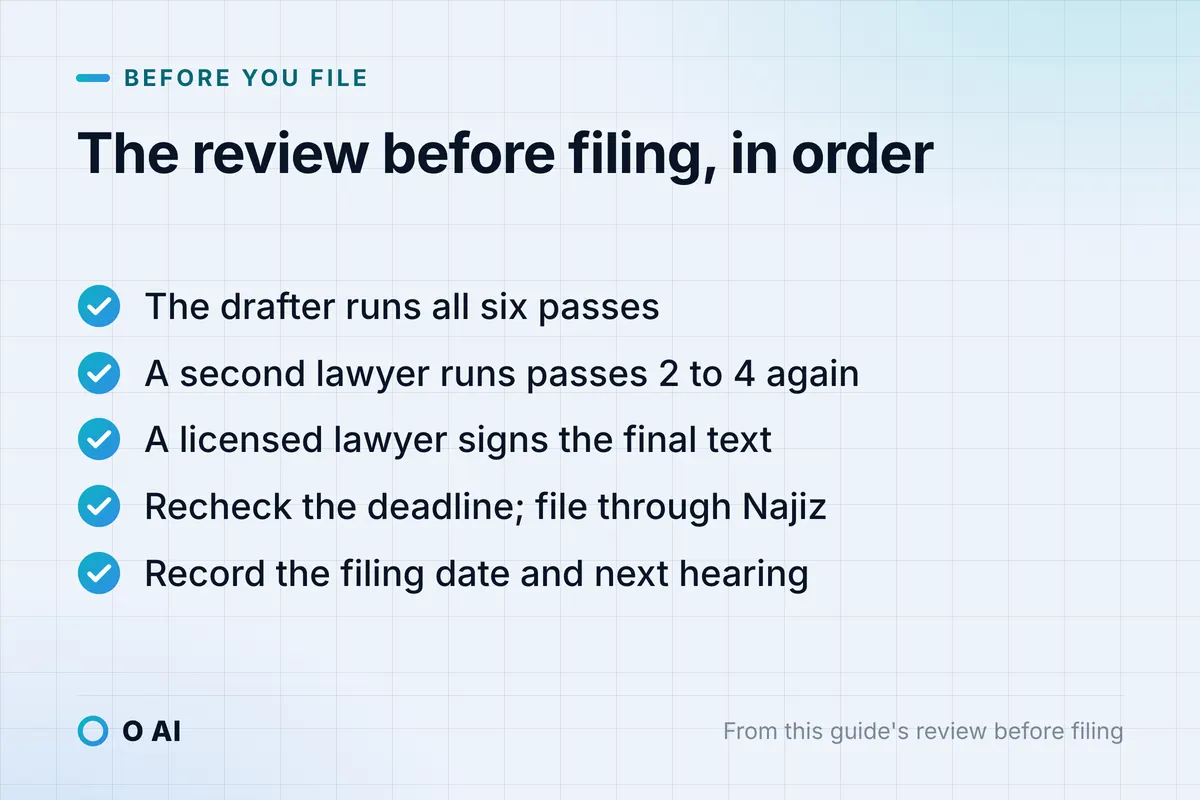
The drafter runs all six and fills in the trace table; a second lawyer re-runs passes 2 to 4 on the final text; a licensed lawyer signs.
| Pass | Ask | Check against |
|---|---|---|
| 1. Facts | Is every fact, date, amount and name in the file, with its exhibit? | The case file, not the prompt or the draft |
| 2. Requests and admissions | Do the requests match the instructions? Is anything conceded without the client's written approval? | Case sheet; power of attorney [1, Art. 51] |
| 3. Pleas | Are the Article 75 pleas first and together? Is any plea on the case sheet missing? | Checklist rows 2–3 [1][8] |
| 4. Citations | Does every legal statement have a trace-table row, opened in its current Arabic text? | Trace table |
| 5. Evidence | Is every document referred to attached once, numbered, described, and translated if foreign? | Annex list [9][2]; Art. 23 [1] |
| 6. Language and form | Arabic throughout; no personal attacks; no tool residue such as English fragments, "as an AI" or placeholders; dated and signed | Law of Legal Practice, Art. 12 [7]; Reg. 65/1, 65/2 [8] |
For pass 1, compare anything taken from a scanned exhibit with the scan itself; Arabic OCR can misread digits, dates and names.
Pass 6 matters because a tool asked for "strong" wording can overshoot into personal attacks, which the Law of Legal Practice forbids and the circuit may strike out [7][8].
Then recheck the deadline, file through Najiz [5], and record the filing date and next hearing where the team sees them. For a memo, these six passes replace the ten checks in our guide to AI in Saudi law practice; keep its checks on numbers and deadlines too.
If you also appear before the DIFC Courts or the Qatar International Court
These rules apply outside the Kingdom. The DIFC Courts' Practical Guidance Note No. 2 of 2023 asks parties to verify AI output through "independent sources such as case law, statutes and credible legal commentary" and to "declare at the earliest possible opportunity" any use of it [12].
The Qatar International Court (also called the QFC Court) announced on 6 January 2026 that its Practice Direction No. 1 of 2026 keeps lawyers "fully responsible for the accuracy, validity, and integrity" of submissions. Advance disclosure is not required unless the court asks, but on request lawyers must identify the AI-assisted parts and explain how they verified them [13].
For Saudi courts, we did not find a court rule or Saudi Bar Association guidance on AI-drafted memos (checked 29 September 2026).
This article is general information, not legal advice. Check your firm's obligations against the current text of the law and its implementing regulations.
A worked example: what the review caught
An invented case, for illustration only. A company is sued in a commercial court over unpaid invoices for a delivery it says was short; an associate drafts the first defence memo with an AI tool from a case sheet. The review finds six problems:
| Pass | What the review found | Fix |
|---|---|---|
| 1. Facts | Delivery date 3 March; the delivery note (Exhibit 2) says 13 March | Corrected from the exhibit |
| 2. Admissions | "The defendant will settle the balance once inspection is complete"; the client denies owing anything | Deleted: it implies an admission, which in a memo is judicial [9][10] |
| 3. Pleas | Territorial-jurisdiction plea on page 4, after the merits | Moved to the top with any other Article 75 plea [1][8]; nothing had been argued at case preparation [4, Art. 33] |
| 4. Citations | "Under Article 65, pleading is oral", from the English translation | Replaced from the amended Arabic text [1][11] |
| 5. Evidence | "Inspection report (Annex 5)" cited, not attached; other annexes undescribed | Attached; every annex numbered and described [9] |
| 6. Language and form | A sentence calling the claimant's lawyer dishonest | Removed [7][8] |
The lawyer signs once the trace table has no empty cells.
Before your next filing
- Turn the case sheet into a one-page template, and use it for your firm's next defence memo.
- Start a trace table for that memo, and fill it in while drafting.
- Ask a second lawyer to re-run passes 2 to 4 on the final text before filing.
Rushd is the practice-management platform that O AI, a Saudi AI and software company in Al Khobar, builds for law firms. Describe the matter and pick a document type, and Rushd produces a structured first draft of a contract, agreement or memorandum in Arabic, English or both, grounded in Saudi statutes and your firm's templates.
You edit, accept or regenerate it clause by clause, and the licensed lawyer reviews and approves. Customer content is not used to train AI models without the firm's explicit consent; AI requests may be processed by the AI provider outside the Kingdom. Rushd is not connected to Najiz, does not file memos and does not give legal advice.
Frequently asked questions
Is the first defence memo mandatory in Saudi courts?
Except in urgent cases and cases where the period to appear was shortened, the law requires the defendant to deposit a defence memo before the hearing: at least three days ahead in the general court (the court of general jurisdiction) and one day in other courts (Law of Procedure before Sharia Courts, Article 45), and one day in the commercial courts, with all pleas, requests and grounds (Commercial Courts Law, Article 22(2)). Those articles state no penalty of their own, but other rules turn on the memo: formal pleas not raised first are lost (Article 75), evidence is due with it unless the court allows another time (Procedural Guides of the Law of Evidence, Article 15), and if the defendant files one and then does not attend, the judgment is treated as made in its presence, not in absentia (Article 57). This is general information, not legal advice.
What is the difference between a defence memo and a reply memo?
The defence memo is the defendant's first written answer to the claim, with all pleas, requests, grounds and evidence. Later memos answer what the other side has newly said or filed, within the number and timing the circuit sets (Ministry of Justice e-litigation procedural guide). Saudi practice uses «مذكرة جوابية» and «مذكرة رد» loosely, so judge a memo by its job rather than its label. A reply memo should not re-argue everything, and in the commercial courts supplementary memos, when the court allows them, clarify and complete what was already submitted, with no new requests, evidence or documents (Commercial Courts Law, Article 58(2); its Implementing Regulation, Article 163).
Can I amend the first defence memo after filing it?
Treat a filed memo as final. Anything it concedes can count as a judicial admission, which binds and cannot be withdrawn (Procedural Guides of the Law of Evidence, Article 29; Law of Evidence, Articles 17–18), and formal pleas left out of it are lost (Law of Procedure before Sharia Courts, Article 75). Article 51 of that law limits what an agent may admit without special authority, but do not rely on it to undo a concession. Further points go in a later memo when the circuit allows one. For what the Najiz service itself allows after filing, call 1950, the Ministry of Justice line (التواصل العدلي) listed on najiz.sa.
Can an AI tool draft a memo that I file in a Saudi court?
We did not find a Saudi rule that forbids it (checked 29 September 2026). But the memo speaks for the client, and the lawyer who signs answers for every sentence. A concession in it can be a judicial admission (Procedural Guides of the Law of Evidence, Article 29), and a formal plea placed after the merits is lost (Law of Procedure before Sharia Courts, Article 75). So let the tool draft from a case sheet, and keep three decisions with the lawyer: what to concede, which pleas to raise, and whether each article is current. Use a tool your firm has approved for client material (Law of Legal Practice, Article 23).
Do I have to tell the court that AI helped draft the memo?
We did not find a Saudi rule requiring it (checked 29 September 2026). Where courts ask, the question is specific: the DIFC Courts expect AI use to be declared at the earliest possible opportunity (Practical Guidance Note No. 2 of 2023), and the Qatar International Court can require lawyers to identify the AI-assisted parts of a submission and explain how they checked them (Practice Direction No. 1 of 2026). For a memo, keep three records that answer this before any court: the case sheet the draft was written from, the trace table showing who checked each row and when, and the reviewing lawyer's sign-off.
How do I file the first defence memo in Najiz?
Through the Najiz e-service "First defence memo request" (طلب مذكرة الدفاع الأولى), which lets the defendant or its agent file the memo online before the first hearing. Check the deadline first: at least three days before the hearing in the general court, and one day before in other courts and in the commercial courts (Law of Procedure before Sharia Courts, Article 45; Commercial Courts Law, Article 22(2)). Attach each document the memo refers to once, numbered and described, and translated into Arabic if it is in another language.
Our company is outside Saudi Arabia. What does the defence memo need from us?
Three things, early. First, written instructions: what to deny, what may be accepted and what must never be conceded; without specific authority in the power of attorney, your Saudi lawyer may not admit the right claimed, waive or settle in your absence (Law of Procedure before Sharia Courts, Article 51). Second, documents: the court works in Arabic, so foreign-language papers need a certified Arabic translation from a licensed office (Article 23), and documents from outside the Kingdom must be authenticated (Implementing Regulations, item 23/1); ask your counsel which route applies to your country. Third, time: in the commercial courts the memo is due at least one day before the hearing (Commercial Courts Law, Article 22(2)).
How this article was made: Researched from the official sources listed below (Bureau of Experts, Ministry of Justice, SDAIA, DIFC Courts, QICDRC), opened on 29 September 2026. Drafted with AI assistance, then checked against those sources. Not reviewed by a lawyer. Images are AI-generated illustrations.
Sources
- Law of Procedure before Sharia Courts (نظام المرافعات الشرعية), Royal Decree M/1 of 22/1/1435H (25 November 2013); official Arabic text with amendments (opens in a new tab)Bureau of Experts at the Council of Ministers · laws.boe.gov.sa
- Procedural Guide for the E-Litigation Service (الدليل الإجرائي لخدمة التقاضي الإلكتروني), Minister of Justice Decision No. 8056 of 5/10/1441H; in Arabic (opens in a new tab)Ministry of Justice, legal portal · laws.moj.gov.sa
- Commercial Courts Law (نظام المحاكم التجارية), Royal Decree M/93 of 15/8/1441H (8 April 2020); official Arabic text (opens in a new tab)Bureau of Experts at the Council of Ministers · laws.boe.gov.sa
- Implementing Regulation of the Commercial Courts Law (اللائحة التنفيذية لنظام المحاكم التجارية), Minister of Justice Decision No. 8344 of 26/10/1441H; in Arabic (opens in a new tab)Ministry of Justice, legal portal · laws.moj.gov.sa
- First defence memo request (طلب مذكرة الدفاع الأولى), e-service page; in Arabic (opens in a new tab)Ministry of Justice, Najiz · najiz.sa
- Generative Artificial Intelligence Guidelines for Public (May 2025) (opens in a new tab)Saudi Data & AI Authority (SDAIA) · sdaia.gov.sa
- Law of Legal Practice (نظام المحاماة), Royal Decree M/38 of 28/7/1422H; official Arabic text with amendments (opens in a new tab)Bureau of Experts at the Council of Ministers · laws.boe.gov.sa
- Implementing Regulations of the Law of Procedure before Sharia Courts (اللوائح التنفيذية لنظام المرافعات الشرعية), Minister of Justice Decision No. 39933 of 19/5/1435H, as amended; in Arabic (opens in a new tab)Ministry of Justice, legal portal · laws.moj.gov.sa
- Procedural Guides of the Law of Evidence (الأدلة الإجرائية لنظام الإثبات), Minister of Justice Decision No. 921 of 16/3/1444H; in Arabic (opens in a new tab)Ministry of Justice, legal portal · laws.moj.gov.sa
- Law of Evidence (نظام الإثبات), Royal Decree M/43 of 26/5/1443H (30 December 2021); official Arabic text (opens in a new tab)Bureau of Experts at the Council of Ministers · laws.boe.gov.sa
- Law of Civil Procedure (English translation of the Law of Procedure before Sharia Courts, PDF created August 2021; the Arabic text is the one in force) (opens in a new tab)Bureau of Experts at the Council of Ministers · laws.boe.gov.sa
- Practical Guidance Note No. 2 of 2023: Guidelines on the use of large language models and generative AI in proceedings before the DIFC Courts (21 December 2023) (opens in a new tab)DIFC Courts · difccourts.ae
- QICDRC Issues Practice Direction No. 1 of 2026 and Practice Guidance on the Use of Artificial Intelligence in Court Proceedings (6 January 2026) (opens in a new tab)Qatar International Court and Dispute Resolution Centre (QICDRC) · qicdrc.gov.qa
About the author