 AI
AICybersecurity for companies in Saudi Arabia: what it is, types and first steps
What cybersecurity means under NCA's definition, the main types a company has to cover, which rules apply to government affiliates, CNI operators, large firms and SMEs, the Saudi market in numbers, and a first 90-day plan.


Key takeaways
- NCA defines cybersecurity as protecting networks, IT and OT systems, services and data from unauthorised access, disruption, modification, use or exploitation.
- The ECC binds government agencies, their affiliated companies and private CNI operators; NCA strongly encourages every other entity to use it.
- NCNICC-1:2025 sets 65 essential controls for large private firms and 26 for small and medium ones, binding once NCA notifies the company.
- Any company processing personal data must notify a breach that could harm people within 72 hours under the PDPL Implementing Regulation.
- NCA put the Saudi cybersecurity market at about SAR 16.3 billion in 2025, with more than 22,000 specialists and 69% of spending by the private sector.
On this page
- What is cybersecurity? NCA's definition
- Types of cybersecurity every company should know
- Cybersecurity for companies in Saudi Arabia: who sets the rules
- Which rules apply to your company?
- The Saudi cybersecurity market in numbers
- Your first 90 days: a starting plan
- Free official resources worth bookmarking
- Your next step
Cybersecurity for companies in Saudi Arabia means protecting networks, systems, services and data from unauthorised access, disruption or misuse [1]. The rules come mainly from the National Cybersecurity Authority (NCA), with the Personal Data Protection Law (PDPL) covering personal data. Most companies should start with an owner, an asset list, multi-factor authentication, tested backups and an incident plan.
This guide explains the concept in plain terms, the main types of cybersecurity a company deals with, which Saudi rules apply to which kind of company, and a first 90-day plan. It is general information, not legal advice; for a specific case, check the official text or ask a licensed advisor.
What is cybersecurity? NCA's definition
NCA defines cybersecurity, under its statute issued by Royal Order No. 6801 dated 11/02/1439H, as protecting networks, IT systems, operational technology systems, their hardware and software, the services they provide and the data they hold from any unauthorised penetration, disruption, modification, access, use or exploitation [1]. NCA adds that the concept also covers information security, digital security and the like [1].
NCA's Essential Cybersecurity Controls name three protection goals [1]. In business terms:
- Confidentiality: only the right people see the data. A leaked customer list is a confidentiality failure.
- Integrity: data and systems stay accurate. A supplier's bank details changed in an invoice is an integrity failure.
- Availability: systems work when needed. An online store taken offline by ransomware is an availability failure.
The same document builds on four pillars: strategy, people, process and technology [1]. That is the practical lesson for a company. Buying a security product covers only the technology pillar; without a named owner, trained staff and written procedures, the product protects far less than it could.
Cybersecurity, information security and digital security
The terms overlap, and NCA's definition deliberately includes the other two [1]. In everyday use they differ in emphasis:
| Term | Usual emphasis | Example |
|---|---|---|
| Cybersecurity | Networks, systems, services and data connected to cyberspace | Blocking an intrusion into the company's cloud accounts |
| Information security | Information in any form, including paper and conversations | Locking contract files and shredding old payslips |
| Digital security | Everyday protection of accounts and devices, often for individuals | A strong passphrase and a second sign-in step on a phone |
Types of cybersecurity every company should know
Specialists slice the field in different ways. The most useful split for a company follows what is being protected. The right-hand column shows where each type sits in NCA's Essential Cybersecurity Controls (ECC-2:2024), which group 108 main controls into 4 domains and 28 subdomains [1].
| Type | What it protects | Typical threat | A first control | ECC reference [1] |
|---|---|---|---|---|
| Identity and access security | Accounts, passwords, permissions | Stolen or guessed passwords | Multi-factor authentication, least privilege | 2-2 |
| Network security | Office network, Wi-Fi, internet link | Intrusion, denial of service | Firewall, separate guest Wi-Fi | 2-5 |
| Endpoint and mobile security | Laptops, phones, servers | Malware, lost devices | Anti-malware, encryption, remote wipe | 2-3, 2-6 |
| Email security | Mailboxes and your email domain | Phishing, spoofed senders | Filtering; SPF, DKIM and DMARC | 2-4 |
| Application and web security | Website, online store, apps | Exploited software flaws | Patching, web application firewall, secure coding | 1-6, 2-10, 2-15 |
| Data security and cryptography | Customer, staff and business data | Leaks, tampering | Classification, encryption, backups | 2-7, 2-8, 2-9 |
| Cloud security | Cloud services and hosting | Weak settings, provider risk | Clear contract terms, data return at exit | 4-2 |
| Third-party security | IT and other suppliers | A supplier used as a way in | Security clauses in contracts | 4-1 |
| Monitoring and incident response | Logs, alerts, response plans | Slow detection | Event logs, a tested incident plan | 2-12, 2-13 |
| Physical security | Server rooms, devices, paper records | Theft, unauthorised entry | Access control, secure disposal | 2-14 |
| People and awareness | Staff behaviour | Social engineering | Regular, role-based training | 1-10 |
| Operational technology security | Industrial and building control systems | Disruption of physical processes | Separate networks; NCA's OTCC | Separate controls (OTCC) [6] |
The threat picture explains why several types matter at once. Verizon's 2026 Data Breach Investigations Report finds that 31% of breaches began with the exploitation of a software vulnerability, and that ransomware appeared in 48% of breaches [2]. The first is an application and patching problem; the second often starts with a person, a password or an unpatched system, and quickly becomes a backup question.

Cybersecurity for companies in Saudi Arabia: who sets the rules
Three kinds of authority shape a Saudi company's obligations.
- NCA is the national cybersecurity reference. It develops policies, frameworks, standards, controls and guidelines, and monitors compliance; its statute states that no public, private or other entity is relieved of responsibility for its own cybersecurity [1].
- The Saudi Data and AI Authority (SDAIA) oversees the Personal Data Protection Law (PDPL). A controller must notify the competent authority of a personal data breach [10], within 72 hours of becoming aware of it where the incident could harm the people concerned [11].
- Sector regulators can add their own requirements. NCA's guidance for e-commerce sellers, for example, points to the Saudi Central Bank's (SAMA) Cyber Security Framework for the financial sector [15].
NCA's main documents, and who each is written for:
| Document | Code | Who it is written for |
|---|---|---|
| Essential Cybersecurity Controls | ECC-2:2024 | Government agencies and their affiliated companies and entities, inside and outside the Kingdom, and private entities that own, operate or host critical national infrastructure; NCA strongly encourages all other entities to use it [1] |
| Non-CNI Private Sector Entities Cybersecurity Controls | NCNICC-1:2025 | Large, medium and small private entities outside critical infrastructure that NCA notifies [3] |
| Cloud Cybersecurity Controls | CCC-2:2024 | Cloud providers serving in-scope customers, and government or CNI entities that use or plan to use cloud services [5] |
| Operational Technology Cybersecurity Controls | OTCC-1:2022 | Protection of industrial control systems; an extension of the ECC [6] |
| Data Cybersecurity Controls | DCC-1:2022 | Protecting data throughout its lifecycle; an extension of the ECC [7] |
| Telework Cybersecurity Controls | TCC | Working remotely in a secure way; an extension of the ECC [8] |
| Organisations' Social Media Accounts Cybersecurity Controls | OSMACC | Protecting official social media accounts from theft, misuse and impersonation; an extension of the ECC [9] |
| Guidelines for e-commerce service providers | CGESP-1:2019 | Awareness guidance for small, medium and home-based online sellers [15] |
If you keep personal data in cloud or AI tools abroad, the PDPL's transfer rules apply as well [10]; our guide to data residency in Saudi Arabia explains them.

Which rules apply to your company?
Find the row that describes you. Where two rows apply, both do.
| Your company | What applies | Practical meaning |
|---|---|---|
| A government agency, or a company or entity affiliated with one, inside or outside the Kingdom | ECC-2:2024 is mandatory [1]; CCC-2:2024 for cloud use [5] | A full programme: strategy, an independent cybersecurity function, audits |
| A private company that owns, operates or hosts critical national infrastructure | ECC-2:2024 is mandatory [1]; CCC-2:2024 for cloud use [5]; OTCC for industrial control systems [6] | The same full programme |
| A large private company outside critical infrastructure (more than 250 full-time staff or SAR 200 million in revenue) | NCNICC Category A, 65 essential controls, binding once NCA notifies it [3] | Governance, defence and third-party controls |
| A small or medium private company (6 to 249 staff or SAR 3 million to SAR 200 million in revenue) | NCNICC Category B, 26 essential controls in the defence domain, binding once NCA notifies it [3] | A defined technical baseline: access, email, backups, patching, logs, incidents |
| A micro company (1 to 5 staff and revenue up to SAR 3 million) [4] | Outside both NCNICC categories, but expected to use the controls as appropriate [3] | The same baseline, adopted voluntarily |
| A cloud provider with government or CNI customers | CCC-2:2024 as a provider [5] | Provider-side controls and NCA's implementation guide |
| Any company that processes personal data | The PDPL and its Implementing Regulation [10][11] | A breach routine with a 72-hour notice where harm is likely |
Size bands follow the General Authority for Small and Medium Enterprises (Monsha'at), which takes the higher class when a company's staff and revenue point to different sizes [4]. Contracts can also bring a company into scope indirectly: a government client or a large customer may write ECC or NCNICC requirements into the agreement, so read your contracts before deciding you are exempt.
The Saudi cybersecurity market in numbers
NCA's 2026 report on the sector's economic indicators gives useful context for planning [12]:
- Market size: about SAR 16.3 billion in 2025, with a compound annual growth rate of 10.7% over the previous three years.
- Workforce: more than 22,000 specialists in 2025, with a compound annual growth rate of 5.9%; women make up 33%, against a global average of 22%.
- Who spends: private-sector entities spent SAR 11.2 billion, or 69% of the market, and government entities SAR 5.1 billion, or 31%.
For a company, the figures mean two things. Specialist help is available inside the Kingdom, which matters because some NCA controls require services such as managed security monitoring to be located in Saudi Arabia [1]. And demand is strong, so plan hiring or outsourcing early rather than after an incident.
Your first 90 days: a starting plan
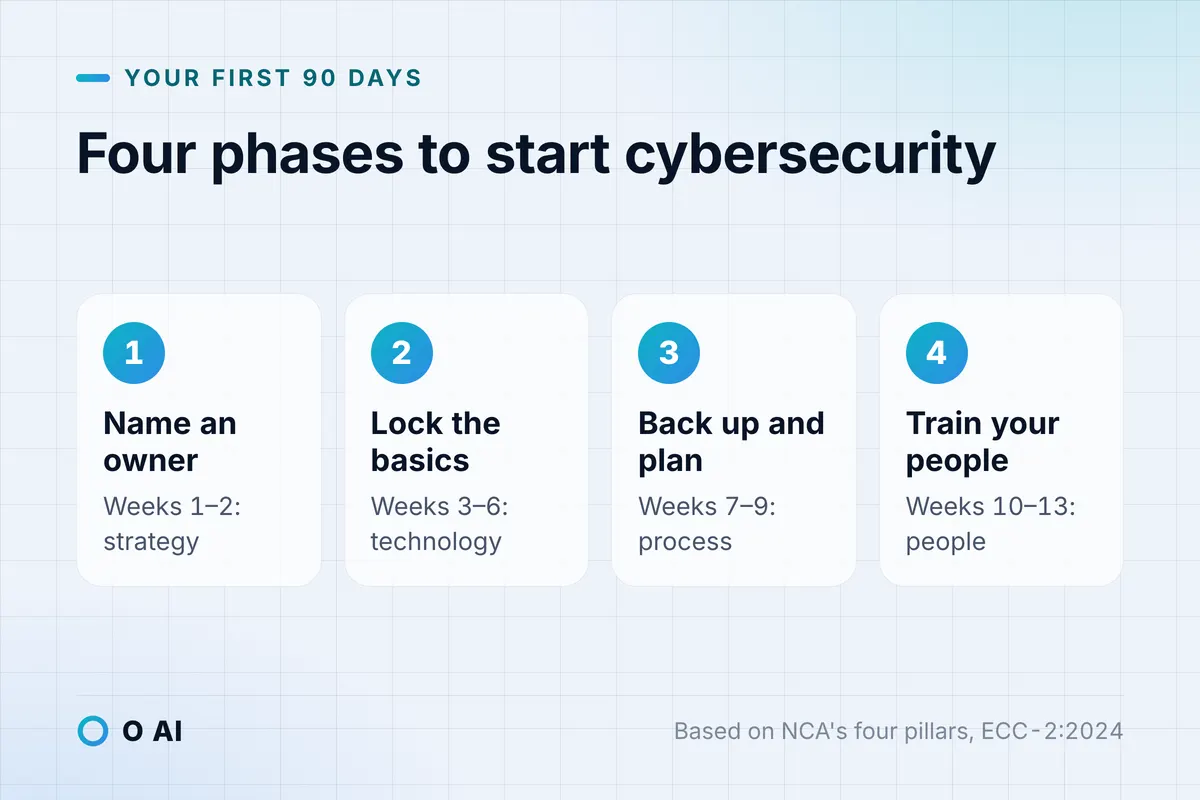
The plan follows NCA's four pillars, so that technology is not the only thing that changes [1]. Each phase builds on the previous one.
| Period | Pillar | What to do |
|---|---|---|
| Weeks 1–2 | Strategy | Name one person accountable for cybersecurity; list the systems, accounts and data that would stop the business if lost; decide which row of the table above describes you |
| Weeks 3–6 | Technology | Turn on multi-factor authentication for email and admin accounts; switch on automatic updates; change default passwords; publish SPF, DKIM and DMARC records |
| Weeks 7–9 | Process | Set up backups for critical systems and test a restore; write a short incident plan with the 72-hour PDPL clock; add security clauses to supplier contracts |
| Weeks 10–13 | People | Run a short awareness session on phishing and payment fraud; review who has admin rights; agree a call-back rule for changes to bank details |
NCA publishes free templates for the policies, standards and procedures this plan produces, including registers for risks and vulnerabilities, and says they serve government, private and other entities [13]. If you build your own software, include these requirements from the first specification; our guide to custom software development in Saudi Arabia covers what to prepare before a first meeting.
Free official resources worth bookmarking
- NCA cybersecurity toolkits: policy, standard and procedure templates in Word and PDF, plus Excel registers [13].
- Tahqaq: NCA's free service for checking suspicious links, files and QR codes before anyone opens them [14].
- Guidelines for e-commerce service providers: NCA's practical guidance for small, medium and home-based online sellers, covering passwords, updates, backups, social media accounts and staff training [15].
- The ECC itself: even where it is not mandatory, NCA strongly encourages other entities to use it as best practice, which makes it a free, detailed reference [1].
Your next step
Today, find your row in the "Which rules apply" table and write down what follows from it. Then book the first two weeks of the 90-day plan: name the owner and draw up the asset list. Cybersecurity for companies in Saudi Arabia starts with knowing what you have and who is responsible for it. You can read about O AI, a software and AI company in Al Khobar, on our home page.
Frequently asked questions
What is cybersecurity in simple terms?
Cybersecurity is the protection of a company's networks, systems, services and data from anyone who should not access, change, disrupt or misuse them. Saudi Arabia's National Cybersecurity Authority defines it this way and says it also covers information security and digital security. In practice it aims at three things: keeping data confidential, keeping it accurate, and keeping systems available when the business needs them. It involves people and procedures as much as technology.
What are the main types of cybersecurity?
The main types follow what is being protected: identity and access security, network security, endpoint and mobile security, email security, application and web security, data security and encryption, cloud security, third-party security, monitoring and incident response, physical security, staff awareness, and operational technology security for industrial systems. NCA's Essential Cybersecurity Controls cover most of these in 28 subdomains, and industrial systems have their own controls. A small company usually starts with access, email, updates and backups.
What is the difference between cybersecurity and information security?
Information security protects information in any form, including paper files and conversations. Cybersecurity focuses on networks, systems, services and data connected to cyberspace. The two overlap heavily, and NCA's definition of cybersecurity explicitly includes information security and digital security. For a company the distinction matters less than the result: the same owner should cover locked filing cabinets, shredded documents, protected accounts and secure systems.
Which authority regulates cybersecurity in Saudi Arabia?
The National Cybersecurity Authority is the national reference for cybersecurity. It issues the Essential Cybersecurity Controls and other controls, guidelines and templates, and monitors compliance. Personal data falls under the Personal Data Protection Law, overseen by the Saudi Data and AI Authority, which receives breach notices. Some sectors, such as banking, also have their own regulator's cybersecurity framework, so check whether your sector regulator adds requirements.
Are private companies in Saudi Arabia required to follow NCA controls?
It depends on the company. Private entities that own, operate or host critical national infrastructure must comply with the Essential Cybersecurity Controls. Other private companies fall under NCA's controls for non-CNI private-sector entities, which bind large, medium and small companies once NCA notifies them. Companies outside both remain responsible for their own cybersecurity and are expected to use the controls as appropriate. Contracts with government or large clients can also impose them.
Is cybersecurity in demand in Saudi Arabia?
Yes. NCA estimates the Saudi cybersecurity market at about SAR 16.3 billion in 2025, after growing at 10.7% a year over the previous three years. The workforce passed 22,000 specialists in 2025, and women made up 33% of it. Private-sector entities accounted for 69% of spending. For companies this means local providers and specialists are available, but competition for experienced people is real, so plan hiring or outsourcing early.
How do I start a cybersecurity programme in a small company?
Start with ownership and visibility: name one accountable person and list the systems, accounts and data the business cannot lose. Then cover the basics within a few weeks: multi-factor authentication, automatic updates, changed default passwords and email domain protection. Add tested backups, a short incident plan that respects the 72-hour personal data breach notice, and staff training on phishing and payment fraud. NCA's free templates help you write the policies.
How this article was made: Researched from the sources listed below, opened on 14 October 2026. Drafted with AI assistance, then checked against those sources. General information, not professional advice. Images are AI-generated illustrations.
Sources
- Essential Cybersecurity Controls (ECC-2:2024) (opens in a new tab)National Cybersecurity Authority (NCA) · cdn.nca.gov.sa
- 2026 Data Breach Investigations Report (opens in a new tab)Verizon · verizon.com
- Non-CNI Private Sector Entities Cybersecurity Controls (NCNICC-1:2025) (in Arabic) (opens in a new tab)National Cybersecurity Authority (NCA) · cdn.nca.gov.sa
- SME definition (opens in a new tab)General Authority for Small and Medium Enterprises (Monsha'at) · monshaat.gov.sa
- Cloud Cybersecurity Controls (CCC-2:2024) (opens in a new tab)National Cybersecurity Authority (NCA) · cdn.nca.gov.sa
- Operational Technology Cybersecurity Controls (OTCC-1:2022) (opens in a new tab)National Cybersecurity Authority (NCA) · nca.gov.sa
- Data Cybersecurity Controls (DCC-1:2022) (opens in a new tab)National Cybersecurity Authority (NCA) · nca.gov.sa
- Telework Cybersecurity Controls (TCC) (opens in a new tab)National Cybersecurity Authority (NCA) · nca.gov.sa
- Organizations' Social Media Accounts Cybersecurity Controls (opens in a new tab)National Cybersecurity Authority (NCA) · nca.gov.sa
- Personal Data Protection Law, with amendments (in Arabic) (opens in a new tab)Bureau of Experts at the Council of Ministers · laws.boe.gov.sa
- Implementing Regulation of the Personal Data Protection Law (in Arabic) (opens in a new tab)Saudi Data and AI Authority (SDAIA), National Data Governance Platform · dgp.sdaia.gov.sa
- Key economic indicators in the cybersecurity sector in the Kingdom 2026 (in Arabic) (opens in a new tab)National Cybersecurity Authority (NCA) · nca.gov.sa
- Cybersecurity toolkits (in Arabic) (opens in a new tab)National Cybersecurity Authority (NCA) · nca.gov.sa
- Tahqaq: a service for checking files and QR codes, 7 October 2026 (in Arabic) (opens in a new tab)National Cybersecurity Authority (NCA) · nca.gov.sa
- Cybersecurity Guidelines for E-commerce Service Providers (CGESP-1:2019) (opens in a new tab)National Cybersecurity Authority (NCA) · nca.gov.sa
About the author