 AI


Data science vs data analysis: the difference, the jobs and the certificates
Data science vs data analysis, based on SDAIA's 2025 occupational framework: what separates the two jobs, the tasks and education on each job card, whom a Saudi company should hire first, and official details of the PL-300, Google, IBM and HRDF-supported certificates.


Key takeaways
- Data analysis explains what happened and why with spreadsheets, SQL, statistics and dashboards; data science builds predictive and machine-learning models.
- SDAIA's 2025 framework lists 16 data and AI occupations in five categories; the data analyst and the data scientist both sit in data science and analytics.
- SDAIA's data scientist card lists a master's or doctorate in machine learning or data science, plus experience in programming and machine learning.
- Most Saudi SMEs should hire or train a data analyst first; data science pays off only with clean history and a prediction problem of clear value.
- On 14 October 2026, Microsoft listed its Azure Data Scientist Associate (DP-100) as retired, while PL-300 renews every 12 months through a free online assessment.
On this page
- Data science vs data analysis: the difference in one table
- What does a data analyst do? The tasks on SDAIA's job card
- What does a data scientist do?
- The wider data team: engineers, BI and governance roles
- Which should a company hire first?
- Data analysis certificates and data science certificates
- A learning path for job seekers in Saudi Arabia
- Your next step
Data analysis explains what happened and why, using spreadsheets, SQL, statistics and dashboards; data science builds models that predict or recommend, using programming and machine learning. SDAIA's 2025 occupational framework lists them as separate jobs, and its data scientist card expects machine-learning experience and usually a master's or doctorate. Most companies need an analyst first.
This guide compares data science vs data analysis for two readers: owners and managers deciding whom to hire, and job seekers in Saudi Arabia choosing a path. It draws on the National Occupational Standard Framework for Data and Artificial Intelligence that the Saudi Data and AI Authority (SDAIA) published in 2025 [1], and on certificate details read on the issuers' own pages on 14 October 2026. O AI is not affiliated with Microsoft, Google, IBM, Coursera or any other company named here.
Data science vs data analysis: the difference in one table
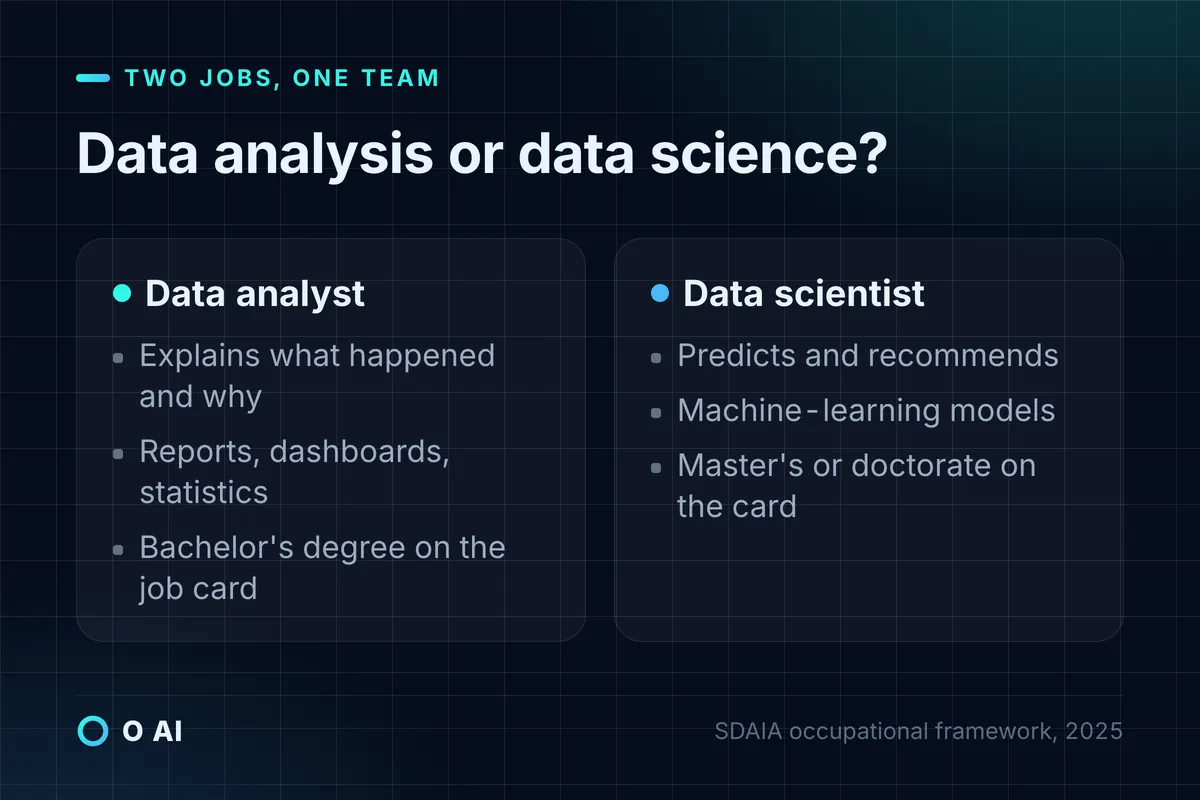
The two fields overlap, so definitions help. The US National Institute of Standards and Technology (NIST) defines analytics as the systematic processing of data to uncover patterns, relationships and historical trends, and to attempt predictions. It defines data science as building useful knowledge directly from data, through discovery or through forming and testing hypotheses [2]. SDAIA's job cards draw the practical line: the data analyst collects, organises and studies data to give the business insight, while the data scientist uses machine learning and predictive modelling to spot trends, extract information from unstructured sources and provide automated recommendations [1].
| Data analysis | Data science | |
|---|---|---|
| Main question | What happened, and why? | What is likely to happen, and what should a system do about it automatically? |
| Typical output | Reports, dashboards and a recommendation to a manager | Forecasts, scores and models built into products or processes |
| Core methods | Descriptive statistics, exploratory analysis, statistical tests, regression | Statistical and machine-learning models, model accuracy metrics, hypothesis testing |
| Everyday tools | Spreadsheets, SQL, a BI tool such as Power BI | Python or a similar language, notebooks, machine-learning libraries, cloud platforms |
| Education on SDAIA's job card | Bachelor's in computer science, statistics, business information systems, information management or a related field | Bachelor's in statistics, mathematics, computer science or a related field, and usually a master's or doctorate in machine learning or data science |
Sources for the table: SDAIA's job cards [1] and Microsoft's role descriptions [3].
The two jobs feed each other. In Microsoft's worked scenario, a data scientist trains a revenue forecast on three years of sales, and the data analyst then shows those predictions in a sales executive's dashboard [3]. In Microsoft's own terms, descriptive and diagnostic analytics answer "what happened?" and "why?", while predictive and prescriptive analytics estimate what comes next and compare options [4].
What does a data analyst do? The tasks on SDAIA's job card
SDAIA's card for the data analyst, occupation code D-An, lists twelve key tasks [1]. In plain terms, an analyst:
- identifies, collects and prepares data from different sources so it is ready to analyse;
- checks that source data, and the findings drawn from it, are valid;
- collects metrics and trend data;
- runs exploratory analysis and statistical tests to inspect, explore and visualise data;
- applies statistical techniques to find relationships that can improve processes and support decisions;
- turns all of this into actionable recommendations, and supports data governance and quality teams in setting standards.
The skills on the same card include writing queries and reports, regression analysis, descriptive statistics and identifying outliers, and the abilities include producing clear charts and using data visualisation tools [1].
Microsoft's description of the role adds the day-to-day reality. The analyst builds the dashboard a manager uses, chooses the right visuals, sets up row-level security so regional managers see only their own region, and schedules the daily refresh. The value of the job, in Microsoft's framing, is making sure the output answers what the business actually needs to know [3].
A typical week for an analyst in a Saudi company
Illustrative example. Sunday: refresh the weekly sales report and reconcile its total with the accounting system. Monday and Tuesday: investigate why one branch's returns rose. Wednesday: clean a new export from the online store whose product codes do not match the point-of-sale system. Thursday: present two charts and one recommendation to the operations manager.
What does a data scientist do?
SDAIA's card for the data scientist, code D-S, centres on models [1]. The key tasks include solving problems with applied mathematics, statistics and probability; building and evaluating statistical and machine-learning models that produce insights and predictions; testing model accuracy with performance metrics and hypothesis tests; building reusable data-cleaning processes; and working with machine-learning engineers to deploy models for business uses such as recommendation systems, fraud detection and demand forecasting [1].
The card's requirements are heavier than the analyst's. Alongside a bachelor's degree, it lists a master's or doctorate in machine learning, data science or a related quantitative field, plus experience in programming and in statistical modelling or machine learning [1]. NIST describes the data scientist as someone who combines business needs, domain knowledge, analytical skills and software engineering across the whole analytics life cycle [2].
That breadth is why one data scientist rarely succeeds alone in a company whose data is still scattered across spreadsheets. A model is only as reliable as the data and the pipelines behind it.
The wider data team: engineers, BI and governance roles
SDAIA's framework groups 16 data and AI occupations into five categories: business and leadership; governance, management and risk analysis; data science and analytics; engineering and architecture; and research [1]. The data analyst sits under the specialty of data analytics and business intelligence, and the data scientist under data science, both in the data science and analytics category [1].
| Role on SDAIA's framework | What the role does | When a company needs it |
|---|---|---|
| Data analyst | Turns data into reports, analysis and recommendations | As soon as managers ask questions that spreadsheets answer slowly |
| Data scientist | Builds and evaluates predictive and machine-learning models | When clean history exists and a prediction problem has a clear value |
| Data engineer | Builds pipelines, data warehouses and ETL processes | When data sits in systems that do not talk to each other |
| Data quality analyst | Monitors and fixes data quality issues | When reports disagree because the source data is unreliable |
| Data governance analyst | Supports data governance policies, procedures, monitoring and staff training | When several departments share data, or regulation demands it |
| Chief data officer | Leads data engineering, analytics, reporting and governance | In larger organisations with a data strategy to run |
Sources for the table: SDAIA's framework [1].
Microsoft adds a bridging role, the analytics engineer, who settles definitions such as "net revenue" in one certified model so every report uses the same figure [3]. Saudi Arabia's National Data Management Office (NDMO) expects a data analytics team to typically include data scientists, data engineers and visualisation engineers [5]. Those standards are written for public entities and business partners handling government data, but the team shape applies anywhere.
Which should a company hire first?
For most Saudi small and mid-sized companies, the honest answer is a data analyst, or an existing employee trained as one. Data science pays off only after the basic reporting is reliable.
| Your situation | Start with | Why |
|---|---|---|
| Monthly reports are rebuilt by hand from several exports | A data analyst | Reliable descriptive reporting comes before any prediction |
| Data sits in systems that cannot be joined | A data engineer, or an integration project | Neither analysis nor models work without connected data |
| Managers argue about whose numbers are right | An analyst plus agreed definitions | The problem is governance, not modelling |
| Two or more years of clean history and a costly prediction problem | A data scientist | Forecasting, churn or fraud models now have something to learn from |
If the data sits in disconnected systems, our guide to custom software development in Saudi Arabia explains when to connect what you have rather than buy something new.
Illustrative example: is a forecast worth a data scientist?
Illustrative example. A food distributor in Jeddah estimates that stock-outs cost it about SAR 40,000 a month in lost gross margin. If a demand forecast halved them, it would protect about SAR 20,000 a month, or SAR 240,000 a year. That is the ceiling to compare against the full yearly cost of a data scientist, tools and the data engineering the model needs.
Before hiring, write the use case down the way NDMO asks public entities to: the objective, the type of analytics, the expected benefit, the owner and users, the data sources and fields, and the technology required [5]. If the distributor cannot list two years of clean sales by product and branch, its first hire is an analyst who can produce that history.

Data analysis certificates and data science certificates
Certificates show that someone has covered a defined syllabus; employers still test what candidates can do with real data. The table lists four well-known options as their official pages showed them on 14 October 2026.
| Certificate | Issuer | Level and format | Language | Points to note |
|---|---|---|---|---|
| Microsoft Certified: Power BI Data Analyst Associate (exam PL-300) | Microsoft | Intermediate; a proctored exam of 100 minutes | Exam offered in ten languages, not including Arabic | Renew every 12 months through a free online assessment; price depends on the country where the exam is taken [6] |
| Google Data Analytics Professional Certificate | Google, on Coursera | Beginner; 9 courses, about 6 months at 10 hours a week | Taught in English | No degree or experience required; covers spreadsheets, SQL, Tableau and some Python, plus AI-assisted data cleaning [7] |
| IBM Data Science Professional Certificate | IBM, on Coursera | Beginner; 12 courses, about 4 months at 10 hours a week | Taught in English, subtitles in 27 languages | No prior experience required; covers Python, SQL, Jupyter and machine learning with scikit-learn [8] |
| Microsoft Certified: Azure Data Scientist Associate (exam DP-100) | Microsoft | Intermediate | Not applicable | Microsoft's page marks the certification and its renewal assessment as retired [9] |
The retired DP-100 entry is a reminder to check the issuer's page before you pay for a course built around an exam. Older Arabic articles still recommend it.
What a data analysis certificate proves, and what it does not
A data analysis certificate shows that you have studied the syllabus and, for proctored exams such as PL-300, passed a timed test. It does not show that you can clean a messy export from a Saudi point-of-sale system or explain a result to a manager. Pair every certificate with two or three portfolio projects.
Does HRDF support data certificates?
The Human Resources Development Fund (HRDF) reimburses the cost of approved professional certificates for Saudi citizens, whether employed in the public or private sector or looking for work [10]. Its published conditions, as of 14 October 2026:
- the certificate must be on HRDF's approved list, and obtained after the date it was approved;
- the applicant declares that the employer did not pay for it;
- no more than two certificates per person;
- the certificate must not be more than six months past its issue date when you apply;
- membership fees are not covered, and reimbursement follows a fixed amount per certificate, with training costs capped;
- eligibility review and payment take 40 working days from a complete application [10].
HRDF states that its list changes with labour-market needs [10], so check that the exact certificate is on it before you enrol.
A learning path for job seekers in Saudi Arabia
Use SDAIA's job cards as your checklist: they list the tasks, skills and knowledge for each role and are meant to be used for job descriptions, hiring and career planning [1]. A practical order:
- Spreadsheets: pivot tables, lookups, charts and cleaning.
- SQL: querying and joining tables.
- A BI tool: Power BI or a similar tool, including a data model and a shared report.
- Statistics: descriptive statistics, sampling, tests and regression.
- Python: data cleaning with pandas and simple automation.
- Machine learning: only if you are heading for data science, after the first five are solid.
Build three portfolio projects, each with a question, the cleaning you did, the result and the recommendation. Use public or synthetic data, never a former employer's customer records. Under the PDPL's Implementing Regulation, data counts as anonymised, and no longer personal, only when identifiers are removed so that re-identifying the person is impossible [11]. Deleting the name column alone is not enough.

Your next step
If you run a company, write one use-case card for the question that costs you most, list the data it needs, and let that card decide whether your first hire in the data science vs data analysis choice is an analyst, an engineer or a scientist. For the wider picture of AI readiness, our guide to SDAIA's AI adoption framework shows what a smaller company can borrow from it. If you are a job seeker, open SDAIA's job card for the role you want, mark the skills you can already prove, and pick one certificate that covers the biggest gap. You can read about O AI, a software and AI company in Al Khobar, on our home page.
Frequently asked questions
Which is better, data science or data analysis?
Neither is better in general; they solve different problems. Data analysis answers what happened and why, and most companies need it every week. Data science builds predictive and machine-learning models, which pays off only when clean history and a valuable prediction problem exist. For a career, data analysis has a lower entry barrier, while SDAIA's job card for data scientists expects machine-learning experience and usually a postgraduate degree. Many people start as analysts and move into data science later.
What does a data analyst do day to day?
A data analyst collects data from systems such as sales, accounting and the online store, checks it for errors and duplicates, and prepares it for analysis. They then explore it, run statistical tests and comparisons, and build reports or dashboards that answer managers' questions. In practice, much of the week goes to cleaning data and reconciling totals, and the rest to explaining findings and recommending actions. SDAIA's job card lists twelve key tasks along these lines.
Do I need a master's degree to become a data scientist in Saudi Arabia?
Not by law, but SDAIA's occupational framework, issued as a reference for the sector, lists a master's or doctorate in machine learning, data science or a related quantitative field for the data scientist, alongside a bachelor's degree and experience in programming and machine learning. Employers set their own requirements, and strong project experience can count. Without a postgraduate degree, a common route is to work as a data analyst first and build modelling experience on the job.
Which data analysis certificates are worth taking?
Choose by the tools employers in your target sector use. Microsoft's Power BI Data Analyst Associate, exam PL-300, suits companies on Microsoft 365 and Power BI and needs yearly renewal through a free online assessment. Google's Data Analytics Professional Certificate on Coursera is a beginner course covering spreadsheets, SQL and Tableau. Check the issuer's page before paying, since exams are retired and updated, and check HRDF's approved list if you hope to be reimbursed.
Does HRDF pay for data analysis certificates?
HRDF reimburses approved professional certificates for Saudi citizens who are employed or looking for work, up to two certificates per person, if the employer did not pay and the certificate is under six months old at application. It covers only certificates on its approved list, which changes over time, and it does not pay membership fees. Check the list on HRDF's website for the exact certificate before you enrol, and keep official invoices.
Can a data analyst become a data scientist?
Yes, and it is a common path. The analyst already works with data preparation, statistics and business questions, which SDAIA lists for both roles. The additions are stronger programming, usually in Python, machine-learning methods, model evaluation, and often postgraduate study. A practical step is to take on a forecasting or classification task inside your current job, document how you tested the model, and use it as evidence when you apply for data science roles.
Will AI replace data analysts?
AI tools now write formulas, summarise data and turn plain questions into queries, which removes much of the routine work. Microsoft's guidance for analysts still leaves the analyst responsible for choosing the right method, checking that the output answers the question and judging whether the data can be trusted. The job is shifting towards defining questions, checking AI output and explaining results, rather than disappearing.
How this article was made: Researched from the sources listed below, opened on 14 October 2026. Drafted with AI assistance, then checked against those sources. General information, not professional advice. Images are AI-generated illustrations.
Sources
- National Occupational Standard Framework for Data and Artificial Intelligence (2025) (opens in a new tab)Saudi Data and AI Authority (SDAIA) · sdaia.gov.sa
- Big Data Interoperability Framework: Volume 1, Definitions (SP 1500-1r2) (opens in a new tab)NIST · nvlpubs.nist.gov
- Roles in data analytics (opens in a new tab)Microsoft Learn · learn.microsoft.com
- Types of data analytics (opens in a new tab)Microsoft Learn · learn.microsoft.com
- Data Management and Personal Data Protection Standards, version 1.5 (opens in a new tab)National Data Management Office, SDAIA · sdaia.gov.sa
- Microsoft Certified: Power BI Data Analyst Associate (opens in a new tab)Microsoft Learn · learn.microsoft.com
- Google Data Analytics Professional Certificate (opens in a new tab)Coursera · coursera.org
- IBM Data Science Professional Certificate (opens in a new tab)Coursera · coursera.org
- Microsoft Certified: Azure Data Scientist Associate (opens in a new tab)Microsoft Learn · learn.microsoft.com
- Professional certificates programme (in Arabic) (opens in a new tab)Human Resources Development Fund (HRDF) · hrdf.org.sa
- Implementing Regulation of the Personal Data Protection Law (opens in a new tab)SDAIA · sdaia.gov.sa
About the author
Newsletter
New guides and news by email
New guides and news about O AI, Rushd and Dalni, at most twice a month. No spam.