 AI


AI in Saudi Arabia in 2026: the agencies, models and regulations
A map of AI in Saudi Arabia as of October 2026: SDAIA and the other entities involved, the ALLaM and HUMAIN models, data centres and cloud regions, the rules from the PDPL to the draft Responsible AI Policy, and a checklist for companies.

Key takeaways
- SDAIA, established in 2019, leads the National Strategy for Data and AI and is the national reference for data and AI regulation; PIF's HUMAIN builds infrastructure and models.
- There is no standalone AI law as of 14 October 2026: the PDPL is the binding layer, with SDAIA's ethics principles, guidelines and frameworks on top.
- 2026 brought the Year of AI (10 March), a draft Responsible AI Policy (2 April), Deepfakes Guidelines (8 May) and a National AI Risk Management Framework (14 July).
- ALLaM 34B, developed with more than 500 billion Arabic tokens according to SDAIA, powers the free HUMAIN Chat app, which its listing says is hosted in Saudi Arabia.
- Official sources report 14th place in the Global AI Index 2025 and 13th of 70 on IMD's 2026 AI indicators; these rank the country, not any one company.
On this page
- AI in Saudi Arabia at a glance (October 2026)
- Who does what: the agencies and companies behind Saudi AI
- Saudi AI models: ALLaM, HUMAIN Chat and newer releases
- Infrastructure: data centres, compute and cloud regions
- The rules: Saudi Arabia's AI regulations as of October 2026
- Programs for people and companies
- How to read Saudi Arabia's AI rankings
- What this landscape means for your company in 2026
- Your next step
AI in Saudi Arabia in 2026 runs through a small set of players. SDAIA leads the national strategy and writes most of the AI rules, PIF's company HUMAIN builds data centres and Arabic models, and SDAIA trains citizens with two ministries through SAMAI. Most AI-specific rules are guidance; the Personal Data Protection Law is the binding layer.
This guide maps who does what, which Saudi models and infrastructure exist, and which rules apply to a company using AI as of 14 October 2026. Every figure comes from an official Saudi source, and where that source quotes an international index, we say so. For the practical side of the national AI year, and for the national AI training program, see the related sections below.
AI in Saudi Arabia at a glance (October 2026)
On 10 March 2026 the Council of Ministers designated 2026 the Year of Artificial Intelligence in the Kingdom [1]. The figures below are the ones SDAIA and the Saudi Press Agency publish. Most are attributed by them to international indices and research firms, so read them as the government's own summary of the sector.
| Indicator | Figure | As reported by |
|---|---|---|
| Global AI Index 2025 | 14th place | SPA, 10 March 2026 [2] |
| IMD World Competitiveness Yearbook 2026, AI indicators | 13th of 70 countries | SPA, 18 June 2026 [3] |
| World Bank, World Development Report 2026 | Among the top 10 countries for private AI investment | SPA, 13 August 2026 [4] |
| Funding raised by Saudi AI companies in 2025 | $9.1 billion across nearly 70 deals | SDAIA, citing Crunchbase [1] |
| Government contract spending on AI and emerging technologies | Up 56.25% in 2024 compared with 2023 | SDAIA, citing the Digital Government Authority [1] |
| Regulatory instruments | 32 in data and 13 in AI | SDAIA, 2025 [1] |
| Public awareness | 84% familiar with the concept of AI | SDAIA AI Awareness Survey, 2025 [1] |
Who does what: the agencies and companies behind Saudi AI
SDAIA was established in 2019 and leads the National Strategy for Data and AI, built on six pillars: ambition, competencies, policies, investment, innovation and ecosystem [2]. SDAIA describes itself as the national reference for the regulation, development and management of data and AI [5]. Around it, a handful of other bodies carry specific parts of the work.
| Entity | Role in AI | Why a company might deal with it |
|---|---|---|
| Saudi Data and AI Authority (SDAIA) | Strategy, data and AI regulation including the PDPL, the National Data Lake, the SDAIA Academy | It issues the rules and guidance your AI use is measured against [5][6][1][3] |
| Public Investment Fund (PIF) and HUMAIN | HUMAIN, launched on 12 May 2025 and owned by PIF, operates across the AI value chain: data centres, AI infrastructure, cloud, and Arabic models [7] | A local supplier of AI models, cloud and applications |
| Ministry of Education and Ministry of Human Resources and Social Development | Partners with SDAIA in the SAMAI training initiative [8] | Free AI training for Saudi staff |
| King Abdullah University of Science and Technology (KAUST) | Operates Shaheen III, which SDAIA calls the most powerful supercomputer in the GCC [1] | Research partnerships and high-performance computing |
| International Center for AI Research and Ethics (ICAIRE) | A UNESCO-sponsored centre in Riyadh [2] | Research and awareness on AI ethics |
| King Salman Global Academy for Arabic Language | Runs the Falak platform, with 2.2 billion language and audio resources [1] | Arabic language data for AI work |
Two governance points matter for a business. SDAIA's AI Ethics Principles let it measure compliance directly or through sector regulators, so a bank or a hospital may also hear about AI from its own regulator [9]. And SDAIA itself received ISO 42001:2023 certification, the international standard for AI management systems, in 2024 [5].
Saudi AI models: ALLaM, HUMAIN Chat and newer releases
The Saudi language model that official sources cite most is ALLaM. SDAIA's Year of AI page states that more than 500 billion Arabic tokens were used to develop the ALLaM 34B language model [1]. A Saudi Press Agency report on PIF's AI strategy, published on 15 September 2026, describes ALLaM as built entirely in the Kingdom by Saudi experts and as the model that powers the HUMAIN Chat app [10].
HUMAIN Chat is a free app. Its App Store listing says it runs on ALLaM 34B, chats in Arabic or English, recognises speech in Arabic dialects from the Gulf to the Maghreb, and is fully hosted and operated in Saudi Arabia [11]. For a company, the last point is the one to note, because where a model is hosted is one of the first things to check in any assistant's terms.
HUMAIN has also released a newer model, HUMAIN M3, in limited preview on its HUMAIN Node platform. HUMAIN describes it as an Arabic-focused, natively multimodal model; access requires approval, and the benchmark results on the page are HUMAIN's own [12]. Treat vendor benchmarks as a starting point and test any model on your own Arabic documents.
SDAIA also cites the Stanford AI Index 2025, which places Saudi Arabia third globally, and first in the Arab region, in the development of leading AI models, with five such models developed in the Kingdom [1].

Infrastructure: data centres, compute and cloud regions
The infrastructure claims on SDAIA's Year of AI page are specific [1]:
- Hexagon data centre: described as the world's largest government data centre with a Tier IV classification and a total planned capacity of 480 megawatts.
- Shaheen III: KAUST's supercomputer, the most powerful in the GCC according to SDAIA.
- Cloud regions: nine cloud regions in Saudi Arabia, four of them still under development by global providers, according to TeleGeography's 2025 map.
- Data centre growth: total data centre capacity rose 42.4% between 2023 and 2024, according to the Ministry of Communications and Information Technology.
- Government data: more than 440 government systems are integrated into the National Data Lake.
PIF's launch statement adds that HUMAIN will streamline data centre initiatives, procure hardware and serve sectors such as energy, healthcare, manufacturing and financial services [7]. For a company choosing where to run AI, the growth in local cloud regions matters more than any single facility: it widens the options for keeping data in the Kingdom.
The rules: Saudi Arabia's AI regulations as of October 2026
There is no standalone AI law on SDAIA's regulations page as of 14 October 2026 [6]. The binding layer for most AI uses is the Personal Data Protection Law (PDPL) with its implementing regulation and its regulation on transferring personal data outside the Kingdom, all listed on that page [6]. On top of it sits a set of AI-specific documents, most of them guidance.
| Instrument | Issued | Nature | What it asks of a company |
|---|---|---|---|
| PDPL, implementing regulation and transfer regulation | In force | Law and regulations | Lawful processing of personal data, including inside AI tools [6] |
| AI Ethics Principles | May 2025 edition (SDAIA-P114E) | Regulatory document, voluntary registration and incentive badges | Seven principles applied by risk level across the AI lifecycle [9] |
| Generative AI guidelines, for government and for the public | Current editions on SDAIA's page | Guidelines | Responsible use of generative AI tools [6] |
| AI Adoption Framework | First issued in 2024 | Guiding framework | A roadmap for adopting AI responsibly [5] |
| Deepfakes Guidelines | Announced 8 May 2026 | Guidelines | Explicit consent, protection of personal data, safeguards such as digital watermarks [13] |
| National AI Risk Management Framework | Launched 14 July 2026 | Framework | Identify, assess, treat and monitor AI risks on a likelihood-and-impact matrix [14] |
| Responsible AI Policy | Draft opened for comment 2 April 2026 | Draft policy | A preventive, risk-based approach and clear roles across the AI lifecycle [15] |
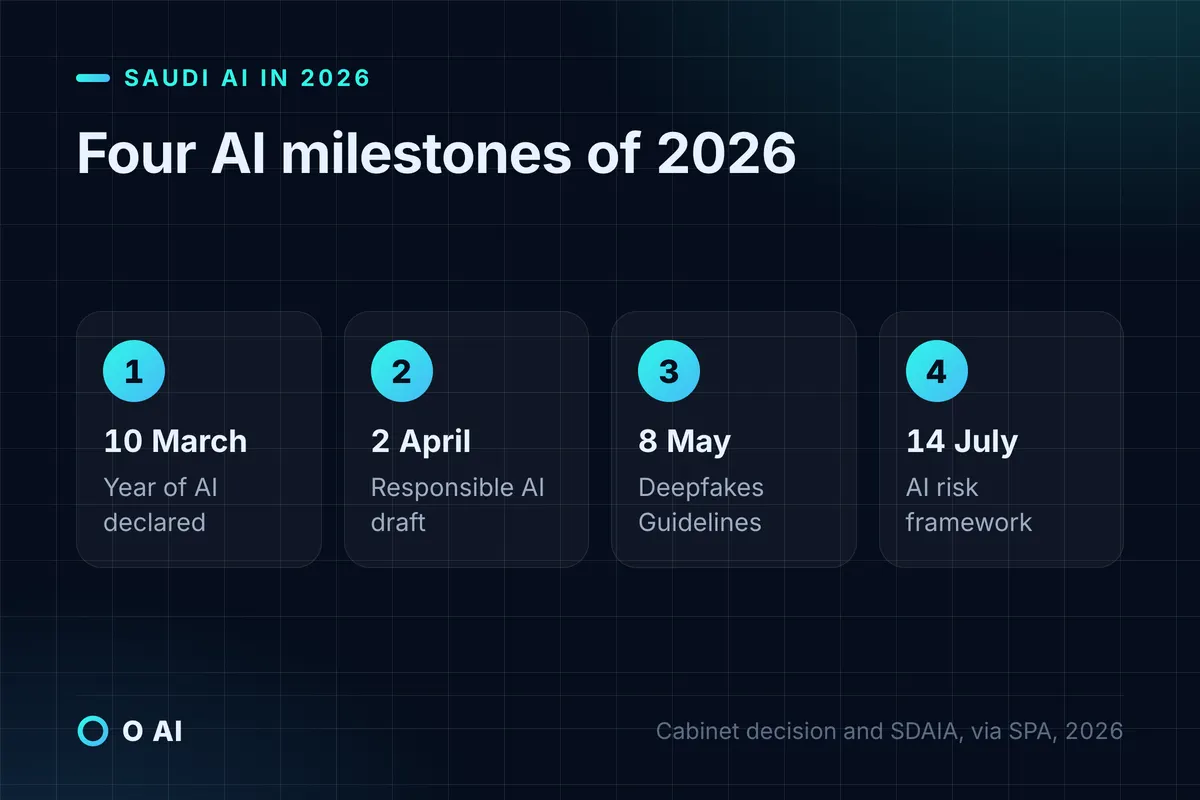
The draft Responsible AI Policy is the one to watch. SDAIA put it to public consultation on the Istitlaa platform on 2 April 2026 [15], and its regulations page did not list a final version when we checked on 14 October 2026 [6]. A final text could add obligations that the current guidance only recommends.
Our guides cover two of these documents in depth: the SDAIA AI Adoption Framework, with a readiness assessment and a risk-scoring example, and data residency in Saudi Arabia under the PDPL. This section is general information; for a specific case, check SDAIA's current texts or ask a licensed advisor.
Programs for people and companies
Three national programs reach companies directly.
- SAMAI. SDAIA launched the "One Million Saudis in AI" initiative with the Ministry of Education and the Ministry of Human Resources and Social Development. On 9 November 2025 the Saudi Press Agency reported that it had trained more than one million citizens, with free access and certificates from SDAIA [8].
- The Year of AI 2026. SDAIA runs the year's official page, with its objectives, national AI figures and brand guidelines for participating entities [1].
- Support for companies adopting AI. In its summary of the IMD 2026 results, SDAIA named the Rowad Package, the AI Ethics Incentive Badges and the Generative AI Accelerator (GAIA) among its initiatives that help companies adopt AI [3]. The release does not describe their terms; check SDAIA's channels before you plan around them.
How to read Saudi Arabia's AI rankings
The rankings are real signals, but they measure the country, not your company. IMD's 2026 yearbook, as summarised by SDAIA, placed Saudi Arabia fourth globally for AI adoption by companies, fourth for societal access to AI, fifth for AI trust, fifth for corporate investment in AI and seventh for AI skills in business [3]. The World Bank's 2026 report placed it among the top 10 for private AI investment and among the economies with the highest net inflows of AI professionals in 2025 [4].
For a business, these numbers suggest two things. AI governance is now part of how the Kingdom presents itself, so expect larger buyers, especially government entities, to ask suppliers about it. And with AI professionals moving into the Kingdom, competition for that talent is real, so training your own staff is often the more realistic route.
What this landscape means for your company in 2026
Use this checklist as-is to place your company's AI use within the Saudi framework.
- List your AI systems. For each one, write its owner, its purpose, the data it uses and who is affected by its output.
- Mark the personal data. Anything touching names, IDs, salaries or customer records falls under the PDPL, wherever the tool is hosted.
- Place each system on SDAIA's risk levels. Use the AI Ethics Principles' four levels, and the national risk framework's matrix for anything that affects people's rights.
- Check synthetic media. If you generate voices, faces or video of real people, apply the Deepfakes Guidelines: consent first, and mark the content.
- Test a local option for Arabic-heavy work. Run the same Arabic samples through a Saudi-hosted assistant and through your current tools, and compare the edits each output needs.
- Train before you buy. Point staff to SAMAI's free Arabic programs before paying for advanced tools.
- Watch for the final Responsible AI Policy. Check SDAIA's regulations page each quarter and update your AI register when it changes.
If you are still deciding where AI fits at all, our guide on how AI can help your business starts with one repetitive task.
Your next step
This week, write down every AI tool your company uses and mark which ones touch personal data. That one page shows which part of the Saudi rule set applies to you, and it is the base for everything else in this guide. Then check the AI in Saudi Arabia sources above once a quarter, since the final Responsible AI Policy is still pending. To read about O AI, a software and AI company in Al Khobar, visit our home page.
Frequently asked questions
Who regulates AI in Saudi Arabia?
The Saudi Data and AI Authority (SDAIA) is the national reference for data and AI regulation. Its regulations page carries the Personal Data Protection Law and its regulations, and it has issued the AI Ethics Principles, generative AI guidelines, the AI Adoption Framework, Deepfakes Guidelines and a National AI Risk Management Framework. Sector regulators can also be involved: SDAIA's ethics principles let it measure compliance through them, so banks or hospitals may receive AI guidance from their own regulator as well.
Is there an AI law in Saudi Arabia?
Not as a standalone law. As of 14 October 2026, SDAIA's regulations page lists no AI-specific law. The binding rules that reach most AI use come from the Personal Data Protection Law and its regulations, while AI-specific documents are principles, guidelines and frameworks. SDAIA opened a draft Responsible AI Policy for public comment in April 2026, and a final version could add obligations. For a specific case, check SDAIA's texts or ask a licensed advisor.
What is ALLaM?
ALLaM is an Arabic large language model developed in Saudi Arabia. SDAIA says more than 500 billion Arabic tokens were used to develop the ALLaM 34B version. According to a Saudi Press Agency report on PIF's AI strategy, it was built in the Kingdom by Saudi experts, and it powers the free HUMAIN Chat app, which chats in Arabic and English and recognises Arabic dialects.
What is HUMAIN?
HUMAIN is a company owned by the Public Investment Fund and chaired by the Crown Prince, launched on 12 May 2025. PIF describes it as operating across the AI value chain: next-generation data centres, AI infrastructure and cloud, and advanced AI models, including Arabic large language models. Its products include the HUMAIN Chat app and, in limited preview, a newer model called HUMAIN M3.
Where does Saudi Arabia rank in AI?
According to the Saudi Press Agency, the Kingdom ranked 14th in the Global AI Index 2025 and 13th of 70 countries on AI indicators in the IMD World Competitiveness Yearbook 2026, including fourth for AI adoption by companies. The World Bank's 2026 World Development Report placed it among the top 10 countries for private AI investment. These rankings describe the country's position, not the readiness of any single company.
What changed in Saudi AI rules during 2026?
Four milestones stand out. The Cabinet named 2026 the Year of AI on 10 March. SDAIA opened a draft Responsible AI Policy for comment on 2 April, announced Deepfakes Guidelines on 8 May, and launched a National AI Risk Management Framework on 14 July. The Personal Data Protection Law remains the binding layer underneath all of them.
How can a small company benefit from Saudi AI programs?
Start with people and rules rather than infrastructure. Saudi staff can take SAMAI's free Arabic AI programs, which end with SDAIA-accredited certificates. SDAIA's guidance documents give a ready structure for an internal AI policy. Companies that sell AI products can apply for SDAIA's voluntary AI ethics accreditation and incentive badge. For Arabic-heavy tasks, testing a Saudi-hosted assistant alongside international tools is a low-cost first step.
How this article was made: Researched from the sources listed below, opened on 14 October 2026. Drafted with AI assistance, then checked against those sources. General information, not professional advice. Images are AI-generated illustrations.
Sources
- The Year of AI 2026 (opens in a new tab)Saudi Data and AI Authority (SDAIA) · sdaia.gov.sa
- Saudi Arabia Emerges as AI Powerhouse under Vision 2030, Declares 2026 the Year of Artificial Intelligence (10 March 2026) (opens in a new tab)Saudi Press Agency · spa.gov.sa
- SDAIA Drives Saudi Arabia's Rise in Global AI Rankings in IMD Competitiveness Yearbook 2026 (18 June 2026) (opens in a new tab)Saudi Press Agency · spa.gov.sa
- Saudi Arabia Ranks Among the Top 10 Global AI Investors: World Bank Report (13 August 2026) (opens in a new tab)Saudi Press Agency · spa.gov.sa
- Saudi Arabia Continues Global Leadership in Ethical Principles and Responsible Use of AI (13 July 2025) (opens in a new tab)Saudi Press Agency · spa.gov.sa
- Laws and Regulations (opens in a new tab)Saudi Data and AI Authority (SDAIA) · sdaia.gov.sa
- HRH Crown Prince launches HUMAIN as global AI powerhouse (12 May 2025) (opens in a new tab)Public Investment Fund · pif.gov.sa
- 9% of Working-Age Saudis Among Over One Million Trained in AI via SAMAI Initiative (9 November 2025) (opens in a new tab)Saudi Press Agency · spa.gov.sa
- AI Ethics Principles (May 2025, SDAIA-P114E) (opens in a new tab)Saudi Data and AI Authority (SDAIA) · sdaia.gov.sa
- PIF Accelerates Saudi Arabia's Global AI Leadership Through Strategic Investments and Infrastructure (15 September 2026) (opens in a new tab)Saudi Press Agency · spa.gov.sa
- HUMAIN Chat (opens in a new tab)HUMAIN, App Store listing · apps.apple.com
- HUMAIN M3 on HUMAIN Node (opens in a new tab)HUMAIN · node.humain.com
- SDAIA Issues Deepfakes Guidelines to Regulate Responsible AI Use (8 May 2026) (opens in a new tab)Saudi Press Agency · spa.gov.sa
- SDAIA Introduces National Framework for Managing AI Risks (14 July 2026) (opens in a new tab)Saudi Press Agency · spa.gov.sa
- SDAIA Invites Public, Entities to Share Views on Responsible AI Policy Draft (2 April 2026) (opens in a new tab)Saudi Press Agency · spa.gov.sa
About the author
Newsletter
New guides and news by email
New guides and news about O AI, Rushd and Dalni, at most twice a month. No spam.