 AI


How to open a commercial registration in Saudi Arabia: requirements, fees and steps
Requirements, fees and steps to open a commercial registration in Saudi Arabia under the 2025 Commercial Register Law: who qualifies, what each legal form costs, trade name rules, deadlines after issue, and how a CR affects Citizen Account and social security.


Key takeaways
- A sole proprietor must be at least 18, not a government employee and not already own an active sole proprietorship; registration costs SAR 500.
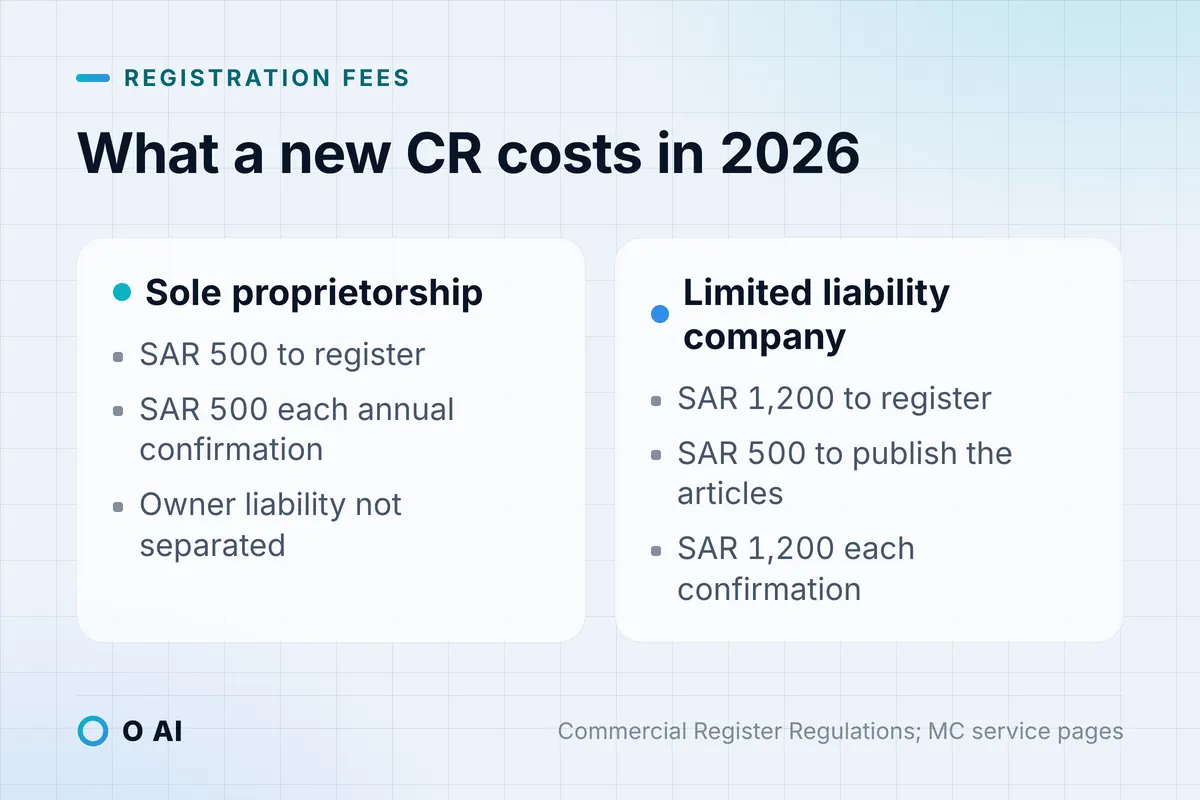
- A limited liability company costs SAR 1,200 to register plus SAR 500 to publish its articles; each annual confirmation costs the same as registration.
- Reserving a trade name costs SAR 200 in Arabic or SAR 500 in English and holds it for 60 days; an English name must be paired with Arabic letters.
- Within 90 days of registration, submit your bank account details and obtain licences for licensed activities; update any change within 15 days.
- A CR alone does not end Citizen Account or social security support, but its income, assets and workers count and must be disclosed.
On this page
- Who can open a commercial registration in Saudi Arabia?
- Sole proprietorship or company: which registration fits?
- Commercial registration fees in 2026
- Choosing and reserving a trade name
- Step by step: opening a sole proprietorship registration online
- After the CR is issued: the first 90 days and every year after
- Does a commercial registration affect Citizen Account?
- Does a commercial registration affect social security?
- Illustrative example: first-year cost for two new businesses
- Your next step
To open a commercial registration in Saudi Arabia as a sole proprietor, you must be at least 18, not a government employee and not already the owner of an active sole proprietorship. You apply online on the Business platform with a Nafath login, choose your activities and trade name, and pay SAR 500; the registration is issued after payment.
The process runs under the Commercial Register Law, approved by Royal Decree M/83 dated 19/3/1446H, which took effect 180 days after its publication on 4 October 2024 and replaced the 1416H law [1]. Its Implementing Regulations, published by the Ministry of Commerce (MC) in 2025, set the fees, deadlines and penalties quoted below [2]. Every fee in this guide was read on an official page on 14 October 2026; check the invoice before you pay, because fees can change. This is general information, not legal advice; for an unusual structure, ask MC or a licensed lawyer.
Who can open a commercial registration in Saudi Arabia?
Every merchant must register in the commercial register (Article 5 of the law) [1]. A merchant is registered once, even with several activities and branches (Article 6 of the Regulations) [2], so a second shop in another city is added to your existing registration rather than opened as a new one.
The Regulations exempt four groups from registering, although they remain subject to the rules that apply to merchants (Article 16) [2]:
- people running a licensed temporary seasonal business;
- street vendors and mobile carts or vehicles licensed by the Ministry of Municipalities and Housing;
- productive families registered with the Social Development Bank;
- micro-businesses operating through business incubators licensed by Monsha'at.
Commercial registration requirements for a sole proprietorship
MC's service page for a sole proprietorship lists these conditions [3]:
- the owner is at least 18 years old;
- the owner is not a government employee;
- the owner does not already hold an active sole proprietorship registration;
- activities that need a licence before issue come with the licensing body's approval;
- if you sell online, you declare it in the application.
The Business platform now falls under the Saudi Center for Competitiveness and Business, created by Cabinet Decision 662 dated 7/9/1447H (24 February 2026) to merge the Saudi Business Center and the National Competitiveness Center [4]. MC's service pages still describe the same steps.
Foreign investors attach proof of registration with the Ministry of Investment or another competent body, plus the documents the registrar requires with a certified Arabic translation (Article 5 of the Regulations) [2].
Sole proprietorship or company: which registration fits?
The legal form decides your liability and your yearly cost. MC describes a limited liability company as one founded by one or more natural or legal persons, with assets separate from its owners, so that owners are liable for its debts only up to their share of the capital [5]. A sole proprietorship has no such separation.
| Sole proprietorship | Limited liability company | |
|---|---|---|
| Who can own it | One person; one active sole proprietorship per owner [3] | One or more natural or legal persons [5] |
| Owner's liability | Not separated from the business | Limited to the owner's share of capital [5] |
| Registration fee | SAR 500 [2] | SAR 1,200, plus SAR 500 for publishing the articles of association [5] |
| Annual confirmation fee | SAR 500 [2] | SAR 1,200 [2] |
| Extra steps | None beyond the registration | Articles of association, published in MC's Aamali gazette [5] |
| Government employees | Not allowed [3] | Partners may not be government employees [5] |
Other legal forms have their own fee, charged at registration and again at each annual confirmation: SAR 1,600 for joint stock and simplified joint stock companies and foreign company branches, and SAR 1,000 for general and limited partnerships [2]. If you expect to take on partners, debt or large contracts, compare the forms with an adviser before you register; converting later is a separate MC service.
Commercial registration fees in 2026
The fee schedule annexed to the Regulations applies the same amount to the first registration and to each annual confirmation (Article 18 and Annex 1) [2]. Trade name fees come from the Trade Names Law's own regulations [6].
| Service | Fee (SAR) | Source |
|---|---|---|
| Registration, sole proprietorship | 500 | [2] |
| Registration, limited liability company | 1,200 | [2] |
| Registration, joint stock or simplified joint stock company, foreign company branch | 1,600 | [2] |
| Registration, general or limited partnership | 1,000 | [2] |
| Annual confirmation | Same as the registration fee for each form | [2] |
| Each update to registered data | 100 | [2] |
| Detailed registration extract | 100 | [2] |
| Reserving a trade name in Arabic | 200 | [6] |
| Reserving a trade name in English | 500 | [6] |
| Extending a name reservation | 100 | [6] |
| Publishing a limited liability company's articles of association | 500 | [5] |
Two costs sit outside this table. The chamber of commerce subscription is priced by subscription category [7], and the limited liability company service page also lists 15% VAT [5]. Licences for regulated activities and municipal licences come from their own authorities.
Choosing and reserving a trade name
Every merchant must take a trade name and register it, and may reserve one in advance for a limited period (Article 3 of the Trade Names Law) [8]. The name can come from your own name, a distinctive name or both, and since 2025 it can be in a language other than Arabic (Article 4) [8].
The Regulations set the practical rules [6]:
- a name is reserved or registered in Arabic or in English, and an English name must be paired with the same name in Arabic letters (Article 2);
- a name made of numbers may not exceed nine digits (Article 2);
- a reservation lasts 60 days from acceptance and can be extended before it ends for the same period, with longer extensions at the registrar's discretion (Article 8);
- a reserved name cannot be used until it is registered in the commercial register (Article 8).
MC's reservation service accepts up to five proposed names in one application, decides within 10 days and rejects names similar to any reserved or registered name, whatever the activity [9]. Search for similar names before you print signs or stationery.
Step by step: opening a sole proprietorship registration online
MC's service page describes the flow on the Business platform [3]:
- Log in with the national single sign-on (Nafath).
- Choose the service from the e-services list: register a commercial registration, type "establishment".
- Enter the establishment's data: accept the terms, add the owner's and contact details, and enter the approved business address.
- Add the required data: choose your activities, add e-commerce details if you sell online, set the capital, and choose and compose the trade name.
- Complete the registration data: the establishment's address and contact details, and the appointed manager.
- Review and submit: check the summary and accept the declaration.
- Approvals: where needed, the owner or other managers approve.
- Pay: an invoice is issued and paid through SADAD or by card; the registration is issued after payment.
After issue, the establishment is registered automatically with the Ministry of Human Resources and Social Development, the Zakat, Tax and Customs Authority, the General Organization for Social Insurance, Saudi Post for the national address, and the chamber of commerce [3].
The law gives the registrar 10 days to decide on a complete application. If yours is returned for an error or a gap, you have 15 days from notice to correct or complete it before it is cancelled (Article 7 of the law; Article 7 of the Regulations) [1] [2]. A rejection must give reasons, and you can appeal to the Ministry within 60 days of being notified [1].

After the CR is issued: the first 90 days and every year after
Opening the registration starts a set of deadlines. Missing them leads to fines, and the fine table in Article 19 of the Regulations gives a warning for a first non-serious violation [2].
| Obligation | Deadline | Fine if missed (sole proprietorship) | Source |
|---|---|---|---|
| Submit your bank account details to the registrar | Within 90 days of registration | SAR 1,000 | Regulations, Articles 3 and 19 [2] |
| Obtain the licence for each activity that needs one | Within 90 days, or the activity is struck off | Activity removed from the register | Regulations, Article 4 [2] |
| Display your basic data through the unified electronic code (QR), inside and outside the shop and on your website | From the start of trading | SAR 1,000 | Regulations, Articles 14 and 19 [2] |
| Update any change to registered data | Within 15 days of the change | SAR 500 | Law, Article 10 [1]; Regulations, Article 19 [2] |
| File the annual confirmation | Due one year after registration; may be filed 30 days early | SAR 500, and suspension after 90 days | Regulations, Articles 10 and 19 [2]; Law, Article 15 [1] |
| Provide accurate data | Always | SAR 10,000, no warning | Regulations, Article 19 [2] |
The QR code is issued free on the Business platform; it requires an active registration and a commercial municipal licence, or the equivalent agreement or lease in industrial cities and economic zones [10]. A suspended registration suspends every licence issued to it, and after a year a sole proprietorship that has not lifted the suspension is struck off (Article 15 of the law) [1].

Does a commercial registration affect Citizen Account?
Not by itself. The Citizen Account programme's official FAQ says that anyone carrying out a commercial activity can benefit from the programme, provided they disclose the income from that activity and meet all the other conditions [11].
The FAQ also covers the case where eligibility is refused because records show an undisclosed registration held by the main applicant or a dependant: disclose the income from the commercial activity, then file an objection so the application enters the next eligibility cycle [11]. If the registration has been struck off, you file an objection to the eligibility result instead [11]. Among the income types on the Citizen Account portal, returns from commercial activities, financial investments and freelance work are a category of their own [11].
Does a commercial registration affect social security?
The Social Security Law, approved by Royal Decree M/32 dated 4/4/1442H, does not list a commercial registration as a reason to refuse support. It defines monthly income as all amounts received in the year before the application, including salaries and commercial returns, and its eligibility conditions include calculated income below the minimum and meeting the wealth criteria set in the Regulations (Articles 1 and 9) [12]. Beneficiaries must report any change that affects eligibility within 15 days (Article 7) [12].
The FAQ on the Ministry of Human Resources and Social Development's social support platform adds three practical points [13]:
- applicants must disclose all household income, including property, assets and wealth;
- income is assessed across all types, except disability allowances and supporting programmes;
- having more than one professional worker affects eligibility.
In short, a registration matters through the income, assets and workers it brings, not through its existence. If you receive either form of support, disclose the new business and its income on time.
Illustrative example: first-year cost for two new businesses
Illustrative example. Two businesses open in October 2026. Amounts exclude the chamber subscription, municipal fees and activity licences.
| Sole proprietorship bakery in Dammam, English trade name | Limited liability company in Riyadh, two partners, Arabic trade name | |
|---|---|---|
| Name reservation (optional, holds the name for 60 days) | SAR 500 | SAR 200 |
| Registration | SAR 500 | SAR 1,200 |
| Publishing the articles of association | Not applicable | SAR 500 |
| Total in the first month | SAR 1,000 | SAR 1,900, plus the 15% VAT the service page lists |
| Annual confirmation from the second year | SAR 500 | SAR 1,200 |
| Fine for a missed confirmation, after a first warning | SAR 500 | SAR 1,200 |
Reserving an Arabic name instead would cost the bakery SAR 200 rather than SAR 500; if the owner keeps the English name, it must be paired with the same name in Arabic letters [6]. Both businesses should put the bank account deadline and the annual confirmation date in a calendar on the day the registration is issued.
Your next step
Before you apply, write down four things: your legal form, the activities you will practise (and which need a licence), two or three trade names you have searched for similarity, and your approved business address. Then reserve the name, open the registration on the Business platform and set reminders for day 90 and for the annual confirmation. Once trading starts, our guide on how AI can help a small business shows how to pick one repetitive task and test it before you spend. If you plan an online store or an app, which must also display your QR code, our guide to choosing a software, AI or app development company lists the questions to ask; O AI is a software and AI company in Al Khobar.
Frequently asked questions
How much does it cost to open a commercial registration in Saudi Arabia?
As of October 2026, registering a sole proprietorship costs SAR 500 and a limited liability company SAR 1,200, plus SAR 500 to publish its articles of association. Joint stock companies and foreign branches pay SAR 1,600, and partnerships SAR 1,000. Reserving a trade name costs SAR 200 in Arabic or SAR 500 in English. The same registration fee is paid again for each annual confirmation, and the chamber of commerce subscription is priced separately by category.
Can a government employee open a commercial registration?
No. MC's conditions for registering a sole proprietorship state that the owner must not be a government employee, and the limited liability company service applies the same condition to partners. If you work in the government sector and plan to start a business, check your position with your employer and the rules that apply to your job before you apply.
Does opening a commercial registration stop my Citizen Account support?
Not by itself. The programme's FAQ says people carrying out a commercial activity can still benefit, provided they disclose the income from it and meet the other conditions. If your eligibility is refused because the records show a registration you did not disclose, you disclose the income and file an objection, and the application enters the next eligibility cycle.
Does a commercial registration affect social security payments?
The Social Security Law counts commercial returns as part of monthly income and applies wealth criteria, so the income and assets a business brings can reduce or end the pension. The social support platform's FAQ also says having more than one professional worker affects eligibility. Beneficiaries must report any change that affects eligibility within 15 days, so declare the new business promptly.
How long does it take to get a commercial registration?
MC lists the sole proprietorship and limited liability company services as immediate, with the registration issued after payment. The law gives the registrar up to 10 days to decide on a complete application, and a name reservation is decided within 10 days. Activities that need a licence before issue require the licensing body's approval first, which can take longer.
Do I need to renew my commercial registration every year?
Registrations no longer carry an expiry date. Instead, you file an annual confirmation of your registered data, due one year after registration and possible up to 30 days early, and pay the same fee as the registration. If you do not file it within 90 days of the due date, the registration is suspended after a 14-day warning, and every licence issued to it is suspended too.
How this article was made: Researched from the sources listed below, opened on 14 October 2026. Drafted with AI assistance, then checked against those sources. General information, not professional advice. Images are AI-generated illustrations.
Sources
- Commercial Register Law, Royal Decree M/83 dated 19/3/1446H (in Arabic) (opens in a new tab)Bureau of Experts at the Council of Ministers · laws.boe.gov.sa
- Commercial Register Law and its Implementing Regulations, with the fee schedule (in Arabic) (opens in a new tab)Ministry of Commerce · mc.gov.sa
- E-service: registering a sole proprietorship (in Arabic) (opens in a new tab)Ministry of Commerce · mc.gov.sa
- Organisation of the Saudi Center for Competitiveness and Business, Cabinet Decision 662 dated 7/9/1447H (in Arabic) (opens in a new tab)Bureau of Experts at the Council of Ministers · laws.boe.gov.sa
- E-service: establishing a limited liability company (in Arabic) (opens in a new tab)Ministry of Commerce · mc.gov.sa
- Trade Names Law and its Implementing Regulations, with the fee schedule (in Arabic) (opens in a new tab)Ministry of Commerce · mc.gov.sa
- Issuing a chamber of commerce subscription (in Arabic) (opens in a new tab)Saudi Center for Competitiveness and Business · scbc.gov.sa
- Trade Names Law, Royal Decree M/83 dated 19/3/1446H (in Arabic) (opens in a new tab)Bureau of Experts at the Council of Ministers · laws.boe.gov.sa
- E-service: reserving a trade name (in Arabic) (opens in a new tab)Ministry of Commerce · mc.gov.sa
- Issuing the unified electronic code (QR code) (in Arabic) (opens in a new tab)Saudi Center for Competitiveness and Business · scbc.gov.sa
- Frequently asked questions (in Arabic) (opens in a new tab)Citizen Account Program · portal.ca.gov.sa
- Social Security Law, Royal Decree M/32 dated 4/4/1442H (in Arabic) (opens in a new tab)Bureau of Experts at the Council of Ministers · laws.boe.gov.sa
- Social support and protection platform (social security): frequently asked questions (in Arabic) (opens in a new tab)Ministry of Human Resources and Social Development · sbis.hrsd.gov.sa
About the author
Newsletter
New guides and news by email
New guides and news about O AI, Rushd and Dalni, at most twice a month. No spam.