 AI


SDAIA AI ethics principles in plain language
What the seven SDAIA AI ethics principles mean for a company that builds, buys or uses AI in Saudi Arabia: the four risk levels, the roles to assign, the 75-question checklist, and the self-assessment and incentive badge on the National Data Governance Platform.


Key takeaways
- SDAIA's AI Ethics Principles (May 2025) set seven principles for anyone who designs, develops, deploys or uses AI in Saudi Arabia, private companies included.
- Duties scale with risk: little-or-no-risk systems are encouraged to comply, limited and high-risk systems must, and unacceptable-risk systems are not allowed.
- A company that uses a vendor's AI system is its owner under the document and should run AI ethics due diligence before procurement or sign-off.
- The annexed checklist has 75 questions across four lifecycle stages; each names the principle it tests and whether it binds third parties.
- Registration is voluntary: SDAIA's National Data Governance Platform offers an AI ethics self-assessment and an accreditation that leads to a product incentive badge.
On this page
- What SDAIA's AI ethics principles are, and who they apply to
- The seven principles, in plain words
- The four AI risk levels: how strict the principles get
- Buying AI instead of building it: what changes
- Who owns AI ethics inside the company
- The AI ethics checklist, self-assessment and incentive badge
- How the principles fit with the PDPL and SDAIA's other AI documents
- Common misreadings of SDAIA's AI ethics principles
- Your next step
SDAIA's AI ethics principles are seven rules for anyone who builds, buys or uses AI in Saudi Arabia: fairness, privacy and security, humanity, social and environmental benefits, reliability and safety, transparency and explainability, and accountability and responsibility. How strictly they apply depends on the system's risk level. The text sets no fines, and companies that offer AI products can register voluntarily for an incentive badge.
This guide explains each principle in everyday terms and shows what it asks of a company that uses AI rather than one that researches it. It is based on the current text, SDAIA's AI Ethics Principles dated May 2025 (document SDAIA-P114E), a 50-page document with a checklist annexed to it [1]. If your question is whether your company is ready to adopt AI at all, our guide to the SDAIA AI Adoption Framework covers readiness and risk scoring. This article stays with the ethics principles.
What SDAIA's AI ethics principles are, and who they apply to
The document applies to everyone who designs, develops, deploys, implements or uses AI systems in the Kingdom, or is affected by them. That explicitly includes public entities, private companies, non-profits, researchers, workers and consumers [1]. A trading company that uses an AI assistant for customer messages is inside the scope, just as a bank that builds its own credit model is.
SDAIA lists five aims for the document. Two of them matter most to a business: governing data and AI models to limit their negative effects, and protecting the privacy and rights of the people whose data is processed [1].
The principles follow an AI system through four stages, which SDAIA calls the AI system lifecycle [1]:
- Plan and design: define the problem, the approach and the performance indicators.
- Prepare input data: gather, assess, clean and transform the data.
- Build and validate: train, tune and test the model, and evaluate its risks.
- Deploy and monitor: put it into use, version it, and review its performance periodically.
Each principle comes with controls for each of the four stages. That is what turns a list of values into something a team can check.
Are the principles mandatory for private companies?
The answer has two parts. The document says it "shall apply" to all AI stakeholders in the Kingdom, and it gives SDAIA the role of measuring and monitoring compliance, directly or through sector regulators [1]. Yet it contains no penalties, and its compliance section is built on optional registration, optional reports and incentive badges [1]. SDAIA's regulations page still links the file under the label "draft of Principles of AI Ethics", while the document itself is marked as a regulatory document, version 1 [2][1].
In practice, treat the principles as the national reference for responsible AI. Obligations with penalties come from laws such as the Personal Data Protection Law (PDPL) and its implementing regulation, which SDAIA lists on the same page [2]. This is general information; for a specific case, read SDAIA's text or ask a licensed advisor.
The seven principles, in plain words
The table summarises each principle as SDAIA defines it and what it means in a company's daily work. The middle column is our plain-language reading; the right column draws on the controls in the document [1].
| Principle | In plain words | What it asks of a company |
|---|---|---|
| 1. Fairness | The system must not treat people worse because of gender, race, religion, disability or age. | Decide at design time how you will measure fairness and what result is acceptable. Keep sensitive attributes, and data that stands in for them, out of the input unless you can justify them. Keep checking the results after launch. |
| 2. Privacy and security | Use only the personal data the system needs, and protect it. | Classify data before use. Profile individuals only with approval from a compliance officer or under a sector code. De-identify sensitive data, and test that combined data does not reveal who someone is. |
| 3. Humanity | AI should serve people and respect human rights and the Kingdom's cultural values. | Do not design systems to deceive or manipulate. Build them to support people's skills and leave them room to choose. |
| 4. Social and environmental benefits | The system should do some good and avoid harm to society and the environment. | Link the system's purpose to a recognisable benefit, and keep an eye on its resource and energy use. |
| 5. Reliability and safety | It must work as designed, including in situations nobody planned for. | Test with unusual and extreme inputs, get sign-off at critical decision points, and keep a person in charge of decisions that are irreversible or hard to reverse. No social scoring or mass surveillance. |
| 6. Transparency and explainability | People affected by an AI decision should be able to understand how it was reached. | Tell users when AI is involved, give them a way to ask for an explanation, keep a log of complaints, and document data and decisions so they can be traced. |
| 7. Accountability and responsibility | Named people answer for the system, even when harm is unintended. | Assign owners for every stage, sign off datasets and models before launch, and set alerts that call a person in when results drift. |
For a company that buys AI rather than builds it, two principles usually carry most of the weight: transparency and accountability. The others still apply, but they are mostly tested through the supplier.
The same seven principles apply to generative AI. SDAIA's Generative AI Guidelines for Public (May 2025) translate them for chat assistants and content tools: tell people when they are dealing with AI, label AI-generated content, offer a non-automated channel for anyone who prefers a human, use watermarks where they help, and check content for factual accuracy before it spreads [3].
The four AI risk levels: how strict the principles get
SDAIA sorts AI systems into four levels and ties a different duty to each [1]:
- Little or no risk, such as spam filters: no restrictions, though compliance with the principles is recommended.
- Limited risk, such as technical programs related to function, development and performance: the principles apply.
- High risk to basic rights: conformity assessments before and after deployment, plus the relevant statutory requirements.
- Unacceptable risk to people's safety, livelihood or rights, such as social profiling, exploitation of children or distortion of behaviour: not allowed.
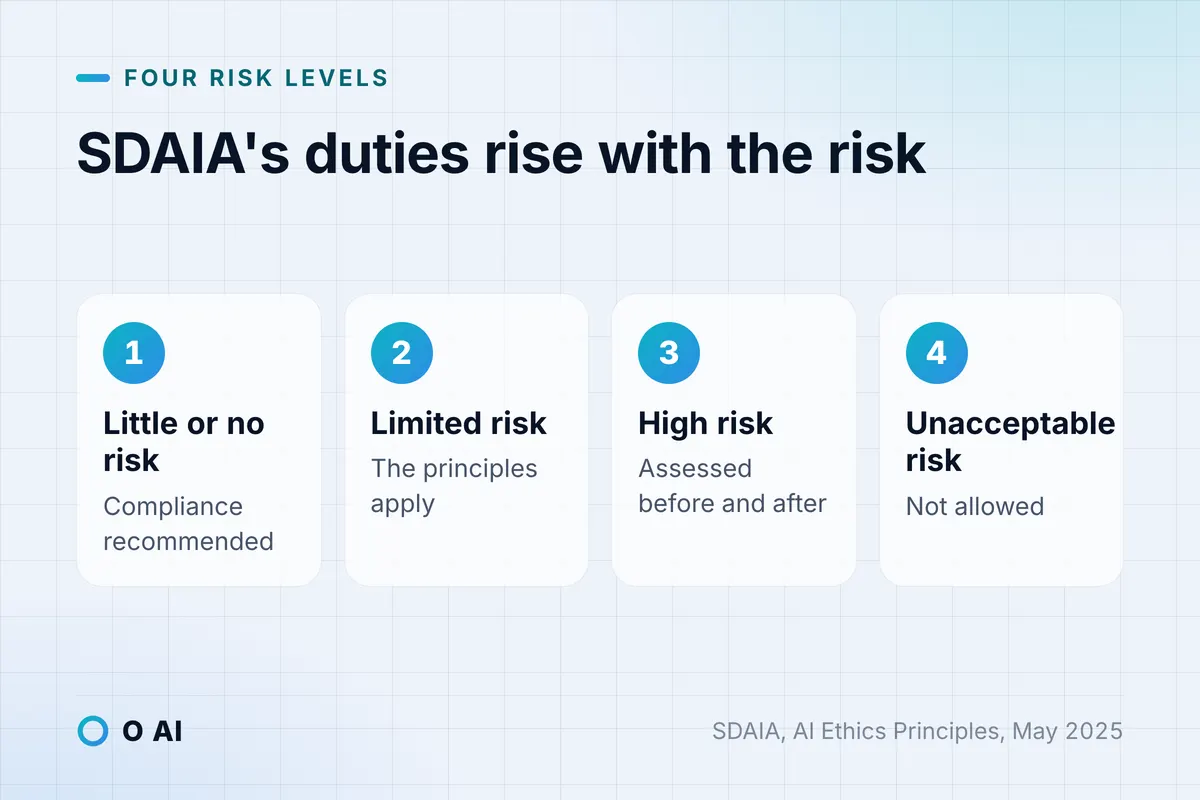
SDAIA gives no example for the high-risk level. The table below applies the definitions to common business uses. Illustrative example: it is our reading, not an SDAIA classification, so confirm the level with SDAIA or your sector regulator before you rely on it.
| AI use in a company | Who is affected | Likely level (our reading) | Why |
|---|---|---|---|
| Spam filter on company email | Staff | Little or no risk | SDAIA's own example [1] |
| Assistant drafting internal reports that staff review | Staff | Limited risk | No decision about a person; a human checks the output |
| Chat assistant answering customer questions | Customers | Limited risk, with transparency duties | Customers must know it is AI and be able to reach a person [3] |
| Shortlisting job applicants or scoring loan requests | Applicants | Treat as high risk | It affects people's access to work or finance |
| Scoring people's behaviour to steer or limit their choices | The public | Unacceptable | Social profiling and behaviour distortion are not allowed [1] |
The document also asks entities to build risk management into the project from the start, covering data, algorithm, compliance, operational, legal, reputational and regulatory risk [1]. For the scoring itself, SDAIA launched a National AI Risk Management Framework on 14 July 2026 that rates each risk on a likelihood-and-impact matrix [4]. Our adoption framework guide works through that matrix with an example, so we do not repeat it here.
Buying AI instead of building it: what changes
Many companies buy AI inside a product rather than train their own models. The principles still reach them. The document distinguishes the AI system owner, who applies or uses a system, from the developer who builds it and the assessor who audits it [1]. A company that deploys a vendor's chatbot is the owner.
Three provisions apply directly to buyers:
- Due diligence before signing. If a third party builds the system, the owner should carry out AI ethics due diligence and make sure the documentation is accessible and traceable before procurement or sign-off [1].
- Contractual guarantees. The compliance officer's duties include making third-party systems comply with the principles through contractual guarantees [1].
- Questions flagged for suppliers. Every question in the annexed checklist is marked as binding for third parties or not, so you can see which questions a supplier should be able to answer [1].
In practice, ask the supplier in writing how it tests for bias, how a person can override or stop the system, what it logs, and how it will tell you about failures or data breaches. If personal data leaves the Kingdom in the process, our guide to data residency in Saudi Arabia covers the PDPL conditions.
Who owns AI ethics inside the company
The document names four roles for adopting entities [1]. They were written with large organisations in mind, but a small company can map them onto people it already has.
| Role in SDAIA's text | Main duties in the document | In a 20-person company (illustrative) |
|---|---|---|
| Head of entity or Chief Data Officer | Approves the AI ethics plan and annual report; first point of contact with SDAIA | The general manager |
| Chief Compliance Officer or Compliance Officer | Leads the practice; checks compliance with data classification, privacy and freedom-of-information rules; secures guarantees from third parties | The finance or legal lead |
| Responsible AI Officer | Writes the AI ethics plan, sets targets and indicators, raises awareness among staff | The person who manages the AI tools day to day |
| AI System Assessor | Reviews the process and documentation periodically and publishes audit reports | An external reviewer, or a colleague who did not build or buy the system |
The point is separation: the person who chose the tool should not be the only one judging whether it behaves well.

The AI ethics checklist, self-assessment and incentive badge
The document ends with an AI ethics checklist, organised by lifecycle stage. We counted 75 questions: 28 for plan and design, 14 for preparing input data, 13 for build and validate, and 20 for deploy and monitor [1]. Each question names the principle it tests. Typical examples ask whether you designed the right level of human oversight, whether fallback plans were tested, whether end users are told the reasons behind an outcome, and whether there is a way to seek redress when something goes wrong [1].
Annex A lists supporting tools: a fairness position statement, an ethical impact assessment, an algorithm assessment, an explanation report on AI methods, a safety self-assessment and data protection methods such as anonymisation, pseudonymisation, masking, encryption and tokenisation [1].
Registration is optional. The document says SDAIA may award motivational badges that reflect a product's or entity's level of compliance [1], and on 26 May 2025 SDAIA called on AI firms to join the National Data Governance Platform to receive incentive badges for AI products [5]. The platform offers two related services:
- AI ethics self-assessment. Log in to the platform, choose the AI ethics assessment tool, compare your current practices with the set criteria, and receive a result for the ethical compliance level of your AI model [6].
- AI service provider accreditation. Register the entity on the platform, appoint an AI officer, log in from that officer's account, add a product, and complete the questionnaire with the required files. After a committee review, the product receives an incentive badge, and the entity receives an AI service provider accreditation certificate [7].
SDAIA listed the AI ethics incentive badges among the initiatives behind Saudi Arabia's fifth place for AI trust in the IMD World Competitiveness Yearbook 2026 [8].

How the principles fit with the PDPL and SDAIA's other AI documents
The ethics principles sit in a wider set of rules. In June 2026 SDAIA said it had issued 10 regulatory documents on the ethical and responsible use of AI [9]. Four related texts are worth knowing next to the principles:
- The PDPL and its implementing regulation: binding law for any processing of personal data, including inside AI tools [2].
- The Generative AI Guidelines for Public: the principles applied to chat assistants and content generation [3].
- The Deepfakes Guidelines, announced on 8 May 2026: explicit consent, protection of personal data and technical safeguards such as digital watermarks [10].
- The draft Responsible AI Policy, opened for public comment on 2 April 2026, which focuses on preventing risks and clarifying roles across the AI lifecycle [11]. SDAIA's regulations page did not list a final version when we checked on 14 October 2026 [2].
Common misreadings of SDAIA's AI ethics principles
- "They are for government entities." The scope names private companies, non-profits, workers and consumers as well [1].
- "We only use ready-made tools, so they do not concern us." A company that uses an AI system is its owner under the document, and due diligence on third-party systems is part of the transparency principle [1].
- "Low risk means nothing to do." For little-or-no-risk systems, compliance is still recommended [1].
- "A badge means we comply with the law." The badge reflects the adoption of AI ethics; PDPL obligations stand on their own [1][2].
- "Ethics is a statement of values." Every principle comes with controls for each lifecycle stage and questions you can answer yes or no [1].
Your next step
Choose the one AI system your company relies on most, whether it is a chat assistant, a scoring model or a tool inside your office suite. Place it on SDAIA's four risk levels, then answer the checklist's plan-and-design questions on human oversight and fallback plans. If the answers are mostly yes, run the AI ethics self-assessment on the National Data Governance Platform to see where SDAIA's AI ethics principles would rate it. If you are building AI into your own product, you can read about O AI, a software and AI company in Al Khobar, on our home page.
Frequently asked questions
What are SDAIA's seven AI ethics principles?
They are fairness; privacy and security; humanity; social and environmental benefits; reliability and safety; transparency and explainability; and accountability and responsibility. SDAIA attaches controls to each principle for the four stages of an AI system's life: plan and design, prepare input data, build and validate, and deploy and monitor. The document also annexes a checklist of yes-or-no questions, so a team can test a specific system against each principle rather than treat them as general values.
Are SDAIA's AI ethics principles mandatory for private companies?
The document says it applies to all AI stakeholders in Saudi Arabia, including private companies, and gives SDAIA a role in measuring compliance. It sets no fines, however, and registration and badges are optional. Penalties come from laws such as the Personal Data Protection Law. A sensible approach is to treat the principles as the national reference for responsible AI and the PDPL as the binding floor. For a specific case, check SDAIA's text or ask a licensed advisor.
Do the principles apply if we only use ready-made AI tools?
Yes. The document calls whoever applies or uses an AI system its owner, and owners carry duties too. When a third party builds the system, the owner should carry out AI ethics due diligence and make sure the documentation is accessible before procurement or sign-off. In practice that means asking the vendor how it tests for bias, how a person can override the system, what it logs and how it reports failures.
How does a company get SDAIA's AI ethics incentive badge?
Through the AI service provider accreditation service on SDAIA's National Data Governance Platform. The entity registers on the platform, appoints an AI officer, adds the product from that officer's account and completes a questionnaire with supporting files. After a committee review, the product receives an incentive badge and the entity receives an accreditation certificate as an AI service provider. Registration is voluntary.
Is there an official way to check our AI against the principles?
Yes. The National Data Governance Platform offers an AI ethics self-assessment tool. You log in, compare your current practices with the set criteria and receive a result showing the ethical compliance level of your AI model. Before using it, it helps to work through the checklist annexed to SDAIA's principles, which asks questions about human oversight, data quality, fallback plans and redress for each stage of the system's life.
How are the ethics principles different from SDAIA's AI Adoption Framework?
The ethics principles say how any AI system should behave: fair, private, safe, explainable and with named people accountable. The AI Adoption Framework is a guiding roadmap for an organisation deciding whether and how to adopt AI, with directions, guidelines and best practices. A company usually reads the adoption framework first to plan, and then applies the ethics principles to each system it builds or buys.
Do the principles cover generative AI such as chat assistants?
Yes. SDAIA says its AI ethics principles apply to all AI tools, not only generative AI. Its Generative AI Guidelines for Public apply them to chat assistants and content tools: tell people when content or replies come from AI, offer a human channel for those who want one, use watermarks where they help, check outputs for accuracy, and respect personal data and intellectual property laws.
How this article was made: Researched from the sources listed below, opened on 14 October 2026. Drafted with AI assistance, then checked against those sources. General information, not professional advice. Images are AI-generated illustrations.
Sources
- AI Ethics Principles (May 2025, SDAIA-P114E) (opens in a new tab)Saudi Data and AI Authority (SDAIA) · sdaia.gov.sa
- Laws and Regulations (opens in a new tab)Saudi Data and AI Authority (SDAIA) · sdaia.gov.sa
- Generative Artificial Intelligence Guidelines for Public (May 2025, SDAIA-P115E) (opens in a new tab)Saudi Data and AI Authority (SDAIA) · sdaia.gov.sa
- SDAIA Introduces National Framework for Managing AI Risks (14 July 2026) (opens in a new tab)Saudi Press Agency · spa.gov.sa
- SDAIA Urges AI Firms to Register on National Data Governance Platform for Incentive Badges (26 May 2025) (opens in a new tab)Saudi Press Agency · spa.gov.sa
- AI Ethics Self-Assessment (in Arabic) (opens in a new tab)SDAIA, National Data Governance Platform · dgp.sdaia.gov.sa
- Accreditation of AI Service Providers (in Arabic) (opens in a new tab)SDAIA, National Data Governance Platform · dgp.sdaia.gov.sa
- SDAIA Drives Saudi Arabia's Rise in Global AI Rankings in IMD Competitiveness Yearbook 2026 (18 June 2026) (opens in a new tab)Saudi Press Agency · spa.gov.sa
- SDAIA Builds Regulatory Environment for Data, AI to Promote Responsible Use (8 June 2026) (opens in a new tab)Saudi Press Agency · spa.gov.sa
- SDAIA Issues Deepfakes Guidelines to Regulate Responsible AI Use (8 May 2026) (opens in a new tab)Saudi Press Agency · spa.gov.sa
- SDAIA Invites Public, Entities to Share Views on Responsible AI Policy Draft (2 April 2026) (opens in a new tab)Saudi Press Agency · spa.gov.sa
About the author
Newsletter
New guides and news by email
New guides and news about O AI, Rushd and Dalni, at most twice a month. No spam.