 AI


ERP software in Saudi Arabia: a buyer's guide (ZATCA, data residency, Arabic)
A buyer's guide to ERP software in Saudi Arabia: what ZATCA's Phase 2 e-invoicing and VAT record rules mean for an ERP, where three vendors host data, how to test Arabic and what licences really cost, with a decision table and a checklist.


Key takeaways
- Shortlist an ERP only if Phase 2 e-invoicing is in the quoted plan, data and backup locations are confirmed, Arabic works with your data, and a local partner supports it.
- ZATCA's Wave 25 covers taxpayers whose VAT-subject revenue exceeded SAR 187,500 in any year from 2022 to 2025, with integration due by 1 February 2027.
- ZATCA's VAT records guideline (May 2026) says a resident taxpayer's records server must be in the Kingdom, with records kept in Arabic for at least six years.
- ZATCA's solution provider list is indicative, not an approval; a test invoice in ZATCA's simulation portal is stronger evidence than a logo.
- Licences are only part of the cost: on 14 October 2026 Business Central listed $80 to $110 per full user a month, before localisation and implementation.
On this page
- What does ERP mean, and when does a company need one?
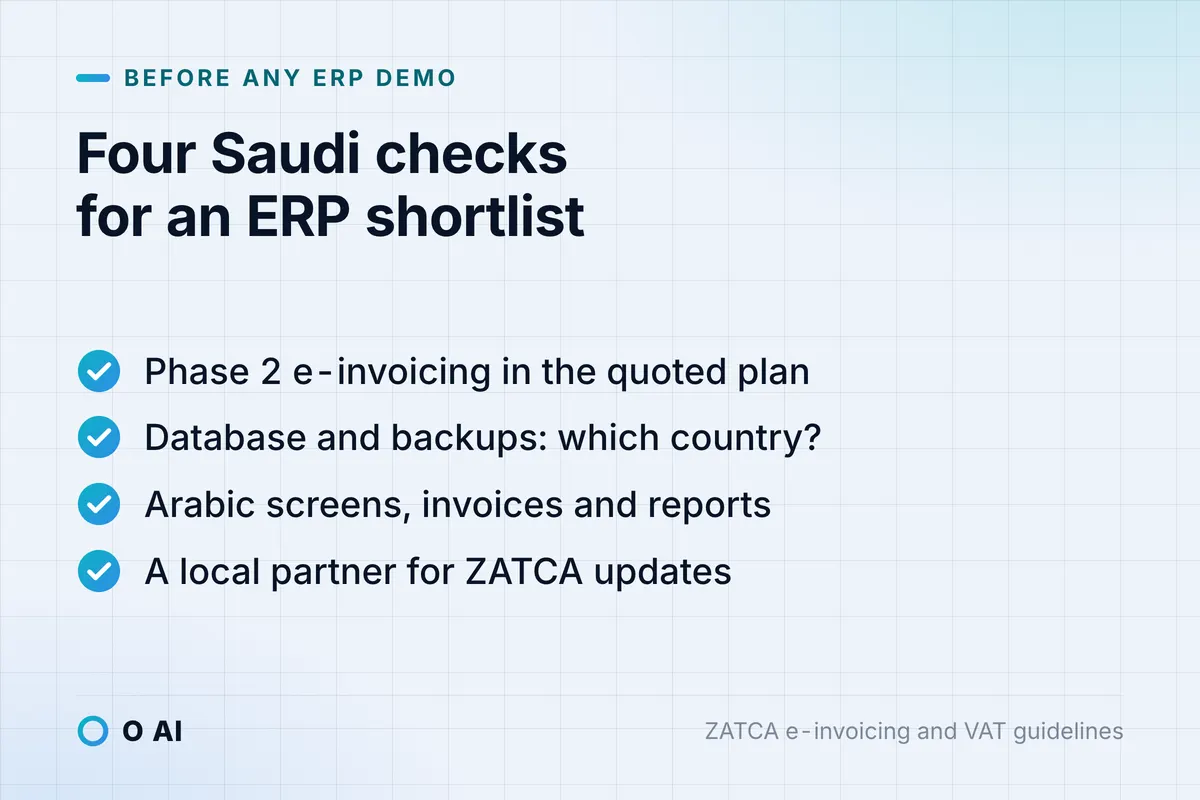
- The four Saudi checks before any ERP demo
- ZATCA e-invoicing inside an ERP: what the rules require
- ERP data residency: where your records and backups live
- Arabic support: more than a translated menu
- Vendor management in an ERP: suppliers, approvals and input VAT
- What ERP software costs: licences are the visible part
- Decision table: which ERP deployment fits your company?
- A buyer's checklist for ERP software in Saudi Arabia
- Your next step
Choosing ERP software in Saudi Arabia comes down to four checks before price: Phase 2 e-invoicing in the plan you will actually buy, where your records and backups are stored, Arabic across screens, invoices and reports, and a local partner who will implement and support it. A product that fails any one of them does not belong on the shortlist.
This guide explains each check, what the official rules say, how three well-known vendors document hosting and localisation, and how the price is built. It ends with a decision table and a checklist you can send to vendors as-is. Everything below was read on official and vendor pages on 14 October 2026; it is general information, not tax or legal advice.
What does ERP mean, and when does a company need one?
Microsoft describes enterprise resource planning (ERP) as business management software that integrates core processes across finance, supply chain, manufacturing, human resources, procurement and project management, and stores transactional and operational data in a central database [1]. In practice, the ERP system meaning is simple: one record for each customer, item, supplier and employee, used by every department instead of being typed again in each one.
Accounting software keeps the books. An ERP runs the operations that create the entries: the purchase order, the goods received, the stock movement, the sales order, the delivery and the invoice. That is why companies usually look at an ERP when several departments re-key the same data, when stock sits in more than one warehouse, when purchases need approvals, or when the group has more than one company.
Typical ERP modules:
- Finance: general ledger, receivables, payables, bank, fixed assets, VAT.
- Sales and point of sale: quotations, orders, invoices, returns and credit notes.
- Procurement: suppliers, purchase requests, approvals, purchase orders and supplier invoices.
- Inventory and warehouses: items, batches, transfers and stock counts.
- Manufacturing or projects: bills of materials, work orders, project budgets and billing.
- HR and payroll: employee files, leave and salaries, often through a local add-on.
The four Saudi checks before any ERP demo
Features look alike in every demo. These four checks decide whether a product can work for a company registered in the Kingdom.
| Check | Why it matters in Saudi Arabia | Ask the vendor to show |
|---|---|---|
| ZATCA Phase 2 e-invoicing | Once your Phase 2 wave applies, every invoice the ERP issues must come from a compliant solution integrated with ZATCA's Fatoora platform [2] | A standard and a simplified invoice sent to ZATCA's simulation environment from the plan you are quoted |
| Data location | ZATCA's VAT guideline expects a resident taxpayer's records on a computer or server in the Kingdom [3] | The country of the primary database and of every backup, in writing |
| Arabic | Tax invoices must carry all fields in Arabic, and records are kept in Arabic [3] | Arabic screens, invoice prints and VAT reports with your real data |
| Local implementation | Saudi localisation often comes from a partner, not the vendor [4] | Who builds and updates the ZATCA and Arabic parts, and a named support contact |
A gap in one check is not always fatal: a partner app may add Phase 2 or Arabic. Get the fix, its price and the name of whoever maintains it in writing before the product stays on the list.
ZATCA e-invoicing inside an ERP: what the rules require
ZATCA's e-invoicing (Fatoora) rules came in two phases: generation from 4 December 2021 and integration from 1 January 2023, rolled out in waves [2][5]. On 24 July 2026 ZATCA set the criteria for Wave 25: taxpayers whose revenue subject to VAT exceeded SAR 187,500 in 2022, 2023, 2024 or 2025 will be notified to integrate their e-invoicing solutions with the Fatoora platform by no later than 1 February 2027 [6].
Phase 2 changes how invoices leave the system [2]:
- Standard tax invoices (usually business to business) are sent to ZATCA for clearance before they are shared with the buyer. ZATCA validates the XML and returns it with its cryptographic stamp and a QR code.
- Simplified tax invoices (usually business to consumer) are stamped by your own solution and reported to ZATCA within 24 hours of issue.
- Format: invoices are generated in XML, or as PDF/A-3 with the XML embedded, and credit and debit notes follow the same route.
An ERP issues invoices from several places: sales orders, the point of sale, project billing and returns. Every one of those paths must run through the compliant e-invoicing component. ZATCA's guideline notes that an e-invoicing solution may contain one or more units [2], and each unit is onboarded to Fatoora and receives its own cryptographic stamp identifier. Ask how many units your branches, tills and companies will need.
Customisation is the second risk. ZATCA lists functions an e-invoicing solution must not have, including deleting or editing issued invoices (cancellation is only by a credit note and a new invoice), resetting the invoice counter, running more than one invoice sequence per unit, and editing system logs [2]. Any change your implementer makes to sales or invoicing screens must leave those controls intact.
Who provides the ZATCA component differs by product. Microsoft lists Saudi Arabia among the countries where Business Central is localised by partners on its international version [4]. Odoo documents a Saudi e-invoicing module, recommends testing every invoicing flow in ZATCA's simulation portal first, and warns that switching the connection to production cannot be undone [7]. Ask who maintains that component when ZATCA updates its specifications, and how fast updates reach you.
ZATCA also publishes a list of solution providers that passed its qualification process. ZATCA describes the list as indicative and not an approval of any solution, and says taxpayers may use any provider whose solution meets the requirements [8]. Being on the list is a useful signal; a live test invoice is better evidence.
ERP data residency: where your records and backups live
Hosting is where ERP options narrow fastest, because an ERP holds everything: invoices, ledgers, contracts, salaries and customer files.
ZATCA's Guideline for Tax Invoicing and Records under VAT Provisions (version 3, May 2026) says records must be retained within the Kingdom in electronic form, and that for a taxpayer resident in the Kingdom the computer or server must be located in the Kingdom. A permanent establishment may keep a central system abroad if a workstation in the Kingdom gives access to all its VAT data. Records are kept in Arabic, for at least six years, and for 15 years for real estate [3].
ZATCA's e-invoicing guideline (May 2023) adds that invoices may be stored on servers in the Kingdom or in the cloud under the VAT rules, and that cloud-hosted data must be reachable through a direct link that can be given to ZATCA for audit [2]. Read the two documents together, and ask ZATCA or a licensed tax advisor how they apply to the hosting model you are considering.
Personal data adds a second test. Article 29 of the Personal Data Protection Law, as amended by Royal Decree M/148 dated 5/9/1444H, allows personal data to be transferred outside the Kingdom only for listed purposes, without harm to national security, with an adequate level of protection based on the competent authority's assessment, and limited to the minimum data needed [9]. Employee files and customer records in an ERP hosted abroad fall within that article. Our guide to data residency in Saudi Arabia covers those conditions in detail.
What three vendors document about hosting, as of 14 October 2026:
| Product | Hosting the vendor documents | Saudi Arabia? |
|---|---|---|
| Microsoft Dynamics 365 Business Central (online) | Environments for Saudi Arabia are deployed to the Azure "UAE" geography [4]; Microsoft says its Saudi Arabia East cloud region opens in November 2026, without naming Dynamics 365 [10] | Not listed for Business Central |
| Odoo Online | Databases sit in the region the customer chooses: Europe, Americas, Asia-Pacific, Middle East and Northern Asia, or Oceania; backups are replicated to data centres in Europe and Canada, and customers cannot restrict that [11]; on-premises hosting is offered on the Custom plan [12] | No Saudi location named |
| Zoho cloud services | Lists Riyadh as the primary and Jeddah as the secondary data centre for Saudi accounts; the data centre follows the country chosen at sign-up [13] | Yes, according to the vendor |
Backups deserve their own question. A primary database in one country with backups copied to another can still mean records leave the Kingdom.
Arabic support: more than a translated menu
Arabic in an ERP is a compliance point, not only a comfort. ZATCA's VAT guideline requires invoices to be issued in Arabic in addition to any other language, with every field of the tax invoice completed in Arabic; the Arabic text is the approved version and any other language counts as a translation. Records are kept in Arabic, and data entered into an electronic system must be in Arabic [3]. The printed or PDF version of an e-invoice must also be in Arabic, with Arabic or Hindi numerals both accepted [2].
Vendor language lists vary. Microsoft's table of Business Central platform and application languages did not include Arabic on 14 October 2026; the same page says partners can supply translations for languages Microsoft does not [4]. In that case the Arabic layer is part of the partner's work, and should be tested as such.
Test Arabic with your own data, not the demo company:
- an invoice to a customer whose name and address are in Arabic, printed and saved as PDF;
- a credit note for a partial return, in Arabic;
- a search for an Arabic item name with and without diacritics and the letter hamza;
- the VAT report and the general ledger exported in Arabic;
- a mixed Arabic and English item description on a purchase order.
Vendor management in an ERP: suppliers, approvals and input VAT
When buyers search for a vendor management system, they often mean the procurement side of an ERP: the supplier master file, purchase requests and approvals, purchase orders, goods receipts and matching the supplier's invoice before payment. A separate tool can do this, but then approved invoices must flow into the ERP rather than becoming a second ledger.
The Saudi angle is input VAT. ZATCA's VAT guideline expects a business to keep a valid tax invoice in Arabic to support its deduction of input tax [3], and buyers' right to deduct VAT charged by suppliers subject to e-invoicing depends on invoices that are electronically generated and meet the generation requirements [2]. Tax invoices between registered businesses carry the buyer's VAT registration number [3].
So the procurement module should:
- store each supplier's VAT registration number and commercial details once, with approval for any change;
- keep the supplier's e-invoice file (XML or PDF/A-3) attached to the purchase invoice;
- flag supplier invoices that lack Arabic fields or your own VAT number before they are posted;
- route purchases above an amount you set to a second approver;
- match purchase order, goods receipt and invoice before payment is released.
These controls also shorten the VAT review, because every input-tax claim already has its supplier invoice attached.

What ERP software costs: licences are the visible part
ERP prices are usually per user, and the licence is only one line of the budget. Two published examples, as shown on 14 October 2026:
| Product | Published price model |
|---|---|
| Microsoft Dynamics 365 Business Central [14] | Essentials $80 and Premium $110 per user a month, paid yearly; Premium adds service management and manufacturing; Team Members, for limited access and approvals, $8 per user a month; Microsoft points buyers to a partner for consulting and additional pricing |
| Odoo [12] | One App Free: one app with unlimited users at $0; Standard (all apps) and Custom (adds Studio, multi-company and external API) per user a month; Odoo.sh hosting is not included; companies under 50 employees typically use Success Packs, and mid-size ones work with a partner |
Odoo showed prices in US dollars when we opened the page, with a discount that applies for 12 months to the initial users ordered. Microsoft's figures come from its US pricing page, which notes that prices are for information and the final price appears at checkout; a Saudi partner may quote differently. Check whether VAT is included before you compare.
Illustrative example. A distributor in Dammam has six people who work in the ERP all day and ten who only approve purchases or look up stock. On Business Central Essentials with Team Members, the licences would be 6 × $80 × 12 = $5,760, plus 10 × $8 × 12 = $960, a total of $6,720 a year. That figure still excludes the partner's Saudi localisation, implementation, data migration, integrations, training and tax.
The full budget usually includes:
- subscriptions or licences, per user, per company or per module;
- Saudi localisation: the ZATCA e-invoicing component, Arabic layouts and VAT reports, if they are sold separately;
- implementation: process design, configuration, data migration and testing;
- integrations: bank, point of sale, e-commerce, payroll and government portals;
- hosting, if you choose a private cloud or your own servers;
- training and support after go-live, with response times in writing.
Decision table: which ERP deployment fits your company?
The hosting model drives much of the compliance work. Use this table to narrow the options before you compare features.
| Deployment | Data location | ZATCA updates | Upfront effort | Fits when |
|---|---|---|---|---|
| Cloud ERP hosted outside the Kingdom | Abroad, sometimes with backups in a third country | Vendor or partner app | Low | You have confirmed with ZATCA or an advisor how the VAT records rules apply, and personal data transfers meet PDPL Article 29 |
| Cloud ERP with a documented Saudi data centre | In the Kingdom, if backups are too | Vendor or partner app | Low | You want SaaS with in-Kingdom hosting; confirm backup locations |
| Partner-hosted private cloud in the Kingdom | In the Kingdom, under the partner's contract | Partner | Medium | You need customisation and in-Kingdom hosting without your own IT team |
| On-premises in your own server room | Your premises | Your team or partner | High | You have IT staff and strict control requirements, and accept slower updates |
If none of the four fits a process that is central to how you make money, a ready-made ERP may need a custom module, or a separate system connected to it. Our guide to custom software development in Saudi Arabia explains when to buy, connect or build.
A buyer's checklist for ERP software in Saudi Arabia
Send these twelve questions to every vendor or partner in writing, and score the answers before you compare prices.
- Phase 2 in the quote: is ZATCA Phase 2 e-invoicing included in the plan and edition you are quoting, or sold separately?
- Every invoice path: do sales, point of sale, project billing and returns all issue invoices and notes through the compliant component?
- Units: how many e-invoicing units will our branches, tills and companies need, and who onboards them on Fatoora?
- Simulation test: can you send a standard and a simplified invoice from our test company to ZATCA's simulation portal before we sign?
- Updates: who maintains the ZATCA component, and within what time after ZATCA changes its specifications?
- Data location: in which country are the primary database and every backup, and can you confirm that in the contract?
- Audit access: how would ZATCA reach our records, and can we export all invoices in XML for at least six years?
- Arabic: can you show Arabic screens, invoice prints, credit notes and VAT reports with our own data?
- Procurement: does the supplier file hold VAT numbers, and does the system match orders, receipts and invoices?
- Personal data: where are employee and customer records processed, and what does that mean under PDPL Article 29?
- Total cost: what are the licence, localisation, implementation, integration, hosting and support costs for three years, with and without VAT?
- Exit: if we leave, in what format do we get our data and invoice archive, and within how many days?
Our guide to choosing a software company in Saudi Arabia suggests how to score written answers like these.
Your next step
This week, list every place your company issues an invoice today, every user who will need the system, and every branch and company. Then send the twelve questions above to three ERP vendors or partners, and ask each for a test invoice in ZATCA's simulation portal from the plan they quote. The ERP software in Saudi Arabia that passes all four checks with your own data is your shortlist; compare prices only within it. If a gap remains that no product covers, you can read about O AI, a software and AI company in Al Khobar, on our home page.
Frequently asked questions
What does ERP system mean?
An ERP (enterprise resource planning) system is business software that runs finance, sales, purchasing, inventory, HR and, where needed, manufacturing or projects on one shared database. Each customer, item, supplier and employee is recorded once and used by every department. Accounting software, by comparison, mainly records the financial result of those activities. A company usually moves to an ERP when several departments re-enter the same data or need approvals and stock control across locations.
Does ERP software in Saudi Arabia need ZATCA approval?
ZATCA does not approve or certify products. It publishes an indicative list of solution providers that passed its qualification process, and says that list is not an approval and that taxpayers may use any provider whose solution meets the e-invoicing requirements. What matters is that the ERP's invoicing component generates compliant invoices, connects to the Fatoora platform for Phase 2, and avoids the functions ZATCA prohibits. Ask for a live test in ZATCA's simulation portal before you sign.
Must ERP data be hosted inside Saudi Arabia?
ZATCA's VAT invoicing and records guideline, updated in May 2026, says records must be retained within the Kingdom in electronic form and that a resident taxpayer's computer or server must be in the Kingdom. Its e-invoicing guideline also describes cloud storage with a direct link for ZATCA's audit access. Personal data sent abroad must meet Article 29 of the Personal Data Protection Law. Confirm how these apply to your hosting with ZATCA or a licensed tax advisor.
Can an ERP replace separate e-invoicing software?
Yes, if its e-invoicing component meets ZATCA's requirements and each unit that issues invoices is onboarded to the Fatoora platform. Many ERPs handle this through a Saudi localisation app supplied by the vendor or a partner. If the ERP cannot do it, a separate e-invoicing solution can issue the invoices, but it must then receive every sale from the ERP, and the two systems must agree on numbering, credit notes and the archive.
What is a vendor management system in an ERP?
In an ERP, vendor management usually means the procurement module: the supplier file, purchase requests and approvals, purchase orders, goods receipts and matching the supplier's invoice before payment. In Saudi Arabia it should also store each supplier's VAT number and keep the supplier's e-invoice attached, because deducting input VAT depends on a valid tax invoice in Arabic. A separate vendor management tool can work if it passes approved invoices into the ERP.
How much does ERP software cost in Saudi Arabia?
Published licence prices are only part of the cost. On 14 October 2026, Microsoft listed Business Central at $80 or $110 per full user a month paid yearly, and Odoo offered one app free with paid plans per user for all apps. A realistic budget also covers Saudi localisation, implementation, data migration, integrations, hosting, training and support, plus VAT where it applies. Ask every vendor for a three-year total for the same list of users and processes.
What is the deadline for Wave 25 of ZATCA e-invoicing?
ZATCA announced on 24 July 2026 that Wave 25 covers taxpayers whose revenue subject to VAT exceeded SAR 187,500 in 2022, 2023, 2024 or 2025. ZATCA said it will notify those taxpayers to integrate their e-invoicing solutions with the Fatoora platform by no later than 1 February 2027. If you are choosing an ERP now and fall in that group, plan the go-live and testing well before that date.
How this article was made: Researched from the sources listed below, opened on 14 October 2026. Drafted with AI assistance, then checked against those sources. General information, not professional advice. Images are AI-generated illustrations.
Sources
- What is ERP? (opens in a new tab)Microsoft · microsoft.com
- Detailed Guidelines for E-Invoicing, version 2 (May 2023) (opens in a new tab)Zakat, Tax and Customs Authority (ZATCA) · zatca.gov.sa
- Guideline for Tax Invoicing and Records under VAT Provisions, version 3 (May 2026) (opens in a new tab)ZATCA · zatca.gov.sa
- Business Central: country/regional availability and supported languages (opens in a new tab)Microsoft Learn · learn.microsoft.com
- E-Invoicing (opens in a new tab)ZATCA · zatca.gov.sa
- ZATCA determines the criteria for selecting the targeted taxpayers in Wave 25 for the integration phase of e-invoicing (24 July 2026) (opens in a new tab)ZATCA · zatca.gov.sa
- Saudi Arabia fiscal localisation (opens in a new tab)Odoo documentation · odoo.com
- Solution Providers List (opens in a new tab)ZATCA · zatca.gov.sa
- Personal Data Protection Law, with amendments (in Arabic) (opens in a new tab)Bureau of Experts at the Council of Ministers · laws.boe.gov.sa
- Microsoft announces Saudi Arabia East datacenter region will be available in November 2026 (opens in a new tab)Microsoft Source EMEA · news.microsoft.com
- Odoo Cloud service level agreement (opens in a new tab)Odoo · odoo.com
- Odoo pricing (opens in a new tab)Odoo · odoo.com
- Know your datacenter (opens in a new tab)Zoho · zoho.com
- Dynamics 365 Business Central pricing (opens in a new tab)Microsoft · microsoft.com
About the author
Newsletter
New guides and news by email
New guides and news about O AI, Rushd and Dalni, at most twice a month. No spam.