 AI


Property management in Saudi Arabia: services, fees and contracts
A guide for owners hiring a property manager in Saudi Arabia: what REGA's property management licence covers, how fees and VAT are set, a worked comparison of two offers, a 10-point contract checklist, and the Ejar and Riyadh rent rules your manager must apply.

Key takeaways
- Property management is the financial and administrative running of a property for its owner; REGA licenses it for establishments only, separately from brokerage.
- No law sets property management fees; the only fixed rate is the 2.5% brokerage commission on first-year rent, which applies unless agreed otherwise in writing.
- Residential leases are VAT-exempt, but a VAT-registered manager charges 15% VAT on its own fee.
- A management contract must be written, deposited with REGA and fixed-term; without a stated term it lasts 90 days.
- Since September 2025, leases renew automatically unless notice is given 60 days ahead, and rents inside Riyadh are frozen for five years.
On this page
- What does a property management company do in Saudi Arabia?
- Who may offer property management: the FAL licence
- Property management fees: what you pay and how to compare offers
- What should a property management contract include?
- Ejar and the 2025 landlord–tenant rules your manager must follow
- How to choose among property management companies
- Common mistakes owners make with property management
- Your next step
Property management in Saudi Arabia means a licensed company runs the financial and administrative side of your property for you: letting units, registering contracts on Ejar, collecting rent, handling tenants and reporting to you. Only establishments holding a REGA property management licence may offer it, and the fee, scope and handling of your money belong in a written contract.
This guide is for owners deciding whether to hand a building, a compound or a few units to a property management company, and for what to check before signing. The rules below were read on the Real Estate General Authority (REGA), Ejar and Bureau of Experts pages on 14 October 2026. It is general information, not legal advice; for a specific case, check REGA or ask a licensed advisor.
What does a property management company do in Saudi Arabia?
The Real Estate Brokerage Law defines property management as taking over the financial and administrative affairs of a property on behalf of its owner, or the owner of its usufruct. It treats facility management separately: the technical side, such as water, gas, electricity, air conditioning, drainage and waste [1].
In practice, a property manager's work usually covers:
- Letting: marketing vacant units, screening tenants and drawing up leases.
- Ejar contracts: registering, renewing and ending leases on the Ejar network.
- Rent: following up payments, chasing arrears and transferring the balance to you.
- Tenants: requests, complaints, move-in and move-out.
- Maintenance: arranging and supervising routine repairs within a limit you approve.
- Reporting: a statement of what was collected, what was spent and what is vacant.
How much of this the company takes on is a matter for the contract. Some owners hand over everything; others keep tenant selection and delegate only collection and maintenance.
Property management, facility management or brokerage: which do you need?
These three services are often sold together, but the law and REGA's licences treat them separately.
| Service | What it covers | REGA licence | How it is usually paid |
|---|---|---|---|
| Brokerage (letting) | Finding a tenant or buyer for one deal | FAL brokerage and marketing licence, for individuals and establishments [2] | Commission of 2.5% of the first year's rent for a lease, unless agreed otherwise in writing [1] |
| Property management | Running the property's financial and administrative affairs | FAL property management licence, for establishments only [2] | A fee set in the contract; no statutory rate |
| Facility management | Running the building's technical systems | FAL facility management licence, for establishments only [2] | A fee set in the contract |
A small landlord with one or two flats may need only a broker to find tenants and register contracts. An owner of a building, a compound or a portfolio across cities usually needs property management, and sometimes a separate facility manager for the technical systems.
Who may offer property management: the FAL licence
No one may practise brokerage or offer real estate services, including property management, without a REGA licence [1]. The Executive Regulations go further: property management, facility management and real estate auctions are limited to licensed establishments, so an individual broker cannot hold this licence in their own name [3].
For an establishment, the licence conditions include [3]:
- a valid commercial registration that includes the activities to be licensed;
- a responsible manager of full legal capacity who has not been convicted of a crime involving honour or trust, unless rehabilitated, and who is qualified for the activity as REGA defines;
- payment of the licence fee;
- every employee who practises the activity passing the qualifying programme for it and being registered on REGA's platform.
A licence runs for one year and may be extended for up to five years; renewal is requested within the 60 days before it expires [3]. REGA keeps a register of licensed brokers and qualified staff that is open to inquiry [3].
To join Ejar, an office must be fully Saudi-owned, hold a commercial registration that includes leasing and managing real estate, and hold a FAL licence [4]. Ejar's homepage listed 47,305 licensed broker offices on 14 October 2026 [5].
Practising without a licence can lead to a warning, suspension of up to one year, cancellation, or a fine of up to SAR 200,000, which may be doubled for a repeat within three years [1].
What the draft property management regulation would add
On 14 May 2026, REGA put a draft property management regulation of 12 articles out for public consultation on the Istitlaa platform, alongside a draft for facility management [6]. The consultation closed on 14 June 2026 [7]. As of 14 October 2026, we found no final version published, so treat the points below as the direction of travel, not the law in force. The draft would [7]:
- limit the licence to legal persons and set its term at five years;
- forbid an owner from appointing more than one property manager for the same property;
- require rent and other money collected for the property to go into the owner's account, not the manager's;
- require financial, administrative and operational records to be kept for at least 10 years;
- require the manager to disclose any professional or financial relationship with a tenant or supplier, and any commission received from third parties;
- require an annual performance report to the owner, and a documented handover to the next manager;
- allow delegation to a third party only with the owner's explicit written approval;
- give existing operators 90 days to comply once it takes effect.
Several of these are good practice today. You can write them into your contract now, whatever the final text says.
Property management fees: what you pay and how to compare offers
Neither the Brokerage Law nor its Executive Regulations set a rate for property management fees. The only fixed figure is the brokerage commission of 2.5%, which itself applies only when the parties have not agreed otherwise in writing [1]. Management fees are therefore negotiated, and offers can look very different.
Most offers combine some of these items:
- Management fee: a percentage of rent, or a fixed amount per unit per year. Check whether the percentage applies to rent collected or rent contracted.
- Letting fee: charged when the manager finds a new tenant; this is brokerage commission.
- Renewal fee: sometimes charged when an existing lease is renewed.
- Maintenance: the cost of repairs, plus any supervision fee or mark-up the manager adds.
- Ejar fees: SAR 125 per year for a residential contract [8], and SAR 200 for the first year then SAR 400 for each additional year for a commercial contract [9].
On VAT: the lease of residential real estate is exempt [10], but the manager's fee is a separate service. A VAT-registered manager charges VAT on it at the basic rate of 15% [11], and commercial leases are not covered by the residential exemption. How this affects your own VAT position is a question for your accountant or ZATCA.
Illustrative example: two offers for a building in Dammam
Illustrative example. An owner has 12 residential apartments let at SAR 30,000 a year each, so SAR 360,000 is contracted. In a typical year, 95% is collected (SAR 342,000) and three units change tenants. Two companies make offers; the rates are assumptions for the exercise, not market prices.
| Offer A | Offer B | |
|---|---|---|
| Basis | 5% of rent collected; letting included | SAR 1,200 per unit per year, plus 2.5% of first-year rent per new tenant |
| Manager's fees | 5% × SAR 342,000 = SAR 17,100 | 12 × SAR 1,200 + 3 × SAR 750 = SAR 16,650 |
| VAT at 15% | SAR 2,565 | SAR 2,497.50 |
| Total to the manager | SAR 19,665 | SAR 19,147.50 |
| Ejar fees (12 × SAR 125) | SAR 1,500 | SAR 1,500 |
Offer B is SAR 517.50 cheaper in a good year. If collection falls to 85% (SAR 306,000), Offer A's total drops to SAR 17,595 while Offer B's stays the same. A percentage of collected rent means the manager shares the cost of vacancies and arrears; a fixed fee does not. Run the same table with your own occupancy and turnover before you choose.
What should a property management contract include?
Under the Brokerage Law, a contract between a licensed broker and the party benefiting from a real estate service must be in writing, deposited with REGA, and for a fixed term; if no term is stated, it is 90 days [1]. Brokers must use REGA's approved contract models and deposit them on REGA's electronic platform [3].
Use this checklist when you read a draft:
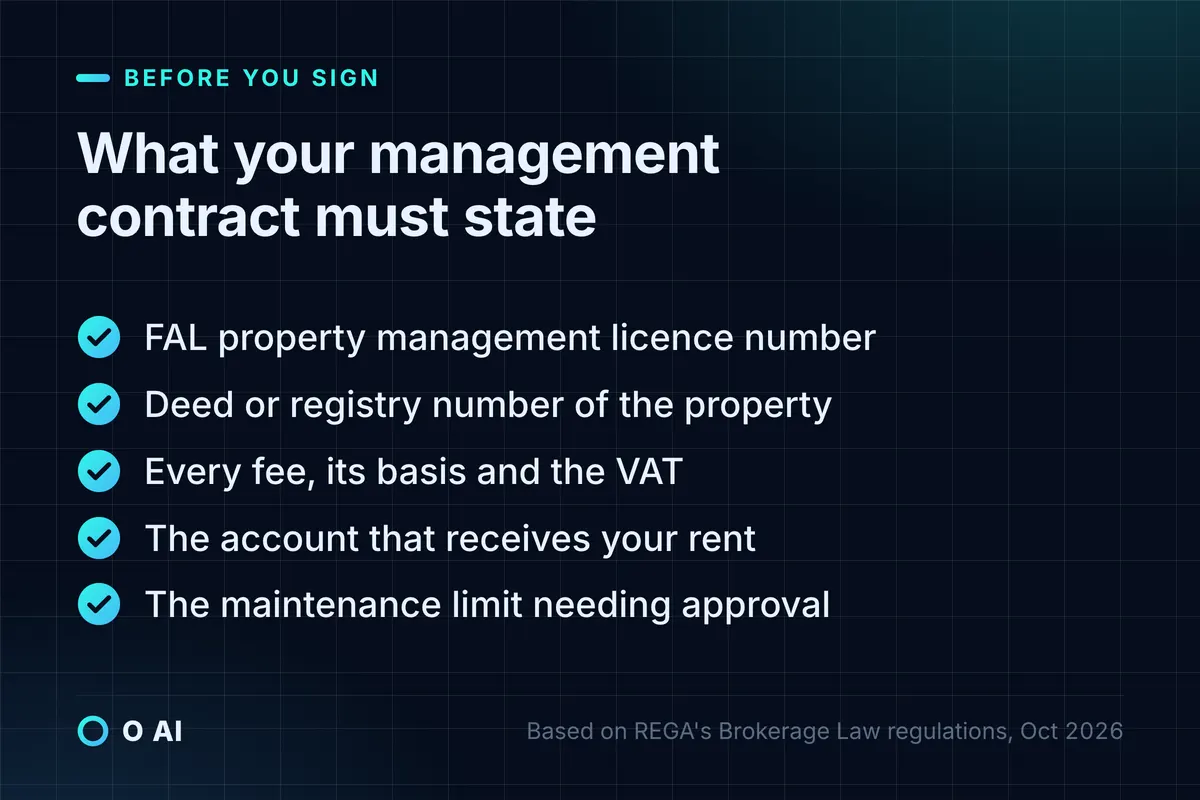
- Parties and licence: the company's commercial registration and FAL property management licence number; the Executive Regulations require the licence number on every contract [3].
- The property: the real estate registry number or deed number and date, a description, and any dispute, mortgage or restriction affecting it [3].
- Scope: exactly which tasks you delegate, from letting to eviction claims, and which you keep.
- Fees: each fee, its basis (collected or contracted rent), whether VAT is added, and who pays Ejar fees.
- Money: which account receives rent, and when the balance reaches you. Before receiving any money, the broker must complete REGA's form stating the amount, purpose and method of receipt, obtain written approval to spend it, show proof of each payment, and return what remains once the purpose ends [3].
- Maintenance limit: the amount above which the manager needs your approval.
- Reports: what you receive and how often, such as occupancy, collection rate, income and expenses.
- Term and exit: duration, notice to end, and handover of keys, files and tenant records.
- Data: how tenant and owner data is protected and returned when the contract ends.
- Disclosure: any relationship between the manager and the contractors it uses.
Ejar and the 2025 landlord–tenant rules your manager must follow
Ejar sets the frame for every residential and commercial lease a manager handles. Ejar says a broker may not use traditional contracts instead of the unified contract, and doing so can lead to a fine of up to SAR 25,000 and closure of the establishment [12]. The unified electronic contract is an enforceable instrument: an unpaid tenant can be pursued at the enforcement court without first filing a lawsuit [8].
Ejar also lists the broker's duties on its network: keeping data accurate, checking the title deed and the right to lease, registering all leases with their deeds and units, supervising signature, and protecting the parties' data [4]. For residential contracts, rent is paid through Ejar's digital channels (mada, Apple Pay or SADAD biller code 153) and reaches the landlord's bank account within 5 working days; as of October 2026, this restriction does not apply to commercial contracts [12].
In September 2025, Royal Decree M/73 dated 2/4/1447H approved new provisions on the landlord–tenant relationship [13]. A manager working for you must apply them. Two apply to leases everywhere:
- Automatic renewal: a lease renews unless either party gives notice at least 60 days before it ends [13].
- Registration: a landlord must apply to register any unregistered lease on Ejar, and the other party may object to its data within 60 days of being notified [13].
Three apply, for now, only to property in Riyadh, for five years [13]:
- Rent freeze: the total rent of existing and new residential and commercial leases may not be increased.
- Vacant units: a unit that was let before may not be offered above its last contract's rent.
- Limited grounds to refuse renewal: such as non-payment, a certified structural danger, or the owner needing a residential unit for himself or a first-degree relative.
Breaching the freeze, the renewal rule or the registration duty can bring a fine of up to 12 months' total rent for the property, plus correction of the violation [13].
A missed 60-day notice or a rent increase in Riyadh may be the manager's error, but it is your lease, and the penalty can fall on you. Ask how the company tracks notice dates and rent caps before you sign.
If you are a tenant with a complaint about a landlord or a management office, Dalni, O AI's consumer-rights guide, explains rent rights and complaints on Ejar.
How to choose among property management companies
Ask each candidate for the same documents and compare the answers in writing:
- the FAL property management licence number, checked on REGA's register, not just a brokerage licence;
- a sample owner statement and a sample tenant file, with personal data removed;
- the full fee schedule, with VAT shown separately;
- the account into which rent will be paid, and how quickly the balance reaches you;
- how notice dates, renewals and the Riyadh rent rules are tracked;
- who carries out maintenance, and whether the manager owns or is paid by those contractors.

Common mistakes owners make with property management
- Hiring a brokerage-only office. A FAL brokerage licence does not cover property management, which is limited to licensed establishments [3].
- A verbal mandate. A contract that is not written and deposited with REGA cannot be relied on [1].
- Rent paid into the manager's account with no rules. The law allows a broker to receive only what its work requires and to use it only for its purpose [1].
- Two managers on one building. Splitting units between companies blurs responsibility; the draft regulation would ban it [7].
- No maintenance limit. Without one, you approve every repair after the money is spent.
- Missing the 60-day notice. The lease renews automatically [13].

Your next step
Before signing with one of the property management companies you are considering, send them the same one-page request: your units, current rents and occupancy, the tasks you want to delegate, and the contract checklist above. Compare the written answers on the same fee table, and confirm each company's licence on REGA's register. If you manage your own units and are weighing software rather than a company, our guide to custom software development in Saudi Arabia explains when to buy and when to build. You can read more about O AI, a software and AI company in Al Khobar, on our home page.
Frequently asked questions
Do I need a licence to manage my own property?
REGA's property management licence covers managing a property on behalf of its owner, so an owner looking after their own units is not providing that service to someone else. Your leases must still be registered on Ejar, and Ejar's rules have owners join and register units through a licensed broker. If you manage property for relatives or partners, or charge anyone a fee, check with REGA, because that can amount to providing a real estate service.
How much do property management companies charge in Saudi Arabia?
There is no official rate. The Brokerage Law fixes only the brokerage commission, at 2.5% of the first year's rent for a lease unless agreed otherwise in writing, and leaves management fees to the contract. Offers usually combine a percentage of rent or a fixed fee per unit with letting, renewal and maintenance charges, plus VAT if the company is registered. Compare offers on the same table, with your own occupancy and turnover figures.
What is the difference between property management and facility management?
Property management is the financial and administrative side: leasing, contracts, rent, tenants and reporting. Facility management is the technical side: water, electricity, air conditioning, drainage, waste and similar systems. REGA issues separate FAL licences for each, and both are limited to establishments. Large buildings often need both; a small residential block may need only property management with a maintenance contractor.
Can a property manager collect rent into its own account?
Under current rules, a broker may receive only the money its work requires and must use it only for that purpose, after completing REGA's form and getting written approval to spend it. For residential leases, rent is paid through Ejar's digital channels to the landlord's registered account. REGA's 2026 draft regulation would go further and require all money collected for the property to be deposited in the owner's account.
Is the property management fee subject to VAT?
The residential lease itself is exempt from VAT, but the management fee is a separate service. If the management company is VAT-registered, it charges VAT on its fee at the basic rate of 15%. Commercial leases are not covered by the residential exemption. Because the effect on your own VAT position depends on your registration and other income, check with your accountant or ZATCA.
How can I check a company's FAL licence?
Ask for the FAL licence number and the commercial registration number, then check them against REGA's register of licensed brokers. Make sure the licence is for property management, not only brokerage and marketing, and that it has not expired. The licence number should also appear on the management contract and the company's adverts.
Can a property manager raise the rent in Riyadh?
Not during the freeze. Under the landlord–tenant provisions approved in September 2025, the total rent of existing and new residential and commercial leases inside Riyadh's urban area may not be increased for five years, and a vacant unit that was let before may not be offered above its last contract's rent. REGA's board may extend the rules to other cities, so check REGA for updates.
How this article was made: Researched from the sources listed below, opened on 14 October 2026. Drafted with AI assistance, then checked against those sources. General information, not professional advice. Images are AI-generated illustrations.
Sources
- Real Estate Brokerage Law (in Arabic) (opens in a new tab)Bureau of Experts at the Council of Ministers · laws.boe.gov.sa
- Frequently asked questions: FAL licences (in Arabic) (opens in a new tab)Real Estate General Authority (REGA) · rega.gov.sa
- Executive Regulations of the Real Estate Brokerage Law, Jumada II 1444H (in Arabic) (opens in a new tab)Real Estate General Authority (REGA) · rega.gov.sa
- The real estate broker on Ejar: eligibility and obligations (in Arabic) (opens in a new tab)Ejar · ejar.sa
- Ejar homepage and network statistics (in Arabic) (opens in a new tab)Ejar · ejar.sa
- Draft property management and facility management regulations released for consultation (in Arabic) (opens in a new tab)Real Estate General Authority (REGA) · rega.gov.sa
- Draft regulation for real estate property management (in Arabic) (opens in a new tab)Istitlaa public consultation platform · istitlaa.scbc.gov.sa
- Residential contract registration and documentation service (in Arabic) (opens in a new tab)Ejar · ejar.sa
- Commercial contract registration and documentation service (in Arabic) (opens in a new tab)Ejar · ejar.sa
- Implementing Regulations of the Value Added Tax Law (opens in a new tab)Zakat, Tax and Customs Authority (ZATCA) · zatca.gov.sa
- Value Added Tax Law, with amendments (in Arabic) (opens in a new tab)Bureau of Experts at the Council of Ministers · laws.boe.gov.sa
- Frequently asked questions (in Arabic) (opens in a new tab)Ejar · ejar.sa
- Regulatory provisions governing the landlord–tenant relationship (in Arabic) (opens in a new tab)Real Estate General Authority (REGA) · rega.gov.sa
About the author
Newsletter
New guides and news by email
New guides and news about O AI, Rushd and Dalni, at most twice a month. No spam.