 AI


Create an online store in Saudi Arabia: platform or custom build?
A step-by-step guide to creating an online store in Saudi Arabia: commercial register or freelance document, platform prices checked on 14 October 2026, payments and VAT, store authentication on business.sa, the E-Commerce Law's return and delivery rules, and when a custom build makes sense.


Key takeaways
- To sell online you need a commercial register or a freelance document plus a business bank account to authenticate the store on business.sa.
- On 14 October 2026, Salla Plus and Zid Launch cost SAR 990 a year billed annually; both platforms also offer free plans with limits.
- Customers may cancel within 7 days of receiving an unused product, and may cancel and get a refund if delivery is more than 15 days late.
- Since 29 March 2023, the Business Platform (business.sa), not Maroof, is the place to authenticate online stores.
- Breaking the E-Commerce Law can lead to a fine of up to SAR 1,000,000, suspension of e-commerce activity or blocking of the store.
On this page
- Step 1: register as a merchant or a freelancer
- Step 2: choose how to build the store
- Online store costs in Saudi Arabia, as of October 2026
- Step 3: set up payments, shipping and VAT
- Step 4: authenticate the store and publish the required details
- Step 5: write the policies your customers rely on
- When a custom-built store makes sense
- Your next step
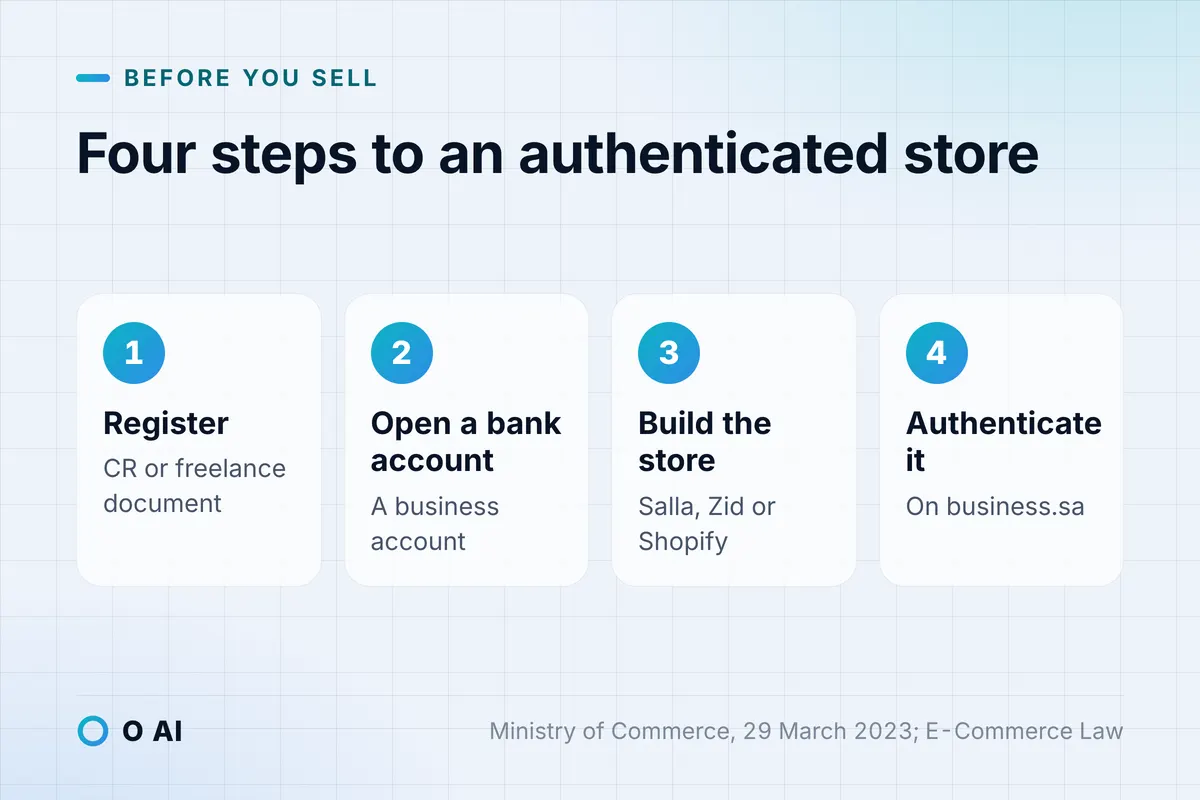
To create an online store in Saudi Arabia, register as a merchant or a freelancer, open a business bank account, build the store on a ready-made platform such as Salla, Zid or Shopify, authenticate it on the Business Platform (business.sa) and publish the details the E-Commerce Law requires. Build custom only when no platform fits.
Customers already buy locally. In the Communications, Space and Technology Commission's Saudi Internet 2025 report, 95.3% of online shoppers had bought from local websites [1]. Sellers are multiplying too: the Ministry of Commerce counted 52,259 existing commercial registrations for e-commerce at the end of the third quarter of 2026, up 25% on a year earlier [2]. The steps below follow the order in which the requirements apply. Platform prices were read on each vendor's page on 14 October 2026. This is general information, not legal advice; for a specific case, check the official source or ask a licensed advisor.
Step 1: register as a merchant or a freelancer
The E-Commerce Law covers two kinds of seller. A "merchant" is a person registered in the commercial register who carries out e-commerce; a "practitioner" does so without a commercial registration [3]. Both are service providers under the law, and both owe customers the same duties.
| Commercial register | Freelance document | |
|---|---|---|
| Who can hold it | Individual establishments and companies | Saudi nationals aged 18 or over with an active Absher account [4] |
| Status under the E-Commerce Law | Merchant [3] | Practitioner [3] |
| Store authentication | Accepted, with a business bank account [5] | Accepted, with a business bank account, in occupations on the approved list [4][5] |
| Main limits | Set by the activities on the register | Cannot be used to open a shop, recruit workers or import in commercial quantities [4] |
The freelance document is valid for one year from issue, and no fee is currently charged for it [4]. A merchant must also record the online store in the commercial register [3].
One practical point: Zid states that a commercial register is not needed to open a store on its platform, but is needed to connect payment gateways such as mada, Visa, Mastercard and Apple Pay [6]. Check what your chosen platform and payment provider accept before you choose the route.
Step 2: choose how to build the store
| Option | Fits when | Watch for |
|---|---|---|
| A Saudi hosted platform such as Salla or Zid | You sell standard products to customers in Saudi Arabia and want local payments and shipping ready to use | Plan limits, and how you would export your products and customers later |
| A global hosted platform such as Shopify | You sell across borders or want its range of add-on apps | Prices in US dollars; an extra fee when you use a third-party payment provider, 2% on the Basic plan [7] |
| Open-source store software on your own hosting | You have a developer to install, secure and update it | Security updates, hosting and payment integration become your job |
| A custom-built store | Your model does not fit a standard checkout, as described later in this guide | Build cost and years of maintenance |
Which is the best website to create an online store?
No single platform is best for every seller. Compare the candidates on five points: the total yearly cost at your expected order volume; the payment methods and their fees; shipping integrations for the cities you serve; Arabic storefront and VAT invoices; and how easily you can export your data if you move. A free trial on two platforms with ten real products answers most of these in a week.

Online store costs in Saudi Arabia, as of October 2026
The table shows each platform's plans as its own page displayed them on 14 October 2026.
| Platform | Free plan | Entry paid plan | Next plan | Notes |
|---|---|---|---|---|
| Salla [8] | Basic: free, with unlimited products, orders and customers; electronic payment is listed from Plus | Plus: SAR 990 a year, or SAR 1,188 a year when paid monthly | Pro: SAR 2,990 a year, or SAR 3,588 when paid monthly | Pro adds instant VAT activation and staff accounts |
| Zid [6] | Starter: free, with unlimited products; bank transfer and cash on delivery only; no custom domain | Launch: SAR 99 a month or SAR 990 a year | Growth: SAR 299 a month or SAR 2,990 a year | No sales commission on paid plans; free domain from Growth |
| Shopify [7] | A 3-day free trial, then $1 a month for the first 3 months | Basic: $27 a month, or $19 a month billed yearly | Grow: $72 a month, or $54 a month billed yearly | Third-party payment fee of 2% on Basic, 1% on Grow |
On these figures, the software for a year on an entry paid plan costs SAR 990 on Salla Plus or Zid Launch billed annually, or $228 on Shopify Basic billed yearly (12 × $19). The software is rarely the largest cost. Budget also for:
- Payment processing: a fee per card transaction, shown in each provider's payment settings.
- Shipping: a cost per parcel; Zid says its shipping service connects a store with more than 30 carriers through one electronic contract, and Salla offers discounted shipping waybills [6][8].
- Domain, themes and apps: some plans include a domain, and paid add-ons accumulate.
- Packaging, product photos and returns.
- VAT: charged at 15% on taxable supplies [9]; check whether a platform's displayed price includes it.
Can you create an online store for free?
You can start one for free: Salla Basic and Zid Starter cost nothing [6][8]. Two limits appear quickly. Card payments are not part of these free plans as described on the pricing pages, so customers would pay by bank transfer or cash on delivery. And authentication on the Business Platform requires a commercial register or freelance document plus a business bank account, whatever plan you use [5]. Free software, in other words, does not mean a free legal set-up.
Step 3: set up payments, shipping and VAT
Payments. Zid's payment service supports mada, Visa and Mastercard, Apple Pay, and buy-now-pay-later through Tabby and Tamara [6]. Whichever platform you use, the money should land in a business account: the Ministry of Commerce made a business bank account a condition of store authentication to strengthen trust and reduce fraud [5].
Delivery promise. Unless you agree another period with the customer, the customer may cancel and recover what they paid if delivery is late by more than 15 days from the contract date or the agreed date, except in force majeure, and you must tell them about expected delays [3]. State realistic delivery times for each city at checkout.
VAT. The standard rate is 15% [9]. ZATCA's VAT Implementing Regulations require a business that is not registered to check, at the end of each month, the value of its supplies over the previous 12 months; once that value exceeds the mandatory registration threshold set in the GCC VAT Agreement, it must apply to register within 30 days [10]. Check the current threshold with ZATCA, and choose a plan that can show VAT on invoices once you register.
Invoices. After each sale, the law requires an invoice showing the cost of each product, the total price including fees, taxes and delivery charges, and the delivery date and place [3].
Step 4: authenticate the store and publish the required details
Since 29 March 2023, the Ministry of Commerce has directed online store owners to authenticate their stores on the Business Platform (business.sa), in place of the Maroof platform. The ministry calls it the only place to verify and register e-stores in the Kingdom [5].
The E-Commerce Law's Implementing Regulations list what an authentication body needs, including the provider's name, address and contact details, whether it is a merchant or a practitioner, its identity or commercial register details, the platform it sells through and any licences [11]. Once authenticated, the store must display its authentication statement clearly and report changes to its details within 30 days [11].
On the store itself, the law requires:
- the seller's name or distinguishing mark and address, unless registered with an authentication body;
- contact details;
- the name and number of the commercial register or other public register, where there is one [3];
- under the Implementing Regulations, a privacy policy, the procedure for receiving and handling complaints, and the tax number where there is one [11];
- for regulated professions, the licensing body and licence details [3].
Step 5: write the policies your customers rely on
| Rule | What the law says | What to publish |
|---|---|---|
| Cancellation | The customer may cancel within 7 days of receiving the product if it has not been used, and bears the costs unless agreed otherwise [3] | A return policy explaining how to request a return and who pays shipping |
| Exceptions | No cancellation right for, among others, items made to the customer's specification (unless defective or not as agreed), used recordings and software, newspapers and books, and downloaded software (unless defective) [3] | Which of your products cannot be returned, and why |
| Late delivery | Cancellation and refund when delivery is more than 15 days late, unless force majeure [3] | Delivery times per city and how you announce delays |
| Before the order | The total price including fees, taxes and delivery; payment, delivery and warranty terms [3] | A clear checkout summary |
| Personal data | Keep it only as long as the transaction needs, and do not use or disclose it without consent [3]; tell the ministry and the customer within 3 days of a breach [11] | A privacy policy that matches what you actually do |
| Advertising | Online adverts bind the seller; no misleading claims or trademarks you have no right to use [3] | Check every offer and product image before it goes live |
Breaches can lead to a warning, a fine of up to SAR 1,000,000, a temporary or permanent suspension of e-commerce activity, or blocking of the store [3].
When a custom-built store makes sense
Ready-made platforms cover most stores. A custom build, or custom parts around a platform, starts to make sense when:
- Many sellers share one marketplace. Commissions, payouts and seller onboarding go beyond a single-shop checkout; the law also lets the ministry regulate platforms that mediate between sellers and consumers [3].
- You sell to businesses. Customer-specific price lists, credit terms and quotes before orders.
- Stock lives in another system. Real-time links to an ERP, a warehouse system or branch points of sale.
- The product is a subscription or a booking. Recurring billing, capacity and appointment slots.
A common middle route is to keep the platform storefront and build only the integration it lacks. Our guide to custom software development in Saudi Arabia explains the cost drivers, and 10 questions to ask before you sign helps you compare providers. O AI is one Saudi company that builds custom software and integrations of this kind.

Your next step
This week, decide between a commercial register and a freelance document, and open the business bank account that authentication requires. Then build your catalogue on the free plan of two platforms with ten real products and compare the checkout, payment options and shipping for your cities. Draft the return, delivery and privacy policies before you authenticate. Taken in that order, the steps to create an online store in Saudi Arabia are manageable in a few weeks.
Frequently asked questions
Do I need a commercial register to open an online store in Saudi Arabia?
Not necessarily. The E-Commerce Law covers sellers with a commercial register and those without one. To authenticate a store on the Business Platform (business.sa), you need either a commercial register or a valid freelance document, plus a business bank account. Some platforms require a commercial register before connecting card payment gateways, and a freelance document cannot be used to open a shop or import in commercial quantities.
Can I create an online store for free?
Yes, to start. Salla's Basic plan and Zid's Starter plan are free and allow unlimited products. On the pricing pages, card payments appear in paid plans, so a free store would rely on bank transfer or cash on delivery. Store authentication still needs a commercial register or freelance document and a business bank account, and you will pay for shipping, packaging and any domain.
What is the best website to create an online store?
There is no single best platform. Salla and Zid are built around the Saudi market, with local payment and shipping services; Shopify suits sellers who need cross-border features or its app range. Compare total yearly cost at your expected volume, payment methods and fees, shipping coverage, Arabic and VAT invoicing, and how easily you can export your data. A one-week trial with real products usually settles it.
How much does it cost to create an online store in Saudi Arabia?
On 14 October 2026, entry paid plans cost SAR 990 a year on Salla Plus or Zid Launch billed annually, and Shopify Basic cost $19 a month billed yearly. Free plans exist on Salla and Zid. On top of the software, budget for card processing fees, shipping per parcel, packaging, product photos, returns, any paid themes or apps, and VAT at 15% once you are registered.
Is Maroof still used to authenticate online stores?
No. Since 29 March 2023, the Ministry of Commerce has directed store owners to authenticate on the Business Platform at business.sa instead of Maroof. The ministry describes it as the only place to verify and register online stores in the Kingdom. Authentication requires a commercial register or valid freelance document and a business bank account.
Do I have to accept returns from online customers?
Under the E-Commerce Law, a customer may cancel within 7 days of receiving a product if it has not been used, and normally bears the cost of cancellation unless you agree otherwise. Some items are excluded, such as products made to the customer's specification and downloaded software, unless defective. Customers may also cancel and get a refund if delivery is more than 15 days late without force majeure.
Does an online store need to register for VAT?
It depends on sales. ZATCA's rules require an unregistered business to check its supplies over the previous 12 months at the end of every month, and to apply within 30 days once they exceed the mandatory registration threshold in the GCC VAT Agreement. The standard rate is 15%. Check the current threshold and your own position with ZATCA or a licensed tax advisor.
How this article was made: Researched from the sources listed below, opened on 14 October 2026. Drafted with AI assistance, then checked against those sources. General information, not professional advice. Images are AI-generated illustrations.
Sources
- Saudi Internet 2025 (opens in a new tab)Communications, Space and Technology Commission (CST) · cst.gov.sa
- Business Sector Bulletin, Q3 2026 (in Arabic) (opens in a new tab)Ministry of Commerce · mc.gov.sa
- E-Commerce Law (in Arabic) (opens in a new tab)Bureau of Experts at the Council of Ministers · laws.boe.gov.sa
- Frequently asked questions (in Arabic) (opens in a new tab)Freelance platform (freelance.sa) · freelance.sa
- E-stores can now be registered via Business Platform instead of Maroof (opens in a new tab)Ministry of Commerce · mc.gov.sa
- Pricing (opens in a new tab)Zid · zid.sa
- Pricing (Saudi Arabia) (opens in a new tab)Shopify · shopify.com
- Salla plans (in Arabic) (opens in a new tab)Salla · salla.com
- Value Added Tax Law, with amendments (in Arabic) (opens in a new tab)Bureau of Experts at the Council of Ministers · laws.boe.gov.sa
- VAT Implementing Regulations (opens in a new tab)Zakat, Tax and Customs Authority (ZATCA) · zatca.gov.sa
- Implementing Regulations of the E-Commerce Law (in Arabic) (opens in a new tab)Ministry of Commerce · mc.gov.sa
About the author
Newsletter
New guides and news by email
New guides and news about O AI, Rushd and Dalni, at most twice a month. No spam.