 AI


Freelance app developer or a company? Cost, risk and who owns the code
A freelancer or a company for your app? This guide compares two-year cost with an illustrative example, sets the risks side by side, explains who owns commissioned code under Saudi Arabia's Copyright Law from 12 August 2026, and gives an eight-point contract checklist.


Key takeaways
- A freelancer fits a small, well-defined app you can test and maintain; a company fits apps with payments, personal data or long-term support.
- Compare total cost over two years on the same scope: design, testing, your staff time, maintenance and replacement risk narrow the gap.
- Under Article 18(2) of Saudi Arabia's Copyright Law, economic rights in commissioned work stay with the author unless agreed otherwise.
- The new Copyright Law was published on 13 February 2026 and takes effect 180 days later, on 12 August 2026.
- The freelance document is issued to Saudi nationals aged 18 or over, is valid for one year and can be checked on freelance.sa.
On this page
- Freelance app developer vs company: which fits your project?
- What each option really costs
- The risks side by side
- Who owns the code? What Saudi copyright law says
- Hiring a freelance app programmer in Saudi Arabia: what to check
- Middle routes between a freelancer and a company
- A contract checklist for hiring a freelancer
- Your next step
Hire a freelance app developer when the app is small, the scope is written down and you can test and maintain it; choose a company when it handles payments or personal data, needs several skills or must be supported for years. Either way, Saudi copyright law leaves commissioned code with its author unless your contract transfers it.
This guide compares a freelance app developer vs a company on three things: what you really pay over two years, what can go wrong, and who owns the code at the end. If you have already decided to hire a company, our 10 questions to ask before you sign cover the comparison between candidates; this article comes one step earlier. O AI, which publishes this guide, is itself a Saudi software company, so we have kept the comparison to facts you can check. Nothing here is legal advice; for your own contract, ask a licensed lawyer.
Freelance app developer vs company: which fits your project?
Start from the project, not from the price. The table shows where each option usually fits.
| Your project | Leans towards | Why |
|---|---|---|
| A prototype to test an idea, with no personal data | A freelancer | One person can build it, and a mistake costs little |
| An internal tool for a small team | A freelancer, with the code kept in your own repository | The scope is narrow, and another developer can take over if the code is documented |
| A customer app with sign-in, payments, or health or financial data | A company, or a freelancer whose work an independent reviewer checks | It needs design, back-end, security and testing skills, and someone accountable for support |
| An app that must be updated for every new iOS and Android version for years | A company or a developer you employ | Continuity matters more than the first quote |
| An app connected to your ERP, a payment gateway or government services | A company | Integrations need several specialists and long-term support |
Many projects sit between two rows. The middle routes later in this guide cover them.
What each option really costs
The quote is only one line of the cost. Both options carry the same other lines, and the difference is who pays for them.
- Build: the figure in the quote.
- Design: Arabic and English screens; a freelancer's quote may assume you supply the designs.
- Testing: on real iPhones and Android phones, by someone other than the person who wrote the code.
- Store accounts: Apple's Developer Program at 99 USD a year and a US$25 one-time Google Play registration fee, both in your company's name [5][7].
- Hosting and paid services: servers, text messages, maps and email, usually billed monthly.
- Maintenance: fixes and updates after each new operating-system release.
- Your own time: someone on your side writes requirements, answers questions and tests each delivery.
- Replacement cost: what it takes for a new developer to understand the code if the first one leaves.
A company usually prices project management, design and testing into its quote. With a freelancer, you often carry those lines yourself, as time or as separate contracts.
Illustrative example: a booking app for a car-wash chain in Dammam
Illustrative example. Every amount below is an assumption chosen to show the method, not a market rate; replace each one with your own quotes. A car-wash chain wants customers to book a slot and pay on site. It receives two quotes on the same written scope and compares them over two years.
| Cost line over two years | Freelancer | Company |
|---|---|---|
| Build, as quoted | SAR 40,000 | SAR 85,000 |
| Design bought separately | SAR 8,000 | Included |
| Your staff time managing and testing, at an assumed SAR 150 an hour | 60 hours: SAR 9,000 | 20 hours: SAR 3,000 |
| Maintenance for two years, as quoted | SAR 12,000 | SAR 18,000 |
| Reserve for a new developer to take over if the first one leaves | SAR 12,000 | Not needed under the support contract |
| Store accounts for two years | 2 × 99 USD plus US$25 | 2 × 99 USD plus US$25 |
| Total, excluding store fees | SAR 81,000 | SAR 106,000 |
On the quotes alone the gap is SAR 45,000; over two years it narrows to SAR 25,000. With different assumptions it can close entirely or widen. The method is the point: compare total cost over the period you will run the app, not the first figure.
The risks side by side
| Risk | With a freelancer | With a company | How to reduce it |
|---|---|---|---|
| The developer becomes unavailable | One person; work stops | A team can usually continue | Name a backup in the contract; keep the code and documentation in your own accounts |
| Missing skills | Design, security or testing may be outside one person's skills | Usually covered in-house or by named subcontractors | Buy design separately; pay for an independent code review at key milestones |
| Accountability | An individual; check their freelance document | A registered entity; check its commercial register | A written contract with milestones and acceptance tests |
| Support after launch | Depends on the person's availability | A support contract with response times | Put the support period and response times in writing |
| Personal data | The freelancer processes your customers' data on your behalf | The same, often with more formal controls | Data terms in the contract; see our guide to data residency in Saudi Arabia |
| Price | A lower quote | A higher quote | Compare two-year cost on the same scope |
Who owns the code? What Saudi copyright law says
Saudi Arabia's new Copyright Law was published in the Umm Al-Qura official gazette on 13 February 2026 and takes effect 180 days after publication [1], which is 12 August 2026 [2]. It replaces the 2003 law issued by Royal Decree M/41 [1]. Four of its provisions matter for anyone paying for an app.
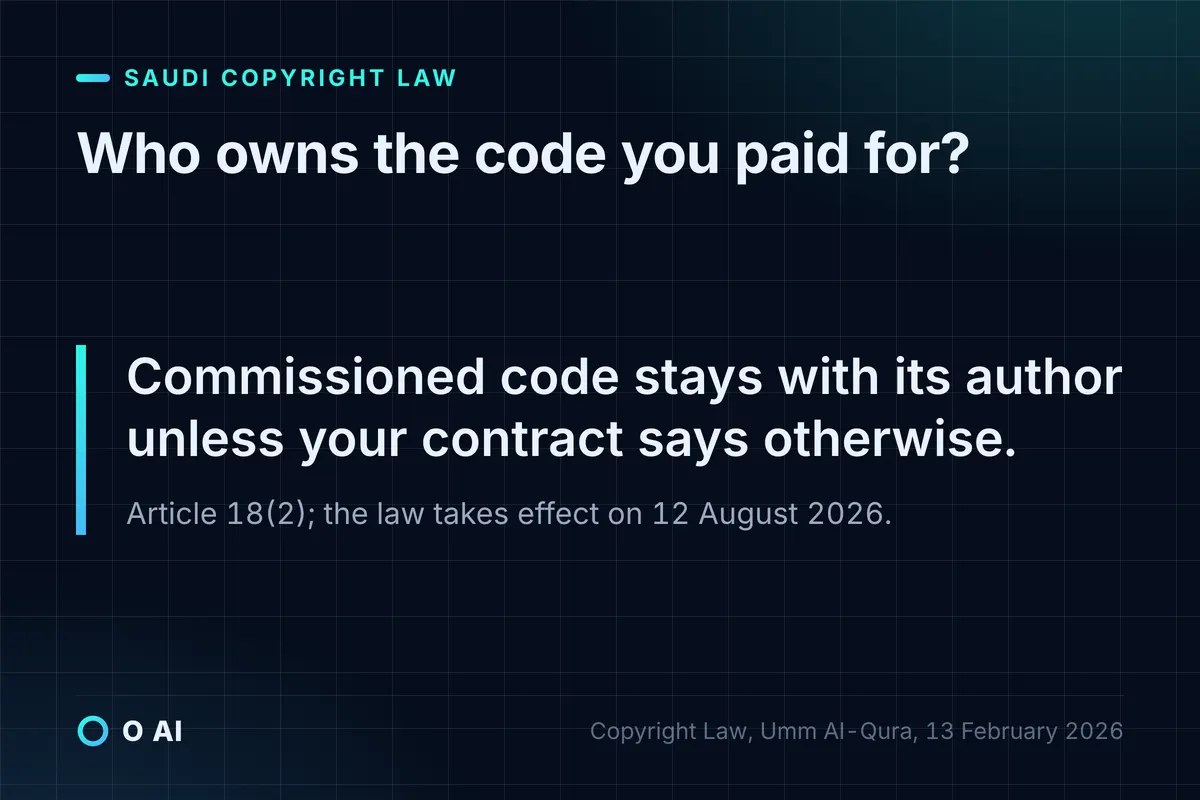
- Commissioned work stays with the author. Article 18(2): when a work is created for another person, the author's economic rights belong to the author unless agreed otherwise [1]. Paying a freelancer or a company does not, by itself, transfer the code to you.
- Employees' work goes to the employer. Article 18(1): when an employee creates a work during their work that relates to the employer's activities, the copyright belongs to the employer unless agreed otherwise [1]. A company that builds with its own staff therefore usually holds the rights it would transfer to you; ask how it treats code written by its own subcontractors.
- Rights move by a disposition. Article 10: the economic rights pass, in whole or in part, by a lawful disposition [1]. In practice, that means a clear clause in your contract assigning the rights to your company.
- Software follows its licence. Article 12: computer programs, applications and databases are subject to the licence that accompanies them [1]. Open-source libraries and paid components inside your app keep their own licences, so ask for a list.
Platform terms can supply the agreement that Article 18(2) mentions. Mostaql's terms, for example, state that the project owner holds all intellectual property and copyright in projects received through the platform, unless the parties agreed otherwise before the project started [3]. Outside a platform, you need your own written clause.
The law also says its implementing regulation will set further details for Article 18 [1], so check for it before you sign a long contract. This section is general information; ask a licensed lawyer to review your contract.
Hiring a freelance app programmer in Saudi Arabia: what to check
The freelance document. The national freelance platform, freelance.sa, issues the freelance document, which records the holder as a freelancer in the Ministry of Human Resources and Social Development's system. It is open to Saudi nationals aged 18 or over with an active Absher account. The document is valid for one year from issue, no fee is currently charged, and each person can hold up to five documents in different occupations [4]. A client can confirm a document through the platform's document verification service [4]. The platform also states that agreements between a document holder and outside parties fall outside the ministry's scope, and that a contract setting out terms and conditions is the first way to protect rights [4].
Freelance platforms. On Mostaql, the project amount is reserved from the owner's balance when an offer is accepted and released to the freelancer when the owner accepts delivery; once delivery is accepted, the project is closed and can no longer be cancelled [6]. Test every function before you accept. Mostaql takes its commission from the freelancer, while the project owner pays fees that cover platform services and payment gateways [3].
Store accounts in your company's name. Apple asks an organisation for a legal entity, a D-U-N-S Number and a public website on its own domain [8]; Google Play also requires a D-U-N-S Number for an organisation account [9]. Open these accounts yourself and add the developer as a member, so the app never depends on someone else's account.
Developers outside Saudi Arabia. The freelance document is for Saudi nationals [4]. A developer abroad works under a different legal system, so the contract's governing law, the ownership clause and any transfer of personal data outside the Kingdom need more care.

Middle routes between a freelancer and a company
| Route | When it fits | Watch for |
|---|---|---|
| A freelancer, plus an independent code review at each milestone | A modest budget, but the app will hold customer data | Pay the reviewer directly, not through the freelancer |
| A company builds the first version, then a freelancer maintains it | The build is complex, but changes after launch are small | Handover documentation and a short paid overlap between them |
| A small studio of two to five people | You want a team without a large company's overheads | Who covers if a key person leaves |
| Employing a developer | The app is core to your business and will change every month | Under Article 18(1), work an employee creates for your business belongs to you unless agreed otherwise |
A contract checklist for hiring a freelancer
These points come from the ownership rules above and complement the 10 questions you would ask any provider.
- An assignment clause covering source code, designs and documentation, made in your company's name.
- A list of third-party components and the licence of each.
- Accounts in your name from the first day: code repository, App Store and Google Play, domain, cloud and any paid services.
- Milestone payments released only after acceptance tests on real devices.
- A named backup or a handover plan if the freelancer is unavailable for more than an agreed number of days.
- Documentation good enough for another developer to build and run the app from the repository alone.
- Data terms if the app touches personal data: purpose, security, where data is stored, and deletion at the end.
- A support period after launch, with response times for faults.
Your next step
Write a one-page scope for your app, place it in the decision table above, and ask at least two freelancers and two companies to quote on that same page. Compare the two-year cost, not the first figure, and do not pay a deposit until the contract assigns the code to your company and the accounts are in your name. Whichever you choose, a freelance app developer vs company decision made this way rests on evidence rather than on the lowest quote.
Frequently asked questions
Is a freelance app developer cheaper than a company?
The quote is usually lower, because a freelancer carries fewer overheads. The total can be closer than it looks once you add design, testing, your own staff time, maintenance and the cost of replacing the developer if they leave. Ask both for quotes on the same written scope and compare the cost over two years. For a small, well-defined app, a freelancer often remains the cheaper route.
Who owns the code if I hire a freelancer?
Under Saudi Arabia's Copyright Law, which takes effect on 12 August 2026, the economic rights in a work created for another person stay with the author unless the parties agree otherwise. Paying for the work does not transfer it by itself. Put a written assignment of the source code, designs and documentation to your company in the contract, or rely on a platform whose terms give the client those rights, and ask a lawyer to review it.
Can I hire a freelancer who is not Saudi or lives abroad?
The Saudi freelance document is issued to Saudi nationals aged 18 or over. You can still contract with developers abroad, but the agreement then sits under another legal system. Make the governing law, the ownership clause and the payment milestones explicit, keep all accounts in your company's name, and check the conditions for sending personal data outside the Kingdom before any customer data reaches them.
Is hiring through a freelance platform safer than a direct contract?
A platform adds structure: Mostaql, for example, holds the project amount once you accept an offer and releases it only when you accept delivery, and its terms give the project owner the intellectual property by default. The limits are that accepted work cannot be reopened, and complex apps need more than a platform's standard terms. For larger projects, add your own written scope, milestones and support terms.
What happens if the freelancer disappears halfway through the project?
If the code, accounts and documentation are already in your company's name, another developer can continue, at the cost of learning the code. If they are not, you may have to start again. Protect yourself before it happens: pay by milestone, keep the repository and store accounts under your control from the first day, require documentation with each delivery and name a backup in the contract.
Should the developer publish the app under their own store account?
No. Open your company's Apple and Google Play developer accounts and add the developer as a member. An organisation account with Apple needs a legal entity, a D-U-N-S Number and a public website on its own domain, and Google Play also asks organisations for a D-U-N-S Number, so start early. An app published under a freelancer's account can be hard to move later.
How do I check that a freelancer is registered?
Ask for their freelance document number and confirm it through the document verification service on the national freelance platform, freelance.sa. The document shows the holder is registered as a freelancer in a stated occupation; it does not judge the quality of their work. Check portfolios, speak to past clients and set a small paid first milestone.
How this article was made: Researched from the sources listed below, opened on 14 October 2026. Drafted with AI assistance, then checked against those sources. General information, not professional advice. Images are AI-generated illustrations.
Sources
- Copyright Law (in Arabic) (opens in a new tab)Umm Al-Qura official gazette · uqn.gov.sa
- Saudi Arabia: new Copyright Law modernises KSA IP framework (opens in a new tab)Baker McKenzie · bakermckenzie.com
- Frequently asked questions (in Arabic) (opens in a new tab)Mostaql · mostaql.com
- Frequently asked questions (in Arabic) (opens in a new tab)Freelance platform (freelance.sa) · freelance.sa
- Apple Developer Program (opens in a new tab)Apple Developer · developer.apple.com
- Your rights guarantee (in Arabic) (opens in a new tab)Mostaql · mostaql.com
- Get started with Play Console: registration fee (opens in a new tab)Play Console Help · support.google.com
- Program enrollment (opens in a new tab)Apple Developer · developer.apple.com
- Choose a developer account type (opens in a new tab)Play Console Help · support.google.com
About the author
Newsletter
New guides and news by email
New guides and news about O AI, Rushd and Dalni, at most twice a month. No spam.