 AI


AI prompts: a guide to writing them, plus 50 ready-to-use work prompts
A practical guide to AI prompts for office work in Saudi Arabia: the five parts of a good prompt, seven techniques drawn from OpenAI, Google, Microsoft and Anthropic guidance, a privacy and review checklist, and 50 ready-to-use prompts organised by task.


Key takeaways
- A good work prompt has up to five parts: role, task, context, source and format. Only a clear task is essential; add the rest for anything that leaves the company.
- Give the reason behind an instruction, add 3 to 5 examples of the output you want, and put long documents before your question.
- Never paste names, ID numbers, phone numbers or bank details unless the tool is approved for them; Saudi Arabia's PDPL treats all of these as personal data.
- Treat every answer as a first draft: check figures, names, references and promises before anything is sent.
- Keep tested prompts in a shared library with the owner, the date last tested and what to check, and review it every quarter.
On this page
- What is a prompt, and why do AI prompts change the answer?
- The five parts of a good work prompt
- Before and after: one prompt rewritten
- Seven techniques that make AI prompts more reliable
- 50 ready-to-use AI prompts for work, by task
- What should never go into a prompt?
- Check every answer before you use it
- Save your best prompts and reuse them
- Your next step
Good AI prompts read like a clear brief to a capable new colleague. Say what you want produced, who it is for, why it matters, what material to use and the format you need back, then check the answer and refine it. This guide gives the method, a worked example and 50 work prompts to copy.
The method draws on the prompting guides that OpenAI, Google, Microsoft and Anthropic publish for their own assistants, all read on 14 October 2026. The prompts work in ChatGPT, Gemini, Copilot, Claude or any similar assistant, in Arabic or English. O AI is not affiliated with OpenAI or any other company named here.
What is a prompt, and why do AI prompts change the answer?
OpenAI describes a prompt as the input that starts a conversation or triggers a response from a language model. It is usually text, but it can also be an image or audio [1]. The model works only from that prompt and whatever you attach. It does not know your company, your customer or the tone your manager expects unless you tell it.
OpenAI's help centre suggests writing to the model as you would to a person: "do this task for me" without context rarely gets what you wanted, while clear, detailed instructions raise the chance of success [2]. Google adds: write as if speaking to another person, in short, specific sentences [3].
Anthropic puts it most memorably. Treat the assistant as a brilliant but new employee who lacks context on your norms and workflows, and apply a "golden rule": if a colleague with no background would be confused by your prompt, the model will be too [5].
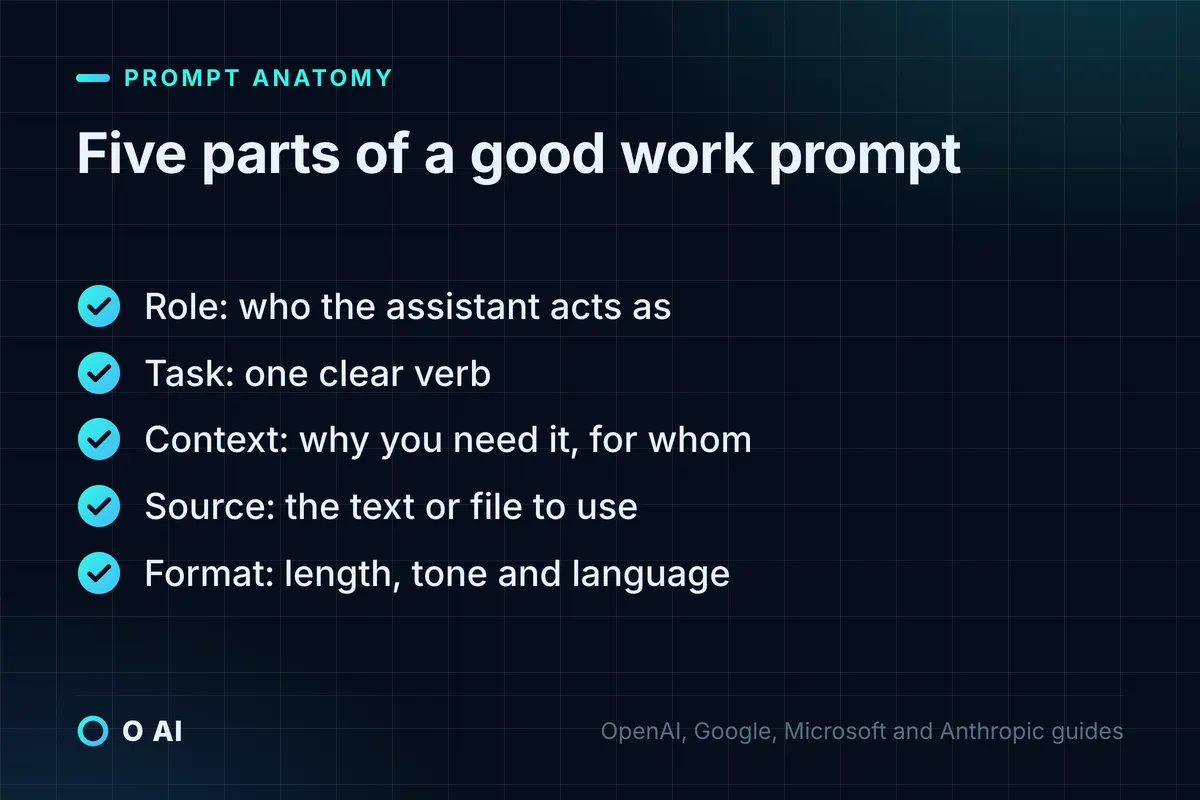
The five parts of a good work prompt
The four vendors describe the same building blocks under different names. Use whichever vocabulary your team already knows.
| Part | What to write | Google's term [3] | Microsoft's term [4] |
|---|---|---|---|
| Role | Who the assistant acts as, or who is asking | Role (persona) | Not named |
| Task | One clear verb: draft, summarise, compare, translate, classify | Task | Goal |
| Context | Why you need it, who will read it, what matters most | Context | Context |
| Source | The text, file or data the answer must use | Not named | Source |
| Format | Length, structure, tone and language of the answer | Format | Expectations |
Not every prompt needs all five: Google says its four areas are not all needed every time, and Microsoft says only a clear goal is required [3][4]. For a quick internal task, task and source are often enough; for anything that leaves the company, add context and format.
Context works best when it includes the reason. Anthropic's example: instead of a bare "never use ellipses", explain that the answer will be read aloud by a text-to-speech engine that cannot pronounce them, and the model generalises from the explanation [5]. In an office, "keep it under 80 words because the client reads email on his phone" works better than "keep it short".
Before and after: one prompt rewritten
Illustrative example. A building-materials supplier in Dammam receives an angry email from a contractor whose order arrived late.
Weak prompt: "Write an email to a customer about a late delivery."
The answer will be generic: invented reasons, an unclear tone, perhaps a promise the company cannot keep.
Strong prompt: "You are the customer service lead at a building-materials supplier in Dammam. Draft a reply to the complaint below from a contractor whose order of [product] arrived [number of days] days late. Apologise once, explain the cause in one sentence ([cause]), offer [remedy] and give a direct contact ([name and phone]). Formal but warm, in the language of the complaint, under 120 words. Do not promise any date I have not given you. Complaint: [paste]."
Each part removes a guess. The role sets vocabulary and formality, the single verb stops the model drifting into analysis, the context says what matters, the pasted complaint keeps names accurate, and the format makes the reply usable without heavy editing.
Seven techniques that make AI prompts more reliable
- Give examples of what good looks like. Anthropic calls examples one of the most reliable ways to steer format, tone and structure, and suggests 3–5 that are relevant and varied [5]. Paste three past letters your manager approved and ask for "the same style".
- Put long documents first and the question last. For long inputs, Anthropic recommends placing documents at the top and the query at the end; in its tests this improved response quality by up to 30% on complex, multi-document inputs [5].
- Ask for quotes before conclusions. For long files, ask the assistant to quote the relevant passages first and then answer [5]. You can check each quote against the page.
- Separate instructions from material. Label each part, for example "Instructions:", "Document:", "Glossary:". Anthropic recommends tags for the same reason: they stop the model confusing your instructions with the text it is working on [5].
- Break big jobs into steps. OpenAI advises splitting a complex task into smaller, focused prompts and asking for several options when you are unsure [2]. Summarise the tender first, then list the risks, then draft the questions to the client.
- Name the tone. OpenAI suggests descriptive adjectives such as formal, friendly or professional [1].
- Refine in the same conversation. OpenAI treats the first prompt as a draft to adjust after you see the answer [1], and Microsoft notes that the same prompt can produce different responses, so expect some back-and-forth [4].
One more habit, from practice rather than a vendor guide: end important prompts with "Before you start, ask me up to three questions if anything is missing." Gaps surface before the model fills them with guesses.
50 ready-to-use AI prompts for work, by task
Each prompt is written for a company in Saudi Arabia. Replace everything in [brackets], paste your material where it says [paste] or attach the file, and check the result with the checklist further down. Every prompt also works in Arabic: add "Reply in formal Arabic" or "Reply in Saudi dialect" at the end.
Email and correspondence
| # | Task | Prompt |
|---|---|---|
| 1 | Reply to a complaint | You are the customer service lead at [company], a [type of business] in [city]. Draft a reply to the complaint below. Apologise once, explain the cause in one sentence ([cause]), offer [remedy] and give [contact]. Polite and direct, under 120 words, in the customer's language. Complaint: [paste] |
| 2 | Formal letter to a government entity | Draft a formal Arabic letter from [company] to [entity] requesting [request]: greeting, subject, two-sentence background, the request, attachments, closing. Invent no reference numbers or regulations; leave [brackets] where details are missing. |
| 3 | Payment reminder | Write a courteous first reminder to [client] about invoice [reference] for SAR [amount], due on [date], with how to pay: [payment details]. Under 90 words. Then write a firmer second reminder for two weeks later. |
| 4 | Notes into an email | Turn these rough notes into a clear email to [recipient] at [company]. Lead with the decision or request, then the details as a short list, then the next step with a date. Do not change any fact. Notes: [paste] |
| 5 | Shorten and soften | Rewrite the email below at half the length and in a less blunt tone, without changing any fact, figure or date. Show the new version, then list what you removed. Email: [paste] |
| 6 | Decline politely | Draft a polite reply declining [request] from [sender]. Give one reason ([reason]), offer an alternative ([alternative]) and keep the door open. Professional and warm, under 100 words. |
| 7 | Request for quotation | Ask [supplier] by email for a quotation for [items, quantities and specifications], delivered to [city] by [date]: unit prices, VAT shown separately, delivery cost, payment terms and offer validity. List our requirements with numbers. |
| 8 | Reply in two languages | Reply to the message below in Arabic and then in English. The Arabic must read as native Saudi business Arabic, not a translation of the English. Same facts in both. Message: [paste] |
Meetings, reports and documents
| # | Task | Prompt |
|---|---|---|
| 9 | Meeting minutes | Here is the transcript of our [meeting] on [date]. Write minutes with attendees, decisions, an action table (action, owner, due date) and open questions. Use only what is in the transcript and mark anything unclear as [unclear]. Transcript: [paste] |
| 10 | Meeting agenda | Prepare a 45-minute agenda on [topic] for [attendees and roles] to decide [decision]. Give each item a time, an owner and the question it must answer, and list what each attendee should bring. |
| 11 | Summarise a long document | Summarise the attached [contract, tender or report] for [reader], who has five minutes: purpose in two sentences, the five points that matter most to us, a table of dates and amounts with page numbers, and anything needing a decision. Quote every obligation word for word. |
| 12 | Executive summary | Write a one-page executive summary of the report below for our general manager: the conclusion first, three findings with figures from the report, then the recommended decision. Add no figure that is not in the report. Report: [paste] |
| 13 | Weekly report | Turn these team updates into a weekly report for [manager]: achievements, delays with reasons, risks and next week's priorities. Bullet points, under 250 words, neutral tone. Updates: [paste] |
| 14 | Compare two versions | Compare version A and version B below. List every change in a table: section, old wording, new wording and why it might matter to [company]. Do not judge which is legally correct. A: [paste] B: [paste] |
| 15 | Internal policy draft | Draft an internal policy on [topic, for example expense claims] for a company of [size] in Saudi Arabia: purpose, scope, rules, approvals, exceptions and review date, in plain language. Mark with [check] every point that depends on a Saudi regulation, for HR to verify at the official source. |
| 16 | Presentation outline | Create a 10-slide outline for a presentation to [audience] on [topic]. For each slide give a title, three bullet points and a suggested chart or visual. The audience must leave knowing [key message]. |
Sales and customer service
| # | Task | Prompt |
|---|---|---|
| 17 | Follow-up after a meeting | Write a follow-up email to [name and role] after our meeting on [date] about [topic]. Thank them, restate their two main needs in their words ([needs]), link each to what we offer ([offer]) and propose a next step with two time options. |
| 18 | Product description | Describe [product] for our website for [buyers]: what it is, three benefits tied to features, a short specification table and a one-line call to action, in 120 to 150 words. No unprovable claims such as "best". |
| 19 | Handle an objection | A prospect says: "[objection, such as: your price is higher than X]". Give three responses of two or three sentences each, in a respectful Saudi business tone, without criticising any competitor. |
| 20 | Customer FAQ | From the customer emails below, find the 10 most common questions and draft a short answer to each using only our policy text. Where the policy has no answer, write [team to answer]. Emails: [paste] Policy: [paste] |
| 21 | WhatsApp reply templates | Write five WhatsApp customer-service templates: order received, order shipped, delay apology, return accepted, and a request for details. Each under 40 words, in polite Saudi dialect, with [placeholders] for names and numbers. |
| 22 | Proposal skeleton | Outline a proposal to [client] for [project]: the need, proposed solution, scope, timeline, team, price assumptions and exclusions. Under each heading, list the questions I must answer before writing it. |
| 23 | Call script | Write a script for a first sales call to [type of business] about [product]: a two-sentence opening, four discovery questions, a 30-second explanation of value and a close that asks for a meeting. Natural spoken tone. |
| 24 | Analyse reviews | Group the customer reviews below into themes such as delivery, price, quality and service. For each theme give the number of reviews, one representative quote and one fix we could test. Reviews: [paste] |
Marketing and social media
| # | Task | Prompt |
|---|---|---|
| 25 | Campaign ideas | Suggest five campaign ideas for [product or service] for [occasion, such as Ramadan or back to school], aimed at [audience and city]. For each: core message, channel and a simple measure. |
| 26 | Batch of posts | Write [number] posts for [platform] about [topic] for [audience], mixing a tip, a question, behind the scenes and a customer story built from these real details: [details]. Each under [length], respectful of local culture, with no exaggerated claims. |
| 27 | One post, three channels | Rewrite the LinkedIn post below as a short X post, an Instagram caption and a WhatsApp broadcast message. Keep the facts and adapt tone and length to each channel. Post: [paste] |
| 28 | Landing page copy | Write landing-page copy for [offer]: headline, subheading, three benefit blocks, a four-question FAQ and a call to action, for [audience]. Formal but friendly. Mark any statistic as [source needed]. |
| 29 | Brand voice guide | From the three texts below that we like, describe our brand voice on one page: tone, words we use, words we avoid, sentence length, and three before-and-after examples. Texts: [paste] |
| 30 | Monthly newsletter | Draft a newsletter for [audience]: short opening, three news items from the notes below, one practical tip, one call to action, under 300 words. Notes: [paste] |
| 31 | Image brief | Write a brief for a designer or image tool for a post about [topic]: subject, Saudi setting, people and dress ([describe]), mood, colours, and what must not appear, such as text or logos. Add a one-sentence alt text. |
HR and administration
| # | Task | Prompt |
|---|---|---|
| 32 | Job description | Write a job description for [role] at [company] in [city]: purpose, six to eight responsibilities, required and preferred qualifications, hours and location, in inclusive wording. Leave salary and benefits as [to be confirmed]. |
| 33 | Interview questions | Create eight interview questions for [role] testing [skills], each with a strong answer and a red flag. Include two practical scenarios from daily work in [industry]. |
| 34 | Onboarding plan | Draft a two-week onboarding plan for a new [role]: daily tasks, people to meet, system access to request, and what they should deliver by the end of week two. |
| 35 | Internal announcement | Write an internal announcement about [change, for example working hours in Ramadan] from [date]: what changes, who is affected and whom to ask. Clear and warm, under 150 words, in Arabic and English. |
| 36 | Constructive feedback | Help me write feedback for an employee about [issue], based only on these facts: [facts]. Structure: what I observed, its effect, what I expect, and the support I will give. Specific and respectful, with no labels about personality. |
| 37 | Training session | Design a two-hour internal training on [topic] for [audience]: learning goals, a timed agenda, one hands-on exercise and five quiz questions with answers. |
| 38 | Standard procedure | Turn the steps below into a standard operating procedure: purpose, roles, numbered steps, checks, and what to do when something goes wrong. Steps: [paste] |
Finance, spreadsheets and data
| # | Task | Prompt |
|---|---|---|
| 39 | Read a table | The table below shows our [sales or expenses] for [period]. Describe the three main trends, any unusual figure and the questions I should ask. Where a total is needed, give the formula rather than calculating it yourself. Data: [paste] |
| 40 | Excel formula | In Excel, column A holds [description] and column B holds [description]. Write a formula that [what you need], explain it in one sentence and show it working on two sample rows. |
| 41 | Budget template | Draft a monthly budget template for [team or project] with categories, planned and actual columns, the variance and a notes column. Suggest the categories usual for [type of business]; I will fill in the amounts. |
| 42 | Explain a variance | Spending on [category] was SAR [actual] against a budget of SAR [budget]. Using the notes below, draft a short explanation for management: the cause, whether it will repeat, and the proposed action. Notes: [paste] |
| 43 | Clean a list | Clean the list below: remove duplicates, standardise company and city names, split full names into first and family name, and flag rows without a phone number. Return a table. List: [paste] |
| 44 | KPI definitions | Suggest five KPIs for [department] in a [type of business], each with its definition, formula, data source, measurement frequency and a common misreading. |
Research, translation and planning
| # | Task | Prompt |
|---|---|---|
| 45 | Research plan | I need to understand [topic] to decide [decision]. List the questions to answer, the Saudi official bodies likely to publish the facts (names only, no unchecked links) and what I must verify myself. |
| 46 | Translate a document | Translate the text below from English into formal Saudi business Arabic. Keep names, numbers and dates exactly as written and use this glossary: [glossary]. After the translation, list any sentence whose meaning was ambiguous. Text: [paste] |
| 47 | Check a translation | Here are an English original and its Arabic translation. Translate the Arabic back into English, then list every place where the meaning differs from the original. Original: [paste] Translation: [paste] |
| 48 | Project plan | Plan [project] from [date] with [team]: phases, tasks, owners, durations and dependencies in a table, then the three biggest risks and how to reduce each. |
| 49 | Decision table | I must choose between [option A], [option B] and [option C] for [purpose]. Build a table with these weighted criteria: [criteria]. Score each option with a one-line reason and say what information would change the result. |
| 50 | Improve my prompt | Here is a prompt I use: [paste]. Rewrite it so it states the role, task, context, source and format, then ask me up to three questions whose answers would improve it. |
When a prompt from this list runs every day on the same kind of input, it has become a workflow. Our guide to AI agents, RPA and workflow tools explains when it is worth automating that step.

What should never go into a prompt?
The commonest privacy mistake is pasting a whole customer file "for context". Saudi Arabia's Personal Data Protection Law defines personal data broadly: any data that identifies a person directly or indirectly, including a name, ID number, address, contact numbers, bank account and card numbers, and photos [8]. The same law restricts transferring personal data outside the Kingdom and limits any transfer to the minimum personal data needed [8].
If an assistant processes your data outside Saudi Arabia, pasting a customer list into it can amount to such a transfer. Our guide to data residency in Saudi Arabia explains the conditions. This section is general information; for a specific case, check SDAIA's guidance or ask a licensed advisor.
The plan matters too. On ChatGPT's Free, Plus and Pro plans, OpenAI may use your content to train its models unless you turn off "Improve the model for everyone" under Settings > Data controls; content from ChatGPT Business, Enterprise and Edu is not used for training by default [9].
Three working rules:
- Replace identifiers with labels: "Customer A", "Employee 2", "[ID removed]". The model rarely needs the real name to draft a reply.
- Paste the minimum: the clause in question, not the whole contract; the three relevant rows, not the full payroll.
- Use the company's business account for internal material, never a personal free account.
Check every answer before you use it
A fluent answer is not a correct one. OpenAI warns that its models can produce incorrect dates and facts, fabricated quotes and citations to sources that do not exist, and can sound confident while wrong; it recommends treating answers as a first draft and verifying important information [7]. Microsoft gives the same advice for Copilot [4].
Run this check before anything leaves your desk:
- Figures and dates: every number matches the source you gave, and totals are recalculated.
- Names and titles: spelled exactly as in your records, with the right honorific.
- References: every regulation, article number or link was opened by a person, preferably on a .gov.sa page.
- Promises: no commitment on price, date or scope that you did not authorise.
- Tone: read it aloud; it should sound like your company, not like a template.
- Language: Arabic reads natively, with no literal translation of English idioms.
If the same error keeps coming back, fix the prompt rather than the output: add the missing context, an example or a rule.
Save your best prompts and reuse them
A prompt that works is a company asset. Two ways to keep it:
- Custom instructions. In ChatGPT, custom instructions apply to every chat and suit standing preferences such as "write in formal Saudi business Arabic" or "use SAR and the Gregorian date first". Free and Go users can save up to 1,500 characters; Plus, Pro and business plans up to 5,000 [10]. OpenAI notes that information from custom instructions is also used to improve its models, unless you have opted out [10].
- A shared prompt library. A simple spreadsheet with five columns: task, prompt, owner, date last tested, and notes on what to check. Anthropic recommends deciding what a good result looks like, and how you will test it, before refining a prompt [6]; record that in the notes column.
Review the library every quarter: assistants change their models often, and a prompt that worked in January may need a new example by June.

Your next step
This week, pick three AI prompts from the list above that match tasks your team already does. Fill in the brackets, run each on a real but anonymised sample, and keep the version that needed the fewest edits in a shared library. Our guide on how AI can help your business shows how to choose one task and measure the time saved before you spend on tools. You can also read about O AI, a software and AI company in Al Khobar, on our home page.
Frequently asked questions
What is a prompt in AI?
A prompt is the instruction or input you give an AI assistant: a question, a request, a pasted document or even an image or audio clip. The assistant generates its answer from the prompt and any files you attach, nothing else. That is why the same assistant can give a vague answer to "write an email" and a usable one to a prompt that names the reader, the purpose, the facts to use and the format you want back.
How long should a good prompt be?
As long as the task needs and no longer. A quick internal task may need one sentence with a clear verb and the text to work on. A letter to a client or a summary of a tender needs more: who it is for, why, what to include and what to avoid, the length and the tone. Long documents should go first, with your question at the end. If a colleague could not do the job from your prompt alone, add what is missing.
Should I write prompts in Arabic or English?
Write in the language you think in, and state the language you want the answer in. Major assistants accept prompts in both, and you can write the instruction in English and ask for formal Saudi business Arabic, or the reverse. For Arabic output, say whether you want formal Arabic or Saudi dialect, and give a short example of the style. Always have a native speaker check anything that goes to a client or a government entity.
Do the same prompts work in ChatGPT, Gemini, Copilot and Claude?
Mostly, yes. OpenAI, Google, Microsoft and Anthropic recommend the same basics: a clear task, context, source material and the format you want. Results still differ between assistants and between models inside one assistant, and the same prompt can give different answers on different runs. Test an important prompt on the tool your team actually uses, with a real sample, and adjust it there.
Why does the same prompt give a different answer each time?
AI assistants generate text rather than look it up, so wording, structure and sometimes facts can vary between runs. Microsoft notes this directly for Copilot. To reduce variation, give a fixed format, an example of the output you expect and the source text to use. For anything that must be consistent, such as standard replies, keep an approved template and ask the assistant only to fill in the details.
Can I put customer or employee data in a prompt?
Avoid it unless your company has approved the tool for that data. Names, ID numbers, phone numbers, addresses and bank details are personal data under Saudi Arabia's Personal Data Protection Law, which also restricts transfers outside the Kingdom. Replace identifiers with labels, paste only what the task needs, and use a business plan that does not train on your content by default. For a specific case, check SDAIA's guidance or ask a licensed advisor.
Where should a company keep its best prompts?
In one shared place that everyone can find: a spreadsheet or document with the task, the prompt, the owner, the date it was last tested and notes on what to check in the answer. Standing preferences, such as language and tone, can go into the assistant's custom instructions. Review the library every few months, because assistants update their models and a prompt may need a new example.
How this article was made: Researched from the sources listed below, opened on 14 October 2026. Drafted with AI assistance, then checked against those sources. General information, not professional advice. Images are AI-generated illustrations.
Sources
- Prompt engineering best practices for ChatGPT (opens in a new tab)OpenAI Help Center · help.openai.com
- How do I create a good prompt for an AI model? (opens in a new tab)OpenAI Help Center · help.openai.com
- Writing effective AI prompts for business (opens in a new tab)Google Workspace · workspace.google.com
- Get started writing prompts in Microsoft Copilot (opens in a new tab)Microsoft Support · support.microsoft.com
- Prompting best practices (opens in a new tab)Anthropic, Claude documentation · platform.claude.com
- Prompt engineering overview (opens in a new tab)Anthropic, Claude documentation · platform.claude.com
- Does ChatGPT tell the truth? (opens in a new tab)OpenAI Help Center · help.openai.com
- Personal Data Protection Law (in Arabic) (opens in a new tab)Bureau of Experts at the Council of Ministers · laws.boe.gov.sa
- How your data is used to improve model performance (opens in a new tab)OpenAI Help Center · help.openai.com
- ChatGPT Custom Instructions (opens in a new tab)OpenAI Help Center · help.openai.com
About the author
Newsletter
New guides and news by email
New guides and news about O AI, Rushd and Dalni, at most twice a month. No spam.