 AI


Correspondence management system for companies: incoming, outgoing and archiving
How companies in Saudi Arabia can manage formal letters: when email stops being enough, the incoming and outgoing workflow, a numbering scheme, what the Commercial Books, Electronic Transactions and VAT rules say about archiving, and 12 features to check before you buy.


Key takeaways
- A correspondence system treats each letter as a numbered transaction with a sender, an owner, a deadline and a history, not just a file in a folder.
- Under the Commercial Books Law, a trader keeps true copies of business correspondence, sent and received, for at least ten years.
- An electronic record satisfies a retention duty if kept in its original or a provably identical form, accessible, and with sender, recipient and dates.
- VAT invoices and records must be kept for at least six years from the end of the tax period, in Arabic and in the Kingdom.
- NCAR's Documents and Archives Law governs government bodies' records; private companies can borrow its method of classification and retention periods.
On this page
- What a correspondence management system does
- Email, a document system or a dedicated correspondence system?
- Incoming correspondence: from the front desk to a closed file
- Outgoing letters: numbering, approval and signature
- Archiving and retention: what Saudi rules say
- How to tell whether your correspondence process works
- Features to check in a correspondence management system
- Common mistakes in managing company correspondence
- Your next step
A correspondence management system registers every incoming and outgoing letter with a unique number and date, routes it to the person who must act, tracks the deadline, keeps the signed copy with its attachments, and archives it so it can be found and proven later. For Saudi companies, it should also meet the retention and electronic-record rules that apply.
This guide is for administration managers, executive offices and company secretaries who handle formal letters to and from government entities, banks, contractors and clients. It explains what the system should do, when email and shared folders stop being enough, and which Saudi rules shape archiving. The rules were read on the Bureau of Experts, ZATCA and ISO pages on 14 October 2026. It is general information, not legal advice; for a specific case, check the official text or ask a licensed advisor.
What a correspondence management system does
Correspondence management, often called administrative communications in Saudi offices, is the formal side of a company's mail: the letters that create obligations, answer requests or carry decisions. A system for it does six jobs:
- Registry: one register of incoming and outgoing letters, each with its own number and date.
- Capture: scanning paper letters and saving email or portal letters with their attachments.
- Routing: sending each incoming letter to the department that must act, with instructions and a deadline.
- Drafting and approval: templates, review by the right people and signature before a letter leaves.
- Follow-up: reminders, escalation and a view of what is overdue.
- Archive: classification, retention periods and search, so a letter from years ago can be found in seconds.
Email does some of this, and a document management system does some more. The difference is the register: a correspondence system treats each letter as a numbered transaction with a sender, an owner, a deadline and a history, not just a file in a folder.
Email, a document system or a dedicated correspondence system?
The right level depends on volume, on how many people touch each letter, and on how often you need to prove what was sent or received.
| Your situation | Usually enough | What to watch |
|---|---|---|
| A small company with a few formal letters a month | A shared mailbox, a numbered register and a shared folder with naming rules | Duplicate numbers, letters saved in personal inboxes |
| A growing company that writes regularly to government entities, banks and contractors | A document management system with a correspondence module | Routing and deadlines are often weak in general document tools |
| Several departments, high volume, confidential letters | A dedicated correspondence management system | Delegation during leave, permissions by confidentiality, audit trail |
| A company already running an ERP with workflows | The ERP's correspondence module, or a connected system | Linking letters to contracts, purchase orders and employee files |
A simple test: if you cannot answer "who has this letter now, and when is the reply due?" within a minute, the current setup has outgrown its tools.
Incoming correspondence: from the front desk to a closed file
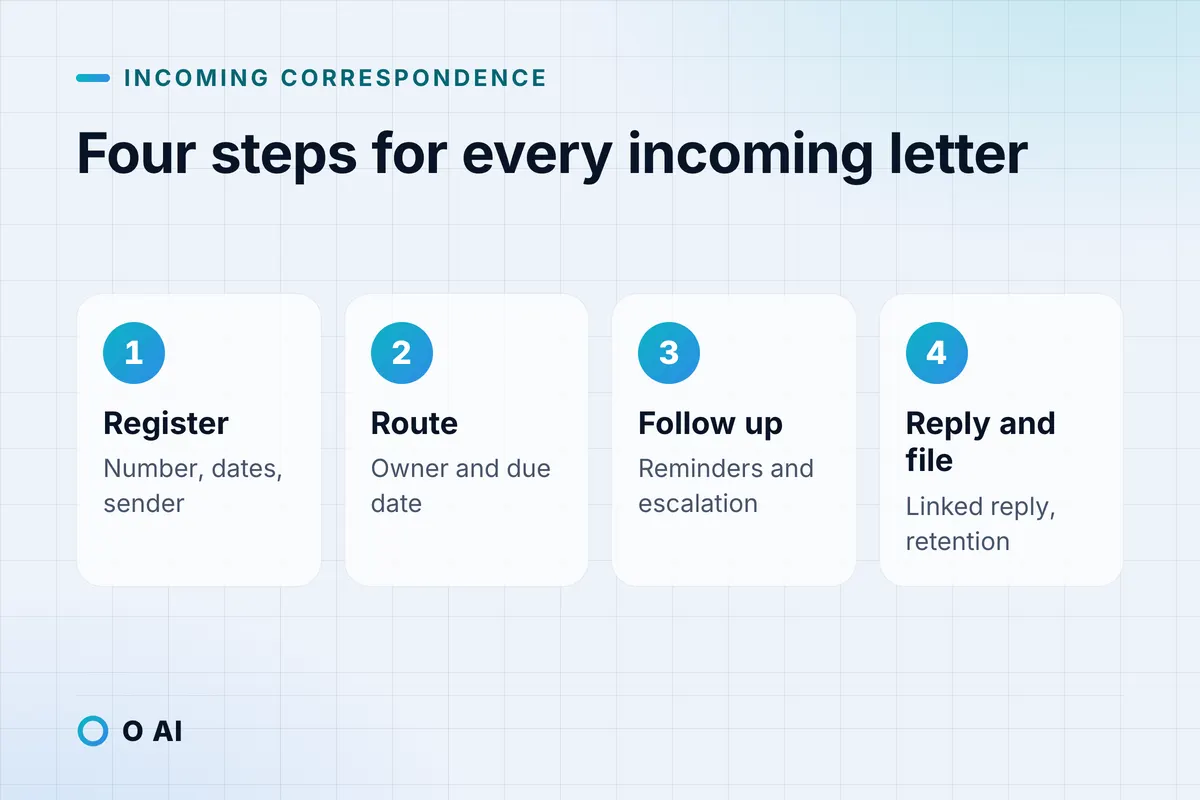
Incoming letters arrive by hand, by post, by email and through government and bank portals. A good process gives all of them the same path.
- Register on arrival. Record the incoming number, the date received in Hijri and Gregorian, the sender, the sender's own reference number and date, the subject, the number of attachments, the channel and the confidentiality level.
- Capture the content. Scan paper letters to searchable PDF and keep the original filed under the same number. Arabic scans need checking: our guide to Arabic OCR for scanned documents explains why numbers and dates come out wrong and how to catch it.
- Route. Refer the letter to the responsible department with an instruction ("for action", "for information", "for opinion") and a due date; copy others for information only.
- Follow up. The system reminds the owner before the due date, escalates when it passes, and passes the task to a named delegate during leave.
- Reply and close. Link the reply to the incoming number, so either can be found from the other, and close the item with a short note.
- File. Assign the classification and retention period before the item disappears from anyone's task list.
Outgoing letters: numbering, approval and signature
An outgoing letter is a commitment, so the system should make the approval path visible. Start from approved templates with the letterhead and standard closing, route the draft to reviewers in a fixed order, and give the outgoing number only when the letter is signed, not when the draft is opened.
Electronic signature is now normal for many letters. Under the Electronic Transactions Law, electronic transactions, records and signatures are binding, and their validity cannot be denied only because they are electronic, provided they meet the law's conditions [1]. An electronic record counts as an original when technical means confirm the integrity of its content from the moment it was finalised [1], and it is accepted as evidence when it meets that requirement [1]. The law does not apply to personal status matters or to issuing title deeds for real estate dispositions, unless the responsible authority allows electronic handling [1].
For each letter sent, record the channel (hand delivery, courier, email or portal), the date, and the proof of delivery: a signed receipt, a courier record or a portal confirmation.
Illustrative example: a numbering scheme for a 60-person company
Illustrative example. A contracting company in Dammam with four departments sets these rules in its correspondence system.
| Type | Format | Example |
|---|---|---|
| Incoming letter | IN-year-serial | IN-2026-00418 |
| Outgoing letter | OUT-department-year-serial | OUT-HR-2026-0091 |
| Internal memo | MEMO-department-year-serial | MEMO-FIN-2026-0032 |
Three rules make the scheme work. The system, not a person, assigns the next number. A cancelled number is never reused; it stays in the register marked "cancelled" with the reason. And every record stores both the Hijri and the Gregorian date, because government letters often cite Hijri dates while contracts and invoices may use Gregorian.
Archiving and retention: what Saudi rules say
Archiving is where a correspondence system earns its cost. Several Saudi rules set how long records must be kept and in what form.
Commercial Books Law. A trader must keep a true copy of all correspondence and documents relating to its business, both sent and received, filed in an orderly way [2]. The trader must keep the books, the correspondence and those documents for at least ten years [2]. The law was issued by Royal Decree M/61 dated 17/12/1409H and was listed as in force when we checked [2].
Electronic Transactions Law. When any law requires a document or information to be kept, keeping it as an electronic record satisfies that requirement if three conditions are met: the record is kept in the form in which it was created, sent or received, or in a form that proves its content is identical; it remains accessible for later use; and it is kept with the information identifying its originator and recipient and the date and time it was sent and received [1]. A correspondence system should therefore keep metadata, not only the scanned image.
VAT records. Invoices, books, records and accounting documents must be kept for at least six years from the end of the tax period they relate to, in Arabic, and in the Kingdom, physically or electronically through access from a point in the Kingdom [3]. Electronic storage must include controls that prevent tampering and allow records to be produced on request [3].
Personal data. Letters often contain ID numbers, salaries or medical details. The Personal Data Protection Law requires personal data to be destroyed once the purpose of collecting it ends, unless a law requires keeping it for a set period, in which case it is destroyed after that period or the end of the purpose, whichever is longer [4].
Government archives (NCAR). The Documents and Archives Law applies to the documents of ministries and other government bodies; it requires a unified classification plan, retention periods and rules for which records may be destroyed [5]. The National Center for Archives and Records puts that law into effect, prepares its regulations and supervises the destruction of records [6]. Private companies are not the bodies it governs, but its method is a sound model, and letters you send to a government entity become part of that entity's records. Keep its reference numbers on your side.
| Record | Minimum period | Rule |
|---|---|---|
| Business correspondence and documents, sent and received | At least 10 years | Commercial Books Law [2] |
| Tax invoices, books and records | At least 6 years from the end of the tax period; longer for capital assets | VAT Implementing Regulations [3] |
| Personal data inside letters | Until the purpose ends, or a period another law sets, whichever is longer | Personal Data Protection Law [4] |
| Records of government bodies | As set by regulations under the Documents and Archives Law | Government entities only [5] |
For the concepts behind all of this, ISO 15489-1:2016, reviewed and confirmed in 2021, sets out principles for records, metadata, records systems, policies and controls, for any type of organisation [7]. It is a useful checklist when a vendor says its product "supports archiving".

How to tell whether your correspondence process works
Four figures, taken from the register each month, show whether the system is doing its job:
- Overdue rate: the share of incoming letters still open after their due date. If it rises, routing or delegation is failing.
- Average reply time: days from registration to the linked reply, by department. Long times often point to an approval chain with too many steps.
- Retrieval time: how long it takes to produce last year's letter with its attachments and proof of delivery. In a working archive this takes minutes, not days.
- Unfiled items: closed letters with no classification or retention period. These are the ones that will be lost, or kept longer than they should be.
Review them in the same meeting as your other operational figures, and fix the process before blaming the software.
Features to check in a correspondence management system
Use this list when you compare products or brief a developer:
- Arabic first: right-to-left screens, Arabic search that handles different letter forms, and both Hijri and Gregorian dates.
- Numbering rules: automatic numbers by type and department, no reuse of cancelled numbers.
- Capture: scanning with barcode or QR labels on paper originals, and saving letters from email with attachments.
- Routing: referral with instructions, due dates, copies for information and automatic escalation.
- Delegation: named substitutes during leave, with their actions recorded under their own names.
- Templates and approvals: letterhead templates and approval chains by letter type.
- Signature: electronic signature, or a controlled process for scanning wet-signed letters.
- Permissions: access by department and confidentiality level, including for the archive.
- Audit trail: who viewed, changed, routed or signed each item, and when.
- Retention: retention periods by classification, legal holds for disputes, and a destruction log.
- Integration: links to email, HR, contracts or ERP records where letters belong.
- Exit: export of letters, attachments and metadata in open formats if you change systems.
Common mistakes in managing company correspondence
- Numbering by hand in a spreadsheet, which leads to duplicates and gaps nobody can explain.
- Keeping only the scan, without the sender, dates and delivery proof that the Electronic Transactions Law asks to be kept with an electronic record [1].
- Final letters left in personal inboxes, which disappear when an employee leaves.
- No retention rule, so the company either keeps everything forever, including personal data it should have destroyed [4], or deletes business letters it must keep for ten years [2].
- Unchecked scanning, with unreadable stamps, missing pages or wrong dates.
- Letters that can be edited after signature, which weakens their value as proof.

Your next step
Take the last 30 days of formal letters and count them: incoming and outgoing, by department and by channel. Note how many missed their reply date and how long it took to find an old letter when someone asked. Those numbers tell you whether a register and clear rules are enough, or whether you need a correspondence management system with routing and retention built in. If you need one connected to your HR, contracts or ERP, our guide to custom software development in Saudi Arabia explains when to buy and when to build. You can read about O AI, a software and AI company in Al Khobar, on our home page.
Frequently asked questions
What is the difference between a correspondence system and a document management system?
A document management system stores and versions files, such as contracts, drawings and policies. A correspondence management system treats each letter as a numbered transaction: who sent it, who must act on it, by when, what was replied and how it was delivered. Many products combine both. If your main pain is lost letters and missed replies rather than finding files, look for strong registry, routing and follow-up features.
How long must a company keep its correspondence in Saudi Arabia?
Under the Commercial Books Law, a trader must keep true copies of the correspondence and documents relating to its business, sent and received, for at least ten years. VAT invoices and records have their own minimum of six years from the end of the tax period, kept in Arabic and in the Kingdom. Personal data inside letters should be destroyed when no longer needed, unless a law requires keeping it longer.
Are emails and scanned letters legally valid in Saudi Arabia?
Under the Electronic Transactions Law, electronic records and signatures are binding and cannot be denied only because they are electronic, if they meet the law's conditions. Where a law requires a document to be kept, an electronic record satisfies it when it is kept in its original form or a provably identical one, remains accessible, and carries the sender, recipient and dates. Personal status matters and real estate title deeds are excluded unless the responsible authority allows otherwise.
Do NCAR's archiving rules apply to private companies?
The Documents and Archives Law and the National Center for Archives and Records govern the documents of ministries and other government bodies, not private companies' internal records. Private companies follow other rules, such as the Commercial Books Law, VAT record-keeping and data protection. NCAR's approach, with one classification plan, set retention periods and controlled destruction, is still a good model, and your letters to government entities become part of their records.
Should we number letters by Hijri or Gregorian year?
Either works if it is applied consistently and the system assigns the numbers. Many Saudi companies number by Gregorian year to match their financial year, while recording both dates on every letter, because government correspondence often cites Hijri dates. What matters more is that numbers are never reused, that the sender's own reference number is recorded, and that every reply is linked to the letter it answers.
Can AI sort and route incoming letters?
It can help. An AI step can read a scanned or emailed letter, suggest its subject, sender and department, and draft a summary for the person who must act. It should not route sensitive letters or close items on its own: a person should confirm the routing, especially for legal, financial or confidential matters. Arabic scans also need a quality check, because names, numbers and dates are where reading errors appear.
Should a correspondence system run in the cloud or on our own servers?
Both can work. Check two things first. VAT records must be kept in the Kingdom or be accessible from a point in the Kingdom, and letters often contain personal data, whose transfer abroad is restricted by the Personal Data Protection Law. Ask any cloud vendor where the data is stored, who can access it, how backups work, and how you can export everything with its metadata if you leave.
How this article was made: Researched from the sources listed below, opened on 14 October 2026. Drafted with AI assistance, then checked against those sources. General information, not professional advice. Images are AI-generated illustrations.
Sources
- Electronic Transactions Law (in Arabic) (opens in a new tab)Bureau of Experts at the Council of Ministers · laws.boe.gov.sa
- Commercial Books Law (in Arabic) (opens in a new tab)Bureau of Experts at the Council of Ministers · laws.boe.gov.sa
- Implementing Regulations of the Value Added Tax Law (opens in a new tab)Zakat, Tax and Customs Authority (ZATCA) · zatca.gov.sa
- Personal Data Protection Law, with amendments (in Arabic) (opens in a new tab)Bureau of Experts at the Council of Ministers · laws.boe.gov.sa
- Documents and Archives Law (in Arabic) (opens in a new tab)Bureau of Experts at the Council of Ministers · laws.boe.gov.sa
- Law of the National Center for Archives and Records (in Arabic) (opens in a new tab)Bureau of Experts at the Council of Ministers · laws.boe.gov.sa
- ISO 15489-1:2016 Information and documentation: Records management, Part 1: Concepts and principles (opens in a new tab)International Organization for Standardization (ISO) · iso.org
About the author
Newsletter
New guides and news by email
New guides and news about O AI, Rushd and Dalni, at most twice a month. No spam.