 AI


How data affects AI performance: the amount versus the quality
How data affects AI performance: more data helps only up to a point, then quality and fit decide the rest. This guide covers the scaling research, why clean data can beat volume, seven data problems from SDAIA's bias guide, the Arabic data gap, the PDPL accuracy rule and a checklist.


Key takeaways
- SDAIA's AI Ethics Principles call for datasets of sufficient quantity and quality, noting that sample size significantly affects the accuracy and fairness of outputs.
- Research shows model error falls as a power law with dataset size, so each doubling of data brings a smaller gain than the one before.
- Clean data can beat volume: test sets averaged at least 3.3% label errors, enough to change which model looked best.
- Arabic made up 0.67% of pages in Common Crawl's CC-MAIN-2026-39 crawl, against 41.86% for English, so test AI on your own Arabic data.
- Saudi Arabia's PDPL bars processing personal data without sufficient steps to verify its accuracy, completeness, timeliness and relevance.
On this page
- How data affects AI performance: quantity, quality and fit
- How much data does AI need? What the scaling research shows
- Why quality beats volume past a certain point
- Seven data problems that hurt AI performance
- Arabic data: why the first gap is volume
- When more data makes things worse: synthetic data and model collapse
- Accurate data is also a legal requirement in Saudi Arabia
- A 10-point data checklist before you use AI
- Your next step
Data sets the ceiling on AI performance. More data usually helps, but each extra batch adds less than the last, and only if the data is accurate, complete, current and representative of real cases. Past a certain point, cleaning data improves results more than adding it, because errors in the data become errors in the output.
This guide explains how data affects AI performance in three ways (quantity, quality and fit), what the research says about each, the data problems that most often hurt AI in Saudi businesses, and a checklist to run before you train, tune or feed an AI system. Examples are illustrative unless a source is cited.
How data affects AI performance: quantity, quality and fit
SDAIA's AI Ethics Principles put it plainly: the quantity and quality of datasets should be sufficient and accurate to serve the purpose of the system, and the sample size collected has a significant impact on the accuracy and fairness of a trained model's outputs [1]. The US National Institute of Standards and Technology (NIST) lists data among the risks that make AI different from ordinary software: the data may not truly represent the context in which the system is used, quality issues can undermine its trustworthiness, and datasets can become stale relative to where the system is deployed [2].
Three questions follow from that:
| Dimension | The question to ask | What goes wrong when it fails |
|---|---|---|
| Quantity | Is there enough data for every case the AI must handle? | Rare cases are guessed, not learned |
| Quality | Is each record correct, complete, consistent and free of duplicates? | The model learns the errors and repeats them |
| Fit | Does the data look like today's real inputs, in the right language, period and mix? | Strong results in testing, weak results in use |
When an AI system disappoints, check these three before you blame the model.
How much data does AI need? What the scaling research shows
For the large language models behind chat assistants, the relationship between data and performance has been measured. A 2020 study found that a model's error (its "loss") falls as a power law with model size, dataset size and the computing power used for training [3]. In plain terms, gains are steady and predictable, but each doubling of data buys a smaller improvement than the last.
A 2022 study trained more than 400 language models, from 70 million to over 16 billion parameters, on 5 to 500 billion tokens. It concluded that model size and the number of training tokens should be scaled equally, and that many large models had been trained on too little data. Its model Chinchilla, with 70 billion parameters and about four times as much data as the 280-billion-parameter Gopher, built with the same compute budget, outperformed Gopher and several larger models across a wide range of tasks [4].
The volumes involved are enormous. SDAIA's National Center for AI says the 7-billion-parameter version of its Arabic and English model ALLaM was trained on 5.2 trillion tokens: 4 trillion in English, then 1.2 trillion of mixed Arabic and English [5]. A token is a short piece of text, often part of a word.
A company rarely trains a model of that kind. It usually adapts an existing model with its own examples, or gives the model its documents to read when answering. The data you need is then far smaller, but it carries more weight: a few hundred wrong or missing examples can decide whether the system works for your customers.
Why quality beats volume past a certain point
Three findings show that cleaner data can matter more than more data.
- Curated data can outperform scale. Researchers trained phi-1, a 1.3-billion-parameter coding model, on about 6 billion tokens of "textbook quality" web data plus about 1 billion tokens of synthetic textbooks and exercises. It reached 50.6% on the HumanEval coding test, and the authors attribute its strength against much larger models to the quality of its data [6].
- Label errors mislead you about performance. A study of 10 widely used test sets estimated an average of at least 3.3% label errors, and at least 6% of the ImageNet validation set. With corrected labels, a smaller model beat a larger one once the share of originally mislabelled test examples rose by just 6% [7]. In other words, errors in your test data can lead you to pick the wrong model.
- Data problems compound. Google researchers who interviewed 53 AI practitioners described "data cascades", compounding events that cause negative downstream effects from data issues, and reported a 92% prevalence among them [8].

Seven data problems that hurt AI performance
SDAIA's AI Bias Reference Guide, first published in May 2026, defines about a hundred ways in which data, models and the people who use them introduce bias or error [9]. The table pairs seven of the most common with what they look like in a Saudi company.
| Problem | SDAIA's description | Illustrative example in a Saudi business | First fix |
|---|---|---|---|
| Coverage bias | The training data does not represent the full population, so the model performs poorly on groups it rarely saw [9] | A complaints classifier trained only on Riyadh branch messages struggles with Eastern Province customers | Collect examples from every branch, channel and customer type |
| Sampling bias | Non-random or convenience sampling skews what the model learns [9] | Training on the first customers who answered a survey email | Sample deliberately across the groups you serve |
| Language bias | A model trained on formal language misreads dialect or informal text [9] | A review analyser trained on Modern Standard Arabic misclassifies Najdi or Hijazi comments | Include real dialect messages in training and testing |
| Labelling bias | Annotators label the same kind of record differently [9] | One accountant tags fuel receipts as "transport", another as "operations" | Write labelling rules and have two people label a sample |
| Historical bias | Old data carries assumptions or conditions that no longer apply [9] | A pricing model trained on years before a VAT or fee change | Drop or re-weight records from before the change |
| Data leakage | Information from test or future data slips into training, so testing looks better than reality [9] | A late-payment model that sees the "paid late" flag as an input | Separate training and test data by date and check every input field |
| Model drift | Performance declines as the environment, the data or the quality of inputs changes [9] | A fraud filter misses new scam patterns months after launch | Re-test on recent cases on a schedule and retrain when results slip |
Missing values and duplicate records belong on the list too. They are not bias in SDAIA's sense, but they distort what a model learns in the same quiet way.
Arabic data: why the first gap is volume
Arabic starts with less data than English. In the latest crawl listed by Common Crawl in October 2026 (CC-MAIN-2026-39), a public archive of web pages widely used to train language models, English made up 41.86% of pages and Arabic 0.67% [10], roughly 63 English pages for every Arabic one. ALLaM's training mix shows the same imbalance: 4 trillion English tokens before 1.2 trillion of mixed Arabic and English [5].
The gap is wider still for Saudi dialects, scanned documents and sector terms. SDAIA's guide gives the classic case: a review model trained only on formal text fails to understand comments written in dialect, which marginalises the way many users actually write [9]. For a Saudi company, the practical lesson is to test any AI system on your own Arabic material, not on a vendor's demo, and to treat your past emails, tickets and forms as data worth cleaning and keeping. If your records are scanned PDFs, our guide to Arabic OCR explains how to turn them into data you can trust first.

When more data makes things worse: synthetic data and model collapse
As more web content is written by AI, more of it ends up in training sets. Researchers found that indiscriminately training models on content generated by other models causes irreversible defects, in which the tails of the original distribution, the rare but real cases, disappear [11]. More data, in that case, means a narrower and less accurate model.
The same logic applies inside a company. AI-generated summaries, draft replies or synthetic records can help, but they are not a substitute for real records. Keep the originals, mark which records were generated by AI, and never let generated text quietly become the "ground truth" a future model learns from.
Accurate data is also a legal requirement in Saudi Arabia
When personal data is involved, quality is not only good practice. Article 14 of the Personal Data Protection Law bars a controller from processing personal data without taking sufficient steps to verify its accuracy, completeness, timeliness and relevance to the purpose for which it was collected [12]. Article 11 limits the content of personal data to the minimum needed to achieve the purpose of its collection [12].
SDAIA's ethics principles add process controls: datasets should be approved and signed off before model development starts, and the data preparation process and quality checks should be documented and validated by the responsible parties [1]. This section is general information; for a specific case, check SDAIA's guidance or ask a licensed advisor.
A 10-point data checklist before you use AI
Run this on any dataset before it trains, tunes or feeds an AI system.
- Name the decision. Write down what the AI will decide or produce, and the cases it must handle.
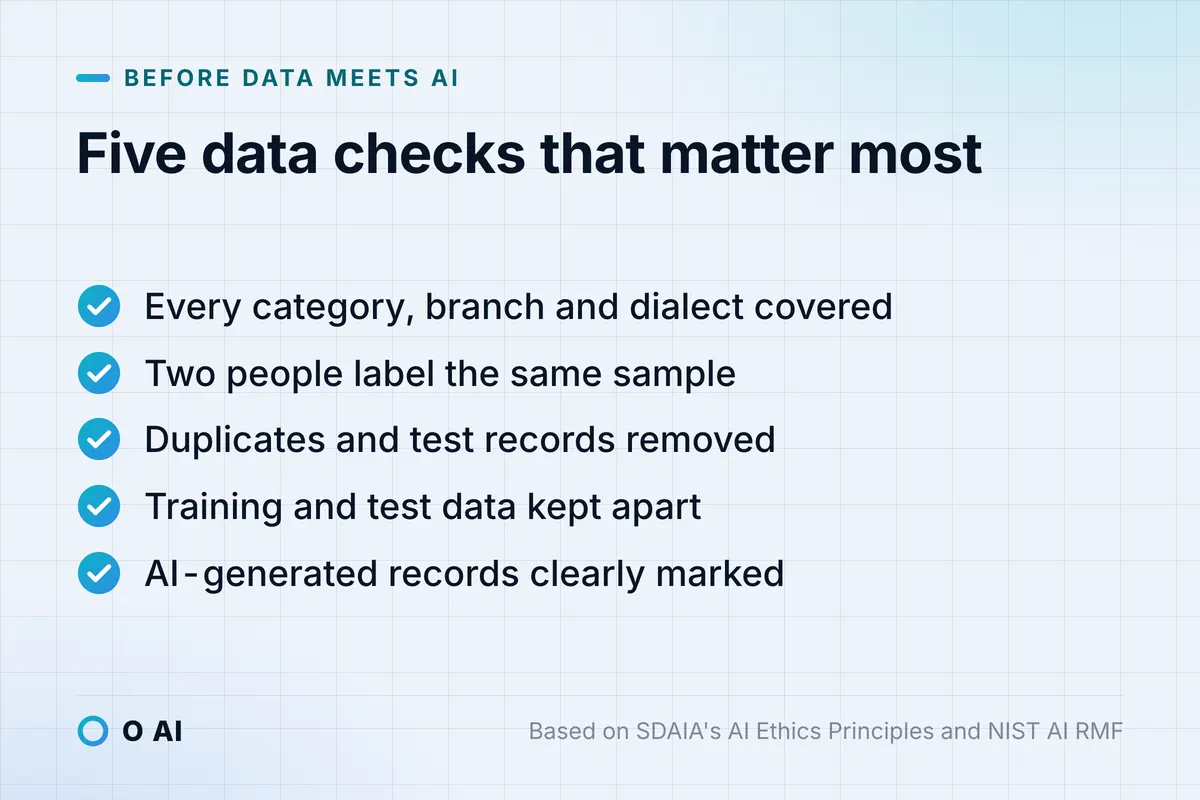
- Count every case. Check that each category, branch, dialect, product line and season the AI will see appears in the data, not just the common ones.
- Test the labels. Have two people label the same sample of records and compare; disagreements show where rules are missing.
- Remove duplicates and test records, including demo entries and cancelled transactions that were never real.
- Check the dates. Note the time range, and flag records from before any change in prices, fees, rules or processes.
- Separate training and test data, by date where possible, and check that no input field gives away the answer.
- Keep a hold-out set of recent real cases that the AI never sees during training, and judge results only on those.
- Mark AI-generated records so they never pass as original data.
- Minimise and verify personal data, in line with the Personal Data Protection Law.
- Monitor after launch. Re-test on fresh cases on a fixed schedule, and retrain or adjust when results slip.
Your next step
Pick one dataset you would like AI to work on, such as customer messages, supplier invoices or service tickets, and run the first five checks on a sample of a few hundred records this week. The gaps you find will tell you more about how the AI will perform than any vendor benchmark. When you are ready to test AI on that task, our guide on how AI can help your business shows how to run a short, measured trial. You can read about O AI, a software and AI company in Al Khobar, on our home page.
Frequently asked questions
Does more data always make AI better?
No. More data tends to improve a model, but with shrinking gains, and only when the extra data is accurate and relevant. Adding duplicates, outdated records, mislabelled examples or text produced by other AI models can make performance worse. For most business uses, the faster improvement comes from fixing labels, filling gaps in rare cases and removing stale or duplicate records, rather than from collecting more of the same.
How much data does an AI model need?
It depends on the task and on whether you train from scratch. Large language models are trained on trillions of tokens, but companies rarely do that; they adapt an existing model with their own examples or give it documents to read. Then the question is coverage: every category, dialect and situation the system will face needs enough real, correctly labelled examples, and a separate set of recent cases to test on.
What is data quality in AI?
Data quality is how well data serves its purpose: whether records are accurate, complete, consistent, current, free of duplicates and representative of the real cases the AI will handle. Saudi Arabia's Personal Data Protection Law requires accuracy, completeness, timeliness and relevance for personal data, and SDAIA's AI Ethics Principles ask that datasets be sufficient, accurate, checked for bias and signed off before a model is built.
Why does AI perform worse in Arabic and Saudi dialects?
Mainly because there is much less Arabic data to learn from. In a recent Common Crawl web archive, English pages outnumbered Arabic pages by more than 60 to 1, and dialects, scanned documents and sector terms are rarer still. Models trained mostly on formal text can misread dialect, which SDAIA describes as language bias. Testing on your own Arabic material and including real dialect examples in training and testing are the most direct remedies.
What is data drift, and why does it matter?
Data drift happens when the data a system sees in use changes from the data it was trained on: new products, new prices, new customer behaviour or new fraud patterns. Performance then declines gradually, often without any obvious error. SDAIA's AI Bias Reference Guide recommends regular retraining on new data that reflects current conditions. In practice, keep a set of recent real cases and re-test on it on a fixed schedule.
Can synthetic or AI-generated data replace real data?
Not fully. Synthetic data can fill gaps, protect privacy or create practice examples, and some models have used generated textbooks successfully alongside carefully chosen real data. But research shows that training repeatedly on model-generated content makes models lose the rare cases found in real data. Use synthetic data as a supplement, label it clearly and always test the final system on real, recent records.
How this article was made: Researched from the sources listed below, opened on 14 October 2026. Drafted with AI assistance, then checked against those sources. General information, not professional advice. Images are AI-generated illustrations.
Sources
- AI Ethics Principles (2025 edition) (opens in a new tab)Saudi Data and AI Authority (SDAIA) · sdaia.gov.sa
- AI Risk Management Framework 1.0 (NIST AI 100-1, January 2023) (opens in a new tab)National Institute of Standards and Technology (NIST) · nvlpubs.nist.gov
- Scaling Laws for Neural Language Models (2020) (opens in a new tab)Kaplan and others, arXiv · arxiv.org
- Training Compute-Optimal Large Language Models (2022) (opens in a new tab)Hoffmann and others, arXiv · arxiv.org
- ALLaM-7B-Instruct-preview model card (opens in a new tab)National Center for AI at SDAIA, on Hugging Face · huggingface.co
- Textbooks Are All You Need (2023) (opens in a new tab)Gunasekar and others, arXiv · arxiv.org
- Pervasive Label Errors in Test Sets Destabilize Machine Learning Benchmarks (NeurIPS 2021) (opens in a new tab)Northcutt, Athalye and Mueller, arXiv · arxiv.org
- "Everyone wants to do the model work, not the data work": Data Cascades in High-Stakes AI (CHI 2021) (opens in a new tab)Sambasivan and others, Google Research · research.google
- AI Bias Reference Guide, first edition (May 2026) (opens in a new tab)Saudi Data and AI Authority (SDAIA) · sdaia.gov.sa
- Statistics of Common Crawl monthly archives: distribution of languages (opens in a new tab)Common Crawl · commoncrawl.github.io
- The Curse of Recursion: Training on Generated Data Makes Models Forget (2023, revised 2024) (opens in a new tab)Shumailov and others, arXiv · arxiv.org
- Personal Data Protection Law, with amendments (in Arabic) (opens in a new tab)Bureau of Experts at the Council of Ministers · laws.boe.gov.sa
About the author
Newsletter
New guides and news by email
New guides and news about O AI, Rushd and Dalni, at most twice a month. No spam.