 AI


Feasibility study: what it includes, what it costs and who prepares it
A feasibility study tests demand, delivery and cash before you commit money. This guide covers its five parts, a worked break-even example, study levels for small projects, who can prepare one in Saudi Arabia, what 'accredited' really means, and what drives the cost.


Key takeaways
- A feasibility study decides whether a project should go ahead; a business plan, prepared afterwards, explains how it will be run.
- SIDF lists a feasibility study and a financial model as mandatory documents for a loan application, and its guideline asks for five-year projections, NPV and IRR.
- As of 14 October 2026, we found no Saudi body that certifies feasibility studies as such; SOCPA and the Saudi Council of Engineers license the professionals who prepare parts of them.
- There is no official price list: scope drives the fee, and SIDF counts feasibility study fees among pre-operating expenses.
- Test at least three scenarios: in our illustrative car wash, five fewer washes a day stretches payback from about 2 years to about 11.
On this page
- What is a feasibility study, and when do you need one?
- What does a feasibility study include?
- Financial feasibility: the numbers that decide
- A feasibility study for a small project: what is enough?
- Who prepares a feasibility study?
- What does an "accredited" feasibility study mean?
- How much does a feasibility study cost?
- Common mistakes that weaken a feasibility study
- Your next step
A feasibility study tests whether a project can work before you commit money: is there demand at your price, can you deliver it, and will the cash cover costs and repayments. It has market, technical, financial and organisational parts. Its cost depends on scope, and you can prepare a small one yourself.
This guide explains each part, works through the financial feasibility with an illustrative example, and sets out who can prepare a study in Saudi Arabia and what "accredited" means in practice. Every rule and requirement below was checked on the official pages listed in the Sources on 14 October 2026.
What is a feasibility study, and when do you need one?
A feasibility study answers one question: should this project go ahead, in this form, at this size? Monsha'at, the Small and Medium Enterprises General Authority, describes it as a tool for deciding whether a product idea is workable, in other words "can we move forward?", and for spotting the risks a new company may face [2]. Its own tool looks at four angles: the product, the target market, the financial side and the people needed to run it [2].
You need one in three situations:
- Before you spend your own savings. A study is cheaper than a shop lease you cannot leave.
- When a lender asks for it. The Saudi Industrial Development Fund (SIDF) states that submitting a feasibility study is mandatory for a loan application, together with a financial model [4]. The Social Development Bank (SDB) lists an integrated economic feasibility study or a business plan, with official price quotes, among the requirements for its Excellence Financing product [5].
- When partners need to agree. A shared set of assumptions settles arguments about price, staffing and timing before they become disputes.
A feasibility study is not the same as a business plan. Monsha'at's business plan tool asks whether a feasibility analysis has been completed and what it found [8]. The study comes first and decides whether to proceed; the plan then explains how you will run the business.
What does a feasibility study include?
The fullest public outline in Saudi Arabia is SIDF's Feasibility Study Preparation Guideline, written for industrial projects [3]. A shop or service business needs a lighter version, but the same five blocks apply.
| Part | The question it answers | What SIDF's guideline asks for [3] |
|---|---|---|
| Project overview | What exactly are we building? | Project description, organisation structure, implementation timetable to commercial start |
| Market study | Will enough customers buy, at what price? | Product, current supply, demand, pricing, competition, sales channels, projected sales and market share |
| Technical study | Can we deliver it, and with what? | Process, capacity, equipment, building, safety, manpower, raw materials, utilities, pre-operating expenses |
| Financial study | Does the money work? | Capital cost, five-year operating cost, an Excel financial model, cash flow, payback, NPV and IRR |
| Risk and financing | What could break it, and who pays for what? | Sensitivity analysis, risk assessment, financing plan, liquidity plan |
The market study
This is where most studies are weakest. SIDF defines demand in a year as local supply plus imports minus exports, asks for evidence from recognised sources, and expects the method behind any forecast to be explained [3]. For a small business, the same discipline means counting real competitors, recording their prices, and showing how you arrived at your daily customer figure.
The technical study
The technical part turns the idea into a shopping list: equipment with quotes, the space needed, staff by position and salary, and the cost of materials per unit [3]. Every figure here feeds the financial study, so vague estimates at this stage weaken everything after it.
The organisational and legal part
This covers the legal form, licences, the team and the hiring plan. SIDF asks for the management structure, CVs for filled positions and the plan for hiring Saudis [3]. For a small project, list each licence or registration you need and who will hold each role.

Financial feasibility: the numbers that decide
Financial feasibility translates the other parts into money. It rests on a few figures that any lender, partner or reviewer will look for first.
- Capital cost (capex): everything spent before opening, including equipment, fit-out, licences and pre-operating expenses. SIDF puts the fees for the feasibility study itself in this pre-operating line [3].
- Operating cost (opex): rent, salaries, materials, utilities and maintenance, year by year. SIDF asks for the first five years of production [3].
- Revenue: volume times price, built from the market study rather than hope.
- Break-even point: the sales level at which revenue exactly covers costs.
- Payback period: how long the project takes to return the initial investment.
- NPV and IRR: net present value and internal rate of return. SIDF lists both, together with return on investment and payback, among the outputs of the financial model [3].
- Sensitivity analysis: what happens to the result when a key assumption moves [3].
Illustrative example: a mobile car wash
Illustrative example. The figures below are assumptions for teaching, not market data. A founder plans a mobile car wash with one van.
| Item | Assumption |
|---|---|
| Van and equipment | SAR 120,000 |
| Cash reserve (three months of fixed costs) | SAR 42,000 |
| Price per wash, before VAT | SAR 60 |
| Variable cost per wash (water, products, fuel) | SAR 15 |
| Fixed costs per month (wages, housing, insurance, phone, marketing) | SAR 14,000 |
| Working days per month | 26 |
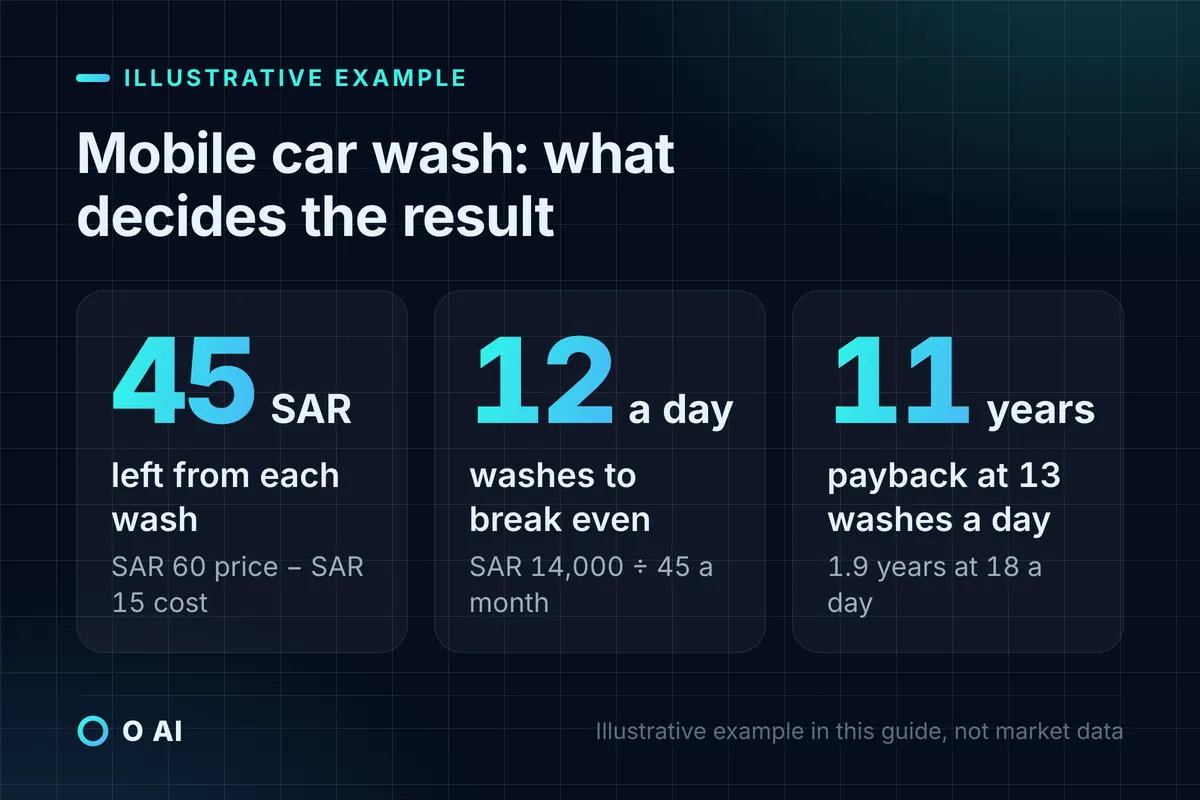
Each wash leaves SAR 45 to cover fixed costs (60 − 15). Break-even is 14,000 ÷ 45 ≈ 311 washes a month, about 12 a day.
| Washes per day | Monthly profit before zakat | Simple payback on SAR 162,000 |
|---|---|---|
| 18 | SAR 7,060 | About 1.9 years |
| 15 | SAR 3,550 | About 3.8 years |
| 13 | SAR 1,210 | About 11 years |
The lesson is in the last two rows. A drop of five washes a day, which a slow season or one new competitor could cause, turns a sound project into a weak one. This is why a study with a single "expected" scenario is not enough; show what happens if volume, price or rent moves against you.
A feasibility study for a small project: what is enough?
Not every project needs SIDF-level detail. Monsha'at classifies a micro enterprise as one with 1 to 5 full-time employees and revenue up to SAR 3 million [14], and a study for a business that size can be short if it is honest.
| Your situation | Study level | What it must contain |
|---|---|---|
| Testing an idea with your own savings | Short study, 5–10 pages | Competitor and price check, startup cost list with quotes, monthly costs, break-even, three scenarios |
| Applying to a lender or development programme | Full study in the lender's format | All five parts, an Excel model, quotes, and the lender's own template where it publishes one |
| Industrial project seeking an SIDF loan | Full study following SIDF's guideline | Five-year projections, NPV, IRR, sensitivity, financing and liquidity plans [3][4] |
| Bringing in a partner or investor | Full financial part with clear assumptions | Capital structure, profit split, cash flow, and what happens if targets are missed |
The SDB's Entrepreneur Financing product accepts projects from the idea-study stage up to a commercial register 12 months old, and requires a training course with a partner entity and a personal interview [6]. A clear study helps at both steps, because you will be asked to defend your numbers.
Who prepares a feasibility study?
Four kinds of people can prepare it, and many studies combine them.
- The founder. For a small project, you know the customers and costs better than anyone. Monsha'at publishes a feasibility study model in Arabic and English, free to download after logging in to its unified profile; it states that its templates are guidance and not binding [1].
- A consulting office. Useful when the project is larger, the market is unfamiliar, or a lender expects a particular format. Give every office the same written scope so their quotes can be compared.
- A licensed accountant or financial consultant for the financial model, especially where the study includes historical accounts or a financing structure.
- A licensed engineering office for buildings, factory layouts and technical specifications.
Free help exists before you pay anyone. Monsha'at offers free one-to-one advisory sessions with specialist consultants, booked through the Nawafeth app [12]. Its business support centres in Riyadh, Jeddah, Al Khobar and Madinah run a Fikra (idea) track that helps founders prepare the studies their project needs [13].

What does an "accredited" feasibility study mean?
Many offices advertise an "accredited feasibility study". As of 14 October 2026, we found no single Saudi authority that certifies feasibility studies as a document type. What exists are licences for the professionals who prepare parts of a study, and each funder's own acceptance rules.
- Financial consulting: the Saudi Organization for Chartered and Professional Accountants (SOCPA) licenses "financial consulting services (non-securities)", defined as professional advice to a person or entity on their financial dealings and activities [9]. The page notes that this competence moved from the Ministry of Commerce to SOCPA. It does not name feasibility studies, so ask which licence covers an office's financial work.
- Ministry of Commerce consulting licences: the ministry's service page lists only two liberal professions it now licenses: chemical consulting and educational consulting [10].
- Engineering work: the Saudi Council of Engineers licenses engineering consulting offices and offers a public search to check one [11].
- The funder: in practice, a study is "accepted" when the lender that receives it is satisfied with its content and format. SIDF, for example, warns that submitting all documents does not guarantee approval [4].
So "accredited" should mean three things you can check: the office has a valid commercial register, the people signing the financial and engineering parts hold the licences their work requires, and the study follows the format your funder asks for. This is general information, not legal advice; for a specific case, check with the licensing body or the funder.
How much does a feasibility study cost?
There is no official price list for feasibility studies in Saudi Arabia; consulting offices set their own fees. What you can control is scope, because scope drives the price.
| Cost driver | Lower cost | Higher cost |
|---|---|---|
| Project type | One shop or service | Factory, clinic or multi-site project |
| Market research | Desk research and competitor visits | Field surveys, customer interviews, import data |
| Financial model | Three-year projection | Five-year model with NPV, IRR and sensitivity, as SIDF asks [3] |
| Format | Your own template | A lender's prescribed format, in Arabic and English |
| Revisions | One round | Rework after lender feedback |
Two practical rules follow. First, decide the scope before you ask for prices, using the table above, so that you are not paying for a five-year industrial model when a three-year shop forecast will do. Second, count the study fee as part of your startup budget; SIDF's own guideline lists feasibility study fees among pre-operating expenses [3].
Common mistakes that weaken a feasibility study
- Demand by assumption. "The market is large" is not evidence. SIDF expects historical demand from recognised sources and an explained forecasting method [3].
- One scenario only. As the car wash example shows, small changes in volume can wipe out the margin. Sensitivity analysis is part of SIDF's outline for a reason [3].
- Missing pre-opening costs. Licences, design, deposits, staff hired before opening and the study fee itself all belong in capital cost [3].
- No cash reserve. Profit on paper does not pay salaries in the first months. Include working capital until sales reach break-even.
- A copied "ready-made" study. Generic figures do not match your site, your rent or your prices, and a lender's questions will expose them quickly.
- Unsupported prices. Lenders such as the SDB ask for official price quotes alongside the study [5]; collect them before you write the numbers.
Kafalah, the SME financing guarantee programme, puts it plainly in its message to business owners: verifying economic feasibility is necessary to obtain financing [7].
Your next step
Write a one-page version of your feasibility study this week: the product and price, three named competitors, a startup cost list with at least one quote per major item, monthly fixed costs, and the break-even volume. If the break-even looks reachable under a pessimistic scenario, expand it into a full study, using Monsha'at's free model or your funder's format. If your project is an app or a software platform, our guide to custom software development in Saudi Arabia explains what drives the build cost you will need for the technical and financial parts. And once the business is running, our guide on how AI can help a small business shows how to test one repetitive task before spending on tools. You can read more about O AI, a software and AI company in Al Khobar, on our home page.
Frequently asked questions
Is a feasibility study required to get financing in Saudi Arabia?
It depends on the funder and the product. The Saudi Industrial Development Fund states that a feasibility study and a financial model are mandatory for a loan application. The Social Development Bank asks for an integrated economic feasibility study or a business plan, with official price quotes, for its Excellence Financing product. Other products, such as short-term liquidity financing, focus on the business's existing record instead. Check the requirements page of the specific product before you prepare anything.
What is the difference between a feasibility study and a business plan?
A feasibility study decides whether a project should go ahead, by testing demand, delivery, costs and returns. A business plan assumes the decision is made and explains how the business will be run, marketed and grown. Monsha'at's business plan tool even asks whether a feasibility analysis was completed and what it found, which shows the order: the study first, then the plan built on its conclusions.
Can I prepare a feasibility study myself?
Yes, especially for a small project. You know your customers, suppliers and costs better than an outside office. Use Monsha'at's free feasibility study model, collect real price quotes, count competitors in person, and build a simple spreadsheet with three scenarios. Bring in a licensed accountant or financial consultant for the financial model if a lender or partner will rely on it, and an engineering office if the project involves construction or a factory layout.
How many years should the financial projections cover?
For an industrial loan, follow the funder: SIDF's guideline asks for operating costs for the first five years of production and a financial model with cash flow, payback, NPV and IRR. For a small shop or service business tested with your own money, three years is often enough to see whether it reaches break-even and repays the investment. Whatever the horizon, show the assumptions behind each year.
Is a ready-made feasibility study from the internet good enough?
Use it as a checklist, not as your study. A downloaded study carries someone else's rent, prices, wages and market, so its conclusions do not apply to your site. Lenders ask detailed questions and request price quotes, and generic figures rarely survive them. Keep the structure, replace every number with your own evidence, and test the result against a pessimistic scenario.
Which body accredits feasibility studies in Saudi Arabia?
As of October 2026, we found no single authority that certifies feasibility studies as such. SOCPA licenses accountants and financial consultants, the Saudi Council of Engineers licenses engineering offices, and the Ministry of Commerce lists only chemical and educational consulting among the professions it licenses. In practice, a study is accepted when the funder receiving it is satisfied. Check the office's commercial register and its professionals' licences, and ask your funder which format it expects.
How this article was made: Researched from the sources listed below, opened on 14 October 2026. Drafted with AI assistance, then checked against those sources. General information, not professional advice. Images are AI-generated illustrations.
Sources
- Feasibility Study Model (opens in a new tab)Monsha'at · monshaat.gov.sa
- Feasibility study tool: SWOT analysis (in Arabic) (opens in a new tab)Monsha'at · monshaat.gov.sa
- Feasibility Study Preparation Guideline (opens in a new tab)Saudi Industrial Development Fund (SIDF) · sidf.gov.sa
- All Requirements for Loan Application (opens in a new tab)Saudi Industrial Development Fund (SIDF) · sidf.gov.sa
- Excellence Financing (in Arabic) (opens in a new tab)Social Development Bank · sdb.gov.sa
- Entrepreneur Financing (in Arabic) (opens in a new tab)Social Development Bank · sdb.gov.sa
- Frequently asked questions (in Arabic) (opens in a new tab)Kafalah SME Financing Guarantee Program · kafalah.gov.sa
- Business plan tool (in Arabic) (opens in a new tab)Monsha'at · monshaat.gov.sa
- Licence to provide financial consulting services (non-securities) (in Arabic) (opens in a new tab)Saudi Organization for Chartered and Professional Accountants (SOCPA) · socpa.org.sa
- Issue a consulting profession licence (in Arabic) (opens in a new tab)Ministry of Commerce · mc.gov.sa
- Engineering office inquiry (in Arabic) (opens in a new tab)Saudi Council of Engineers · saudieng.sa
- Consulting and mentoring sessions (in Arabic) (opens in a new tab)Monsha'at · monshaat.gov.sa
- Business support centres (in Arabic) (opens in a new tab)Monsha'at · monshaat.gov.sa
- Enterprises' classification (opens in a new tab)Monsha'at · monshaat.gov.sa
About the author
Newsletter
New guides and news by email
New guides and news about O AI, Rushd and Dalni, at most twice a month. No spam.