 AI


HR management for small businesses: functions, compliance, automation
A practical guide for owners who run HR themselves: the eight functions a small business must cover, one-page HR planning with Nitaqat in mind, work regulations and the HR handbook, a compliance calendar for Qiwa, GOSI and Mudad, and which tasks to automate.


Key takeaways
- Monsha'at classes 6 to 49 full-time employees as a small enterprise; at 50 employees, work regulations must be customised by an approved law firm.
- Every establishment needs work regulations approved by the Ministry; those with 49 employees or fewer can use Qiwa's model regulations.
- Document each contract in Qiwa from the first working day, register new staff with GOSI by the end of the joining month and pay contributions by the 15th.
- Since April 2026, listed administrative support roles, including HR clerks and HR specialists, are restricted to Saudis at entity level.
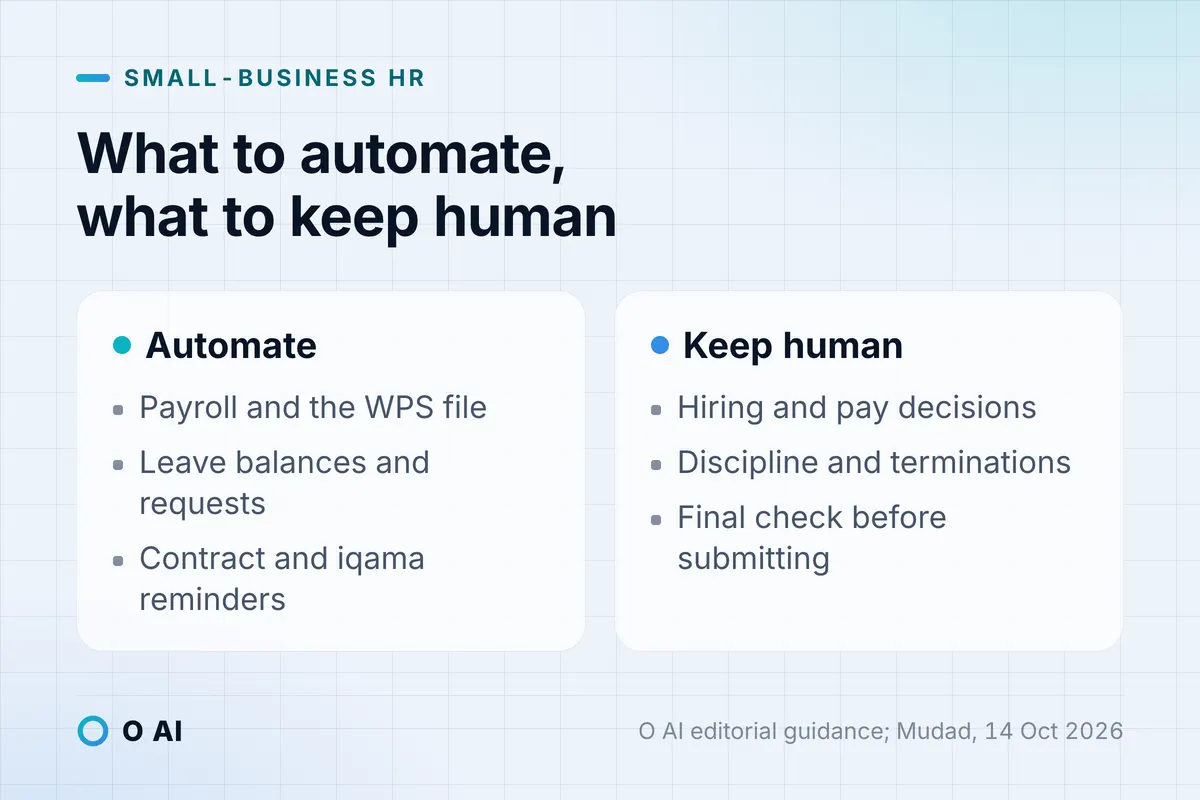
- Automate payroll, the Mudad wage file, leave balances and date reminders; keep hiring, pay changes, discipline and terminations with people.
On this page
- What counts as a small business, and why it changes HR
- HR management for small businesses: the eight functions to cover
- HR planning for a small business
- HR policy and the HR handbook
- The compliance calendar for small-business HR
- What to automate and what to keep human
- Common HR mistakes in small businesses
- Your next step
HR management for small businesses in Saudi Arabia comes down to eight functions done consistently: planning, hiring, contracts, pay, time and leave, performance and training, policy, and exits. Keep Qiwa, GOSI and Mudad in step every month, put your rules into approved work regulations, and automate the repetitive steps before you think about hiring an HR team.
This guide is for owners and managers who run HR themselves, usually alongside finance or operations. It sets out what each function involves, a compliance calendar built from the official rules checked on 14 October 2026, what belongs in an HR policy and handbook, and which tasks to automate. It is general information, not legal advice: for a specific case, check the official source or ask a licensed advisor.
What counts as a small business, and why it changes HR
Monsha'at, the Small and Medium Enterprises General Authority, classifies an enterprise by full-time employees and annual revenue together. A micro enterprise has 1 to 5 employees and revenue up to SAR 3 million; a small enterprise has 6 to 49 employees and revenue above SAR 3 million and up to SAR 40 million; a medium enterprise has 50 to 249 employees [1].
Those bands line up with real HR thresholds. An establishment with 49 employees or fewer can adopt Qiwa's model work regulations, which the Ministry of Human Resources and Social Development (HRSD) approves automatically; at 50 employees or more, the regulations must be customised by a law firm approved by the Ministry [2]. Qiwa's Nitaqat calculator works for entities with 6 to 50,000 employees [3]. So the jump from five to six people, and from 49 to 50, is worth planning for.
HR management for small businesses: the eight functions to cover
Large companies split HR into departments. A small business needs the same coverage, but usually one person holds several roles.
| Function | What it covers | Who usually does it in a 10-person company | Where it meets a government platform |
|---|---|---|---|
| Workforce planning | Roles needed this year, Saudi and non-Saudi mix, budget | Owner | Qiwa (Nitaqat band) |
| Recruitment | Job description, advert, interviews, offer | Owner with the line manager | Qiwa (contract offer) |
| Contracts and onboarding | Documented contract, probation, first-week checklist | Office manager | Qiwa (contract), GOSI (registration) |
| Pay and benefits | Payroll, allowances, deductions, insurance contributions | Accountant | GOSI (contributions), Mudad (wage file) |
| Time and leave | Working hours, overtime, annual and other leave | Office manager | None directly; rules come from the Labour Law and work regulations |
| Performance and training | Goals, reviews, training records | Line manager | Training Saudi workers is an employer duty [4] |
| Policy and employee relations | Work regulations, discipline, grievances | Owner | Qiwa (work regulations) |
| Exits | Resignation, termination, final settlement | Owner with the accountant | Qiwa (contract end), GOSI (exclusion) |
The point of the table is coverage, not job titles. If no one owns a row, that function is where problems start.
HR planning for a small business
HR planning in a small business is a one-page document, reviewed every year and whenever a big contract is won or lost. It answers four questions.
- Which roles will we need in the next 12 months? List them by function, not by person.
- Which roles must, or should, be filled by Saudis? Nitaqat measures the Saudi share of the whole entity against a band that depends on the economic activity and the number of employees; the bands run from red through three greens to platinum [5]. Some occupations are also localised one by one. Since April 2026, for example, a list of administrative support occupations, including HR clerks, HR specialists and receptionists, is restricted to Saudis at the entity level, with the last grace period ending on 4 October 2026 [6].
- What will each hire cost? Add the employer's GOSI share to gross pay: 11.75% or 12.75% of basic salary plus housing for a Saudi employee, depending on when they first registered, and 2% for a non-Saudi [7][8][9].
- When must each hire start? Work back from the start date to allow for the advert, interviews and the contract in Qiwa.
Run the planned headcount through Qiwa's Nitaqat calculator before you commit. It shows how the band moves with the expected numbers of Saudi and non-Saudi employees [3], and the band matters: an entity in the red band cannot request new visas, issue or renew work permits for expatriate workers, or transfer expatriate workers in [5].
HR policy and the HR handbook
Your HR policy has a legal home: the work regulations. Every establishment subject to the Labour Law, whatever its size, must have work regulations approved by the Ministry and announce them to all staff; failing to do so is a violation under the Ministry's table of penalties. Approved regulations cannot be edited, but a new version can be created, and once the Ministry approves it, the previous one is cancelled automatically [2].
An HR handbook is the friendly companion to the regulations. It does not replace them and must not contradict them, but it tells employees how things work day to day. A small-business HR handbook usually covers:
- Working hours, breaks, Ramadan hours and how overtime is approved.
- How to request annual leave, sick leave and the other leave types, and who approves.
- How salaries are paid, when, and how to read a payslip.
- Expected conduct, confidentiality and use of company devices.
- How to raise a grievance, and what happens in a disciplinary case.
- What happens when someone resigns or leaves.
Write the handbook in Arabic and English if your team needs both, and keep it to a length people will actually read.
The compliance calendar for small-business HR
Most compliance work in a small business is triggered by an event or by the calendar. This table collects the deadlines from the official sources.
| When | What to do | Rule |
|---|---|---|
| Before the first working day | Document the contract in Qiwa, including the probation period | Contracts are documented in Qiwa first and update GOSI automatically; an unanswered offer is cancelled after 10 days [10] |
| During probation | Track the end date | Probation may run up to 180 days if stated in the contract [4] |
| By the last day of the joining month | Register the employee with GOSI | GOSI 1445H regulations [9] |
| Every month, by the 15th | Pay GOSI contributions for the previous month | Late payment is fined 2% for each month [9] |
| Within 30 days of the 1st of each month | Upload the wage file to Mudad | Wage Protection System [11] |
| When pay or data change | Update GOSI by the end of that month | GOSI 1445H regulations [9] |
| Within 3 days of learning of a work injury | Report it to GOSI if more than first aid is needed | GOSI 1445H regulations [9] |
| At least 30 days before annual leave | Tell the employee the leave dates | Labour Law [12] |
| Before announcing new rules | Get the new work regulations approved in Qiwa | Qiwa work regulations [2] |
| By the last day of the month of leaving | Exclude the employee from GOSI and end the contract in Qiwa | GOSI 1445H regulations [9] |
Two rules from the 2025 Labour Law amendments, in force since 19 February 2025, catch many small employers: maternity leave is 12 weeks at full pay, and a resignation is treated as accepted if 30 days pass without a reply from the employer [4]. For the employee's side of probation and early termination, Dalni, O AI's rights guide, has a page on ending a contract during probation.

What to automate and what to keep human
Automation pays off first on tasks that repeat every month, follow fixed rules and are painful when forgotten. Decisions about people stay with people.
| Task | Automate? | Why |
|---|---|---|
| Payroll calculation and the bank salary file | Yes | Fixed rules; errors are costly and visible |
| Wage file for Mudad | Yes, through your bank or Mudad's payroll system | Mudad's payroll system uploads the file after each transfer [13] |
| Leave balances and requests | Yes | Simple rules, frequent questions |
| Attendance capture | Usually | Saves disputes over hours, but biometric data needs care |
| Reminders for contract, probation and iqama dates | Yes | Missed dates cause fines or lost rights |
| Standard letters and certificates | Yes | Employees can also issue salary certificates themselves in Qiwa |
| Job adverts and first drafts of policies | Assisted | AI can draft; a person checks every rule and number |
| Hiring decisions and pay changes | No | Judgement and fairness |
| Discipline, terminations and sensitive conversations | No | Legal risk and trust |
| The final check before anything goes to a government platform | No | Someone must own the submission |
For a ten-person company, a ready-made HR and payroll tool plus Qiwa, GOSI and Mudad usually covers the "yes" rows. Our guide on how AI can help your business explains how to test one repetitive task, such as leave requests or letters, before you spend.
Common HR mistakes in small businesses
- Hiring before the contract is in Qiwa. The contract should be documented from the first working day, even during probation [10].
- Using a generic policy instead of approved work regulations. A handbook downloaded from the internet has no standing if the establishment has no approved regulations [2].
- One GOSI rate for every Saudi employee. Rates differ by first registration date, so the payroll cost of two similar hires can differ [8].
- Paying salaries in cash. Cash cannot be proven in the Wage Protection System, and poor compliance can block services such as visas and the Saudization certificate [11].
- Ignoring the Nitaqat band until a visa is refused. Check the calculator before every hiring round [3].
- Giving a localised role a different title. Occupation-based Saudization looks at the work actually done as well as the job title [6].

Your next step
HR management for small businesses works best as a routine. This week, copy the compliance calendar above into your shared calendar, name one owner for each of the eight functions, and check that your establishment has approved work regulations in Qiwa. Then pick the most repetitive HR task of the month and test whether a tool can take it over. You can read more about O AI, a software and AI company in Al Khobar, on our home page.
Frequently asked questions
What are the main functions of HR management in a small business?
Eight functions cover almost everything: workforce planning, recruitment, contracts and onboarding, pay and benefits, time and leave, performance and training, policy and employee relations, and exits. In a small business one person often holds several of them, so the useful step is to name an owner for each function rather than create an HR department. If nobody owns a function, deadlines in Qiwa, GOSI or Mudad are usually where the gap shows first.
Does a small business need work regulations?
Yes. Every establishment subject to the Labour Law needs work regulations approved by the Ministry of Human Resources and Social Development, whatever its size, and must announce them to its staff. Establishments with 49 employees or fewer can use Qiwa's model regulations, which are approved automatically. From 50 employees, the regulations must be customised by a law firm approved by the Ministry.
What is the difference between an HR policy and an HR handbook?
In Saudi Arabia the binding HR policy lives in the approved work regulations: hours, leave, discipline and similar rules. An HR handbook is a practical guide for employees that explains how those rules work day to day, such as how to request leave or raise a grievance. The handbook must not contradict the regulations, and it cannot replace them.
How does HR planning work for a small company?
Keep it to one page and review it every year. List the roles you will need, decide which must or should be filled by Saudi employees under Nitaqat and any occupation-specific Saudization decision, cost each hire including the employer's GOSI share, and set start dates that leave time for recruitment and the Qiwa contract. Test the planned numbers in Qiwa's Nitaqat calculator before you commit.
Which HR tasks should a small business automate first?
Start with tasks that repeat every month and follow fixed rules: payroll and the bank salary file, the Mudad wage protection file, leave balances and requests, and reminders for contract, probation and residence permit dates. Keep hiring decisions, pay changes, discipline and terminations with people. Test one task for a few weeks and measure the time saved before you buy a larger system.
When does a small business need a full-time HR person?
There is no legal threshold. Many owners bring in a dedicated HR person once routine HR work regularly takes more than a day a week, or around the time the company approaches 50 employees and needs customised work regulations. Before hiring, check how much of the workload automation and better routines would remove.
How this article was made: Researched from the sources listed below, opened on 14 October 2026. Drafted with AI assistance, then checked against those sources. General information, not professional advice. Images are AI-generated illustrations.
Sources
- Enterprise size classification (in Arabic) (opens in a new tab)Small and Medium Enterprises General Authority (Monsha'at) · monshaat.gov.sa
- Work regulations service (in Arabic) (opens in a new tab)Qiwa · qiwa.sa
- Nitaqat calculator (in Arabic) (opens in a new tab)Qiwa · qiwa.sa
- FAQ guide to the 2025 Labour Law amendments (PDF, in Arabic) (opens in a new tab)Ministry of Human Resources and Social Development (HRSD) · hrsd.gov.sa
- Procedural guide to the developed Nitaqat programme, 2026 (PDF, in Arabic) (opens in a new tab)HRSD · hrsd.gov.sa
- Procedural guide to the decision localising administrative support occupations, April 2026 (PDF, in Arabic) (opens in a new tab)HRSD · hrsd.gov.sa
- Employer FAQs (opens in a new tab)General Organization for Social Insurance (GOSI) · gosi.gov.sa
- Employer journey: the new Social Insurance Law 1445H (in Arabic) (opens in a new tab)GOSI awareness platform · awareness.gosi.gov.sa
- Social Insurance Law 1445H and its Implementing Regulations (in Arabic) (opens in a new tab)GOSI · gosi.gov.sa
- Contract management service (in Arabic) (opens in a new tab)Qiwa · qiwa.sa
- Frequently asked questions: Wage Protection System (in Arabic) (opens in a new tab)Mudad · mudad.com.sa
- Labour Law, with amendments (in Arabic) (opens in a new tab)Bureau of Experts at the Council of Ministers · laws.boe.gov.sa
- Payroll management system (in Arabic) (opens in a new tab)Mudad · mudad.com.sa
About the author
Newsletter
New guides and news by email
New guides and news about O AI, Rushd and Dalni, at most twice a month. No spam.