 AI


HR system for Saudi companies: modules and integration with GOSI and Mudad
Choose an HR system for a Saudi company by its modules and by how it works with GOSI, Qiwa and Mudad. This guide maps HR events to GOSI deadlines, explains Qiwa contracts and occupations, the Wage Protection System and the PDPL, and gives a 12-question vendor checklist.


Key takeaways
- Qiwa is the master record for contracts: they are documented there first and update GOSI automatically, so the HR system should mirror Qiwa.
- Under GOSI's 1445H regulations, new hires and leavers must be reported by the last day of the month, and work injuries within 3 days.
- Wage files go to Mudad within 30 days of the first day of each Gregorian month; Mudad's payroll system can upload them automatically.
- Health, credit and biometric data in HR records are sensitive data under the PDPL; collect only what the purpose needs.
- Ask every vendor to show each GOSI, Qiwa and Mudad step live, and to say which steps stay manual.
On this page
- What an HR system does for a Saudi company
- The core modules and when you need each
- Integration with GOSI: the events your HR system must catch
- Integration with Qiwa: contracts and occupations
- Integration with Mudad and the Wage Protection System
- Employee data and the PDPL
- HR system checklist: 12 questions for every vendor
- Ready-made HR solutions, connected systems or a custom build?
- Your next step
An HR system for Saudi companies should hold one clean record per employee and keep it in step with three government platforms: GOSI for social insurance registration and wages, Qiwa for documented contracts and occupations, and Mudad for the monthly wage protection file. Pick modules by headcount, and test every integration live before you sign.
This guide explains what each module does, what it has to exchange with GOSI, Qiwa and Mudad, how employee data falls under the Personal Data Protection Law (PDPL), and how to compare HR software with a 12-point checklist. The platform rules were checked on the official sites on 14 October 2026. It is general information, not legal advice: for a specific case, check the official source or ask a licensed advisor.
What an HR system does for a Saudi company
An HR system (sometimes sold as an HR suite or HR solutions) is the software that holds employee records and runs the processes around them: contracts, payroll, attendance, leave, requests and reports. In Saudi Arabia it has a second job. Most HR events also have to be reported to, or mirrored from, a government platform, and the deadlines are short.
Three platforms matter most:
- GOSI registers employees for social insurance, holds the contributory wage and invoices the establishment every month.
- Qiwa, the Saudi labour-market platform, documents employment contracts, manages occupations and hosts the work regulations.
- Mudad receives the bank's wage file for the Wage Protection System and measures each establishment's compliance.
A spreadsheet can track ten employees. Once the company has several branches, a mix of Saudi and non-Saudi staff, or shift work with overtime, the number of events per month makes a system worth its cost.
The core modules and when you need each
| Module | What it does | Saudi-specific requirement | Typically needed from |
|---|---|---|---|
| Employee records (core HR) | One file per employee: ID or iqama, nationality, job, branch, documents | Store the GOSI system (older or new) and the occupation code used in Qiwa | The first employee |
| Contracts | Templates, renewals, probation dates, end dates | Qiwa is the record of documented contracts; probation may run up to 180 days since the 2025 amendments [1] | The first employee |
| Payroll | Gross to net, deductions, bank file | GOSI rates differ by nationality and first registration date; wage file for Mudad | A few employees |
| Time and attendance | Shifts, clock-in, overtime | 8 hours a day or 48 a week, 6 or 36 in Ramadan for Muslim workers [2] | Shift or field work |
| Leave | Balances, requests, approvals | 21 days a year, 30 after five years [2]; 12 weeks' maternity leave at full pay, 5 days for marriage or the death of a spouse or a direct ascendant or descendant, 3 days for a new baby [1] | About 10 employees |
| Self-service | Requests, letters, payslips on mobile | Arabic and English interface; employees can also issue their own salary certificate on Qiwa | About 20 employees |
| Recruitment and onboarding | Job requisitions, offers, first-day checklists | Offer details must match the contract sent through Qiwa | Regular hiring |
| Performance and training | Goals, reviews, training records | Employers must train and qualify Saudi workers [1] | About 50 employees |
| Saudization reporting | Saudi share by entity and by occupation | Occupation codes must match the Saudi Unified Classification of Occupations [3] | Mixed workforce |
The "typically needed from" column is our editorial judgement, not a rule. A ten-person company with night shifts may need attendance before a fifty-person office does.
Integration with GOSI: the events your HR system must catch
GOSI's business services cover registering a contributor, updating wages, excluding a contributor who leaves, reporting a work injury and viewing the establishment's invoice [4]. Each of these starts as an event in your HR system, and GOSI's regulations under the 1445H Social Insurance Law set the deadlines [5].
| HR event | GOSI action | Deadline in GOSI's 1445H regulations |
|---|---|---|
| New establishment becomes subject to the law | Register the establishment | Within 10 days of meeting the conditions |
| New employee joins | Register the contributor | Immediately, and by the last day of the month of joining at the latest |
| Employee leaves | Exclude the contributor | Immediately, and by the last day of the month of leaving at the latest |
| Wage or other data changes | Update the record | By the last day of the month of the change |
| Work injury that needs more than first aid | Report the injury | Within 3 days of the employer learning of it |
| Month closes | Pay contributions | Within the first 15 days of the following month; late payment is fined 2% a month |
Two practical points follow. The payroll module must know which GOSI system each Saudi employee is on, because the pension rate for people first registered on or after 3 July 2024 rises every July until 2028 [5]. And the HR system should raise a task for each event above, with its deadline, rather than relying on someone to remember.
Integration with Qiwa: contracts and occupations
Qiwa's contract service lets business owners and HR teams create, update and end employment contracts, free of charge. Contracts are documented in Qiwa first and then updated automatically in GOSI, not the other way round. Every employee's contract should be documented from the start date, including during probation, and a contract offer that the employee neither accepts nor rejects is cancelled automatically after 10 days [6].
For an HR system, that means Qiwa is the master record of contract status. The HR system can draft the offer and store the signed copy, but it should mirror what Qiwa shows rather than keep a separate truth.
Occupations work the same way. Qiwa's occupation service shows a compliance indicator: the number of employees whose occupations match the Saudi Unified Classification of Occupations, and how many correction requests the establishment still needs to issue [3]. Saudization decisions that target specific occupations are checked automatically against the occupational titles held in GOSI's database [7], so the HR system's job titles should map to the official occupation code, not just to an internal title.
Qiwa also hosts the work regulations every establishment needs. Establishments with 49 employees or fewer can use the model regulations, which the Ministry approves automatically; those with 50 or more need customised regulations prepared by a law firm approved by the Ministry [8]. Your leave, overtime and discipline settings in the HR system should copy the approved regulations.

Integration with Mudad and the Wage Protection System
The Wage Protection System proves that salaries were paid on time and in full. Wage files are uploaded only through Mudad, within 30 days of the due date, which is the first day of each Gregorian month. The file is issued by the bank after the transfer, so salaries paid in cash cannot be uploaded, and continued non-compliance can lead the Ministry to suspend services such as visas and the Saudization certificate [9].
There are two common set-ups:
- Your HR system produces the bank salary file. The bank pays the salaries and issues the wage protection file, which someone uploads to Mudad.
- Payroll runs through Mudad's own payroll system. It reads company and employee data through Mudad's link with GOSI and uploads the wage protection file automatically after each transfer. Mudad states that customers of HR systems can use its payroll services to transfer salaries and get the automatic upload [10].
Either way, the HR system should store the WPS file reference for each month next to the payroll run, so the compliance rate in Mudad can be traced back to a specific payment.
Employee data and the PDPL
An HR system holds more personal data than almost any other system in the company. Under the Personal Data Protection Law, health data, credit data and biometric data that identifies a person are all sensitive data. Collected data must be limited to the minimum needed for the purpose, and the controller must publish a privacy policy that people can read before their data is collected [11].
Three settings deserve attention before go-live:
- Biometric attendance. Fingerprint and face scans are biometric identity data; collect them only where a simpler method will not do, and restrict who can see them.
- Medical certificates and sick leave. Keep them in a restricted section, not in the general employee file.
- Hosting location. If the vendor stores data outside the Kingdom, transfers must meet the PDPL's conditions; our guide on data residency in Saudi Arabia walks through them.

HR system checklist: 12 questions for every vendor
Ask each vendor to show the answer live, on your data or realistic test data, rather than on slides.
- Language and calendar. Full Arabic and English interfaces, with Hijri and Gregorian dates.
- Employee record. Fields for ID or iqama, nationality, GOSI system, Qiwa contract reference and occupation code.
- Payroll rules. Different GOSI rates per employee, the SAR 45,000 cap on the contributory wage, and a clear audit trail.
- Attendance and overtime. Daily or weekly standard, Ramadan hours, rest-day hours as overtime, compensatory leave.
- Leave types. Annual leave at 21 and 30 days, plus the leave types added in 2025.
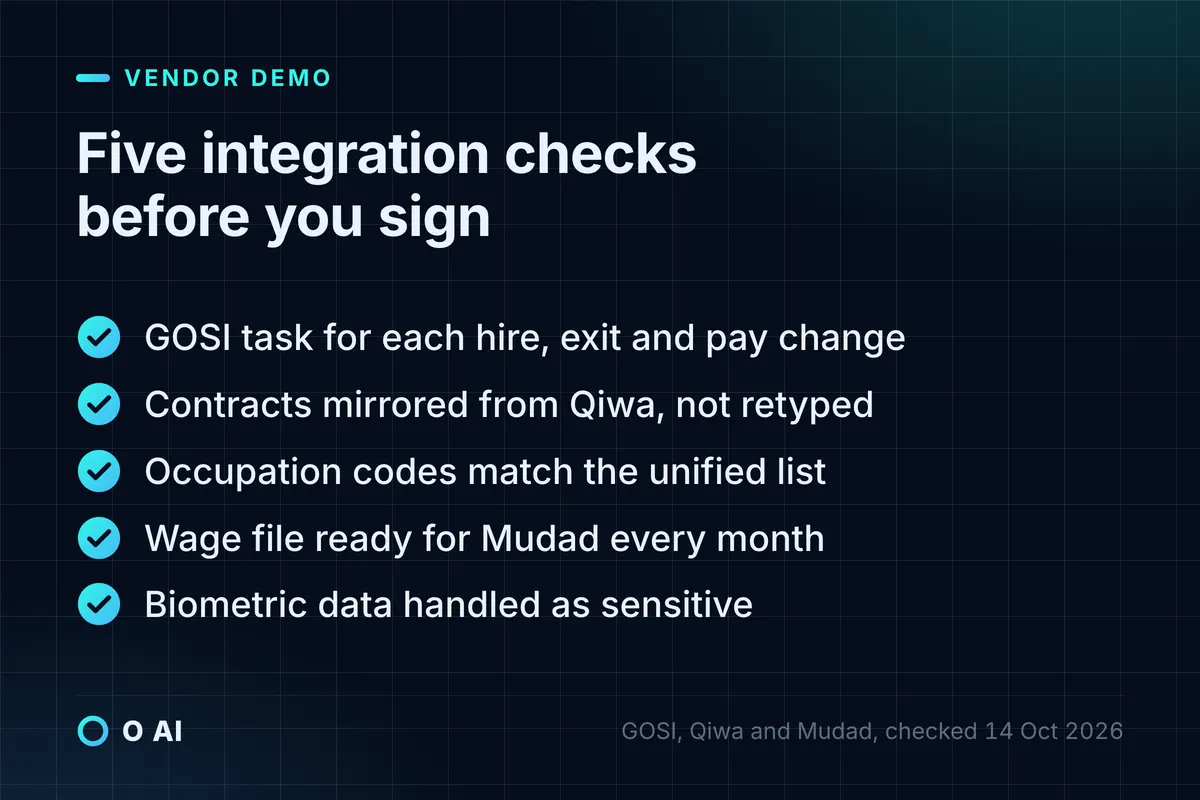
- GOSI events. A task with a deadline for every hire, exit and wage change.
- Qiwa. Contract status and occupations mirrored from Qiwa, with no second version kept in the HR system.
- Mudad. A bank salary file in your bank's format, or a working route through Mudad's payroll system.
- Saudization view. Saudi share by entity and by occupation code, ready for Nitaqat planning.
- Self-service. Leave requests, approvals and letters on mobile, in both languages.
- Data protection. Hosting location, role-based access, an audit log, handling of biometric and health data, and a full export of your data.
- Price and exit. Price per employee per month, implementation fee, Arabic support hours and what happens to your data if you leave.
Not every vendor connects directly to every platform. Ask which steps are automatic, which are a file you upload, and which stay manual, and price the manual steps in staff hours.
Ready-made HR solutions, connected systems or a custom build?
Most small and medium companies are best served by a ready-made HR system plus Mudad and the government portals. A company with unusual shift patterns, several legal entities or an existing ERP may need its HR system connected to other software, and a few need a tailored build. Our guide to custom software development in Saudi Arabia sets out when to buy, connect or build.
Whatever you choose, roll it out in six steps:
- Clean the master list. Match every employee against GOSI's contributor list and Qiwa's employee list before importing anything.
- Fix occupations in Qiwa first. Correct codes there, then copy them into the HR system.
- Configure from your approved work regulations. Leave, overtime, allowances and discipline settings follow the regulations, not a vendor's default template.
- Run one parallel month. Calculate payroll in the old way and in the new system, and reconcile both with the GOSI invoice.
- Train HR and line managers, then switch on self-service for employees.
- Review after 90 days. Check missed GOSI deadlines, Mudad compliance and the requests still handled outside the system.
Your next step
This week, list every HR event from the last three months (hires, exits, wage changes, injuries, leave and overtime) and note which platform each one touched and how long it took. That list becomes the brief for your HR system for Saudi companies: the modules you need, the integrations to test live, and the manual steps worth removing. If an AI assistant could help with the letters and requests that remain, our guide on AI agents, RPA and workflow tools shows which kind of automation fits which step. You can read more about O AI, a software and AI company in Al Khobar, on our home page.
Frequently asked questions
What modules should an HR system for a Saudi company include?
At minimum: employee records, contracts, payroll, leave and attendance. As the company grows, add employee self-service, recruitment and onboarding, performance and training, and Saudization reporting. What makes a system fit Saudi Arabia is not the module list but the details inside it: GOSI rates per employee, occupation codes that match the Saudi Unified Classification of Occupations, leave types from the 2025 Labour Law amendments, and a payroll output that works with the Wage Protection System.
Does an HR system connect directly to GOSI, Qiwa and Mudad?
It depends on the vendor. Some steps can be automated, some produce a file you upload, and some stay manual on the government portal. Qiwa is the master record for documented contracts and updates GOSI automatically, and Mudad's payroll system can upload the wage protection file after each transfer. Ask every vendor to show each connection live and to say which steps your team will still do by hand.
Do small companies need an HR system?
Not always at the start. A company with a handful of employees can manage with Qiwa, the GOSI business account, Mudad and a well-built spreadsheet. The case for a system grows with branches, shift work, a mix of Saudi and non-Saudi staff, and the number of monthly events such as hires, exits and wage changes. Count those events for three months before you decide.
How does an HR system help with Saudization?
It can show the Saudi share of the workforce by entity and by occupation, which is how Nitaqat and occupation-specific Saudization decisions are measured. For that to work, each employee's occupation must match the code used in Qiwa and GOSI, not just an internal job title. The HR system then becomes a planning tool: it shows which roles must be filled by Saudis and how a hire or exit changes the ratio.
Is employee data in an HR system covered by the PDPL?
Yes. Employee records are personal data, and some of them, such as health records, credit data and biometric data from attendance devices, are sensitive data under the Personal Data Protection Law. Collect only what the purpose needs, publish a privacy policy, restrict access by role and check where the vendor hosts the data. If it is stored outside the Kingdom, the transfer must meet the law's conditions.
What should I ask an HR software vendor before signing?
Ask them to show, on realistic data, how the system handles different GOSI rates, overtime under the daily and weekly standards, Ramadan hours and the 2025 leave types. Ask which government steps are automatic and which stay manual, where the data is hosted, how biometric and medical data are protected, what you pay per employee per month, and how you export all your data if you leave.
How this article was made: Researched from the sources listed below, opened on 14 October 2026. Drafted with AI assistance, then checked against those sources. General information, not professional advice. Images are AI-generated illustrations.
Sources
- FAQ guide to the 2025 Labour Law amendments (PDF, in Arabic) (opens in a new tab)Ministry of Human Resources and Social Development (HRSD) · hrsd.gov.sa
- Labour Law, with amendments (in Arabic) (opens in a new tab)Bureau of Experts at the Council of Ministers · laws.boe.gov.sa
- Occupation management service (in Arabic) (opens in a new tab)Qiwa · qiwa.sa
- Business services (in Arabic) (opens in a new tab)General Organization for Social Insurance (GOSI) · gosi.gov.sa
- Social Insurance Law 1445H and its Implementing Regulations (in Arabic) (opens in a new tab)GOSI · gosi.gov.sa
- Contract management service (in Arabic) (opens in a new tab)Qiwa · qiwa.sa
- Procedural guide to the decision localising administrative support occupations, April 2026 (PDF, in Arabic) (opens in a new tab)HRSD · hrsd.gov.sa
- Work regulations service (in Arabic) (opens in a new tab)Qiwa · qiwa.sa
- Frequently asked questions: Wage Protection System (in Arabic) (opens in a new tab)Mudad · mudad.com.sa
- Payroll management system (in Arabic) (opens in a new tab)Mudad · mudad.com.sa
- Personal Data Protection Law, with amendments (in Arabic) (opens in a new tab)Bureau of Experts at the Council of Ministers · laws.boe.gov.sa
About the author
Newsletter
New guides and news by email
New guides and news about O AI, Rushd and Dalni, at most twice a month. No spam.