 AI


NCA Essential Cybersecurity Controls (ECC): who must comply, with a readiness checklist
The ECC binds government agencies, their affiliates and private operators of critical infrastructure; other companies fall under NCA's separate private-sector controls or none. The scope in NCA's words, the 2024 changes, surprising requirements and a 12-point readiness checklist.


Key takeaways
- ECC-2:2024 binds government agencies, their affiliated companies inside and outside the Kingdom, and private entities that own, operate or host CNI.
- Other entities are strongly encouraged, not required, to use the ECC; NCNICC-1:2025 covers non-CNI private firms once NCA notifies them.
- ECC-2:2024 has 4 main domains, 28 subdomains, 108 main controls and 92 subcontrols, and its Arabic text is the binding version.
- The 2024 update moved industrial control systems to the OTCC and data localisation to the NDMO, and added DKIM, DMARC and DDoS controls.
- NCA checks compliance through self-assessment, compliance-tool reports and field audits, so keep evidence for every applicable control.
On this page
- What are the NCA Essential Cybersecurity Controls?
- Who must comply with the ECC, in NCA's words
- Does the ECC bind your private company? ECC, NCNICC or neither
- ECC-2:2024 at a glance: four domains and 28 subdomains
- What changed from ECC-1:2018
- Requirements that surprise first-time readers
- How NCA checks compliance
- ECC readiness checklist: 12 points
- Your next step
The NCA Essential Cybersecurity Controls (ECC-2:2024) are mandatory for Saudi government agencies, their affiliated companies and entities inside and outside the Kingdom, and private entities that own, operate or host critical national infrastructure [1]. Other companies are strongly encouraged, not required, to use them [2]. Readiness starts with confirming your scope in writing.
This guide sets out the ECC's scope in the National Cybersecurity Authority's (NCA) own terms, how it relates to NCA's separate controls for other private companies, what changed in the 2024 version, which requirements surprise first-time readers, and a 12-point readiness checklist. It is general information; for a decision about your own entity, rely on NCA's official text or a licensed advisor.
What are the NCA Essential Cybersecurity Controls?
The ECC sets the minimum cybersecurity requirements for national entities within its scope [2]. NCA issued the first version, ECC-1:2018, and announced the update to the current version in October 2024 [3]. The current document, ECC-2:2024, contains [1]:
- 4 main domains;
- 28 subdomains;
- 108 main controls;
- 92 subcontrols.
The controls aim at three protection goals, confidentiality, integrity and availability, and build on four pillars: strategy, people, process and technology [2]. NCA publishes the document in Arabic and English, and states that the Arabic version is binding for any question of meaning or interpretation [2].
The legal basis is NCA's statute and High Order No. 57231 dated 10/11/1439H. Under Article 10(3) of the statute and that order, every entity within the scope must take the measures needed for ongoing and continuous compliance [2].
Who must comply with the ECC, in NCA's words
NCA defines the scope in one sentence. The controls apply to [1][2]:
- Government agencies in Saudi Arabia, including ministries, authorities, establishments and others;
- their affiliated companies and entities, inside and outside the Kingdom;
- all private-sector entities that own, operate or host critical national infrastructure (CNI).
NCA then "strongly encourages" all other entities in the Kingdom to use the controls to improve their cybersecurity [2]. Encouragement is not an obligation, which is why a statement such as "every Saudi company must comply with the ECC" is inaccurate.
The ECC defines critical national infrastructure as essential elements of infrastructure, meaning assets, facilities, systems, networks, processes and the key people who run them, whose loss or compromise could significantly affect the availability or delivery of basic services, cause serious loss of property or lives, or significantly affect national security, defence or the economy [2]. If you are unsure whether your company counts as a CNI operator, ask your sector regulator or NCA rather than deciding alone.
Within an entity in scope, every applicable control must be met [2]. Applicability varies with the business: for example, the cloud computing and hosting controls in subdomain 4-2 bind only entities that use, or plan to use, cloud or hosting services [2].
Does the ECC bind your private company? ECC, NCNICC or neither
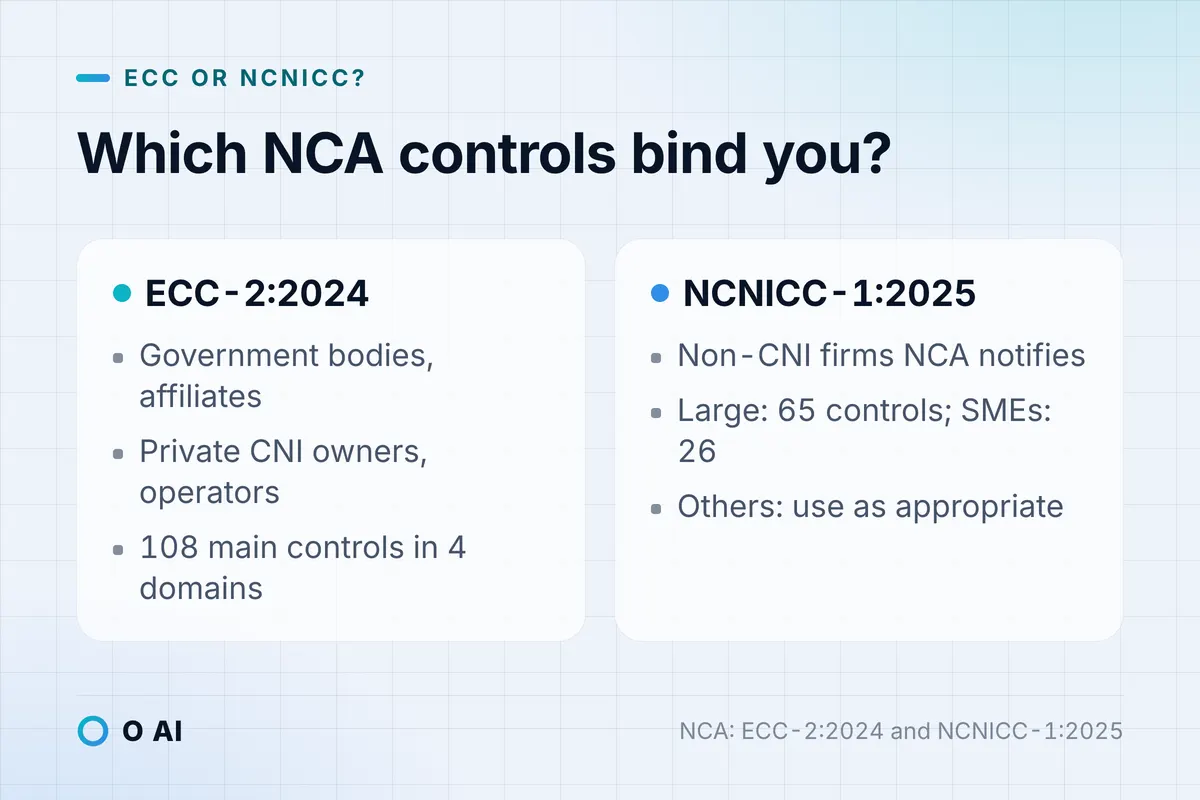
Most private companies are not CNI operators and are not affiliated with a government agency. For them, NCA issued a separate document in 2025: the Non-CNI Private Sector Entities Cybersecurity Controls (NCNICC-1:2025), developed from the ECC as a version better suited to large, medium and small private entities [4].
| Your situation | What applies | Source |
|---|---|---|
| Government agency, or a company or entity affiliated with one (inside or outside the Kingdom) | ECC-2:2024, all applicable controls | [1][2] |
| Private entity that owns, operates or hosts CNI | ECC-2:2024, all applicable controls | [1][2] |
| Large private entity outside CNI (more than 250 full-time staff or more than SAR 200 million in revenue) that NCA has notified | NCNICC Category A: 3 main domains, 22 subdomains, 65 essential controls | [4] |
| Small or medium private entity outside CNI (6 to 249 staff or SAR 3 million to SAR 200 million) that NCA has notified | NCNICC Category B: cybersecurity defence only, 13 subdomains, 26 essential controls | [4] |
| Private entity not notified, or a micro business | No ECC duty; NCA encourages use of the ECC, and expects entities outside NCNICC's scope to use those controls as appropriate | [2][4] |
| Supplier to a government or CNI client | No direct duty, but where your service could affect the client's data or services, its contract must oblige you to apply its cybersecurity requirements | [2] |
| Cloud provider serving government or CNI customers | The Cloud Cybersecurity Controls (CCC-2:2024) for providers | [6] |
NCNICC's size bands follow the definition of the Small and Medium Enterprises General Authority (Monsha'at) [4][5]. Two practical consequences follow. First, a notified small or medium company faces 26 defensive controls rather than the ECC's 108. Second, a company that serves government or CNI clients meets ECC requirements through its contracts even when the ECC does not bind it directly: control 4-1-2 requires in-scope entities to include non-disclosure, secure data removal at the end of service, incident communication procedures and an obligation to follow their cybersecurity requirements in third-party contracts [2].
Entities that run industrial control systems should also read NCA's Operational Technology Cybersecurity Controls (OTCC-1:2022), which extend the ECC to those systems [7].
ECC-2:2024 at a glance: four domains and 28 subdomains
| Domain | Subdomains | What they cover |
|---|---|---|
| 1. Cybersecurity governance | 10 (1-1 to 1-10) | Strategy, the cybersecurity department, policies and procedures, roles, risk management, cybersecurity in IT projects, compliance, periodic review and audit, human resources, awareness and training |
| 2. Cybersecurity defence | 15 (2-1 to 2-15) | Asset management, identity and access, systems and processing facilities, email, networks, mobile devices, data protection, cryptography, backup and recovery, vulnerabilities, penetration testing, event logs and monitoring, incident and threat management, physical security, web applications |
| 3. Cybersecurity resilience | 1 (3-1) | Cybersecurity aspects of business continuity management |
| 4. Third-party and cloud computing cybersecurity | 2 (4-1, 4-2) | Third-party contracts and managed services; cloud computing and hosting |
Source: ECC-2:2024, subdomain list [2].
What changed from ECC-1:2018
NCA's appendix of updates lists the changes against the 2018 version [2]. The ones with the most practical effect:
| Area | ECC-1:2018 | ECC-2:2024 |
|---|---|---|
| Scope | Government entities and their companies and entities | Government agencies and their affiliated companies and entities, inside and outside the Kingdom |
| Industrial control systems | Main domain 5 | Removed; the controls moved to the OTCC |
| Staffing (1-2-2) | The head of cybersecurity and supervisory and critical positions filled by full-time, experienced Saudi professionals | All cybersecurity positions filled by full-time, qualified Saudi professionals |
| Multi-factor authentication (2-2-3-2) | For remote access | Factors chosen by impact assessment, for remote access and for privileged accounts |
| Email (2-4-3-5) | Domain validation, for example SPF | SPF, DKIM and DMARC |
| Denial of service (2-5-3-9) | No specific sub-control | New sub-control on protection against DDoS attacks |
| Cryptography (2-8-3) | Its own list of requirements | At least the requirements of NCA's National Cryptographic Standards |
| Data localisation (4-2-3-3) | Hosting and storage inside the Kingdom | Removed from the ECC and moved to the National Data Management Office at SDAIA, which entities must consult before acting |
The last change matters for any entity choosing a cloud provider. Data location questions now go to the National Data Management Office rather than being settled by the ECC alone [2]; our guide to data residency in Saudi Arabia covers the related personal data rules.
Requirements that surprise first-time readers
Several ECC controls go further than a typical commercial security standard. All of the following come from ECC-2:2024 [2]:
- An independent department (1-2-1). The cybersecurity department must be independent of the IT and communications department, as High Order No. 37140 dated 14/08/1438H requires, and NCA recommends that it report to the head of the entity.
- Saudi staffing (1-2-2). Every cybersecurity position must be filled by full-time, qualified Saudi professionals.
- A supervisory committee (1-2-3) that includes the head of the cybersecurity department.
- Independent audit (1-8-2). Parties other than the cybersecurity department must review and audit the controls, following generally accepted auditing standards.
- Risk assessments at set moments (1-5-3): early in technology projects, before major infrastructure changes, when planning third-party services, and before launching new technology services.
- Secure development (1-6-3): secure coding standards, trusted and licensed sources for development tools and libraries, and compliance testing before release.
- Trusted time (2-3-3-4): central clock synchronisation with an accurate source, such as those of the Saudi Standards, Metrology and Quality Organization.
- Twelve months of logs (2-12-3): security event logging for critical assets and privileged accounts, continuous monitoring, and retention of at least 12 months.
- Reporting to NCA (2-13-3): incidents must be reported to NCA, and incident notifications and threat intelligence shared with it.
- Testing the outside (2-11-3): periodic penetration tests covering every internet-facing service, including websites, mobile apps, email and remote access.
- Monitoring inside the Kingdom (4-1-3-2): managed security operations centres that use remote access must be located entirely in Saudi Arabia.
Personal data breaches add a separate duty. The PDPL's Implementing Regulation requires notice to the competent authority within 72 hours where harm is likely, and states that this does not affect any duty to report incidents under NCA's rules [11].
How NCA checks compliance
NCA assesses compliance through self-assessment by the entity, periodic reports from its compliance tool, field audit visits, or any mechanism it considers appropriate [2]. ECC-2:2024 also announces an assessment and compliance tool to organise how entities measure their compliance [2]. NCA's ECC page publishes the controls together with a Guide to ECC Implementation [8].
In practice, this means evidence matters as much as controls: approved documents, records of reviews, test results and audit reports. The checklist below lists the evidence to keep for each area.
ECC readiness checklist: 12 points
Use it as a first gap assessment. Mark each row yes, partly or no, and attach the evidence.
| # | Readiness check | ECC reference [2] | Evidence to keep |
|---|---|---|---|
| 1 | Scope confirmed in writing: why the ECC applies, and which subdomains do not | Scope; statement of applicability | A signed scoping memo |
| 2 | Strategy approved by the head of the entity, with an action plan | 1-1 | Approved strategy and roadmap |
| 3 | Cybersecurity department independent of IT, staffed by full-time qualified Saudis, with a supervisory committee | 1-2 | Organisation chart, committee charter |
| 4 | Policies, procedures and technical standards approved and communicated | 1-3 | Approved policy set, distribution records |
| 5 | Risk methodology applied at the four trigger points | 1-5 | Risk register, assessment reports |
| 6 | Complete, classified inventory of information and technology assets | 2-1 | Asset register with owners and classification |
| 7 | Multi-factor authentication for remote and privileged access, privileged access management, periodic access reviews | 2-2 | Configuration evidence, review records |
| 8 | Patching, vulnerability assessment and periodic penetration testing of internet-facing services | 2-3, 2-10, 2-11 | Scan and test reports, remediation tickets |
| 9 | Event logs for critical assets, continuous monitoring, at least 12 months' retention | 2-12 | Log retention settings, monitoring reports |
| 10 | Incident response plan, incident classification and a route for reporting to NCA | 2-13 | Plan, exercise reports, reporting contacts |
| 11 | Backups with periodic restore tests, plus continuity and disaster recovery plans | 2-9, 3-1 | Restore test logs, approved plans |
| 12 | Third-party contracts with security clauses, and any managed security centre located in the Kingdom | 4-1 | Contract clauses, provider confirmations |
To draft missing documents, NCA publishes free templates for policies, standards, procedures and registers, which it describes as intended for government, private and other entities [9].

How to choose cybersecurity companies to help
Most entities bring in outside help for gap assessments, monitoring or penetration testing. A few checks narrow the field:
- Registration or licence. In October 2026, NCA reminded providers of cybersecurity services, products and solutions in the Kingdom that they must register on the national cybersecurity portal, Haseen, for activities that do not require an NCA licence [10]. Ask every candidate for its registration or licence.
- Location. If the service is a managed security operations centre with remote access, it must be located entirely in Saudi Arabia [2].
- Contract terms. Before signing, run a cybersecurity risk assessment, and include the clauses that control 4-1 requires [2].
- Accountability. An outside firm can do the work, but NCA's statute states that no entity is relieved of responsibility for its own cybersecurity [2].
Our guide to choosing a software development company in Saudi Arabia offers a written-question method that also works for security providers.

Your next step
This week, write a one-page scoping memo: which sentence of the ECC's scope applies to you, or why it does not, and whether NCNICC or a client contract applies instead. If the ECC does apply, run the 12-point readiness table as a first gap assessment and attach the evidence to each row. The NCA Essential Cybersecurity Controls reward entities that can show their work, not only do it. You can read about O AI, a software and AI company in Al Khobar, on our home page.
Frequently asked questions
What are the NCA Essential Cybersecurity Controls?
The Essential Cybersecurity Controls are the National Cybersecurity Authority's minimum cybersecurity requirements for national entities within their scope. The current version, ECC-2:2024, replaced ECC-1:2018 and contains 4 main domains, 28 subdomains, 108 main controls and 92 subcontrols, covering governance, defence, resilience, and third-party and cloud security. The Arabic text is the binding version, and NCA publishes an English translation and an implementation guide on its website.
Who must comply with ECC-2:2024?
Government agencies in Saudi Arabia, including ministries, authorities and establishments, must comply, together with their affiliated companies and entities inside and outside the Kingdom. All private-sector entities that own, operate or host critical national infrastructure must also comply. NCA strongly encourages every other entity in the Kingdom to use the controls as best practice, but that encouragement does not make them mandatory.
Is the ECC mandatory for private companies in Saudi Arabia?
Only for private companies that own, operate or host critical national infrastructure, or that are affiliated with a government agency. Other private companies come under NCA's separate controls for non-CNI private-sector entities, which bind the large, medium and small companies NCA notifies. A supplier to a government or CNI client may still have to meet ECC-based requirements through its contract, because the ECC requires in-scope clients to impose their cybersecurity requirements on third parties.
How many controls are in ECC-2:2024?
ECC-2:2024 has 108 main controls and 92 subcontrols, organised in 4 main domains and 28 subdomains. Governance has 10 subdomains, defence 15, resilience 1, and third-party and cloud computing security 2. Not every control applies to every entity; for example, the cloud and hosting controls apply only to entities that use or plan to use those services. Each entity in scope must meet all the controls that apply to it.
What is the difference between the ECC and the NCNICC?
The ECC applies to government agencies, their affiliates and private operators of critical national infrastructure, with 108 main controls. The NCNICC, issued in 2025, covers private companies outside critical infrastructure and was developed from the ECC as a better fit for them: large companies get 65 essential controls and small and medium companies 26, all binding only once NCA notifies the company. Companies outside both are expected to use the controls as appropriate.
What changed in ECC-2:2024 compared with ECC-1:2018?
The update clarified that affiliated companies inside and outside the Kingdom are in scope, moved the industrial control systems domain to the separate operational technology controls, and required all cybersecurity positions to be filled by full-time, qualified Saudis. It expanded multi-factor authentication to privileged accounts, added DKIM and DMARC to email validation, added a DDoS protection sub-control, linked cryptography to the National Cryptographic Standards, and moved data localisation to the National Data Management Office.
How do I choose a cybersecurity company in Saudi Arabia?
Start with registration: NCA requires providers of cybersecurity services, products and solutions in the Kingdom to register on its Haseen portal for activities that do not need an NCA licence, so ask each candidate for its registration or licence. Check where the service runs, because ECC-scope entities need managed security operations centres located entirely in the Kingdom. Put security clauses into the contract, and remember that responsibility for your cybersecurity stays with you.
How this article was made: Researched from the sources listed below, opened on 14 October 2026. Drafted with AI assistance, then checked against those sources. General information, not professional advice. Images are AI-generated illustrations.
Sources
- Essential Cybersecurity Controls (ECC-2:2024), Arabic binding text (opens in a new tab)National Cybersecurity Authority (NCA) · cdn.nca.gov.sa
- Essential Cybersecurity Controls (ECC-2:2024), English version (opens in a new tab)National Cybersecurity Authority (NCA) · cdn.nca.gov.sa
- NCA announces an update to the Essential Cybersecurity Controls, 17 October 2024 (in Arabic) (opens in a new tab)National Cybersecurity Authority (NCA) · nca.gov.sa
- Non-CNI Private Sector Entities Cybersecurity Controls (NCNICC-1:2025) (in Arabic) (opens in a new tab)National Cybersecurity Authority (NCA) · cdn.nca.gov.sa
- SME definition (opens in a new tab)Small and Medium Enterprises General Authority (Monsha'at) · monshaat.gov.sa
- Cloud Cybersecurity Controls (CCC-2:2024) (opens in a new tab)National Cybersecurity Authority (NCA) · cdn.nca.gov.sa
- Operational Technology Cybersecurity Controls (OTCC-1:2022) (opens in a new tab)National Cybersecurity Authority (NCA) · nca.gov.sa
- Essential Cybersecurity Controls page, with the Guide to ECC Implementation (opens in a new tab)National Cybersecurity Authority (NCA) · nca.gov.sa
- Cybersecurity toolkits (in Arabic) (opens in a new tab)National Cybersecurity Authority (NCA) · nca.gov.sa
- Registration of cybersecurity service providers on the Haseen portal, 2 October 2026 (in Arabic) (opens in a new tab)National Cybersecurity Authority (NCA) · nca.gov.sa
- Implementing Regulation of the Personal Data Protection Law (in Arabic) (opens in a new tab)Saudi Data and AI Authority (SDAIA), National Data Governance Platform · dgp.sdaia.gov.sa
About the author
Newsletter
New guides and news by email
New guides and news about O AI, Rushd and Dalni, at most twice a month. No spam.