 AI


Saudi VAT Implementing Regulations in plain language: key articles
A plain-language map of Saudi Arabia's VAT Implementing Regulations: which edition is current, what each of the 12 chapters settles, what is exempt or zero-rated, which input VAT is blocked, and the deadlines for invoices, returns, payment and records, with article numbers.


Key takeaways
- The official Arabic text is the tenth edition (April 2025), covering amendments to 19 November 2024; ZATCA's English translation is the 2021 edition.
- Exemptions sit in Articles 29 and 30 and zero rates in Articles 31 to 36; there is no separate official PDF list of exempt goods.
- Article 50 blocks input VAT on entertainment, staff hospitality without a legal duty, and vehicles for up to 10 people, subject to listed exceptions.
- Returns and payment are due by the last day of the month after the tax period (Articles 59 and 62), even on a weekend (Article 74).
- Penalties are in the VAT Law, Articles 39 to 49, not in the Implementing Regulations.
On this page
- How the VAT Law, the GCC Agreement and the regulations fit together
- Which version of Saudi Arabia's VAT Implementing Regulations is current?
- The 12 chapters at a glance, and the articles businesses use most
- Registration rules in brief (Articles 2 to 13)
- Exempt and zero-rated supplies: what the regulations actually list
- Input tax: what you can deduct and what is blocked (Articles 49 to 51)
- Tax invoices, credit notes and records (Articles 53, 54 and 66)
- Returns, payment and corrections: the procedural articles
- Six mistakes people make when reading the regulations
- Your next step
Saudi Arabia's VAT Implementing Regulations are ZATCA's detailed rulebook under the VAT Law: 79 numbered articles in 12 chapters on registration, exempt and zero-rated supplies, input tax, invoices, returns, payment, records and refunds. The official text is Arabic, now in its tenth edition of April 2025 [1]; ZATCA's English translation is an older 2021 edition [2].
This guide walks through the articles a business meets most often, using the numbering of the current Arabic text, so you can check every point at the source. It is general information, not tax advice: confirm a specific case with ZATCA or a licensed tax adviser.
How the VAT Law, the GCC Agreement and the regulations fit together
VAT in Saudi Arabia rests on three texts, and each one answers a different question.
- The GCC Unified VAT Agreement sets the common framework for the Gulf states, including the registration thresholds. The Kingdom ratified it by Royal Decree M/51 dated 3/5/1438H [3].
- The VAT Law, issued by Royal Decree M/113 dated 2/11/1438H, has 53 articles. Article 2, as amended by Royal Order A/638 dated 15/10/1441H, applies a standard rate of 15% to the value of a supply or import unless the supply is exempt or zero-rated [4]. The penalties also sit in the Law, in Articles 39 to 49 [4].
- The Implementing Regulations were issued by ZATCA Board decision No. 3839 dated 14/12/1438H and have been amended by 11 Board decisions since [1]. Wherever the Law says the regulations will specify something, this is where you find it: deadlines, conditions, documents and exceptions.
ZATCA also publishes guidelines that explain how it applies these rules. They are useful, but each one states that its content is not an amendment to any law or regulation in force [3]. Where a guideline and the regulations seem to differ, go back to the regulations.
Which version of Saudi Arabia's VAT Implementing Regulations is current?
As of 14 October 2026, ZATCA's Arabic PDF is the tenth edition, dated Shawwal 1446H (April 2025). It includes every amendment up to Board decision 01-06-24 dated 19 November 2024, and a footnote under each changed paragraph names the decision that changed it [1]. ZATCA's regulations page links to it [5].
The English file on the same site is the eighth edition, dated 9 November 2021, and it states that the Arabic version prevails where the two differ [2]. It predates the 2022, 2023 and 2024 amendments, and the gaps are not cosmetic:
| Point | English translation, 8th edition (2021) | Official Arabic, 10th edition (2025) |
|---|---|---|
| Understated VAT that may go into the current return instead of amending the old one (Article 63(3)) | Less than SAR 5,000 [2] | Less than SAR 15,000 [1] |
| "Restricted vehicle" for blocked input tax (Article 50) | Any road vehicle, unless used only for work or held for resale [2] | A vehicle designed to carry no more than 10 people, with listed exceptions [1] |
| Staff catering, insurance and healthcare (Article 50) | Catering in hotels and restaurants blocked, no exception for legal duties [2] | Blocked unless a law in force obliges the employer to provide them [1] |
| Tax groups, electronic marketplaces, refunds to designated persons | Pre-2024 wording | Rewritten by decision 01-06-24 [1][3] |
ZATCA issued a separate guideline in April 2025 that explains the November 2024 amendments with worked examples [3]. Read it next to the Arabic text, not instead of it.
The 12 chapters at a glance, and the articles businesses use most
The table maps each chapter to what it settles. The last column lists the articles that come up most in day-to-day bookkeeping and compliance [1].
| Chapter | Articles | What it settles | Most-used articles |
|---|---|---|---|
| 1. Definitions | 1 | Terms take their meaning from the Agreement and the Law | 1 |
| 2. Taxable persons | 2–13 | Mandatory and voluntary registration, tax groups, deregistration | 3, 4, 7, 8, 13 |
| 3. Supplies of goods and services | 14–20 | Deemed supplies, transfer of a business, vouchers, date of supply | 15, 17, 20 |
| 4. Place of supply | 21–28 | Where a supply is taxed: real estate services, telecom and electronic services, goods | 23, 24, 25 |
| 5. Exempt supplies | 29–30 | Financial services and real estate | 29, 30 |
| 6. Zero-rated supplies | 31–36 bis (2) | Exports, services to non-GCC residents, transport, medicines, investment metals | 32, 33, 35, 36 |
| 7. Value of supplies | 37–40 | Related persons, fair market value, price changes and bad debts | 38, 40 |
| 8. Imports | 41–44 | Import exemptions, collection at customs, import VAT through the return | 42, 43 |
| 9. Calculation of tax | 45–54 | Invoice and cash basis, reverse charge, input tax, blocked costs, invoices, credit notes | 46, 47, 49, 50, 53, 54 |
| 10. Procedure and administration | 55–68 | Tax period, payment, instalments, returns, corrections, audits, records, objections | 58–60, 62–64, 66 |
| 11. Refunds | 69–73 | Overpaid tax, designated persons, tourists | 69, 70 |
| 12. General provisions | 74–79 | Deadlines on non-working days, interpretive rulings, tax representatives, transition | 74, 75 |
Registration rules in brief (Articles 2 to 13)
Chapter 2 tells you when you must register, when you may, and how you leave the system.
- Mandatory registration: at the end of every month, a resident business that is not registered adds up its supplies for the previous 12 months (Article 3) and estimates them for the next 12 (Article 4). If either figure exceeds the mandatory threshold, it applies within 30 days of that month's end [1]. ZATCA's guidance puts the threshold at SAR 375,000 of taxable supplies, and leaves exempt supplies, out-of-scope supplies and sales of capital assets out of the count [6].
- Voluntary registration: a resident whose supplies or expenses reach the voluntary threshold of SAR 187,500 may apply (Article 7) [1][6].
- Non-residents who must pay VAT on supplies in the Kingdom apply within 30 days of the first such supply, whatever its value (Article 5) [1].
- After registration, a business tells ZATCA about changes to its registration details within 20 days, and displays its registration certificate at its head office, branches and online stores (Article 8(7) and (8)) [1].
- Deregistration is required when the activity stops. A business that registered voluntarily cannot ask to deregister during its first 12 months unless it stops trading (Article 13) [1].
Exempt and zero-rated supplies: what the regulations actually list
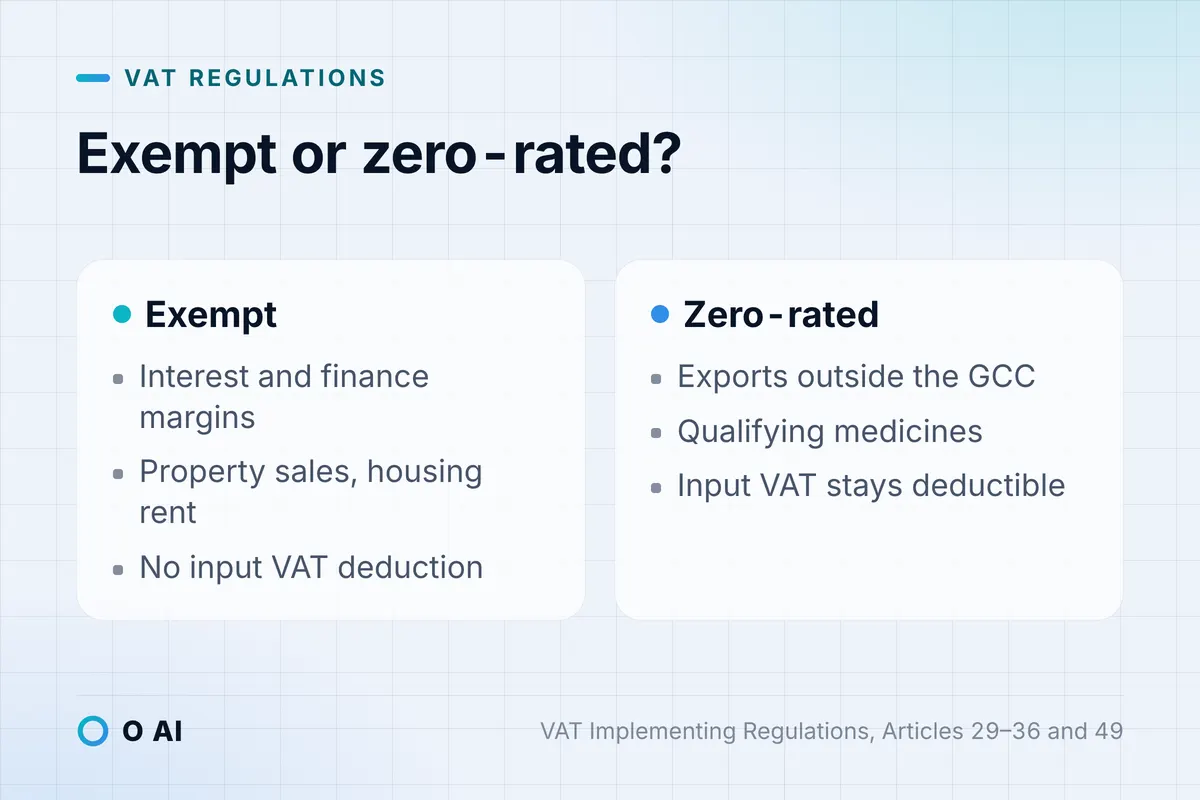
Both mean the customer pays no VAT, but they work differently for the seller. A zero-rated sale is a taxable supply at 0%, so the seller keeps the right to deduct the input VAT on its costs (Article 49(1)). An exempt sale carries no VAT, and the input VAT on costs used for it cannot be deducted; a business with both kinds of sales splits its input VAT under Article 51 [1].
| Exempt (Chapter 5) | Zero-rated (Chapter 6) |
|---|---|
| Financial services charged through an implicit margin, such as interest, finance profit or Murabaha margins; explicit fees and commissions stay taxable (Article 29) | Exports of goods outside the GCC, with proof within 90 days that the goods left (Article 32) |
| Life insurance and life reinsurance, even when charged as an explicit fee (Article 29(7)) | Services to customers not resident in any GCC state, with exceptions (Article 33) |
| Sale or other transfer of ownership of real estate, whether residential, commercial, agricultural or land (Article 30(1)(a)) | Transport of goods and passengers to and from the Kingdom and related supplies (Article 34) |
| Residential rent; hotels, guest houses and serviced accommodation do not count as residential (Article 30) | Qualifying medicines and medical goods (Article 35) |
| Investment-grade gold, silver and platinum (at least 99% pure) under the conditions of Article 36, qualifying military goods (Article 36 bis) and supplies to diplomatic missions (Article 36 bis (2)) |
Real estate sales are exempt from VAT because a separate tax covers them. The Real Estate Transactions Tax Law, issued by Royal Decree M/84 dated 19/3/1446H, imposes 5% on real estate disposals (Article 2 of that law) [7].
Is there an official PDF list of VAT-exempt goods?
Many people search for a PDF of VAT-exempt goods. There is no separate official list: the exemptions and zero rates are the articles above, in Chapters 5 and 6 of the regulations PDF on ZATCA's website [1][5]. For imports, Article 42 adds personal effects and gifts that travellers carry within customs rules, and equipment for people with disabilities that ZATCA's Board lists [1]. A supply that no provision exempts or zero-rates is taxed at the 15% standard rate [4].
Input tax: what you can deduct and what is blocked (Articles 49 to 51)
Input VAT is what you pay your suppliers. The regulations let you deduct it when the purchase is used to make taxable supplies, including zero-rated ones and exports (Article 49(1)), but only with the evidence the rules require, normally a valid tax invoice (Article 49(7)). A deduction you missed can be claimed in a later return, though not more than five years after the calendar year of the supply (Article 49(8)). Services received in the six months before registration, and goods still held at registration, can also qualify under conditions (Article 49(2) and (3)) [1].
Article 50 blocks input VAT on the following, unless you resell them as taxable supplies [1][3]:
- entertainment, sports and cultural services, including events;
- hospitality and food and beverage catering, unless a law in force obliges you to provide it to staff at the workplace;
- insurance and healthcare for staff and their dependants, unless a law in force obliges you to provide it;
- buying or leasing vehicles designed to carry no more than 10 people, plus their insurance, repairs, maintenance and fuel; trucks and heavy equipment, vehicles for resale or rental, emergency vehicles, and vehicles used only for business and never made available for personal use are excluded from the block;
- anything for personal use or outside the business.
Illustrative example: input VAT for one quarter
Illustrative example. A Jeddah trading company registered for VAT records these purchases in one quarter, all charged at 15%.
| Purchase | Value before VAT (SAR) | VAT paid (SAR) | Deductible? |
|---|---|---|---|
| Rent of a commercial showroom | 60,000 | 9,000 | Yes, used for taxable sales |
| Laptops for the sales team | 20,000 | 3,000 | Yes |
| Appreciation dinner for staff | 4,000 | 600 | No, hospitality with no legal duty (Article 50) |
| Lease of a sedan the manager also uses privately | 9,000 | 1,350 | No, restricted vehicle |
| Fuel for that sedan | 1,200 | 180 | No |
| Total | 94,200 | 14,130 | 12,000 deductible; 2,130 blocked |
The blocked SAR 2,130 becomes a cost. Claiming it anyway is the kind of error that leads to an understated return.

Tax invoices, credit notes and records (Articles 53, 54 and 66)
- When to invoice: a tax invoice for a supply to another business or entity is due by the 15th day of the month after the supply (Article 53(1)(b)). For such supplies under SAR 1,000, a simplified tax invoice is allowed (Article 53(1)(c)). Sales to consumers get a simplified invoice on the date of supply or of payment, whichever comes first (Article 53(7)) [1].
- What it must show: the invoice is in Arabic, alongside any other language, and includes the issue date, a serial number, the supplier's VAT number, both parties' names and addresses, the goods or services, the rate and the VAT in riyals (Article 53(5)) [1].
- Electronic invoices: Article 53(6) requires invoices to be generated electronically where the e-invoicing regulation applies [1]. ZATCA enforced the first phase on 4 December 2021 for all resident taxpayers, and has rolled out the second, integration phase in waves since 1 January 2023 [8].
- Credit and debit notes: when a price changes or goods come back after invoicing, the note is due within 15 days of the following month (Article 54(6)) [1].
- Records: keep invoices, books and records for at least six years from the end of the tax period, and capital-asset records for the adjustment period plus five years (Article 66(1)). Records are kept in Arabic, and stored in the Kingdom, on paper or electronically, or reachable from a terminal in the Kingdom (Article 66(2) and (3)) [1].
If your accounting system runs on servers abroad, that last rule sits alongside the personal data rules covered in our guide to data residency in Saudi Arabia.
Returns, payment and corrections: the procedural articles
Chapter 10 holds the deadlines most businesses track. The table summarises them [1].
| Article | Rule |
|---|---|
| 58 | Monthly tax periods if taxable supplies exceeded SAR 40 million in the previous 12 months; quarterly for everyone else, who may ask to file monthly |
| 59(1) and 62(1) | The return and the payment are due by the last day of the month after the period ends |
| 60 | ZATCA may allow instalments, normally over no more than 12 months; late-payment fines still apply for the extra time |
| 63 | Understated tax: notify ZATCA within 20 days by correcting the earlier return, or put a net error under SAR 15,000 into the current return; overstated tax can be corrected in a later return, within five years |
| 64 | ZATCA may assess within five years of the end of the calendar year; 20 years where there is evasion or a failure to register |
| 69 | Refund of a credit balance or overpaid tax |
| 74 | Returns and payments are due on the date even if it falls on a weekend or holiday |
The fines for missing these deadlines are in the Law, not in the regulations: SAR 10,000 for failing to apply for registration on time (Article 41), 5% to 25% of the tax for a late return (Article 42(3)), and 5% of the unpaid tax for each month or part of a month of late payment (Article 43) [4].

Six mistakes people make when reading the regulations
- Reading the English file as the current text. It is the 2021 edition. Check every number against the Arabic tenth edition [1][2].
- Skipping the footnotes. They show when a paragraph was added, changed or deleted. Some paragraphs added in April 2020 were deleted again in October 2020, so an older printout can show rules that no longer exist [1].
- Treating a guideline as law. ZATCA's guidelines explain its approach but do not amend the regulations [3].
- Looking for the thresholds in the regulations. Articles 3, 4 and 7 refer to "the threshold set in the Agreement"; the amounts come from the Agreement and ZATCA's guidance [1][6].
- Treating exempt and zero-rated as the same. Only a zero-rated seller keeps its input VAT deduction (Article 49(1)) [1].
- Downloading copies from other websites. Take the PDF from ZATCA's own regulations page and note the edition on its cover [5].
Your next step
Download the Arabic text of Saudi Arabia's VAT Implementing Regulations from ZATCA's page and build a one-page index of the articles your business actually uses: usually 3 and 4 for registration, 49 and 50 for input tax, 53 and 54 for invoices and notes, 58, 59 and 62 for returns, and 66 for records. Write the edition date at the top, and check the cover each quarter for a new one. If your team still types scanned supplier invoices into spreadsheets before each return, our guide to Arabic OCR for scanned PDFs sets out a workflow with a human check. O AI is a software and AI company in Al Khobar; you can read more about us on our home page.
Frequently asked questions
What are the VAT Implementing Regulations in Saudi Arabia?
They are the detailed rules that ZATCA's Board issued under the VAT Law. The Law sets the principles, the 15% standard rate and the penalties; the regulations fill in how the system works day to day, including registration deadlines, exempt and zero-rated supplies, input tax conditions, invoice contents, tax periods, return and payment deadlines, corrections, records and refunds. They have 79 numbered articles in 12 chapters and have been amended many times since 2017, most recently by a Board decision in November 2024.
Where can I download the VAT Implementing Regulations PDF?
From ZATCA's website, on the VAT Implementing Regulations page under rules and regulations. The Arabic PDF is the official text; as of October 2026 it is the tenth edition, dated April 2025. An English translation is also posted, but it is the eighth edition from November 2021 and does not include the later amendments. Avoid copies on other websites, because you cannot tell which edition they are.
Is there an official list of VAT-exempt goods in Saudi Arabia?
No separate list exists. The exemptions are in Articles 29 and 30 of the regulations: financial services with an implicit margin, life insurance, real estate sales and residential rent. Zero rates are in Articles 31 to 36, covering exports, certain services to non-GCC residents, international transport, qualifying medicines and medical goods, and investment metals. Article 42 adds a few exemptions at import. Everything else follows the 15% standard rate unless a specific provision says otherwise.
What is the difference between exempt and zero-rated supplies?
In both cases the customer pays no VAT. The difference is on the seller's side. A zero-rated supply is still a taxable supply, charged at 0%, so the seller can deduct the VAT it paid on related costs. An exempt supply is outside that system: the seller charges no VAT and cannot deduct the VAT on costs used to make it. A business making both kinds of sales has to split its input VAT between them.
Which text is authoritative, the Arabic or the English?
The Arabic. ZATCA's English translation says on its cover that it is unofficial and that the Arabic version prevails where they differ, and ZATCA's guidelines carry the same note. The difference matters in practice: the English file still shows the pre-2024 limit for correcting errors in the current return, SAR 5,000, while the current Arabic text sets SAR 15,000.
Where are the VAT penalties set out?
In the VAT Law, not in the regulations. Articles 39 to 49 of the Law cover tax evasion, failing to register on time, incorrect and late returns, late payment, issuing tax invoices while unregistered, failing to keep records and repeat violations. ZATCA's Board issues a classification of violations that ZATCA uses to apply them, and decisions can be challenged before the tax committees.
How this article was made: Researched from the sources listed below, opened on 14 October 2026. Drafted with AI assistance, then checked against those sources. General information, not professional advice. Images are AI-generated illustrations.
Sources
- Implementing Regulations of the VAT Law, official Arabic text, tenth edition, April 2025 (opens in a new tab)Zakat, Tax and Customs Authority (ZATCA) · zatca.gov.sa
- Implementing Regulations of the Value Added Tax Law, English translation, eighth edition, November 2021 (opens in a new tab)Zakat, Tax and Customs Authority (ZATCA) · zatca.gov.sa
- Guideline for Amendments to the Implementing Regulation of VAT, Board Resolution 01-06-24, Issue 1, April 2025 (opens in a new tab)Zakat, Tax and Customs Authority (ZATCA) · zatca.gov.sa
- Value Added Tax Law, with amendments (in Arabic) (opens in a new tab)Bureau of Experts at the Council of Ministers · laws.boe.gov.sa
- VAT Implementing Regulations (opens in a new tab)Zakat, Tax and Customs Authority (ZATCA) · zatca.gov.sa
- Guideline on VAT Provisions in Economic Activity, second version, May 2026 (opens in a new tab)Zakat, Tax and Customs Authority (ZATCA) · zatca.gov.sa
- Real Estate Transactions Tax Law (in Arabic) (opens in a new tab)Bureau of Experts at the Council of Ministers · laws.boe.gov.sa
- What is e-invoicing? (opens in a new tab)Zakat, Tax and Customs Authority (ZATCA) · zatca.gov.sa
About the author
Newsletter
New guides and news by email
New guides and news about O AI, Rushd and Dalni, at most twice a month. No spam.