 AI


Payroll calculation in Saudi Arabia: basic salary to net pay, plus a template
A step-by-step guide for employers: what counts for GOSI, the 2026 rates for Saudi employees on the older and new systems, overtime and annual leave formulas, a worked October 2026 payroll in SAR, a payroll register template and a salary certificate template.


Key takeaways
- GOSI is calculated on basic salary plus housing allowance, capped at SAR 45,000 a month; transport, other allowances and overtime stay outside the base.
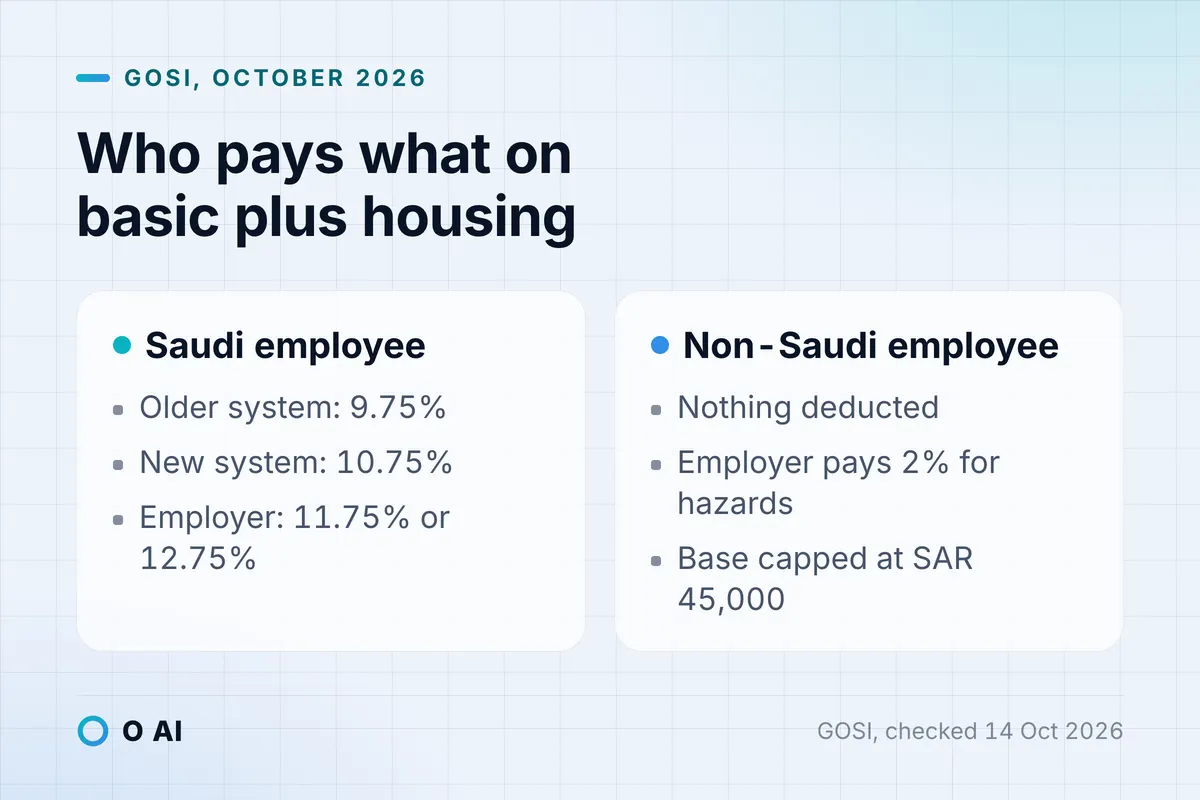
- Saudis first registered before 3 July 2024 pay 9.75%; those registered on or after that date pay 10.75% from 1 July 2026. Non-Saudis pay nothing; the employer pays 2%.
- Overtime is paid at the hourly wage plus 50% of the basic wage, and hours worked on rest days and public holidays count as overtime.
- Annual leave is at least 21 days a year, or 30 after five continuous years, paid in advance; the usual daily rate is the monthly wage divided by 30.
- Wage files go through Mudad within 30 days of the first day of each Gregorian month, and salaries paid in cash cannot be proven there.
On this page
- Payroll calculation in Saudi Arabia, step by step
- GOSI deductions: which pay counts and which rate applies
- Overtime calculator: the formula in practice
- Absences and other deductions
- Annual leave calculator: leave days and leave pay
- Illustrative example: October 2026 payroll for three employees
- Payroll register template
- Paying salaries through Mudad and the Wage Protection System
- Salary certificate template
- Five payroll mistakes that cost employers
- Your next step
Payroll calculation in Saudi Arabia starts from the employment contract. Basic salary plus fixed allowances gives gross pay; overtime and permitted deductions adjust it; Saudi employees then lose their GOSI share of basic salary plus housing. What remains is net pay, transferred through a bank and proven in Mudad's Wage Protection System.
This guide is written for employers and payroll staff. It walks through each step with the rules published by GOSI, the Ministry of Human Resources and Social Development (HRSD), Qiwa and Mudad, all checked on 14 October 2026, and ends with a payroll register template and a salary certificate template. It is general information, not legal advice: for a specific case, check the official source or ask a licensed advisor.
Payroll calculation in Saudi Arabia, step by step
The Labour Law gives payroll two key terms. The basic wage is everything paid for the work under the contract, plus periodic increments. The actual wage is the basic wage plus other entitlements such as commissions and allowances paid for effort or risk. When the law says "wage" without a qualifier, it means the actual wage, and a month counts as 30 days unless the contract or work regulations say otherwise [1].
Every monthly payroll then follows the same six steps:
- Gross pay: basic salary plus the fixed allowances in the contract, such as housing and transport.
- Variable pay: add overtime, commission or a bonus earned that month.
- Deductions: subtract unpaid days and any deduction the law allows.
- GOSI share: subtract the employee's contribution, which applies to Saudi employees only.
- Net pay: what is left is transferred to the employee's bank account.
- Employer cost: gross pay plus the employer's GOSI contribution.
Monthly-paid workers must be paid once a month, in Saudi riyals, and payment through an approved bank in the Kingdom is allowed when the worker agrees [1].
GOSI deductions: which pay counts and which rate applies
GOSI contributions are the part of payroll most often calculated wrongly, because the base is not the full salary and the rate depends on when the employee first registered.
The contributory wage
GOSI calculates contributions on the basic wage, which includes commissions and percentages of sales or profit, plus the cash housing allowance agreed between employer and employee. Housing provided in kind is valued at two months of basic wage. The contributory wage is capped at SAR 45,000 a month [2][3]. Transport and other allowances are not on GOSI's list, so they stay outside the base.
GOSI contribution rates in October 2026
| Employee | Pension branch (employee / employer) | SANED unemployment insurance (employee / employer) | Occupational hazards (employer) | Total deducted from employee | Total paid by employer |
|---|---|---|---|---|---|
| Saudi, first registered before 3 July 2024 [4][5] | 9% / 9% | 0.75% / 0.75% | 2% | 9.75% | 11.75% |
| Saudi, first registered on or after 3 July 2024, from 1 July 2026 [3][6] | 10% / 10% | 0.75% / 0.75% | 2% | 10.75% | 12.75% |
| Non-Saudi [2][4] | Not covered | Not covered | 2% | 0% | 2% |
All percentages apply to the contributory wage, not to gross pay. The pension and SANED branches apply only to Saudi workers, while the occupational hazards branch covers every worker in the Kingdom [2].
The step-up for new entrants
The Social Insurance Law of 1445H applies to people with no contribution periods under the civil retirement or social insurance systems before 3 July 2024 [6]. For them, the pension rate rises by 0.5 percentage points a year on each side:
- 3 July 2024: 9%
- 1 July 2025: 9.5%
- 1 July 2026: 10%
- 1 July 2027: 10.5%
- 1 July 2028: 11%
The step-up applies to the pension branch only, and what counts is the date of first registration with GOSI, not the date the employee joined your company. GOSI shows employers which contributors fall under the new law through a filter in the establishment account [6].
Contributions are due within the first 15 days of the month after the month they cover, and late payment carries a fine of 2% of the contribution for each month or part of a month [2]. Once unpaid periods reach six months, the employees' coverage and contribution periods are suspended [6].
Overtime calculator: the formula in practice
Normal working hours are 8 a day under the daily standard or 48 a week under the weekly standard, cut to 6 a day or 36 a week for Muslim workers in Ramadan [1]. Overtime is paid at the hourly wage plus 50% of the basic wage, and the worker may agree to take paid compensatory leave instead [7]. Every hour worked on rest days and public holidays counts as overtime [1].
A common way to turn that rule into numbers:
- Hourly wage = monthly actual wage ÷ 30 ÷ 8
- Hourly basic wage = monthly basic wage ÷ 30 ÷ 8
- One overtime hour = hourly wage + (hourly basic wage × 50%)
Illustrative example. An employee earns a basic salary of SAR 6,000, a housing allowance of SAR 1,500 and a transport allowance of SAR 500, so the actual wage is SAR 8,000. The hourly wage is 8,000 ÷ 240 = SAR 33.33, and half the hourly basic wage is (6,000 ÷ 240) × 50% = SAR 12.50. One overtime hour therefore costs SAR 45.83, and six hours cost SAR 275.00.
If the contract or the approved work regulations use the weekly standard or a different definition of the month, follow that document and keep the formula consistent across employees.
Absences and other deductions
The Labour Law limits what an employer can take from wages without the worker's written consent. Repayment of an employer loan may not exceed 10% of the wage in any month; social insurance contributions, savings-fund contributions and fines for violations are among the other listed cases. In all cases, total deductions may not exceed half of the wage due, unless the labour dispute body decides otherwise [1].
Days not worked without approved leave are usually left unpaid at the daily rate of monthly wage ÷ 30. Any penalty beyond that should come from the establishment's approved work regulations, not from a payroll clerk's judgement. Keep the reference for every deduction (loan agreement, approved leave record or penalty decision) next to the payroll line.
Annual leave calculator: leave days and leave pay
Every worker is entitled to at least 21 days of paid annual leave a year, rising to at least 30 days after five continuous years with the same employer. Leave pay is paid in advance, the leave must be taken in the year it is due, and it may not be exchanged for cash while the worker remains in service. The employer sets the dates but must tell the worker at least 30 days ahead [1].
For a simple leave calculator:
- Monthly accrual: 21 ÷ 12 = 1.75 days, or 30 ÷ 12 = 2.5 days after five years.
- Daily rate: monthly wage ÷ 30.
- Leave pay: daily rate × leave days.
Illustrative example. For the employee above, with an actual wage of SAR 8,000, the daily rate is SAR 266.67 and 21 days of leave pay SAR 5,600.00, paid before the leave starts.
Unused leave and the end-of-service award are settled when employment ends; that is a separate calculation. For the worker's side of it, Dalni, O AI's rights guide, explains the end-of-service benefit.
Illustrative example: October 2026 payroll for three employees
Illustrative example. A small trading company in Al Khobar runs its October 2026 payroll for three people: an accountant who first registered with GOSI in 2019, a sales coordinator who first registered in August 2025 and worked six overtime hours, and a non-Saudi technician repaying an employer loan.
| Line (SAR) | Accountant (Saudi, older system) | Sales coordinator (Saudi, new system) | Technician (non-Saudi) | Total |
|---|---|---|---|---|
| Basic salary | 10,000.00 | 6,000.00 | 4,000.00 | 20,000.00 |
| Housing allowance | 2,500.00 | 1,500.00 | 1,000.00 | 5,000.00 |
| Transport allowance | 1,000.00 | 500.00 | 400.00 | 1,900.00 |
| Overtime (6 hours × 45.83) | 0.00 | 275.00 | 0.00 | 275.00 |
| Gross pay | 13,500.00 | 8,275.00 | 5,400.00 | 27,175.00 |
| Contributory wage (basic + housing) | 12,500.00 | 7,500.00 | 5,000.00 | |
| Employee GOSI share | 9.75% = 1,218.75 | 10.75% = 806.25 | 0.00 | 2,025.00 |
| Loan instalment (within the 10% limit) | 0.00 | 0.00 | 300.00 | 300.00 |
| Net pay | 12,281.25 | 7,468.75 | 5,100.00 | 24,850.00 |
| Employer GOSI share | 11.75% = 1,468.75 | 12.75% = 956.25 | 2% = 100.00 | 2,525.00 |
| Total employer cost | 14,968.75 | 9,231.25 | 5,500.00 | 29,700.00 |
Three things stand out. Overtime raises gross pay but not the GOSI base, because GOSI counts basic plus housing. The two Saudi employees on similar terms pay different rates because of their first registration dates. And the employer's real monthly cost is 9.3% above gross pay in this example.
Payroll register template
A payroll register (sometimes called a payroll sheet) is the monthly table behind every transfer. Whether you keep it in a spreadsheet or a payroll system, it needs these columns:
| Column group | What goes in it | Check before approval |
|---|---|---|
| Employee | Employee number, name, nationality, ID or iqama number, IBAN | IBAN matches the bank's records |
| GOSI status | Older system, new system or non-Saudi | Matches the filter in the GOSI account |
| Fixed pay | Basic, housing, transport, other contractual allowances | Matches the signed contract |
| Variable pay | Overtime hours and amount, commission, bonus | Approved timesheet or sales report attached |
| Unpaid days | Number of days and amount | Attendance record attached |
| Deductions | Loan instalment, other deductions with a reference | Within 10% for loans and half of the wage in total |
| Totals | Gross pay, contributory wage, employee GOSI share, net pay | Contributory wage capped at SAR 45,000 |
| Employer cost | Employer GOSI share, total cost | Ties to the GOSI invoice for the month |
| Payment | Payment date, bank reference, WPS file reference | Uploaded within Mudad's deadline |
Lock the register after approval and keep each month's file. When an employee disputes a figure, the register, the attachments and the WPS file together show what was paid and why.

Paying salaries through Mudad and the Wage Protection System
HRSD launched the Wage Protection System in 2013, and wage files are now uploaded only through the Mudad platform. Registering and uploading are free. The system accepts a wage file within 30 days of the due date, which is the first day of each Gregorian month [8].
The file comes from the bank after the transfer, so salaries paid in cash cannot be uploaded; a worker without a bank account can be paid through a payroll card or a Mudad e-wallet [8]. Continued non-compliance can lead HRSD to suspend services such as new visas, transfers of workers between contracts and the issue of a Saudization certificate. To get a compliance certificate, an establishment needs an average compliance rate of 70% or more over the previous 12 months, or 50% for a new establishment [8].
Mudad also sells a payroll management system for small and medium establishments. It reads company and employee data through its link with GOSI and uploads the wage protection file automatically after each transfer; its basic package is free and its premium package starts from SAR 460 [9].
Salary certificate template
Employees can issue their own salary certificate on Qiwa, instantly and free of charge, without the employer's approval. It is an official document showing the current job and monthly salary details, including basic salary, commissions and allowances [10].
Some banks, embassies and landlords still ask for a letter on company letterhead. A salary certificate template needs:
- Date, reference number and the name of the receiving party (or "To whom it may concern").
- Employee name, nationality, ID or iqama number and employee number.
- Job title and joining date.
- Monthly basic salary, each allowance and the total.
- A sentence that the letter is issued at the employee's request.
- Name, title and signature of the authorised signatory, the company stamp and a contact for verification.
Use the same figures as the contract and the payroll register. A letter that shows a different salary from the Qiwa certificate creates questions for the employee and for the company.

Five payroll mistakes that cost employers
- One GOSI rate for every Saudi. Since 1 July 2026, employees first registered on or after 3 July 2024 pay 10.75%, not 9.75% [6].
- GOSI on gross pay. The base is basic plus housing, capped at SAR 45,000; transport and overtime stay out [3].
- Overtime on basic salary only. The rule is the hourly wage plus half of the basic hourly wage, and rest-day hours count as overtime [1][7].
- Cash salaries or a late wage file. Cash cannot be proven in the Wage Protection System, and a missed upload affects the compliance rate [8].
- Deductions above the limits. Loan repayments above 10% a month, or total deductions above half the wage, need the worker's written consent or a labour dispute body's decision [1].
Your next step
Payroll calculation in Saudi Arabia rewards a fixed routine. Before the next payroll run, open your GOSI establishment account, filter contributors by system and mark each Saudi employee as older or new system in the register. Then recalculate one overtime case and one leave payment with the formulas above, and compare the GOSI invoice with the employer share in your register. If your payroll has outgrown spreadsheets, our guide on custom software development in Saudi Arabia explains when a ready-made payroll system is enough and when a tailored tool pays off. You can read more about O AI, a software and AI company in Al Khobar, on our home page.
Frequently asked questions
How is net salary calculated in Saudi Arabia?
Start with gross pay: basic salary plus the fixed allowances in the contract, plus any overtime or commission earned that month. Subtract unpaid days and permitted deductions such as an employer loan instalment. For Saudi employees, subtract the GOSI share, which is calculated on basic salary plus housing allowance, not on gross pay. The result is net pay. Non-Saudi employees have no GOSI deduction, although the employer still pays 2% for occupational hazards.
What percentage does GOSI deduct from a Saudi employee's salary in 2026?
It depends on when the employee first registered with GOSI. Saudis first registered before 3 July 2024 pay 9.75%: 9% for the pension branch and 0.75% for SANED unemployment insurance. Saudis first registered on or after that date pay 10.75% from 1 July 2026, because their pension rate rises by half a point each July until it reaches 11% in 2028. Both rates apply to basic salary plus housing, capped at SAR 45,000 a month.
Do non-Saudi employees pay GOSI contributions?
No. Non-Saudi employees are not covered by the pension branch or by SANED, so nothing is deducted from their salary. The employer pays 2% of the contributory wage, which is basic salary plus housing, for the occupational hazards branch, which covers every worker in the Kingdom regardless of nationality. That 2% is an employer cost and should not be passed on to the employee.
How do I calculate overtime pay in Saudi Arabia?
The Labour Law sets overtime at the hourly wage plus 50% of the basic wage. A common method divides the monthly actual wage by 30 and then by 8 to get the hourly wage, then adds half of the basic hourly wage. For a basic salary of SAR 6,000 and allowances of SAR 2,000, one overtime hour is about SAR 45.83. Hours worked on rest days and public holidays count as overtime, and the worker may agree to compensatory paid leave instead.
How many days of annual leave does an employee get, and how is leave pay calculated?
At least 21 days a year, rising to at least 30 days after five continuous years with the same employer. Leave pay is paid in advance, and the usual daily rate is the monthly wage divided by 30. An employee earning SAR 8,000 a month receives about SAR 5,600 for 21 days. Leave must be taken in the year it is due and cannot be exchanged for cash while the worker stays in service.
When must salaries be uploaded to Mudad?
Wage files for the Wage Protection System go through Mudad, and the system accepts a file within 30 days of the due date, which is the first day of each Gregorian month. The file is issued by the bank after the salary transfer, so cash payments cannot be proven. Late or missing files lower the establishment's compliance rate, and continued non-compliance can block services such as visas and the Saudization certificate.
How can an employee get a salary certificate?
The quickest route is Qiwa: employees can issue a salary certificate themselves, free and instantly, without waiting for the employer's approval. It shows the current job and the monthly salary details, including basic salary and allowances. If a bank or embassy asks for a letter on company letterhead instead, the employer issues one with the same figures, signed by an authorised signatory and stamped.
How this article was made: Researched from the sources listed below, opened on 14 October 2026. Drafted with AI assistance, then checked against those sources. General information, not professional advice. Images are AI-generated illustrations.
Sources
- Labour Law, with amendments (in Arabic) (opens in a new tab)Bureau of Experts at the Council of Ministers · laws.boe.gov.sa
- Social Insurance Law 1445H and its Implementing Regulations (in Arabic) (opens in a new tab)General Organization for Social Insurance (GOSI) · gosi.gov.sa
- Employer journey: the new Social Insurance Law 1445H (in Arabic) (opens in a new tab)GOSI awareness platform · awareness.gosi.gov.sa
- Employer FAQs (opens in a new tab)GOSI · gosi.gov.sa
- Unemployment Insurance (SANED) FAQs (opens in a new tab)GOSI · gosi.gov.sa
- Guide for new contributors: the gradual increase in contribution rates, 2025 (PDF, in Arabic) (opens in a new tab)GOSI · awareness.gosi.gov.sa
- FAQ guide to the 2025 Labour Law amendments (PDF, in Arabic) (opens in a new tab)Ministry of Human Resources and Social Development (HRSD) · hrsd.gov.sa
- Frequently asked questions: Wage Protection System (in Arabic) (opens in a new tab)Mudad · mudad.com.sa
- Payroll management system (in Arabic) (opens in a new tab)Mudad · mudad.com.sa
- Salary certificate service (in Arabic) (opens in a new tab)Qiwa · qiwa.sa
About the author
Newsletter
New guides and news by email
New guides and news about O AI, Rushd and Dalni, at most twice a month. No spam.