 AI


What is an AI agent? A clear definition with Saudi examples
What is an AI agent? Software that takes a goal, plans the steps, uses tools and checks the result. This guide explains how agents work, how they differ from chatbots, generative AI and RPA, SDAIA's five maturity levels, examples from Saudi Arabia and the limits every agent needs.


Key takeaways
- SDAIA describes agentic AI as systems that perceive, analyse, learn and decide towards set goals, then act on other systems without a person at every step.
- An AI agent combines a model, tools and instructions; unlike a chatbot, it chooses its next step and can read from and write to other systems.
- SDAIA sets out five maturity levels, from rule-based agents to executive agents that remain experimental; most companies should start at levels 2 and 3.
- SDAIA cites estimates that Saudi agentic AI revenue could grow from USD 36.7 million in 2024 to USD 386.4 million by 2030.
- Give agents the narrowest access each task needs, and require a person's approval for payments, cancellations and other irreversible actions.
On this page
- What is an AI agent? How Saudi and international sources define it
- How an AI agent works: goal, plan, tools, check
- AI agent vs chatbot, generative AI and RPA
- Types of AI agents: SDAIA's five maturity levels
- Examples of AI agents in Saudi Arabia
- Where AI agents go wrong, and the limits they need
- Six questions to tell whether a product is really an AI agent
- Your next step
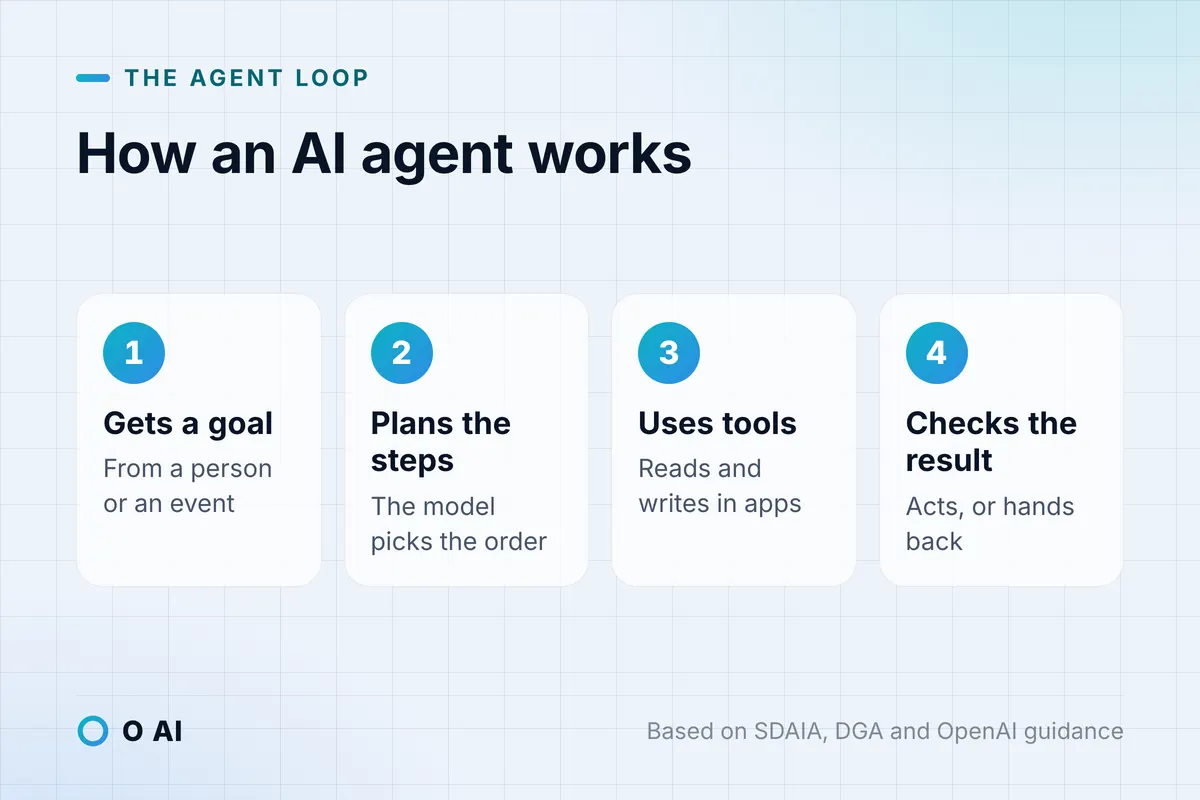
An AI agent is software that is given a goal, plans the steps, uses tools such as email, databases or other applications to carry them out, checks the result and decides what to do next, with limited human input. A chatbot answers your question; an AI agent completes a task. SDAIA calls the wider field "agentic AI".
This guide explains what an AI agent is, how one works, how it differs from a chatbot or a bot that clicks through screens, the types defined by Saudi authorities, and the limits every agent needs. The company examples are illustrative. If you are choosing a tool for a specific process, our guide to AI agents, RPA and workflow tools covers that decision step by step. O AI is not affiliated with OpenAI or any other company named here.
What is an AI agent? How Saudi and international sources define it
The definitions differ in wording but agree on the core: a goal, some freedom over the steps, and the ability to act.
- SDAIA (July 2025): an automated digital system able to perceive its environment, analyse information, learn from experience and make decisions based on set goals, then carry out commands or interact with external systems without needing direct human intervention at every step [1].
- Digital Government Authority (December 2025): autonomous or semi-autonomous software entities that perceive their environment, make decisions and act to achieve predefined goals [2].
- OpenAI's guide to building agents: systems that independently accomplish tasks on your behalf. It adds that applications which use a language model but do not let it control how the work runs, such as simple chatbots or sentiment classifiers, are not agents [3].
- Anthropic: in "workflows", models and tools follow predefined code paths; in "agents", the model dynamically directs its own process and tool use [4].
SDAIA also separates a single AI agent from an agentic AI system, in which several agents work together [1]. In Arabic, SDAIA's term for the field is «الذكاء الاصطناعي التوكيلي», and the individual programs are «وكلاء الذكاء الاصطناعي».
How an AI agent works: goal, plan, tools, check
OpenAI's guide reduces an agent to three components: a model that reasons and decides, tools it can use to act, and instructions that set its behaviour and limits [3]. It sorts tools into three kinds: data tools that fetch context (query a database, read a PDF, search the web), action tools that change something (send an email, update a customer record) and orchestration, where one agent calls another [3].
The Digital Government Authority describes the cycle in four steps: perceive, decide, act and learn [2]. Anthropic calls the building block an "augmented" language model, one enhanced with retrieval, tools and memory [4]. To plug those tools in, many products now use the Model Context Protocol (MCP), an open-source standard for connecting AI applications to data sources, tools and workflows, which its maintainers liken to a USB-C port for AI [5].
Illustrative example: an agent for booking changes at a car-rental firm in Dammam
Illustrative example. A rental company receives dozens of emails a day asking to extend or change bookings. An agent handles each one like this:
| Step | What the agent does | Tool it uses | Where a person comes in |
|---|---|---|---|
| 1. Perceive | Reads the email and identifies the booking and the request | Email inbox (read only) | None |
| 2. Gather | Looks up the booking, the car's next reservation and the price list | Booking system (read) | None |
| 3. Decide | Works out whether the extension is possible and what it costs | The model, with the company's pricing rules | None for standard cases |
| 4. Act | Drafts the amended booking and the reply to the customer | Booking system (write), email (draft) | A staff member approves changes above a set amount |
| 5. Check | Confirms the booking saved correctly, then sends the reply | Booking system, email (send) | Escalates to staff if anything fails twice |
| 6. Record | Logs every action it took | Activity log | The branch manager reviews the log weekly |
The agent is not answering one question; it is completing a task across two systems, choosing its next step from what it finds. That is the difference.
AI agent vs chatbot, generative AI and RPA
SDAIA's report sets out how agentic AI differs from three neighbouring technologies [1]:
| Technology | What it does | Who decides the next step | SDAIA's example |
|---|---|---|---|
| Generative AI | Produces content, such as text, images or code, in response to a command | The user, prompt by prompt | A model writes a well-phrased email |
| AI agent | Pursues a goal through a series of decisions and actions | The agent, within its limits | It decides which emails to send, to whom and when, then writes and sends them |
| Robotic process automation (RPA) | Repeats a script fixed in advance, such as copying data between systems | The script | Checking simple product dimensions on a production line |
| Simple digital assistant | Gives an answer or carries out a single direct command | The user, one command at a time | Showing your calendar, where an agent would reschedule clashing meetings itself |
SDAIA notes that agents often use generative models as one tool among several, but remain responsible for reaching a goal [1]. It also notes that RPA works well for repetitive tasks but usually fails in complex processes or unexpected situations [1]. That is why most real processes mix the two, with fixed automation for the predictable steps and an agent only where judgement is needed. The step-by-step comparison of AI agents, RPA and workflow tools shows how to split a process that way.
Types of AI agents: SDAIA's five maturity levels
SDAIA describes five levels of agentic AI, from simple automation to systems that plan and coordinate on their own [1].
| Level | What it does | SDAIA's examples | Its limit |
|---|---|---|---|
| 1. Rule-based agents | Repetitive tasks in structured settings, using predefined if-then rules | Heating and cooling control by temperature; traffic lights that change with vehicle counts | Cannot learn, adapt or handle new situations |
| 2. Analysis agents (RAG or standalone language models) | Extract insights from large volumes of data and inform a person's decision | Analysing customer conversations to find why conversions fell; sorting emails by priority and suggesting replies | Do not take actions themselves |
| 3. Solver agents (complex flow) | Sit at critical points in a known workflow to verify, summarise or make sub-decisions | Reviewing discount requests against pricing rules; insurance approvals across stages; triaging security alerts | Cannot leave the programmed process; need a person for new cases |
| 4. Worker agents (multi-flow) | Work across several systems and other agents, choosing the next step from earlier results | Processing thousands of complex messages and recommending actions; assessing eligibility from context and history | Limited to the tools and flows they were given |
| 5. Executive agents | Coordinate across systems, redesign whole processes and create new ones | Redesigning an organisation's procedures after its goals change | Still in research and trial, with reliability and trust challenges |
SDAIA adds three other ways to classify agents: by who uses them (consumer agents or enterprise agents), by whether they have a physical body (virtual agents in software, or embodied agents such as mobile robots and industrial arms), and by the human's role (a person approves before the final decision, or the agent acts alone) [1]. For government work, the Digital Government Authority uses a simpler three-tier scale of basic, intermediate and advanced agents, and calls basic agents, such as FAQ chatbots and form validation, the ideal entry point for pilots [2].
For most companies, levels 2 and 3 are the sensible place to start, because a person still sees each result before it matters. Level 5 is not something to buy yet.

Examples of AI agents in Saudi Arabia
SDAIA's report places agentic AI among the core enablers of Vision 2030 and describes the national groundwork [1]:
- SDAIA launched ALLaM, its large Arabic language model, as a building block for national agentic AI solutions.
- PIF-backed companies such as HUMAIN were set up to develop and localise AI technology.
- Current national efforts include projects applying agentic AI in several government entities to automate service delivery, and smart-city projects such as NEOM and the Red Sea include advanced trials in facility management, transport, energy and tourism services.
SDAIA also cites Grand View Research's estimate that the Saudi agentic AI market earned USD 36.7 million in 2024 and could reach USD 386.4 million by 2030, a compound annual growth rate of 48.8% from 2025 [1]. The Digital Government Authority expects agents to guide residents through tasks such as licence renewals and to give small businesses instant, policy-aligned answers on licensing and permits [2].
Illustrative examples. In private companies, agents tend to start with narrow, repetitive work. The businesses below are hypothetical.
| Business | What the agent does | What it may not do alone |
|---|---|---|
| Distributor in Riyadh | Chases suppliers about late deliveries and updates expected dates in the purchasing system | Cancel an order or change a price |
| Clinic in Jeddah | Reschedules appointments when a doctor's day changes, and messages patients | Give any medical advice |
| Real-estate office in Al Khobar | Asks new enquiries about budget and area, then books viewings in the agents' calendars | Promise a price or a contract term |
| Accounting office in Dammam | Requests missing invoices from clients and files them to the right month | Post entries or submit a tax return |
Where customer conversations happen on WhatsApp, our guide to WhatsApp chatbots for business sets out what an assistant should answer itself, what it should pass to staff and what Meta charges.
Where AI agents go wrong, and the limits they need
An agent's strength, acting without waiting for you, is also its main risk. Anthropic advises starting with the simplest solution, and only adding complexity when needed, because agents trade higher cost and latency for better task performance, and their autonomy can let errors compound [4]. It recommends extensive testing in sandboxed environments, guardrails, checkpoints where the agent pauses for human feedback, and stopping conditions such as a maximum number of iterations [4].
Three risks deserve particular attention:
- Hijacking through the data it reads. NIST's Center for AI Standards and Innovation describes agent hijacking as a type of indirect prompt injection: an attacker hides instructions in data the agent may read, such as an email, a file or a website, to make it do a different and harmful task [6].
- Too much access. The OWASP Top 10 for Agentic Applications, published in December 2025, lists risks including agent goal hijack, tool misuse, identity and privilege abuse, memory and context poisoning, cascading failures and rogue agents [7]. Its advice is "least agency": give each tool the narrowest rights it needs, for example read-only database queries, and no send or delete rights for an email summariser [7].
- Irreversible actions. OpenAI's guide says sensitive, irreversible or high-stakes actions, such as cancelling orders, authorising large refunds or making payments, should trigger human oversight until confidence in the agent grows, and that an agent should hand control back after repeated failures [3].

Six questions to tell whether a product is really an AI agent
Many products now carry the word "agent". Ask these questions before you believe it:
- Does it work towards a goal, or does it only answer one question at a time?
- Does it choose its next step, or follow a script fixed in advance?
- Can it use tools, reading from and writing to other systems?
- Does it check its own results, retrying or handing back when something fails?
- What can it do without approval, and can you change that list?
- Can you see a log of every action and switch it off at once?
If the answers to the first three are "no", you are looking at a chatbot or a fixed automation, which may be exactly what the task needs. If questions 5 and 6 have no clear answer, the product is not ready for your live systems.
Your next step
Take one process your team repeats every day, write its steps on a page and mark the single step that needs judgement rather than a fixed rule. That step, not the whole process, is the candidate for an AI agent; the rest may be better served by simpler automation. When you are ready to choose tools for each step, the guide to AI agents, RPA and workflow tools includes a permission sheet to complete before an agent touches live data. You can read about O AI, a software and AI company in Al Khobar, on our home page.
Frequently asked questions
What is an AI agent in simple terms?
An AI agent is a program that takes a goal, such as "rebook this customer's delivery", and works out and carries out the steps itself. It reads information, decides what to do, uses other software to do it, checks the result and either finishes or hands the task back to a person. A chatbot replies to what you type; an agent acts on your behalf, within limits that someone sets in advance.
What is the difference between an AI agent and a chatbot?
A chatbot answers questions, one message at a time, and usually cannot change anything in your systems. An AI agent pursues a goal across several steps and can use tools: it can look up a booking, update a record or send an email. Many agents talk to users through a chat window, so the interface can look the same. The difference is whether the software decides and acts, or only replies.
What is agentic AI?
Agentic AI is the field of AI systems that act with a degree of independence to reach goals. SDAIA's July 2025 report uses the Arabic term «الذكاء الاصطناعي التوكيلي» and distinguishes a single AI agent from an agentic system in which several agents work together. These systems usually run on large language models, but add planning, memory, tools and the ability to take actions in other software.
What are the types of AI agents?
SDAIA describes five maturity levels: rule-based agents that follow fixed if-then rules; analysis agents that extract insights but take no action; solver agents placed at critical points in a known workflow; worker agents that move across several systems and choose their next step; and executive agents that redesign whole processes, which remain experimental. Agents can also be classed by user (consumer or enterprise), by form (software or physical robots) and by human role.
Are AI agents used in Saudi Arabia?
Yes, and their use is growing. SDAIA reports projects applying agentic AI in several government entities, trials in smart-city projects such as NEOM and the Red Sea, and positions its Arabic model ALLaM as a foundation for national agent solutions. It also cites market estimates that Saudi agentic AI revenue could rise from about USD 37 million in 2024 to around USD 386 million by 2030. In companies, early uses include customer service, scheduling and purchasing follow-up.
Is it safe to connect an AI agent to company systems?
It can be, if access is tightly limited. Give the agent its own account with the narrowest rights each task needs, keep read-only access where possible, require a person's approval for payments, cancellations and anything irreversible, log every action and keep a way to switch it off. Test it first on copies of real data. Agents can also be manipulated by instructions hidden in emails or web pages they read, so treat their inputs as untrusted.
Do I need an AI agent or simple automation?
Most processes need both. If a step follows a clear rule and the data is structured, ordinary workflow automation is cheaper and more predictable. Add an agent only where the step needs judgement, such as reading free-text requests, handling exceptions or choosing between options. Start with the simplest design that works, measure it, and give the agent more freedom only as it proves reliable.
How this article was made: Researched from the sources listed below, opened on 14 October 2026. Drafted with AI assistance, then checked against those sources. General information, not professional advice. Images are AI-generated illustrations.
Sources
- Agentic AI: its technologies and national applications (July 2025, in Arabic) (opens in a new tab)Saudi Data and AI Authority (SDAIA) · sdaia.gov.sa
- AI Agents as Government Partners (7 December 2025) (opens in a new tab)Digital Government Authority (DGA) · dga.gov.sa
- A practical guide to building agents (opens in a new tab)OpenAI · cdn.openai.com
- Building effective agents (19 December 2024) (opens in a new tab)Anthropic · anthropic.com
- What is the Model Context Protocol (MCP)? (opens in a new tab)Model Context Protocol · modelcontextprotocol.io
- Technical blog: strengthening AI agent hijacking evaluations (January 2025) (opens in a new tab)NIST, Center for AI Standards and Innovation · nist.gov
- OWASP Top 10 for Agentic Applications for 2026 (9 December 2025) (opens in a new tab)OWASP Gen AI Security Project · genai.owasp.org
About the author
Newsletter
New guides and news by email
New guides and news about O AI, Rushd and Dalni, at most twice a month. No spam.