 AI


When to convert a sole proprietorship to a company, and what it costs
Thinking of turning your establishment into an LLC? This guide sets out when conversion pays off, the Ministry of Commerce fees and conditions as of October 2026, the steps on the business platform, what happens to old debts and in-kind assets, and a worked cost comparison.


Key takeaways
- The Ministry of Commerce lists SAR 1,200 plus SAR 500 publication, with 15% VAT, to convert an establishment into an LLC, completed within 72 hours.
- Under Article 220 of the Companies Law, the owner stays responsible for the establishment's earlier debts unless the creditors expressly accept otherwise.
- If in-kind assets exceed half the company's capital, an accredited valuer must report their fair value (Articles 141 and 159).
- One commercial registration can now carry unrelated activities (Article 9 of the Commercial Register Law), so a new activity alone is no reason to convert.
- Yearly fees rise modestly: SAR 1,200 annual confirmation for an LLC against SAR 500 for an establishment; accounting duties are the bigger change.
On this page
- What changes when an establishment becomes a company
- When converting pays off, and when it does not
- Which company form to convert into
- What it costs to convert a sole proprietorship to a company
- Conditions the Ministry checks before converting
- How to convert a sole proprietorship to a company, step by step
- Old debts, assets and the closing figures
- After the conversion: what to update
- Common mistakes when converting
- Your next step
To convert a sole proprietorship to a company in Saudi Arabia, the owner applies through the Ministry of Commerce's conversion service on the business platform, chooses the company form and moves the establishment's assets into it. For an LLC, the Ministry lists SAR 1,200 plus SAR 500 publication and VAT, with processing within 72 hours [1].
This guide is for owners of a sole proprietorship, usually called an "establishment" in Saudi Arabia, who are weighing the move. It uses the Ministry's service pages, the Companies Law and the Commercial Register Law as we read them on 14 October 2026. It is general information, not legal or tax advice; for your own case, check the Ministry's service page or ask a licensed lawyer or accountant.
What changes when an establishment becomes a company
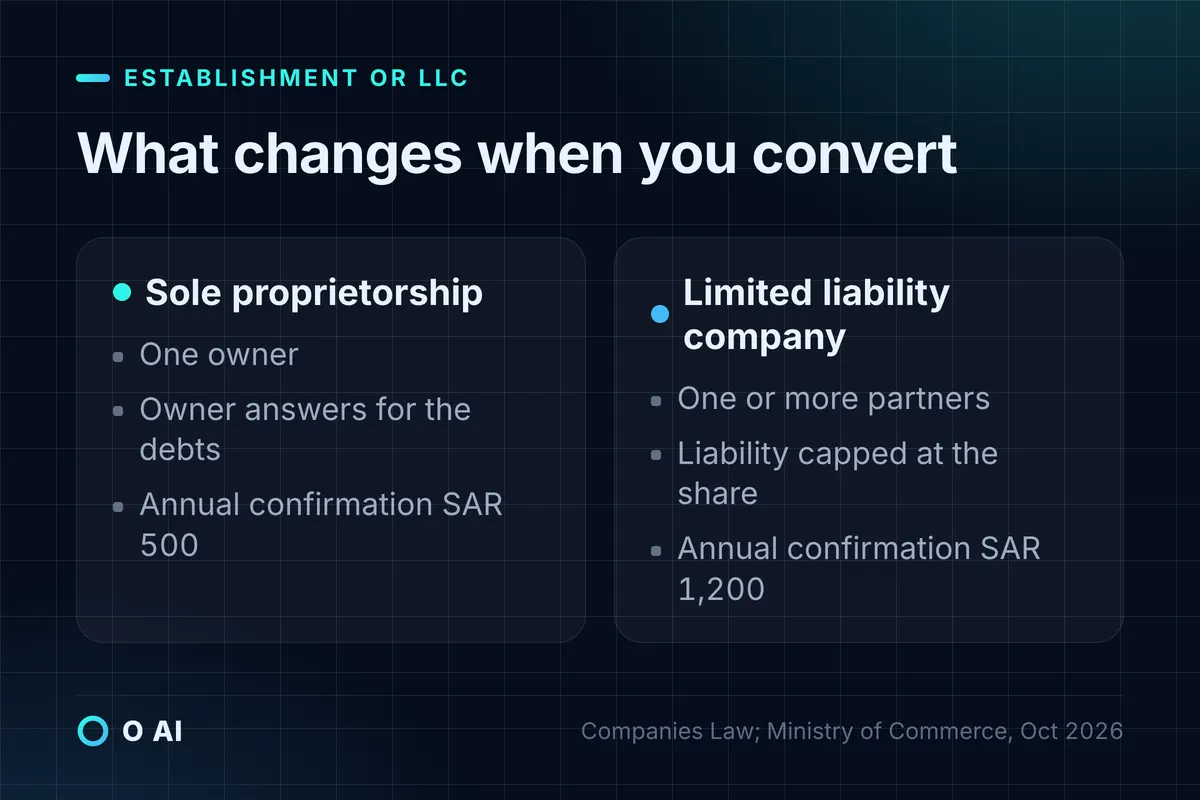
An establishment's debts are its owner's debts. The Companies Law makes the point when it deals with conversion: forming the company does not release the owners of an establishment from its debts and obligations incurred before the company was formed, unless the creditors expressly accept it (Article 220) [2].
A limited liability company is different. Its financial estate is separate from its partners', the company alone answers for its debts, and a partner's exposure is capped at their share in the capital (Article 156) [2][3].
| Sole proprietorship | Limited liability company | |
|---|---|---|
| Owners | One owner; a person may hold only one active establishment registration [4] | One or more partners (Article 156) [2] |
| Liability for business debts | The owner | The company; partners up to their share (Article 156) [2] |
| Founding document | None | Articles of association, or by-laws for a single owner (Articles 7 and 157) [2] |
| Minimum capital | None for the registration [5] | None set in the LLC chapter [2] |
| Registration fee | SAR 500 [4] | SAR 1,200 plus SAR 500 publication [1] |
| Annual confirmation of the registration | SAR 500 [6] | SAR 1,200 [7] |
| Chamber subscription while small and under five years old | SAR 500 (fifth class) [5] | SAR 200 (sixth class) [5] |
| Accounts | The Companies Law's rules on financial statements do not apply | Accounting records and annual financial statements filed within six months of year-end (Article 17) [2] |
The chamber classes depend on capital under SAR 375,000 and no more than five employees [5]. A larger business moves into a higher class whichever form it has.
When converting pays off, and when it does not
Converting is a business decision. These signals point towards it:
- A partner or investor is coming in. An establishment has a single owner [4]; shares in a company can be divided, transferred and set out in the articles.
- The risk has grown. Larger supply contracts, leases, staff and stock all create obligations. In a company they sit with the company rather than with the owner's personal assets [2].
- You want to plan succession or family ownership. The Companies Law allows partners to sign a binding agreement or a family charter covering ownership, management and how heirs come in (Article 11) [2].
- Clients or financiers ask to contract with a company. That is a commercial request, so weigh it against the extra running costs below.
Some old reasons have gone. Under the Commercial Register Law, issued in 2024 and in force since 2025, one registration can carry different activities without any need for them to be related (Article 9) [8], and existing traders have five years from the law's entry into force to settle their sub-registrations, after which these are struck off [8]. Adding a second line of business is therefore no longer a reason on its own to form a company; the Ministry also confirms that activities can be added to an establishment's registration through the amendment service [5].
Converting is often not worth it for a one-person business with few contracts, no staff and low stock. The yearly fees rise, and a company must keep accounting records and prepare annual financial statements (Article 17) [2]. Micro and small companies are exempt from appointing an auditor, unless their articles require one or another listed exception applies, such as being a foreign company (Article 19) [2].

Which company form to convert into
Article 220 lets an establishment's owner move its assets into any of the company forms [2]. In practice the choice narrows quickly:
- Limited liability company: the usual destination. One person can own it, so the owner can convert alone and add partners later, and liability is capped at the share in the capital (Articles 156 and 157) [2].
- Simplified joint stock company: also possible for a single owner (Article 150), with capital divided into shares. It suits an establishment that expects outside investors, at SAR 1,600 instead of SAR 1,200 [1][2].
- Joint stock company: needs at least SAR 500,000 of issued capital, a quarter paid at formation (Article 59) [2].
- General partnership: cheaper to register at SAR 1,000, but its partners answer for the company's debts from all their own assets (Article 35), so it does not solve the liability problem that drives most conversions [1][2].
What it costs to convert a sole proprietorship to a company
The Ministry's conversion service lists these fees on 14 October 2026 [1]:
| Company form | Registration fee | Publication fee | VAT |
|---|---|---|---|
| Joint stock or simplified joint stock company | SAR 1,600 | SAR 500 | 15% listed |
| Limited liability company | SAR 1,200 | SAR 500 | 15% listed |
| General or limited partnership | SAR 1,000 | SAR 500 | 15% listed |
Other costs depend on your case. If the assets you transfer as an in-kind share exceed half of the company's capital, an accredited valuer must report their fair value (Articles 141 and 159), and the valuer charges their own fee [2]. An accountant to prepare the closing figures and the company's first statements is the other common cost.
Illustrative example: a printing establishment in Al Khobar
Illustrative example. An owner runs a three-year-old printing establishment with four employees. She converts it into a single-owner LLC with SAR 150,000 capital: SAR 60,000 in cash and SAR 90,000 of equipment and stock.
| Item | Establishment | LLC |
|---|---|---|
| One-off conversion fees | SAR 1,200 + SAR 500 + SAR 255 VAT, if charged on both = SAR 1,955 | |
| Valuer's report | Required: the in-kind share (SAR 90,000) is more than half of SAR 150,000; fee by quote | |
| Annual confirmation each year | SAR 500 | SAR 1,200 |
| Chamber subscription each year, small business under five years old | SAR 500 | SAR 200 |
| Yearly government fees in this example | SAR 1,000 | SAR 1,400 |
In this example the yearly government fees rise by SAR 400. The bigger change is the accounting work. If the owner had put in SAR 80,000 in cash and SAR 70,000 of equipment, the in-kind share would stay under half of the capital and no valuer's report would be required by law [2].
Conditions the Ministry checks before converting
The Ministry's conversion service lists these conditions [1]:
- the establishment's commercial registration is active;
- the applicant owns the establishment or holds an electronic authorisation from the owner;
- every partner is at least 18 (a guardianship deed is needed for a minor) and is not a government employee;
- a waiver decision from the owner if the owner will not be a partner in the company;
- a valid investment registration certificate if any partner is foreign;
- a licence or initial approval from the Saudi Central Bank if the activity needs one;
- for a professional company, valid professional licences, licensed partners holding at least 70%, and a licensed Saudi partner holding at least 25% in a mixed company.
An establishment owned by a foreign investor follows a different route: the Ministry's answer is that it needs an investment licence first, and the conversion is then requested through the "digital branch" service on the business platform [5].
How to convert a sole proprietorship to a company, step by step
The service steps on the Ministry's page follow the same pattern as forming a new company [1]:
- Log in to the business platform and choose the service "Conversion from a sole proprietorship to a company".
- Set the number of partners, and the company's capacity if it is professional.
- Enter the registration term, head office, activities and objects.
- Enter the partners' data, then the commercial registration data.
- Enter the company's data, then its management.
- Complete the contract data.
- Review the summary and submit.
The Ministry's FAQ describes what happens next: you complete a company alignment form for the target form, an employee reviews and approves the request electronically, and the alignment is then approved [5]. The service time is listed as within 72 hours [1].
Old debts, assets and the closing figures
Three points are easy to miss.
Old debts stay with you. Article 220 lets owners transfer an establishment's assets into any company form, but the owner remains responsible for the establishment's debts and obligations from before the company was formed, unless the creditors expressly accept otherwise [2]. If you want a supplier or lender to look only to the company, ask for that consent in writing.
In-kind shares need care. If assets worth more than half of the capital go in without an accredited valuer, or at a value other than the valuer's, the founders become personally liable to third parties for a fair valuation and must pay any shortfall to the company in cash. Such claims can be heard for five years from the company's registration (Article 141) [2].
The figures have a cut-off date. The Saudi Center for Competitiveness and Business answers that when an entity changes its legal form, financial statements must be prepared from the start of the current financial year to the conversion date [5]. Agree that date with your accountant before you apply.

After the conversion: what to update
The Ministry's conversion page lists the conditions and fees, but not how each agency moves your files. Check each of these directly:
- ZATCA: how your tax registration and VAT number are handled for the company.
- GOSI, Qiwa and the Ministry of Human Resources: that your employees and their contracts sit under the company's file.
- The bank: whether accounts move to the company or new accounts are needed.
- Municipal and activity licences: the licence holder's name and number.
- Contracts and subscriptions: leases, suppliers and software. Our guide to choosing a software or app development company lists the questions to settle before you sign any new technology contract.
- Invoices and documents: a company's contracts and invoices must show its name, form, head office, commercial registration number and capital (Article 12) [2].
- The annual confirmation date: a company's registration is suspended if the annual confirmation is 90 days late (Article 15) [8].
Common mistakes when converting
- Assuming conversion releases you from the establishment's old debts. Under Article 220, the owner stays responsible unless creditors expressly agree [2].
- Putting in equipment and stock worth more than half the capital without a valuer's report [2].
- Converting only to add a new activity, when one registration can now carry several [8].
- Leaving the closing figures to the end of the year instead of cutting them at the conversion date [5].
- Forgetting the waiver when the establishment's owner will not be a partner [1].
Your next step
Before you convert a sole proprietorship to a company, list on one page what the establishment owns, what it owes, and who will own the company. Then compare two numbers: the yearly fees and accounting costs of a company, and the risk you carry personally today. If the list shows new partners, larger contracts or staff on the payroll, the case for converting is strong. If the business will need systems of its own as it grows, our guide to custom software development in Saudi Arabia explains when to buy, connect or build. O AI is a software and AI company in Al Khobar. Our ERP and business systems page describes the business systems we build.
Frequently asked questions
How much does it cost to convert an establishment into an LLC?
The Ministry of Commerce's conversion service lists SAR 1,200 for the registration and SAR 500 for publication, with 15% VAT listed. A joint stock or simplified joint stock company costs SAR 1,600, and a partnership SAR 1,000, each with the same publication fee. If the in-kind assets exceed half of the capital, add an accredited valuer's fee. After conversion, the LLC's annual confirmation costs SAR 1,200, against SAR 500 for an establishment.
How long does the conversion take?
The Ministry lists the conversion service as completed within 72 hours. Prepare the partners' details, the capital split and any valuer's report beforehand so the application is complete when you submit it. An establishment owned by a foreign investor takes longer, because it needs an investment licence first and the conversion then goes through the digital branch service.
Am I still liable for my establishment's old debts after conversion?
Yes, as a rule. Article 220 of the Companies Law allows the owner to move an establishment's assets into a company, but forming the company does not release the owner from the establishment's debts and obligations incurred before it, unless the creditors expressly accept that. New debts the company takes on after registration belong to the company, with each partner's exposure limited to their share.
Can I convert my establishment into a company if I am the only owner?
Yes. A limited liability company or a simplified joint stock company can be formed by one person. A single-owner LLC has by-laws instead of articles of association, and the owner holds the powers of the managers and of the partners' assembly, with decisions recorded in writing. Partners can join later by amending the company's founding document.
Do I need a valuer to convert my establishment?
Only in some cases. If the assets you contribute as an in-kind share, such as equipment or stock, are worth more than half of the company's capital, an accredited valuer must report their fair value. Below that level a report is not required by law unless the founders agree to one. Without a required report, founders can be personally liable for an unfair valuation for five years.
Is a company more expensive to run than an establishment?
Usually a little. The annual confirmation is SAR 1,200 for an LLC against SAR 500 for an establishment, while a small company under five years old pays a lower chamber subscription than an establishment, SAR 200 against SAR 500. The larger difference is accounting: a company must keep accounting records and file annual financial statements, though micro and small companies are generally exempt from appointing an auditor.
How this article was made: Researched from the sources listed below, opened on 14 October 2026. Drafted with AI assistance, then checked against those sources. General information, not professional advice. Images are AI-generated illustrations.
Sources
- Conversion from a sole proprietorship to a company: service details (in Arabic) (opens in a new tab)Ministry of Commerce · mc.gov.sa
- Companies Law, Royal Decree M/132 of 1/12/1443H (in Arabic) (opens in a new tab)Bureau of Experts at the Council of Ministers · laws.boe.gov.sa
- Establishing a limited liability company: service details (in Arabic) (opens in a new tab)Ministry of Commerce · mc.gov.sa
- Commercial registration for a sole proprietorship: service details (in Arabic) (opens in a new tab)Ministry of Commerce · mc.gov.sa
- Frequently asked questions, with answers from the Ministry of Commerce and partner agencies (in Arabic) (opens in a new tab)Saudi Center for Competitiveness and Business · scbc.gov.sa
- Annual confirmation of a sole proprietorship's commercial registration: service details (in Arabic) (opens in a new tab)Ministry of Commerce · mc.gov.sa
- Annual confirmation of a company's main commercial registration: service details (in Arabic) (opens in a new tab)Ministry of Commerce · mc.gov.sa
- Commercial Register Law, Royal Decree M/83 of 19/3/1446H (in Arabic) (opens in a new tab)Bureau of Experts at the Council of Ministers · laws.boe.gov.sa
About the author
Newsletter
New guides and news by email
New guides and news about O AI, Rushd and Dalni, at most twice a month. No spam.