 AI


Law of Procedure before Sharia Courts in Saudi Arabia: a 2026 guide
A plain guide to the Law of Procedure before Sharia Courts (Sharia courts): which court hears a case, how claims are filed and served, appeal deadlines, its Implementing Regulations, the Board of Grievances rules, and the chapters later laws repealed.


Key takeaways
- The Law of Procedure before Sharia Courts was issued by Royal Decree M/1 of 22/1/1435H and replaced the 1421H law of the same name.
- Chapter Nine on evidence (Articles 101 to 158) was repealed by the Evidence Law (Royal Decree M/43 of 26/5/1443H).
- Commercial cases left the law when Article 35 was repealed by the Law of Commercial Courts (M/93 of 15/8/1441H).
- The appeal period is 30 days, or 10 days for urgent matters (Article 187).
- The Implementing Regulations were approved by Minister of Justice Decision No. 39933 of 19/5/1435H and amended since.
On this page
- What the Law of Procedure before Sharia Courts is, and which version applies
- Which court hears the case
- How a claim is filed and served
- Hearings, absence and written pleading
- Evidence now sits in the Evidence Law
- Judgments and the deadlines to challenge them
- Urgent matters and provisional enforcement
- The Implementing Regulations of the Law of Procedure before Sharia Courts
- The Law of Procedure before the Board of Grievances
- A pre-filing checklist
- Your next step
The Law of Procedure before Sharia Courts (نظام المرافعات الشرعية) sets how cases run before Saudi courts: which court hears a claim, how it is filed and served, how hearings and judgments work, and how to appeal. It was issued by Royal Decree M/1 of 22/1/1435H and, as of October 2026, is in force with amendments up to 1444H.
This guide explains the law as it reads on the official legislation portal of the Bureau of Experts at the Council of Ministers, which we opened on 29 October 2026, together with its Implementing Regulations and the laws that have since taken whole chapters out of it. It is general information, not legal advice. For a specific case, read the official text and speak to a licensed lawyer.
What the Law of Procedure before Sharia Courts is, and which version applies
The law's official English name on the legislation portal is "Law of Procedure Before Sharia Courts"; some English commentary describes it simply as the Saudi civil procedure law. It was issued on 22/1/1435H (25 November 2013), published on 3/2/1435H (6 December 2013) and took effect on publication (Article 242) [1]. It replaced the earlier law of the same name issued by Royal Decree M/21 of 20/5/1421H (Article 241) [1].
Article 1 states the rule that frames everything else: courts apply Islamic Sharia and the laws issued by the State that do not conflict with it, and follow this law in their procedure [1]. Two related laws sit beside it. Commercial disputes follow the Law of Commercial Courts, and administrative disputes follow the Law of Procedure before the Board of Grievances; both fall back on the Law of Procedure before Sharia Courts where they are silent [4][5].
The text you read today is not the 2013 text. Several chapters were repealed or moved by later laws, and that is the most common source of mistakes in older explainers.
| What changed | Instrument | Effect on the Law of Procedure before Sharia Courts |
|---|---|---|
| Absence of the claimant | Royal Decree M/38 of 30/3/1441H | Articles 55 and 56 amended: strike-off and the 60-day lapse rule [1] |
| Commercial court jurisdiction | Royal Decree M/93 of 15/8/1441H (Law of Commercial Courts) | Article 35 repealed; commercial cases follow the new law [1][4] |
| Electronic service | Royal Decree M/18 of 15/1/1442H | Articles 11, 12, 13 and 16 amended to allow electronic notification [1][2] |
| Written pleading | Royal Decree M/78 of 10/9/1442H | Article 65: proceedings are in writing by default [1] |
| Title deeds (istihkam) | Royal Decree M/101 of 14/11/1442H | Article 31(b) and the istihkam chapter deleted [1] |
| Evidence | Royal Decree M/43 of 26/5/1443H (Evidence Law) | Chapter Nine (Articles 101 to 158) repealed [3] |
| Judicial custody | Royal Decree M/191 of 29/11/1444H (Civil Transactions Law) | Articles 212 to 217 repealed and part of Article 211 deleted [1][7] |
We found no amendment to the law dated 1445H to 1447H (2023 to 2026) on the portal when we checked on 29 October 2026 [1].
Which court hears the case
Jurisdiction comes first, because a court can raise lack of jurisdiction on its own at any stage (Article 76) [1]. The law splits subject-matter jurisdiction between court types:
- General courts hear every claim not assigned to another court, notary, or the Board of Grievances, in particular real estate disputes and claims arising from traffic accidents (Article 31) [1]. Where a governorate has no specialised court, the general court there hears those cases (Article 32) [1].
- Personal status courts hear marriage, divorce, custody, maintenance, inheritance and guardianship matters (Article 33) [1].
- Labour courts hear employment contract, wage, dismissal and social insurance disputes (Article 34) [1].
- Commercial courts are now governed by the Law of Commercial Courts, after Article 35 was repealed by Royal Decree M/93 [1][4].
For place, the default rule is the court where the defendant lives; if the defendant has no residence in the Kingdom, the court where the claimant lives (Article 36) [1]. Article 39 adds exceptions: a maintenance claimant may sue where either party lives, and a woman in marital, custody and visitation cases may file in her own town or the defendant's [1]. Articles 24 to 30 set when Saudi courts hear claims against foreigners, including claims about property in the Kingdom or an obligation made or performed there [1].
How a claim is filed and served
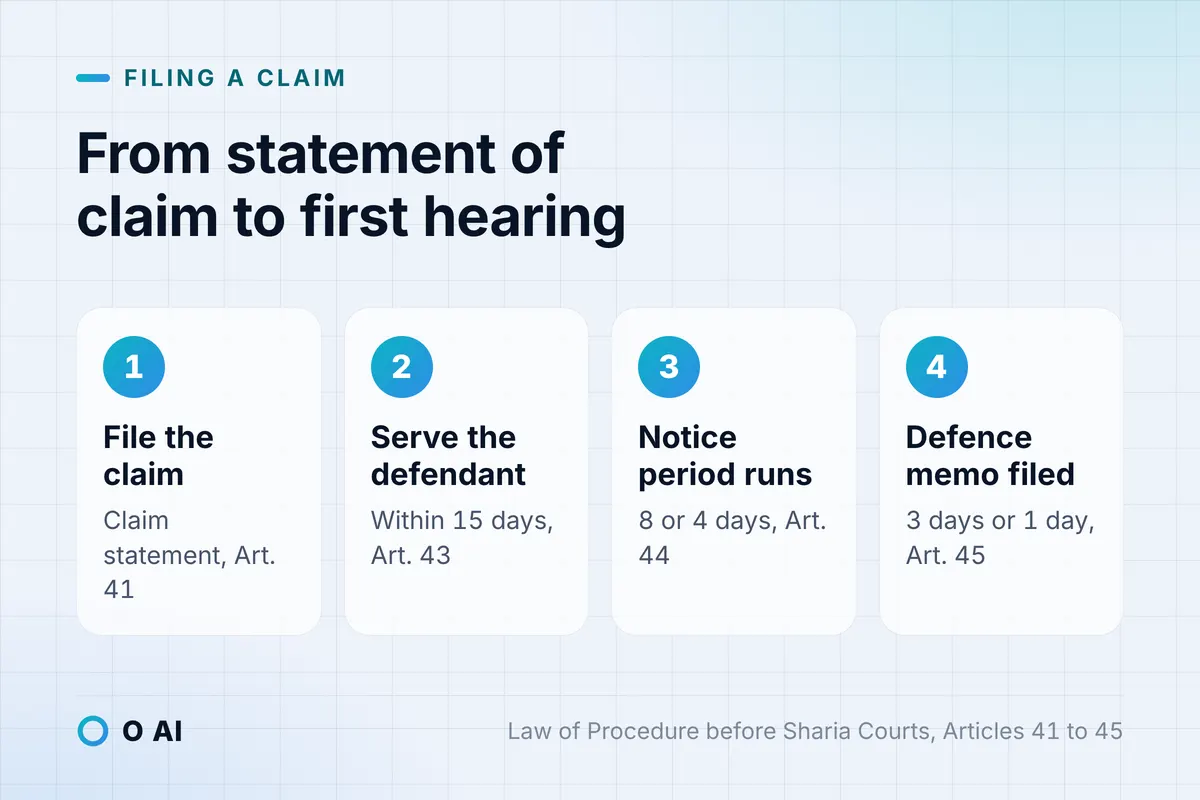
A claim starts with a statement of claim signed by the claimant or the claimant's representative, with copies for each defendant (Article 41). It must state the claimant's full name, ID number, occupation, residence and workplace, the defendant's name and whatever is known of their occupation and residence, the filing date, the court, and the subject of the claim with the requests and their grounds; unrelated requests may not be combined in one statement [1]. The clerk records the claim on the day it is filed and fixes the hearing date (Article 42) [1].
The defendant must receive the copy within 15 days at most (Article 43). The minimum notice before the first hearing is eight days before a general court, and four days before labour, commercial and personal status courts (Article 44) [1]. The defendant files a defence memo at least three days before the hearing in a general court, or one day before in other courts (Article 45) [1].
Service has moved online. Since Royal Decree M/18 of 15/1/1442H, electronic means are a valid form of judicial notification with the same effect as other methods (Article 11), and electronic service may be made at any time, while service at a residence is not allowed before sunrise, after sunset or on official holidays except in cases of necessity and with a judge's written permission (Article 12) [1][2]. The Implementing Regulations treat service by the claimant to the defendant's national address as personal service once a postal provider confirms delivery and that the address belongs to the defendant (Regulation 11/1) [2].
Arabic is the language of the courts. Documents in a foreign language need a certified Arabic translation from a licensed office (Article 23) [1].
Hearings, absence and written pleading
Since Royal Decree M/78 of 10/9/1442H, Article 65 says that proceedings and pleading are in writing, and the court may hear the parties orally on its own initiative or at a party's request [1]. The judge must first ask the claimant to state the claim precisely; if the claimant cannot or will not, the claim is dismissed (Article 66) [1].
Absence has fixed consequences:
- Claimant absent. Under amended Article 55, if the claimant misses a hearing without an accepted excuse, the court may strike the case off. If 60 days pass without a request to resume, or the claimant fails to attend after resuming, the case is treated as if it was never filed [1].
- Defendant asks for judgment. Under amended Article 56, when the claimant is absent the defendant may ask the court to decide the case if it is ready, and the judgment counts as made in the claimant's presence [1].
- Defendant absent. Under Article 57, if the defendant was served personally or through an agent, filed a defence memo, or attended any hearing, the judgment counts as made in the defendant's presence. If service was not personal, the court adjourns once and serves again before ruling in absentia [1].
Evidence now sits in the Evidence Law
Older explainers still describe witness testimony, oaths, expert evidence and documents under Articles 101 to 158 of the Law of Procedure before Sharia Courts. Those articles are repealed. Article 128 of the Evidence Law, issued by Royal Decree M/43 of 26/5/1443H, repealed Chapter Nine of the Law of Procedure before Sharia Courts and Chapter Seven of the Law of Commercial Courts [3]. The Evidence Law took effect 180 days after its publication on 7 January 2022 (Article 129) [3].
The Law of Procedure before Sharia Courts still applies to evidence procedure where the Evidence Law has no provision (Evidence Law, Article 125) [3]. In practice, read the two laws together: the Evidence Law for what proves a fact, the Law of Procedure before Sharia Courts for how the hearing runs.
Judgments and the deadlines to challenge them
After pleading closes, the court rules at once or sets a date to pronounce judgment (Article 159), and judgment is read in a public hearing (Article 164) [1]. The court must explain the routes and deadlines for challenge after pronouncing judgment (Article 165), and issue the judgment deed within 20 days of pronouncement (Article 166) [1].
The three routes of challenge are appeal, cassation and review (Article 176) [1]. All first-instance judgments can be appealed except minor claims set by the Supreme Judicial Council (Article 185) [1].
| Step | Time limit | Article |
|---|---|---|
| Serving the statement of claim | Within 15 days of receipt by the process server | 43 [1] |
| Notice before the first hearing | At least 8 days (general court) or 4 days (labour, commercial, personal status) | 44 [1] |
| Resuming a struck-off case | 60 days, or the case lapses | 55 [1] |
| Issuing the judgment deed | Within 20 days of pronouncement | 166 [1] |
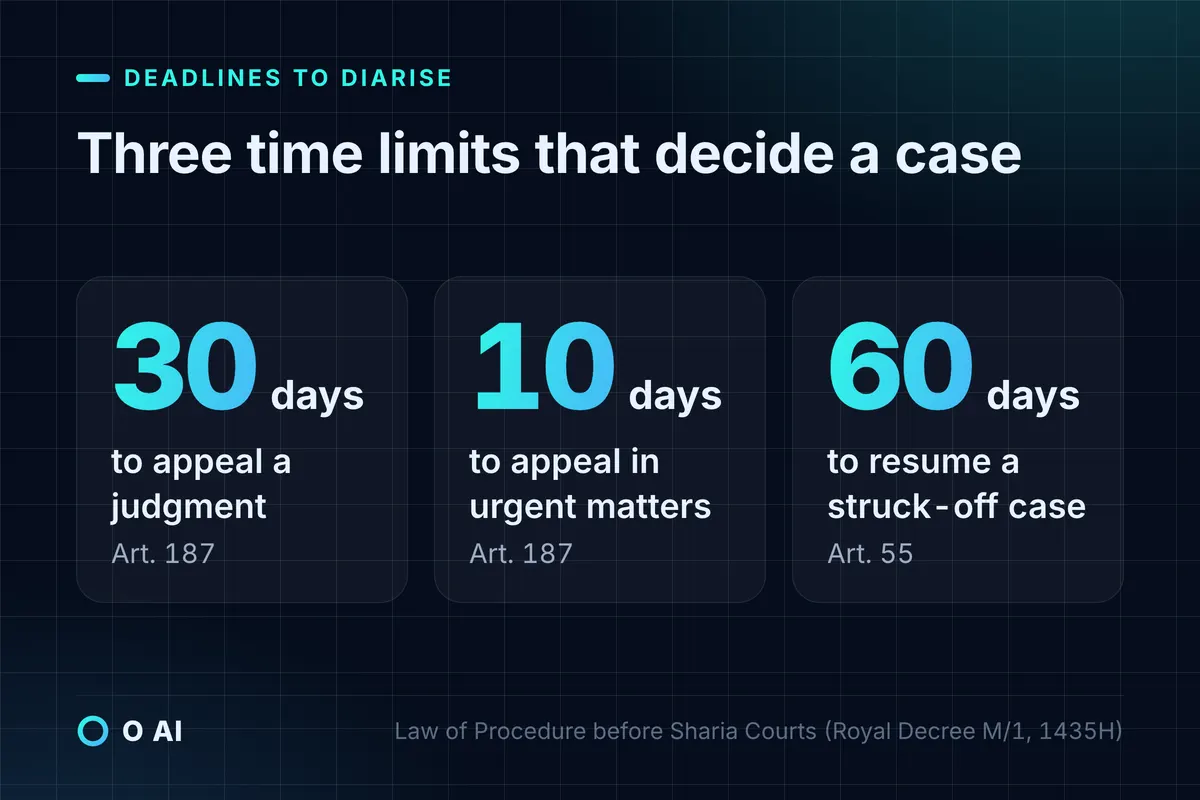
| Appeal or scrutiny request | 30 days; 10 days for urgent matters | 187 [1] |
| Appellant absent after notice | 60 days without a request to resume, then the right lapses | 190 [1] |
| Attendance in urgent cases | 24 hours, shorter in extreme necessity | 207 [1] |
If no objection is filed within the period in Article 187, the right to appeal lapses and the judgment becomes final [1]. Cassation before the Supreme Court is limited to grounds such as breach of Sharia or the law, an improperly formed court, lack of jurisdiction or wrong characterisation of the facts (Article 193) [1]. Review of a final judgment is available in listed cases, such as forged documents discovered after judgment or fraud by the other party (Article 200) [1].
Urgent matters and provisional enforcement
Urgent matters are decided provisionally without affecting the merits (Article 205). They include inspection to record a state of affairs, travel bans, possession claims and stopping new works (Article 206) [1]. A travel ban requires the claimant to post security set by the judge to compensate the defendant if the claim fails (Article 208) [1].
Judgments in urgent matters and certain family judgments, such as maintenance or custody, carry provisional enforcement (Article 169) [1]. The provisions on judicial custody in Articles 212 to 217 were repealed by the Civil Transactions Law, which now governs custody of disputed property [1][7].
Enforcement itself is not in this law. The new Enforcement Law, issued by Royal Decree M/237 of 3/11/1447H, keeps the old enforcement law's provisional attachment rules in force until they are moved into the Law of Procedure before Sharia Courts [6]. Expect a further amendment on that point.
The Implementing Regulations of the Law of Procedure before Sharia Courts
Article 240 gives the Minister of Justice, in coordination with the Supreme Judicial Council, the power to issue the Implementing Regulations [1]. They were approved by Minister of Justice Decision No. 39933 of 19/5/1435H and amended several times, including Decision No. 5062 of 7/9/1440H and Decision No. 7414 of 26/6/1441H [2]. The regulations are numbered after the article they explain, so Regulation 11/1 is the first rule under Article 11 [2].
Two examples show why they matter in practice. Regulation 12/2 defines official holidays for service as Friday and Saturday, the two Eid holidays and any day declared a public holiday [2]. Regulation 11/1 makes national address service count as personal service [2].
The Ministry of Justice's Research Center publishes a consolidated text of the law, the regulations and related circulars, current to 15/1/1442H [2]. Later amendments, such as M/78, M/101, M/43 and M/191, are not in that compilation, so check each article against the legislation portal [1].
The Law of Procedure before the Board of Grievances
The Law of Procedure before the Board of Grievances was issued by Royal Decree M/3 on the same day as the Law of Procedure before Sharia Courts, 22/1/1435H [5]. It governs administrative courts, and its Article 60, as amended with the Evidence Law, applies the Law of Procedure before Sharia Courts and the Evidence Law where it is silent, as far as they suit an administrative dispute [5].
Key differences for anyone suing a government body:
- Grievance first. For a claim to cancel an administrative decision not related to civil service, the claimant must first file a grievance with the issuing body within 60 days of learning of the decision, and the body has 60 days to decide (Article 8) [5].
- Written by default. Proceedings are in writing, and the panel may hear oral statements (Article 10) [5].
- Absence. If the claimant misses the first hearing, the court may decide the case or strike it off; after 60 days without resumption it lapses (Article 15) [5].
- Appeal period. 30 days from receiving the copy of the judgment (Article 33) [5].

A pre-filing checklist
Most procedural losses come from a few repeated errors. Before filing under the Law of Procedure before Sharia Courts, check:
- The court type is right: general, personal status, labour, or commercial under its own law [1][4].
- The place is right: the defendant's residence unless an exception applies (Articles 36 and 39) [1].
- The statement of claim has every item in Article 41 and a clear, precise request (Articles 41 and 66) [1].
- Foreign-language documents have a certified Arabic translation (Article 23) [1].
- Evidence is prepared under the Evidence Law, not the repealed Articles 101 to 158 [3].
- Every deadline is diarised, especially the 30-day appeal period and the 60-day lapse rule [1].
Your next step
Open the Law of Procedure before Sharia Courts on the legislation portal and read the articles that apply to your case in their current, amended form, then check the regulation under each one in the Ministry of Justice compilation [1][2]. If you run a law firm, put the deadlines in the table above into your case diary on the day each one starts; Rushd by O AI, our law-firm software, is one way to track hearings and deadlines per case. For how the appeal clock works in practice, see our guide to the appeal deadline in Saudi Arabia, and for hearings held online, our guide to Najiz remote hearings.
Frequently asked questions
What is the Law of Procedure before Sharia Courts in Saudi Arabia?
It is the main procedural law for Saudi courts, issued by Royal Decree M/1 of 22/1/1435H. It sets the jurisdiction of general, personal status and labour courts, how claims are filed and served, how hearings and judgments work, the routes of appeal, urgent matters, and non-contentious applications. Commercial and administrative cases have their own procedure laws but fall back on it where those laws are silent.
Where can I read the Law of Procedure before Sharia Courts with its amendments?
The official updated text is on the legislation portal of the Bureau of Experts at the Council of Ministers, which marks amended and repealed articles with the decree number and date. The Ministry of Justice publishes a consolidated text with the Implementing Regulations current to 15/1/1442H. This guide helps you see what changed after that, but the official text is the reference when you apply the law.
Where are the evidence rules now?
In the Evidence Law issued by Royal Decree M/43 of 26/5/1443H. It repealed Chapter Nine of the Law of Procedure before Sharia Courts, which held Articles 101 to 158 on questioning parties, admissions, oaths, inspection, testimony, experts and documents. Any guide that still cites those articles for evidence is out of date.
How long do I have to appeal a judgment?
Thirty days under Article 187, or ten days for judgments in urgent matters. If no appeal or scrutiny request is filed within that period, the right lapses and the judgment becomes final. Commercial and administrative courts have their own appeal rules, so check the law that governs your case.
Can court notices be sent by text message or email?
Yes. Since the 1442H amendments, electronic means are a valid form of judicial notification with the same effect as other methods, and electronic service may be made at any time of day. The Implementing Regulations also accept service to the defendant's national address when a postal provider confirms delivery.
Who issues the Implementing Regulations?
The Minister of Justice, in coordination with the Supreme Judicial Council, under Article 240 of the law. The first version was approved by Decision No. 39933 of 19/5/1435H and has been amended several times since. The Ministry of Justice publishes a consolidated text, but check later amendments against the official portal.
How this article was made: Researched from the official sources listed below, opened on 29 October 2026. Drafted with AI assistance, then checked against those sources. General information, not legal or professional advice. Illustrations were made for this article.
Sources
- Law of Procedure before Sharia Courts (Royal Decree M/1 of 22/1/1435H), current text with amendments (opens in a new tab)Bureau of Experts at the Council of Ministers · laws.boe.gov.sa
- Law of Procedure before Sharia Courts, its Implementing Regulations, royal decrees, decisions and circulars, current to 15/1/1442H (PDF) (opens in a new tab)Ministry of Justice, Research Center · moj.gov.sa
- Evidence Law (Royal Decree M/43 of 26/5/1443H) (opens in a new tab)Bureau of Experts at the Council of Ministers · laws.boe.gov.sa
- Law of Commercial Courts (Royal Decree M/93 of 15/8/1441H) (opens in a new tab)Bureau of Experts at the Council of Ministers · laws.boe.gov.sa
- Law of Procedure before the Board of Grievances (Royal Decree M/3 of 22/1/1435H) (opens in a new tab)Bureau of Experts at the Council of Ministers · laws.boe.gov.sa
- Enforcement Law (Royal Decree M/237 of 3/11/1447H) (opens in a new tab)Bureau of Experts at the Council of Ministers · laws.boe.gov.sa
- Civil Transactions Law (Royal Decree M/191 of 29/11/1444H) (opens in a new tab)Bureau of Experts at the Council of Ministers · laws.boe.gov.sa
About the author
Newsletter
New guides and news by email
New guides and news about O AI, Rushd and Dalni, at most twice a month. No spam.