 AI


Nafith promissory notes in Saudi Arabia: issue, accept, enforce
Nafith is the Ministry of Justice platform for electronic promissory notes. Since 28 October 2026, only notes registered on a national platform are enforcement instruments. This guide covers validity, issuing, enforcement, objections and bounced cheques.


Key takeaways
- Under Article 87 of the Commercial Papers Law, a promissory note must state seven elements, including an unconditional promise to pay a fixed sum and the maker's signature.
- Since 28 October 2026, a promissory note is an enforcement instrument only if registered on a national electronic platform such as Nafith.
- Paper notes issued before the new Enforcement Law took effect remain enforcement instruments for one year if otherwise valid.
- If the debtor does not pay within five working days of the enforcement order, compulsory measures such as asset attachment begin.
- Drawing a cheque without funds in bad faith is punishable by up to three years in prison and a fine of up to SAR 50,000.
On this page
- What a promissory note is under the Commercial Papers Law
- What makes a promissory note invalid
- How Nafith works: issuing and accepting an electronic note
- What changed on 28 October 2026: the new Enforcement Law
- Enforcing an unpaid note at the Enforcement Court
- Objecting to a promissory note
- Time limits on a promissory note
- Promissory note or cheque: the bounced-cheque rules
- Your next step
Nafith (نافذ) is the Ministry of Justice platform for issuing electronic promissory notes. Since the new Enforcement Law took effect on 28 October 2026, a promissory note is an enforcement instrument only if it is registered on a national electronic platform such as Nafith. Notes issued before that date keep enforcement status for one year, so registration now decides whether a creditor can go straight to the Enforcement Court.
This guide covers what a valid promissory note must contain under the Commercial Papers Law, how a note is issued and accepted on Nafith, what changed with the 2026 Enforcement Law, how enforcement and objections work, and how a note differs from a bounced cheque. We read the laws on the official legislation portal on 29 October 2026. It is general information, not legal advice; for a specific debt, read the official text and speak to a licensed lawyer.
What a promissory note is under the Commercial Papers Law
A promissory note (سند لأمر) is a written, unconditional promise by one person, the maker, to pay a fixed sum of money to another person, the payee, or to the payee's order. It is governed by the Commercial Papers Law, issued by Royal Decree No. 37 of 11/10/1383H (24 February 1964) and still in force [1]. The law is also translated as the Negotiable Instruments Law. There is no new Commercial Papers Law as of October 2026: the portal shows the 1383H law with its penalty articles amended in 1409H, and the 2026 change came through the Enforcement Law [1][2].
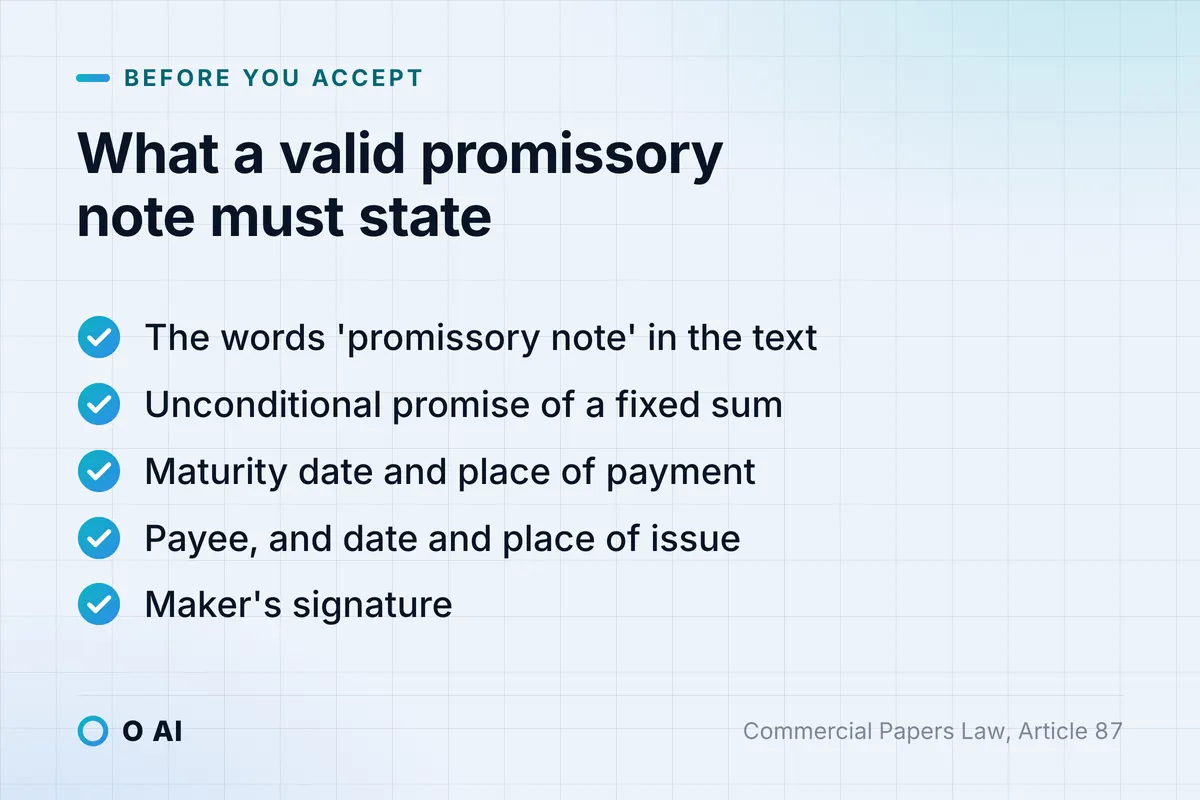
Article 87 lists seven elements a promissory note must contain [1]:
- The order clause or the words "promissory note" in the body of the document, in the language it is written in.
- An unconditional undertaking to pay a fixed sum of money.
- The maturity date.
- The place of payment.
- The name of the payee, or the person to whose order payment is made.
- The date and place of issue.
- The signature of the maker.
The maker is bound in the same way as the acceptor of a bill of exchange (Article 90), and the bill of exchange rules on endorsement, guarantee (aval), payment, protest and recourse apply to the note as far as they fit its nature (Article 89) [1].
What makes a promissory note invalid
Searches for the "nullifiers" of a promissory note (مبطلات سند لأمر) usually mean one thing: a missing element. Under Article 88, a document that lacks one of the seven elements is not a promissory note, with three exceptions [1]:
- No maturity date: the note is payable at sight.
- No place of payment: the place of issue counts as the place of payment and the maker's domicile.
- No place of issue: the note is treated as issued at the place stated next to the maker's name.
So a missing amount, a missing payee, a missing signature, or a promise tied to a condition ("I will pay if the project is delivered") leaves you without a promissory note. Two further points are often misread:
- An interest clause does not cancel the note. Article 89 applies the bill of exchange rule that such a clause is void, so the note stands without it [1].
- "On demand" wording is valid. Council of Ministers Decision No. 251 of 23/4/1442H interpreted "at sight" in Article 38 to include "on demand" and "on presentation" [1].
From 28 October 2026 there is a third practical test. A paper note issued after that date can be a valid commercial paper and still not be an enforcement instrument, because it is not registered on a national electronic platform [2]. Validity and enforceability are now two separate questions.
How Nafith works: issuing and accepting an electronic note
Nafith is an electronic platform for issuing and managing enforcement instruments, approved by the Ministry of Justice, and its current scope is the promissory note [4][5]. It creates and registers the note electronically with the elements required by the Commercial Papers Law, and the parties are authenticated through approved electronic verification [4]. The Saudi Central Bank told banks in Circular No. 41044391 of 25/6/1441H (19 February 2020) that they may connect to the platform and use its services [5].
The steps, as Nafith's own FAQ lists them, are [4]:
- Register on Nafith. Sign-in is through the National Single Sign-On (Nafath) [4].
- Choose to issue a note. Only the creditor can start a request to create a promissory note, and it enters the data the Commercial Papers Law requires, which the platform shows on screen [4].
- Verify the other party's details [4].
- Record the debtor's approval. The creditor sets the time allowed for approval; once it passes, the request is cancelled automatically and the debtor can no longer approve it [4].
- Create and archive the note. The note is stored on the platform and linked directly to the Ministry of Justice enforcement system. It cannot be amended after approval, and only the creditor can cancel it [4].
"Nafith for individuals" (سند لأمر للأفراد) is not a separate product. Nafith is open to all citizens, residents and establishments registered in Saudi Arabia, and a person can issue or receive a note in their own name [4]. It also supports multiple notes: a set of notes linked to one main request, each with its own maturity date and enforceable on its own [4].
Fees, limits and the exact screens change, so check them on nafith.sa before you rely on them.
What changed on 28 October 2026: the new Enforcement Law
The Enforcement Law issued by Royal Decree M/237 of 3/11/1447H (20 April 2026) replaced the Enforcement Law of 1433H [2]. It was published in the Official Gazette on 1 May 2026 and took effect 180 days after publication (Article 65); its Implementing Regulations, published on 23 October 2026, took effect with it on 28 October 2026 [2][3].
The key change for promissory notes is in Article 7. The list of enforcement instruments now includes "bills of exchange and promissory notes when registered on the national electronic platforms", and the Implementing Regulations set the conditions and procedures for registration [2]. Cheques remain enforcement instruments without that condition [2].
The royal decree gives a transition. Bills of exchange and promissory notes issued before the law took effect, and meeting the legal conditions other than registration on the electronic platforms, remain enforcement instruments for one year after it takes effect (item Fifth) [2].
| Instrument | Enforcement instrument from 28 October 2026? | Basis |
|---|---|---|
| Promissory note registered on Nafith or another national platform | Yes | Enforcement Law, Article 7(1)(d) [2] |
| Paper note issued before 28 October 2026, otherwise valid | Yes, for one year after the law took effect | Royal Decree M/237, item Fifth [2] |
| Paper note issued on or after 28 October 2026, not registered | No; the creditor needs a judgment or another route | Enforcement Law, Article 7 [2] |
| Cheque | Yes | Enforcement Law, Article 7(1)(e) [2] |
| Any instrument due more than 10 years ago | Enforcement request not accepted | Enforcement Law, Article 11 [2] |
Enforcing an unpaid note at the Enforcement Court
The Enforcement Court checks that the instrument meets its legal conditions without examining the underlying right (Article 4) [2]. For a registered note, the steps under the new law are:
- Notice where required. The Implementing Regulations set the cases in which the creditor must notify the debtor to pay before the enforcement request is recorded (Article 12) [2].
- File the request. The competent department records the request once it is complete; missing items must be supplied within 10 working days or the request is treated as rejected (Article 13) [2].
- Enforcement order. If the instrument meets its conditions, the court orders the debtor to pay and notifies them at once (Article 14). The debtor must disclose their assets from that notice (Article 15) [2].
- Five working days. If the debtor has not paid five working days after notice, compulsory measures start: credit bureaus are informed and the debtor's assets are attached. A bank guarantee covering the debt buys ten more working days (Article 18) [2].
- Further measures. On the creditor's request, the court orders a travel ban of up to three years, extendable to a total of six (Article 19). The court may also impose a fine of up to SAR 5,000 a day for each day the order is not carried out, capped by the regulations (Article 18) [2].
Illustrative example. A Riyadh supplier sells equipment worth SAR 60,000 to a contractor, payable in one sum on 1 March 2027, and the contractor issues a note to the supplier on Nafith. On 1 March 2027 the note is due and unpaid. Because the note is registered, the supplier files an enforcement request rather than a lawsuit. If the contractor ignores the enforcement order for five working days, the court begins attachment and credit reporting, and the supplier can ask for a travel ban.

Objecting to a promissory note
People searching how to object to a promissory note (الاعتراض على سند لأمر) usually mean one of two routes, and they lead to different places:
- Enforcement dispute. Anyone with an interest may raise an enforcement dispute about the validity of the instrument, the conditions for enforcing it, or the court's jurisdiction. The court decides it under the rules for urgent cases (Article 45) [2].
- Grievance against a step. A party may file a grievance against listed enforcement orders and decisions within 10 working days, and the decision on it is final (Article 46) [2].
- Dispute over the debt itself. A claim that the money was never owed, or was already paid, goes to the court competent for the underlying right. The Enforcement Court does not examine the underlying right (Article 4) [2].
Neither a dispute nor a grievance stops enforcement by itself; the proceedings continue unless the judge hearing it orders otherwise (Article 47) [2]. The new law also makes it a crime to file a lawsuit to obstruct enforcement or to hide assets, punishable by up to three years in prison, a fine of up to SAR 1 million, or both (Article 50) [2].
Time limits on a promissory note
Two clocks run on a note, and both matter:
- Commercial Papers Law. A claim against the acceptor of a bill of exchange is not heard after three years from maturity (Article 84), and Article 90 places the maker of a promissory note in the acceptor's position [1]. Claims of the holder against endorsers are not heard one year after the protest, and endorsers' claims against each other six months after payment (Article 84) [1].
- Enforcement Law. An enforcement request on any instrument due more than ten years ago is not accepted (Article 11) [2].
Do not wait. The three-year rule under the Commercial Papers Law is the shorter one, and the transition for old paper notes ends one year after 28 October 2026 [1][2].
If a note cannot be enforced directly, a trader may have a faster route than a full lawsuit. Under the Law of Commercial Courts, a creditor whose right is in writing, due and of a fixed amount can ask the commercial court for a payment order, after giving the debtor written notice at least five days in advance (Articles 67 and 68) [6]. The court decides within ten days of recording the request (Article 70) [6].
Promissory note or cheque: the bounced-cheque rules
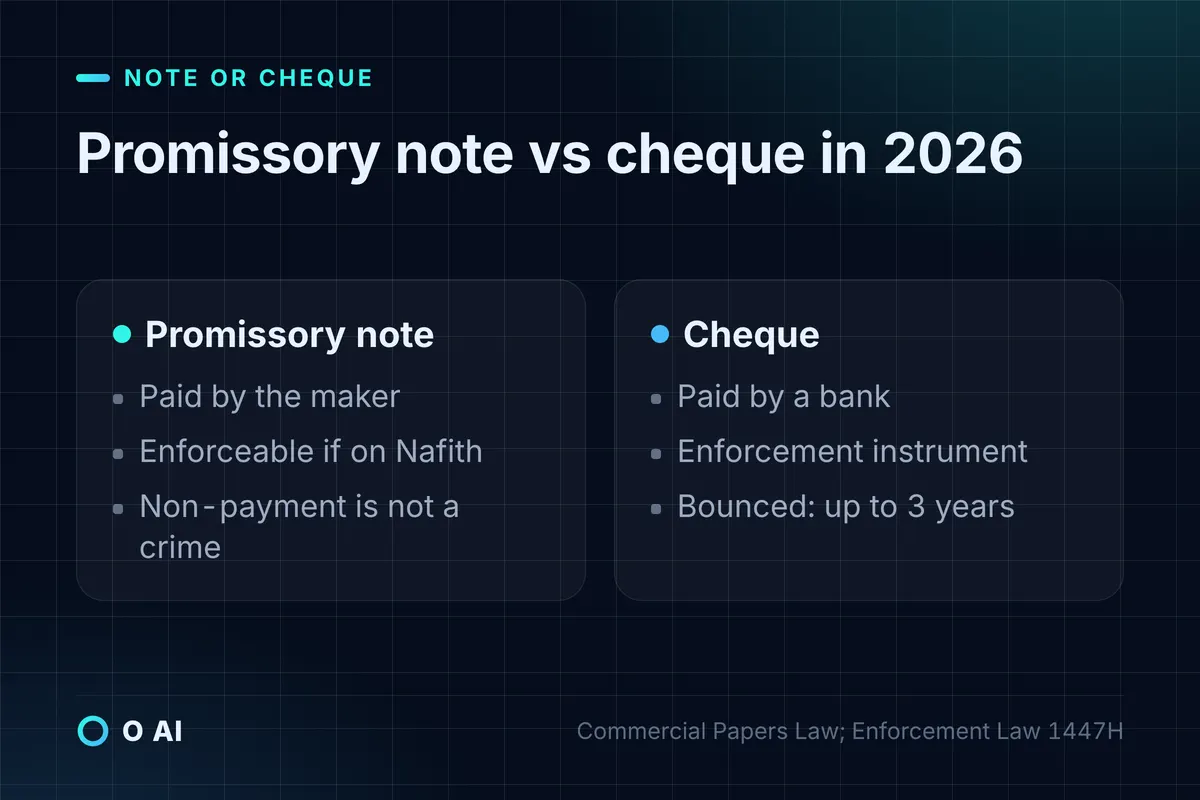
A cheque (شيك) is different. It is an order to a bank to pay, and it is payable at sight: any statement to the contrary is disregarded, and a cheque presented before its stated issue date must be paid on presentation (Article 102) [1]. A cheque drawn and payable in the Kingdom must be presented within one month (Article 103) [1].
A bounced cheque is also a crime. Article 118, as amended by Royal Decree M/45 of 12/9/1409H, punishes anyone who in bad faith draws a cheque without sufficient funds, withdraws the funds after issuing it, or stops its payment, with prison of up to three years, a fine of up to SAR 50,000, or both. A repeat offence within three years of a conviction raises the maximum to five years and SAR 100,000 [1]. A promissory note carries no equivalent criminal penalty in the Commercial Papers Law; its strength is enforceability.
| Point | Promissory note | Cheque |
|---|---|---|
| Who pays | The maker | A bank, on the drawer's order [1] |
| Enforcement instrument | Only if registered on a national platform | Yes [2] |
| Criminal penalty for non-payment | None in the Commercial Papers Law | Up to 3 years and SAR 50,000 if in bad faith [1] |
| Typical use | Instalments, deposits, deferred sales | Immediate payment |
Your next step
Before you accept a promissory note, check the seven elements in Article 87 and insist that it is issued on Nafith, not on paper, so it is an enforcement instrument from day one [1][2]. If the other party is a business, verify its commercial registration first, and if you are planning credit for a small company, our guide to small business financing in Saudi Arabia covers the options. Law firms handling enforcement files can track each note, order and deadline per case in Rushd by O AI, our law-firm software.
Frequently asked questions
What is Nafith?
Nafith is an electronic platform approved by the Ministry of Justice for issuing and managing enforcement instruments, and its current scope is the promissory note. The creditor creates the note, the debtor approves it within the time the creditor sets, and both sign in through Nafath. The note is then archived and linked to the Ministry's enforcement system. It is open to citizens, residents and establishments registered in Saudi Arabia.
Is a paper promissory note still valid in 2026?
It can still be a valid commercial paper if it has the seven elements required by the Commercial Papers Law. Since 28 October 2026, however, a promissory note is an enforcement instrument only when registered on a national electronic platform. Paper notes issued before that date keep enforcement status for one year; after that, an unregistered note needs a court judgment or another legal route.
Can an individual issue a promissory note on Nafith?
Yes. The platform serves both individuals and establishments, and a person can issue or receive a note in their own name after signing in through Nafath. There is no separate product for individuals; the note has the same legal elements whoever issues it.
What happens if the debtor does not pay a Nafith note?
The creditor files an enforcement request. If the note meets its conditions, the Enforcement Court orders the debtor to pay. After five working days without payment, compulsory measures begin, including attachment of assets and notice to credit bureaus. On request, the court can also order a travel ban of up to three years, extendable to six.
How do I object to a promissory note?
If you dispute the note's validity or the conditions for enforcing it, you can raise an enforcement dispute before the Enforcement Court, which decides it as an urgent matter. If you dispute the debt itself, you go to the court competent for the underlying right. Filing does not stop enforcement unless the judge orders it.
Is a bounced cheque treated the same as an unpaid promissory note?
No. Both can be enforced, but drawing a cheque without funds in bad faith is a crime under Article 118 of the Commercial Papers Law, punishable by up to three years in prison and a fine of up to SAR 50,000. An unpaid promissory note is a civil debt enforced through the Enforcement Court.
How this article was made: Researched from the official sources listed below, opened on 29 October 2026. Drafted with AI assistance, then checked against those sources. General information, not legal or professional advice. Illustrations were made for this article.
Sources
- Commercial Papers Law (Royal Decree No. 37 of 11/10/1383H), current text (opens in a new tab)Bureau of Experts at the Council of Ministers · laws.boe.gov.sa
- Enforcement Law (Royal Decree M/237 of 3/11/1447H) and its issuing decree (opens in a new tab)Bureau of Experts at the Council of Ministers · laws.boe.gov.sa
- Implementing Regulations of the Enforcement Law (12/5/1448H, 23 October 2026) (opens in a new tab)Umm Al-Qura (Official Gazette) · uqn.gov.sa
- Nafith platform: promissory note and frequently asked questions (opens in a new tab)Nafith · nafith.sa
- "Nafith" electronic platform approved by the Ministry of Justice, Circular No. 41044391 (opens in a new tab)Saudi Central Bank (SAMA) Rulebook · rulebook.sama.gov.sa
- Law of Commercial Courts (Royal Decree M/93 of 15/8/1441H) (opens in a new tab)Bureau of Experts at the Council of Ministers · laws.boe.gov.sa
About the author
Newsletter
New guides and news by email
New guides and news about O AI, Rushd and Dalni, at most twice a month. No spam.