 AI


Property management software: the features you need (rent, billing, maintenance)
A buyer's guide to property management software for Saudi landlords, brokerage offices and management companies: what Ejar and Ejar Plus already cover, the rent, billing and maintenance features you still need, a worked monthly statement and 12 questions for vendors.


Key takeaways
- Ejar registers leases and takes residential rent; property management software covers the rest: owner ledgers, VAT invoices, maintenance and owner statements.
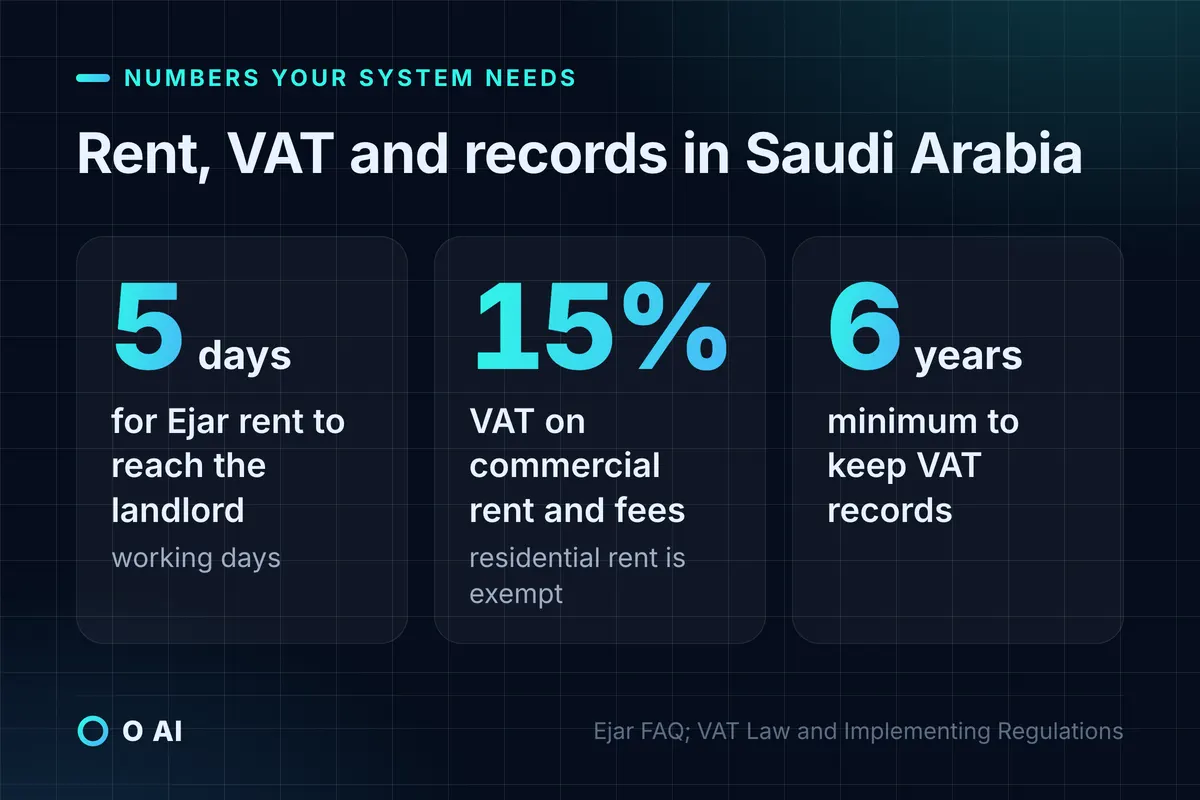
- Residential rent paid through Ejar's digital channels reaches the landlord within 5 working days with an automatic receipt, so software should reconcile it, not collect it.
- Residential leases are VAT-exempt, while commercial rent and management fees carry 15% VAT when the supplier is registered, so every unit needs a type flag.
- VAT records must be kept for at least six years, in Arabic and in the Kingdom, with controls that prevent tampering.
- Since September 2025, leases renew unless notice is given 60 days ahead and Riyadh rents are frozen for five years; reminders in the software prevent costly misses.
On this page
- What property management software does, and what Ejar already covers
- Rent and collection: the core of any property management system
- Billing, VAT and e-invoicing features
- Client money and owner statements
- Maintenance features: from tenant request to closed job
- Contracts, renewals and the 2025 rent rules
- Data protection: what tenant data your software holds
- Which property management system fits your portfolio?
- 12 questions to ask a property management software vendor
- Your next step
Property management software should hold one record for every unit, tenant and contract, match rent against what Ejar reports, issue the right invoice for taxable rent and fees, follow each maintenance job from request to cost, and give owners clear statements. Choose it by your portfolio's size, the Saudi rules it must follow and how it works alongside Ejar.
This guide is for landlords, brokerage offices and property management companies in Saudi Arabia comparing systems, whether ready-made or built for them. It describes features, not brands. Every rule below was read on Ejar, REGA, ZATCA and Bureau of Experts pages on 14 October 2026. It is general information, not legal or tax advice; for a specific case, check the official source or ask a licensed advisor.
What property management software does, and what Ejar already covers
Before listing features, separate what the government network already does from what your own system must do. Ejar registers and documents residential and commercial leases, handles renewals, helps follow up and collect rent payments, documents a unit's condition at handover, and lists approved brokers [1].
For brokerage offices, Ejar also offers Ejar Plus: a dashboard for contracts, contract review by several reviewers before documentation, a notification centre, user permissions, and reports on properties, units, contracts, finances and office users [2]. It is a paid subscription with a free first trial period, and it is optional [2].
| Task | Ejar | Ejar Plus | Property management software |
|---|---|---|---|
| Register, renew and end leases | Yes | Yes, with review steps | Tracks them; registration still happens on Ejar |
| Residential rent payment | Yes, through its digital channels [3] | Reports on it | Reconciles payouts against the rent schedule |
| Commercial rent and other income | Records the contract | Reports | Invoices, receipts and arrears |
| Owner accounting and statements | No | Office-level financial reports | Per-owner ledgers and statements |
| Maintenance requests and costs | Handover condition only | No | Full job tracking |
| Expenses, suppliers and VAT invoices | No | No | Yes |
The pattern is clear. Ejar is where leases become legally effective; your software is where the money, the maintenance and the owner relationship are managed. A good system never asks staff to choose between them.

Rent and collection: the core of any property management system
For residential leases, Ejar says tenants pay through its digital channels (mada, Apple Pay or SADAD biller code 153), the money reaches the landlord's bank account within 5 working days, and no separate receipt voucher is needed because one is issued automatically [3]. As of October 2026, this restriction applies to residential contracts only [3].
That changes what your software needs to do. It does not need to collect residential rent itself; it needs to know what was due, what Ejar paid out, and what is still missing. Look for:
- Rent schedules per contract: monthly, quarterly, half-yearly or annual instalments, matching the Ejar contract.
- Reconciliation: importing bank statements and matching each Ejar payout to the right unit and instalment.
- Arrears ageing: who is late, by how many days, and the history of reminders sent.
- Commercial rent: invoices, receipts and payment tracking outside Ejar's digital channels.
- Security deposits: a record of each deposit, any deductions and the refund, with the supporting documents.
Ejar's residential contract is an enforceable instrument, so an unpaid tenant can be pursued at the enforcement court without first filing a lawsuit [4]. Your software's arrears file, with dates and reminders, is the evidence your lawyer will ask for.
Billing, VAT and e-invoicing features
Billing is where Saudi rules shape the software most. The lease of residential real estate is exempt from VAT [5], while commercial rent and a property manager's fees are taxable at the basic rate of 15% when the supplier is VAT-registered [6]. The system must therefore know, unit by unit, whether a lease is residential or commercial.
ZATCA's e-invoicing rules require invoices to be issued through a compliant electronic solution; a scanned paper invoice does not count [7]. The first phase has applied since 4 December 2021, and the second phase, which integrates the solution with ZATCA's systems, has been rolled out in waves since 1 January 2023 [7]. Ask any vendor which phase its invoicing meets today, and whether your company has been called into an integration wave.
The VAT Implementing Regulations also set the record-keeping rules your software must support [5]:
- invoices, books and records kept for at least six years from the end of the tax period;
- records in Arabic, and tax invoices issued in Arabic, with any other language as a translation;
- records kept in the Kingdom, physically or electronically through access from a point in the Kingdom;
- for electronic records, security measures and controls that prevent tampering, and records that can be produced on request.
Illustrative example: one month's statement for a mixed-use building
Illustrative example. A building in Al Khobar has 8 apartments let at SAR 2,500 a month and 2 shops at SAR 6,000 a month. We assume the owner is VAT-registered and the manager charges 6% of rent collected; both are assumptions for the exercise.
| Line | Calculation | Amount (SAR) |
|---|---|---|
| Residential rent, paid through Ejar (VAT-exempt) | 8 × 2,500 | 20,000 |
| Commercial rent | 2 × 6,000 | 12,000 |
| VAT on commercial rent, to be declared by the owner | 15% × 12,000 | 1,800 |
| Total collected | 33,800 | |
| Management fee | 6% × 32,000 | −1,920 |
| VAT on management fee | 15% × 1,920 | −288 |
| Plumbing repair, supplier invoice including VAT | 600 + 90 | −690 |
| Net transferred to the owner | 30,902 |
The software has to tag each unit as residential or commercial, keep VAT apart from rent, attach the supplier's invoice to the repair, and show the owner which VAT belongs on their own return. How the owner treats that VAT is for their accountant; the system's job is to keep every line separate and traceable.
Client money and owner statements
If you manage property for others, the software must enforce the rules on other people's money. The Brokerage Law allows a broker to receive only the amounts its work requires and to use them only for their purpose [8]. Its Executive Regulations require the broker, before receiving any money, to complete REGA's form stating the amount, the purpose and how it will be received; to obtain written approval to spend it; to give proof of each payment by receipt or invoice; and to return what remains once the purpose ends [9].
REGA's draft property management regulation, published for consultation in May 2026, would go further: money collected for a property would have to be deposited in the owner's account, the manager would send periodic reports on occupancy, collection, income and expenses plus an annual performance report, and records would be kept for at least 10 years [10]. As of 14 October 2026, we found no final version published, but software chosen today should already handle these.
In practice, look for:
- a separate ledger for each owner, with no mixing of owners' money;
- spending approvals with a limit per owner and the invoice attached to each payment;
- owner statements showing occupancy, collection rate, income and expenses;
- an annual report per property, and an export of all records for a handover to another manager.
Maintenance features: from tenant request to closed job
Maintenance is where tenants judge a manager, and where costs leak. The draft regulation defines limited maintenance as repairs that do not affect the building's structure, such as minor faults, damaged tiles, sanitary and electrical fittings, leaks, locks, doors and windows [10]. Your software should track each of these jobs end to end:
- Request: the tenant reports through an app, a web form or WhatsApp, with photos, and receives a reference number.
- Triage: category, priority and whether the job falls within the owner's approved limit.
- Assignment: to an in-house technician or a contractor, with a target time.
- Approval: above the limit, the owner approves before work starts.
- Completion: photos, the supplier's invoice, the cost booked to the right unit and owner, and the tenant's confirmation.
- Prevention: recurring tasks such as air-conditioning servicing and water tank cleaning.
Ejar documents a unit's condition at handover [1]; keep those records linked to the unit so move-out deductions can be supported. If many requests arrive by WhatsApp, our guide to a WhatsApp chatbot for business explains what an assistant can log automatically and what must go to a person.
Contracts, renewals and the 2025 rent rules
The landlord–tenant provisions approved in September 2025 by Royal Decree M/73 turned several dates into legal deadlines [11]. A lease renews automatically unless either party gives notice at least 60 days before it ends, and a landlord must apply to register any unregistered lease on Ejar [11]. Inside Riyadh, for five years, total rent may not be increased, a vacant unit that was let before may not be offered above its last contract's rent, and a landlord may refuse renewal only on listed grounds [11]. Breaches can bring a fine of up to 12 months' total rent [11].
Software can prevent most of these mistakes:
- a flag on every unit for its city, so Riyadh units are treated differently;
- reminders well before the 60-day notice deadline, with a log of notices sent and received;
- a check that blocks a rent increase on a Riyadh unit, and shows the last registered rent for a vacant one;
- a report of leases not yet registered on Ejar.

Data protection: what tenant data your software holds
Property software holds national ID numbers, phone numbers, IBANs and payment histories. The Personal Data Protection Law requires a privacy policy available to people when their data is collected, stating the purpose, the data collected, how it is stored and destroyed, and their rights [12]. Data must be destroyed once its purpose ends, unless another law requires keeping it for a set period [12].
Check where the vendor hosts your data, who on their side can access it, and how you export everything if you leave. If the system runs on cloud services outside the Kingdom, read our guide to data residency in Saudi Arabia before you sign.
Which property management system fits your portfolio?
| Your situation | Usually enough | Why |
|---|---|---|
| An owner with a few residential units | Ejar, plus a spreadsheet or simple accounting app | Ejar handles contracts and residential rent; little to reconcile |
| A brokerage office with many Ejar contracts | Ejar Plus, plus accounting software | Dashboards, contract review and user permissions inside Ejar [2] |
| A property management company with several owners | Dedicated property management software alongside Ejar | Per-owner ledgers, maintenance, owner statements and VAT invoicing |
| A developer or large owner with its own ERP | A property management module or a custom integration | Rent and costs must post to existing finance and asset systems |
12 questions to ask a property management software vendor
- Does each unit carry its type (residential or commercial) and city, and does billing follow from it?
- How does the system work with Ejar: re-keyed data, file imports, or a documented connection? Ask to see it.
- Can it match Ejar payouts and bank statements to instalments automatically?
- Which ZATCA e-invoicing phase does it meet, and are invoices issued in Arabic?
- Does it keep a separate ledger per owner, with no mixing of funds?
- Can spending be capped per owner, with approval and an attached invoice?
- Can tenants report maintenance with photos and see the status?
- Does it warn before the 60-day notice deadline and log every notice?
- Can it produce monthly owner statements and an annual report per property?
- Does it have role-based permissions and an audit trail of changes?
- Where is the data hosted, how is it backed up, and can you export everything?
- Is the interface Arabic-first, with both Hijri and Gregorian dates?
Your next step
Write down your portfolio in one page: number of units by type and city, number of owners, how rent is paid, and how maintenance requests arrive today. Then send the 12 questions above to two or three vendors and ask each to demonstrate one month of your real workflow, from Ejar payout to owner statement. If no ready-made property management software fits, our guide to custom software development in Saudi Arabia explains when building or connecting systems makes sense. You can read about O AI, a software and AI company in Al Khobar, on our home page. Our ERP and business systems page lists property among the operations one system can bring together.
Frequently asked questions
Does Ejar replace property management software?
No. Ejar is where leases are registered, renewed and documented, and where residential rent is paid through its digital channels. It does not keep per-owner accounts, issue VAT invoices for commercial rent and fees, manage maintenance jobs or produce owner statements. Brokerage offices can add Ejar Plus for dashboards, contract review and reports. Property management software sits alongside Ejar and handles the money, the maintenance and the owner relationship.
Is Ejar Plus free?
Ejar describes Ejar Plus as a paid subscription package for brokerage offices, with a free trial period for first-time subscribers before fees start. It is optional, and subscribing does not change the office's existing Ejar account or contracts. Check the current package prices inside the office manager's Ejar account, under office management, before you compare it with other property management software.
Does property management software need ZATCA e-invoicing?
If your company is VAT-registered and issues tax invoices, for commercial rent or management fees for example, those invoices must come from a compliant electronic solution under ZATCA's e-invoicing rules. The second phase, integration with ZATCA's systems, is being applied in waves. Ask the vendor which phase its invoicing meets today, and check whether your company has been notified of its own integration date.
Is residential rent subject to VAT in Saudi Arabia?
No. The VAT Implementing Regulations exempt the lease of residential real estate, such as houses, flats and apartments used as homes. Hotels, serviced accommodation and other temporary lodging are not treated as residential. Commercial rent is taxable at the basic rate of 15% when the landlord is VAT-registered, and so is a property manager's fee. Your software should apply this unit by unit.
Can tenants pay residential rent through our software instead of Ejar?
For residential leases, Ejar says rent is paid through its digital channels, such as mada, Apple Pay or SADAD, and reaches the landlord's account within five working days with an automatic receipt. Your software should therefore record and reconcile those payments rather than collect them. Commercial leases are not currently covered by this restriction, so the software can invoice and record their payments directly.
Should we buy ready-made real estate management software or build our own?
Most landlords and management companies should start with ready-made software used alongside Ejar, because rent, maintenance and owner statements are common needs. Building or extending makes sense when you must connect to an existing ERP or accounting system, manage unusual contracts, or when no product handles Arabic, Hijri dates and Saudi VAT the way you need. Test two products with a month of your real data first.
What should owners receive from property management software?
At least a monthly statement showing rent due and collected, vacancies, VAT shown separately, each expense with its invoice, the manager's fee and the net amount transferred. An annual report per property is also good practice, and REGA's draft regulation would require one. Owners should also be able to see open maintenance jobs and lease renewal dates without asking.
How this article was made: Researched from the sources listed below, opened on 14 October 2026. Drafted with AI assistance, then checked against those sources. General information, not professional advice. Images are AI-generated illustrations.
Sources
- Ejar homepage: services and statistics (in Arabic) (opens in a new tab)Ejar · ejar.sa
- Ejar Plus for brokerage offices (in Arabic) (opens in a new tab)Ejar · ejar.sa
- Frequently asked questions (in Arabic) (opens in a new tab)Ejar · ejar.sa
- Residential contract registration and documentation service (in Arabic) (opens in a new tab)Ejar · ejar.sa
- Implementing Regulations of the Value Added Tax Law (opens in a new tab)Zakat, Tax and Customs Authority (ZATCA) · zatca.gov.sa
- Value Added Tax Law, with amendments (in Arabic) (opens in a new tab)Bureau of Experts at the Council of Ministers · laws.boe.gov.sa
- What is e-invoicing (opens in a new tab)Zakat, Tax and Customs Authority (ZATCA) · zatca.gov.sa
- Real Estate Brokerage Law (in Arabic) (opens in a new tab)Bureau of Experts at the Council of Ministers · laws.boe.gov.sa
- Executive Regulations of the Real Estate Brokerage Law, Jumada II 1444H (in Arabic) (opens in a new tab)Real Estate General Authority (REGA) · rega.gov.sa
- Draft regulation for real estate property management (in Arabic) (opens in a new tab)Istitlaa public consultation platform · istitlaa.scbc.gov.sa
- Regulatory provisions governing the landlord–tenant relationship (in Arabic) (opens in a new tab)Real Estate General Authority (REGA) · rega.gov.sa
- Personal Data Protection Law, with amendments (in Arabic) (opens in a new tab)Bureau of Experts at the Council of Ministers · laws.boe.gov.sa
About the author
Newsletter
New guides and news by email
New guides and news about O AI, Rushd and Dalni, at most twice a month. No spam.