 AI


Management information system (MIS): a guide for Saudi businesses
A management information system turns daily transactions into reports managers act on. This guide covers MIS components and types, how an MIS differs from ERP and BI, the ZATCA e-invoicing and PDPL points for Saudi companies, a worked monthly report and seven steps to improve yours.


Key takeaways
- An MIS is people, procedures, data, software and hardware working together to turn daily transactions into regular reports that managers use to decide.
- Classic types serve different levels: transaction processing for front-line staff, MIS reports for middle managers, decision support for what-if questions, executive dashboards for owners.
- An ERP is one software application with a central database; it is often the backbone of an MIS, but it is not the MIS itself.
- ZATCA's Wave 25 covers taxpayers with VAT-taxable revenue above SAR 187,500 in any year from 2022 to 2025, with Fatoora integration due by 1 February 2027.
- Fix the transaction layer and data ownership first; dashboards and AI add value only once the numbers underneath are clean.
On this page
- What is a management information system?
- The five components of an MIS
- Types of management information systems by management level
- MIS vs ERP vs business intelligence: what is the difference?
- What a Saudi MIS has to handle in 2026
- What an MIS looks like at each company size
- Illustrative example: one monthly report for a distributor in Dammam
- How to build or improve an MIS in seven steps
- Where AI fits in a management information system
- Your next step
A management information system (MIS) is the mix of people, procedures, data, software and hardware that turns a company's daily transactions into regular reports managers use to decide. For a Saudi business it usually means invoicing, accounting, inventory and payroll systems feeding one trusted monthly management report, not a single product you buy.
This guide explains the components and types of management information systems, how an MIS differs from ERP and business intelligence, and what Saudi rules in 2026 mean for the systems underneath it: e-invoicing integration with ZATCA and the Personal Data Protection Law. The definitions come from open university textbooks, the rules from the official sources listed at the end, and every company in the examples is hypothetical.
What is a management information system?
Textbooks word it slightly differently, but they agree on the job. OpenStax's Foundations of Information Systems (2025) describes an MIS as the system that gives middle managers reports and summaries to support decisions [1]. OpenStax's Introduction to Business calls it the users, hardware and software that support decision-making: it collects and stores the company's key data and produces the information managers need for analysis, control and decisions [2].
The difference between data and information is the whole point. In the OpenStax payroll example, payroll staff receive a weekly report showing how each paycheque was calculated, while higher-level managers receive a summary of total labour cost and overtime by department, compared with the previous year [2]. The data is the same; the report, the reader and the decision are different.
In everyday use, "the MIS" also means the whole set of systems a company runs, from the point-of-sale terminal to the owner's dashboard. That broader meaning is the one this guide uses. Management information systems is also a field of study in business schools, which is why so much of what ranks for the term is written for students rather than for companies.
The five components of an MIS
David Bourgeois's open textbook lists five components: hardware, software, data, people and process. The first three are technology; the last two, he argues, are what separate information systems from purely technical fields such as computer science [3]. OpenStax lists the same five, calling the fifth "procedures" [1].
| Component | What it covers | Illustrative example in a Saudi company | Typical gap |
|---|---|---|---|
| Hardware | Computers, servers, networks, point-of-sale terminals, scanners | Point-of-sale devices at each branch; cloud hosting instead of a server room | Old branch PCs that cannot run the current software |
| Software | Accounting, ERP, point of sale, payroll, reporting tools | Accounting software connected to ZATCA's Fatoora platform | Separate programs that do not share customer or item codes |
| Data | Transactions plus master data: customers, items, employees | Customer VAT numbers, item codes, employee records | Duplicate customers; one item named three ways across branches |
| People | Users, data owners and whoever builds the reports | A finance officer who owns the monthly management pack | Nobody owns data quality |
| Procedures | Rules for entering, approving, closing and reporting | Books closed by the fifth working day of each month | Each branch closes its books differently |
Better software fixes only one row of that table. If item codes differ by branch or nobody owns the customer list, the reports stay wrong whatever the tool. Bourgeois makes the same point about process: automating activities is not enough; the aim is to manage and improve the processes themselves [3].
Types of management information systems by management level
Textbooks group information systems by the level of management they serve [1]. The labels below are the classic ones; in a small company two or three of them often live inside one product.
| Type | Main users | What it does | Illustrative example |
|---|---|---|---|
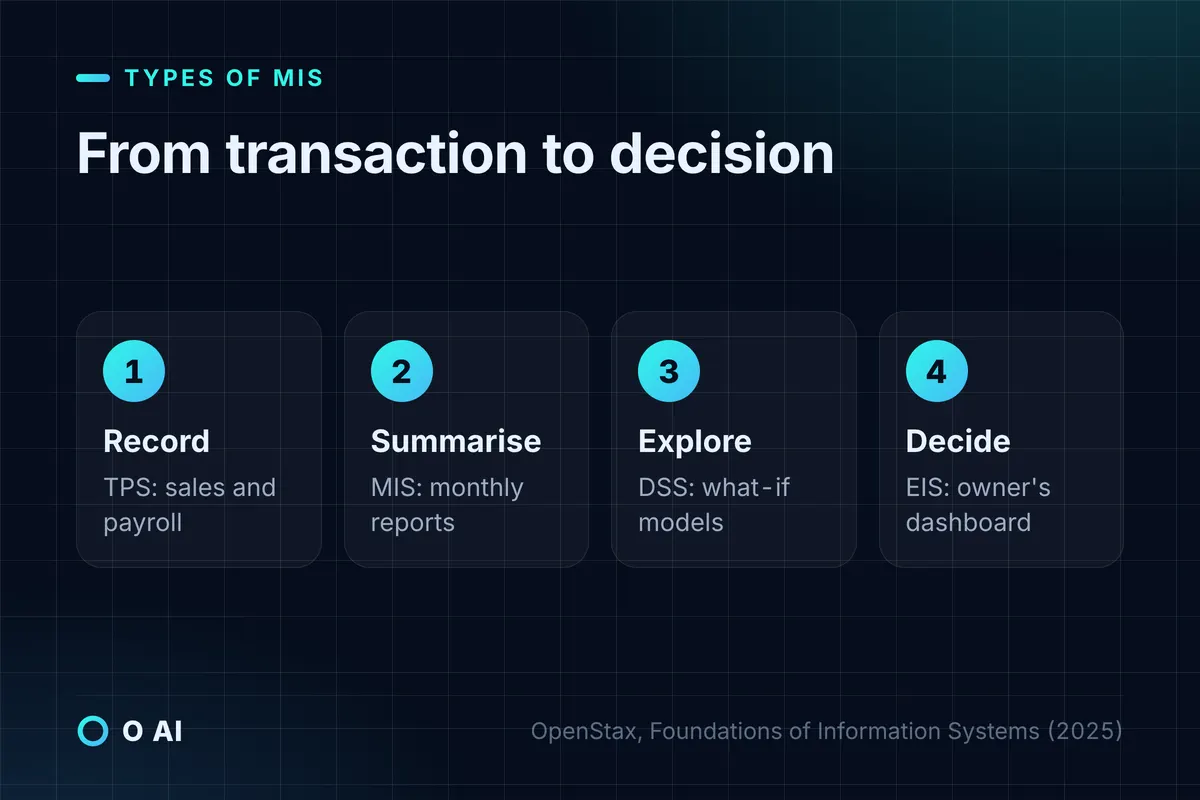
| Transaction processing system (TPS) | Front-line staff | Records day-to-day transactions such as orders and payroll [1] | Point-of-sale sales, tax invoices, goods received, the payroll run |
| Management information system (MIS) | Middle managers | Produces regular reports and summaries such as budgets and cash-flow statements [1] | Monthly profit by branch; receivables ageing |
| Decision support system (DSS) | Managers and analysts | Uses interactive models to answer what-if questions [2] | "What happens to margin if delivery fees rise by SAR 5?" |
| Executive information system (EIS) | Owners and top executives | Supplies strategic information, often tailored to one executive [1][2] | A one-page dashboard for the owner or the board |
Two related terms complete the picture. Enterprise resource planning (ERP) software integrates processes such as human resources, accounting, payroll and customer service across the whole organisation [1]. And OpenStax's business textbook describes expert systems, which use artificial intelligence to give managers advice similar to a human consultant's [2]; today's AI assistants are the modern version, covered later in this guide.
The labels matter less than the flow: each transaction is recorded once, summarised for managers, explored when a decision needs it, and condensed for the owner.
MIS vs ERP vs business intelligence: what is the difference?
The terms overlap, which is why vendors use them loosely. A simple way to separate them is by the question each one answers.
| Term | What it is | The question it answers |
|---|---|---|
| MIS | The whole arrangement of people, procedures and systems that produces management reports | "Are we on budget this month, by branch?" |
| ERP | One software application with a central database, sold in modules such as finance, manufacturing and sales [4] | "Where is this order, its invoice and its payment?" |
| Business intelligence (BI) | Tools that query and chart data from one or several systems | "Which products lost margin this quarter, and where?" |
| IT | The people and infrastructure that keep the systems running | "Is the system up, secure and backed up?" |
An ERP is often the backbone of an MIS, but it is not the MIS itself. Bourgeois notes the trade-off: an ERP comes with built-in processes, and every customisation has to be maintained and retested at each upgrade, so it makes most sense to customise only the processes critical to the company's competitive advantage [4]. Our guide to custom software development in Saudi Arabia covers when to buy a package, connect what you have or build something specific.
What a Saudi MIS has to handle in 2026
Two sets of rules shape the systems at the base of any MIS in the Kingdom.
E-invoicing integration with ZATCA
ZATCA's e-invoicing Phase 1 (generation) has applied since 4 December 2021. Phase 2 (integration) started on 1 January 2023 and is rolled out in waves, with each wave told at least six months ahead [6]. On 24 July 2026 ZATCA announced Wave 25: taxpayers whose VAT-taxable revenue exceeded SAR 187,500 in any year from 2022 to 2025 will be notified to connect their e-invoicing solutions to the Fatoora platform by 1 February 2027 at the latest. Phase 2 means integrating with Fatoora, issuing invoices in a specific format and adding extra fields to each invoice [5].
For an MIS, this is good news in disguise. Sales are the most important transaction stream, and an integrated invoicing system produces them in a consistent, structured form that reports can trust. This is general information; to confirm your company's wave and date, check ZATCA's notice to you or ask a licensed tax advisor.
Personal data inside your systems
The Personal Data Protection Law applies to the customer, employee and supplier records an MIS holds. Article 19 requires the controller to take the organisational, administrative and technical measures needed to protect personal data, including when it is transferred [7]. Article 18, as amended by Royal Decree M/148, requires personal data to be destroyed without delay once the purpose of collecting it ends, unless a legal provision requires keeping it for a set period or it is closely linked to a case before a court [7]. Amended Article 20 requires notifying the competent authority of a leak, damage or unlawful access, and notifying the person concerned when it could harm them [7].
In MIS terms, that means role-based access (the sales team does not need salaries), a retention rule per type of record, an audit trail, and a deliberate choice about where each system stores its data. Our guide to data residency in Saudi Arabia covers cloud tools hosted abroad.
What an MIS looks like at each company size
Monsha'at classifies enterprises by full-time employees and annual revenue [8]. The setups below are typical patterns, not requirements.
| Size (Monsha'at) | Employees / annual revenue | Typical MIS setup | First report to get right |
|---|---|---|---|
| Micro | 1–5 / up to SAR 3 million | Cloud accounting with e-invoicing, a point-of-sale or sales app, spreadsheets for the rest | Weekly cash and unpaid invoices |
| Small | 6–49 / over SAR 3 million to 40 million | Accounting or a small ERP with inventory, a payroll system, a dashboard tool | Monthly profit by branch or product line |
| Medium | 50–249 / over SAR 40 million to 200 million | ERP modules, a CRM, a BI tool with a reporting database, system integrations | Monthly management pack with budget variances |
| Large | 250 or more / over SAR 200 million | ERP, a data warehouse and a dedicated data team | Board pack and rolling forecasts |
The common thread is the order of work: transactions first, then a few reports people trust, then dashboards and analysis.
Illustrative example: one monthly report for a distributor in Dammam
Illustrative example. A building-materials distributor in Dammam has 40 staff, two branches and a warehouse, which makes it a small enterprise by Monsha'at's employee bands. The owner wants one page by the fifth working day of each month. Kaplan and Norton opened their 1992 Harvard Business Review article on the balanced scorecard with the observation that what you measure is what you get [9], so the page keeps to eight measures, each with one owner.
| Measure | How it is calculated | Source system | Owner |
|---|---|---|---|
| Sales by branch | Invoiced sales excluding VAT | E-invoicing and point of sale | Sales manager |
| Gross margin | (Sales − cost of goods sold) ÷ sales | Accounting and inventory | Finance |
| Receivables over 60 days | Unpaid invoices older than 60 days | Accounting | Credit controller |
| Inventory days | Stock value ÷ average daily cost of goods sold | Inventory | Warehouse manager |
| Stock-outs | Order lines not supplied in full | Sales orders | Warehouse manager |
| Four-week cash position | Bank balances + expected receipts − scheduled payments | Bank statements and accounting | Finance |
| Overtime hours by department | Hours paid above normal hours | Payroll | HR |
| VAT payable for the period | Output VAT − input VAT | Accounting | Finance |
With September's figures: sales of SAR 2,400,000 and cost of goods sold of SAR 1,872,000 give a gross margin of 22%. Stock worth SAR 1,560,000 against an average daily cost of goods sold of SAR 62,400 (1,872,000 ÷ 30) gives 25 inventory days. Receivables over 60 days of SAR 310,000 out of SAR 2,380,000 outstanding is 13%.
The same data serves two readers, as in the payroll example earlier. The warehouse manager gets a daily list of every short-supplied order line; the owner sees one stock-out figure with its trend against last month and the same month last year.

How to build or improve an MIS in seven steps
- List the decisions. Write down the ten decisions managers make most often, such as reordering stock, chasing a customer or approving overtime.
- Pick one measure per decision, with an owner. If a number has no owner, nobody will fix it when it is wrong.
- Trace every number to its source. Note the system, the field and who enters it. Anything re-keyed by hand is a risk.
- Fix the transaction layer first. Clean customer and item codes, and make sure invoicing meets ZATCA's Phase 2 requirements on time.
- Decide to buy, connect or build. A package covers standard processes; connecting existing systems is often cheaper than replacing them; build only what differentiates you.
- Set access, retention and backups. Give each role only the data it needs, define how long each record type is kept under the PDPL, and test a restore.
- Review the pack monthly. Retire any report nobody has opened in three months, and add a measure only when a real decision needs it.
Common mistakes
- Buying a dashboard tool before cleaning customer and item codes.
- Every branch keeping its own spreadsheet version of the truth.
- Re-keying data between systems instead of connecting them.
- Customer and employee personal data sitting in shared spreadsheets.
- Customising an ERP for processes that do not differentiate the business [4].
Where AI fits in a management information system
AI adds most value at the top of a working MIS, not as a substitute for one. Once transactions are clean and consistent, an assistant can draft the monthly commentary in Arabic and English, explain the largest budget variances, flag unusual entries such as duplicate invoices, and answer a manager's question about the pack in plain language. On messy data it produces confident, wrong summaries faster.
Keep a person responsible for every figure that reaches the owner. Our guide on how AI can help your business shows how to test one task before spending, and the comparison of AI agents, RPA and workflow tools explains which kind of automation suits each step between systems.

Your next step
This month, list the five decisions your managers make most often and the number each one depends on. Trace each number back to the system and the person that produce it, and mark every place where someone copies data by hand. That one page is the working specification of your management information system: fix the copied numbers first, then decide what to buy, connect or build. If you later need a system built around your own processes, you can read about O AI, a software and AI company in Al Khobar, on our home page.
Frequently asked questions
What are examples of management information systems?
Common examples include a monthly profit report by branch built from accounting data, a receivables ageing report, an inventory report showing stock days and stock-outs, a payroll summary of labour cost and overtime by department, and an owner's dashboard combining a handful of these. The systems underneath are usually point-of-sale, e-invoicing, accounting, inventory and payroll software, sometimes combined in one ERP. What makes them an MIS is that their output is regular, summarised information that managers use to decide.
Is an ERP the same as an MIS?
No. An ERP is one software application with a central database and modules for functions such as finance, sales and inventory. An MIS is the broader arrangement of people, procedures, data and systems that produces management reports. An ERP is often the backbone of an MIS because it keeps transactions in one place, but a company can run a working MIS on separate accounting, sales and payroll systems that are connected, and an ERP with poor data and no report owners will not give managers useful information.
Can a spreadsheet be a management information system?
For a micro business, a well-kept spreadsheet fed from the accounting and invoicing systems can serve as a simple MIS. Problems start when several people keep their own versions, figures are typed in by hand, and nobody can tell which file is current. At that point errors reach decisions. A sensible path is to keep spreadsheets for analysis while the transactions themselves live in proper systems, and to move recurring reports into a reporting tool once the business has several branches or departments.
Does a small business in Saudi Arabia need an MIS?
Every business already has one, even if it is a ledger and a WhatsApp group. The real question is whether it gives the owner reliable numbers on time. A small company in Saudi Arabia benefits from a few basics: invoicing that meets ZATCA's e-invoicing requirements, accounting with clean customer and item codes, payroll records, and one monthly page of measures with named owners. That is enough to run on facts, and it can grow into ERP and dashboards later.
What is the difference between MIS and IT?
IT is the infrastructure and the team that keep computers, networks, software and security running. An MIS is about the information those systems produce for managers: which reports exist, what they measure, who owns each figure and which decisions they support. A company can have strong IT and a weak MIS, with reliable systems producing reports nobody trusts, or the reverse. In small companies the same person often covers both, which is why naming report owners matters.
Is management information systems also a university major?
Yes. Business schools teach management information systems as a field that combines business processes, data and technology. Students study topics such as databases, systems analysis, business processes and the role of information in decisions, which is why many search results for the term are written for students. In a company, the same knowledge is applied by business analysts, ERP specialists, reporting and data analysts, and managers who own information systems.
How this article was made: Researched from the sources listed below, opened on 14 October 2026. Drafted with AI assistance, then checked against those sources. General information, not professional advice. Images are AI-generated illustrations.
Sources
- Foundations of Information Systems, section 1.1: Introduction to Information Systems (2025) (opens in a new tab)OpenStax (Mahesh S. Raisinghani) · openstax.org
- Introduction to Business, section 13.3: Management Information Systems (2018) (opens in a new tab)OpenStax (Gitman, McDaniel and others) · openstax.org
- Information Systems for Business and Beyond, chapter 1: What Is an Information System? (opens in a new tab)David T. Bourgeois, eCampusOntario Pressbooks · ecampusontario.pressbooks.pub
- Information Systems for Business and Beyond, chapter 8: Business Processes (opens in a new tab)David T. Bourgeois, eCampusOntario Pressbooks · ecampusontario.pressbooks.pub
- ZATCA Determines the Criteria for Selecting the Targeted Taxpayers in Wave 25 for the Integration Phase of E-invoicing (24 July 2026) (opens in a new tab)Zakat, Tax and Customs Authority (ZATCA) · zatca.gov.sa
- E-invoicing roll-out phases (opens in a new tab)Zakat, Tax and Customs Authority (ZATCA) · zatca.gov.sa
- Personal Data Protection Law, with amendments (in Arabic) (opens in a new tab)Bureau of Experts at the Council of Ministers · laws.boe.gov.sa
- SMEs definition (opens in a new tab)Monsha'at (Small and Medium Enterprises General Authority) · monshaat.gov.sa
- The Balanced Scorecard: Measures That Drive Performance (January–February 1992) (opens in a new tab)Robert S. Kaplan and David P. Norton, Harvard Business Review · hbr.org
About the author
Newsletter
New guides and news by email
New guides and news about O AI, Rushd and Dalni, at most twice a month. No spam.