 AI


What is artificial intelligence? Types, uses and Saudi examples
What is artificial intelligence? A plain guide: three official definitions, how machine learning differs from ordinary software, the types of AI, GASTAT's 2025 figures on AI use by Saudi establishments, illustrative business examples and SDAIA's ethics rules.


Key takeaways
- The OECD and SDAIA define AI by what it does: it infers from its input how to produce predictions, content, recommendations or decisions, with varying autonomy.
- Only narrow AI exists today; general and super AI remain theoretical, so every AI product on the market is built for specific tasks.
- GASTAT found that 33.1% of Saudi establishments used AI in 2025, led by information and communications at 61.1% and finance and insurance at 52.9%.
- The National Strategy for Data and AI targets a top-15 global ranking in AI, more than 20,000 specialists and about SAR 75 billion of investment.
- SDAIA's AI Ethics Principles apply to public, private and non-profit entities, set seven principles and do not allow AI systems that pose unacceptable risk.
On this page
Artificial intelligence (AI) is software that learns from data to do tasks that normally need human intelligence: recognising images, understanding language, predicting demand, recommending a choice or drafting a text. In Saudi Arabia it already reads documents, answers customers in Arabic, forecasts sales and flags suspicious payments, and it sits at the centre of the national data and AI strategy.
This guide explains what artificial intelligence is in plain terms, how it learns, the main types you will hear about, where it is used in the Kingdom and why it matters for companies. Business examples are marked as illustrative; figures come from the official and primary sources listed at the end, opened on 14 October 2026. O AI is not affiliated with OpenAI or any other company named here.
What is artificial intelligence? Three definitions that agree
There is no single legal definition, but the main ones say the same thing in different words.
- OECD: an AI system is a machine-based system that, for explicit or implicit objectives, infers from the input it receives how to generate outputs such as predictions, content, recommendations or decisions that can influence physical or virtual environments. The OECD adds that AI systems vary in how autonomous and adaptive they are after deployment [1].
- SDAIA's AI Adoption Framework (2025): software systems that rely on advanced technologies to predict, generate content, provide recommendations or make decisions, with varying levels of autonomy, depending on the data and the context in which they operate [2].
- SDAIA's AI Ethics Principles: a collection of technologies that can enable a machine or system to sense, comprehend, act and learn [3].
Put simply, an AI system takes an input (a photo, a sentence, a column of sales figures), works out a pattern it learned from earlier data, and returns an output (a label, a forecast, a suggestion or a new piece of text).
The idea is older than most people think. The term comes from a proposal dated 31 August 1955 by John McCarthy, Marvin Minsky, Nathaniel Rochester and Claude Shannon for a summer research project at Dartmouth College. It rested on the conjecture that every aspect of learning, or any other feature of intelligence, can in principle be described so precisely that a machine can be made to simulate it [4].
How does AI work? Rules versus learning
Ordinary software follows rules a programmer wrote: "if the invoice total is above SAR 10,000, send it to the finance manager." AI, and machine learning in particular, works the other way round. You give the system many examples and it learns the rule itself. SDAIA's framework describes machine learning as technology that lets systems learn from data and improve their performance without being explicitly programmed [2].
| Traditional software | Machine learning | |
|---|---|---|
| Who writes the rule | A programmer, in advance | The system, from examples |
| What it needs | A clear rule | Enough good, representative data |
| How it fails | Breaks when a case is not covered by a rule | Gets cases wrong when they differ from its training data |
| Best for | Fixed calculations, such as 15% VAT | Patterns too complex to write down, such as reading handwriting |
SDAIA lists three forms of machine learning [2]:
- Supervised learning: learning from labelled examples, such as thousands of past invoices marked "approved" or "rejected".
- Unsupervised learning: finding groups in unlabelled data, such as customers who buy in similar ways.
- Reinforcement learning: learning by trial and error from feedback, as systems that optimise delivery routes or energy use can do.
Because the system learns from examples, the examples decide much of the result. Data that is old, one-sided or full of errors produces a model with the same faults, which is why data preparation takes so much of the work in any serious AI project.
Types of artificial intelligence
You will meet two ways of classifying AI. One describes how capable a system is; the other describes the technique it uses.
By capability: narrow, general and super AI
IBM's widely used classification separates three levels [5]:
- Narrow AI (weak AI): systems that do one task or a set of related tasks. It is the only type of AI that exists today, from a spam filter to the most advanced chat assistant.
- General AI (strong AI): a system that could learn and apply knowledge across any task like a person. It remains a theoretical concept.
- Super AI: intelligence beyond human ability in every field. It is strictly theoretical.
So when a product claims to "think like a human", treat it as marketing. Every system you can buy is narrow AI, however broad it looks.
By technique: the branches you will meet at work
SDAIA's framework names the technologies that make up modern AI [2]. The table pairs each one with an illustrative Saudi business example.
| Branch | What it does | Illustrative example |
|---|---|---|
| Machine learning | Learns patterns from data to predict or classify | A Dammam supermarket chain forecasts demand for each branch before Ramadan |
| Deep learning | Uses many-layered neural networks for complex data such as text, images and audio | A bank's system learns to spot unusual card payments |
| Natural language processing | Understands and produces human language, including translation and question answering | A Riyadh clinic sorts patient WhatsApp messages by request type |
| Computer vision | Recognises objects and people in images and video | A date-packing plant in Al-Qassim grades dates on the conveyor by size and colour |
| Speech processing | Converts speech to text and text to speech | A training firm in Al Khobar transcribes Arabic workshops |
| Intelligent robots | Combine AI analysis with physical movement | A warehouse in Jeddah uses robots to move shelves to pickers |
| Generative AI | Creates new content such as text, images, music and code | A real-estate office drafts Arabic and English listings |
Generative AI tools such as ChatGPT, Gemini and HUMAIN Chat are the branch most people now meet first. AI agents, software that chooses its own next step and uses other systems to complete a task, build on the same models; our guide to AI agents, RPA and workflow tools explains when a business needs one.
How AI, machine learning, deep learning and generative AI fit together
Think of nested circles. Artificial intelligence is the outer circle. Machine learning is the large part of it that learns from data. Deep learning is the part of machine learning that uses many-layered neural networks, and today's generative AI models are built with deep learning. Not every AI system learns, either: a hand-built expert system that follows rules written by specialists is AI too.

Uses of artificial intelligence in Saudi Arabia
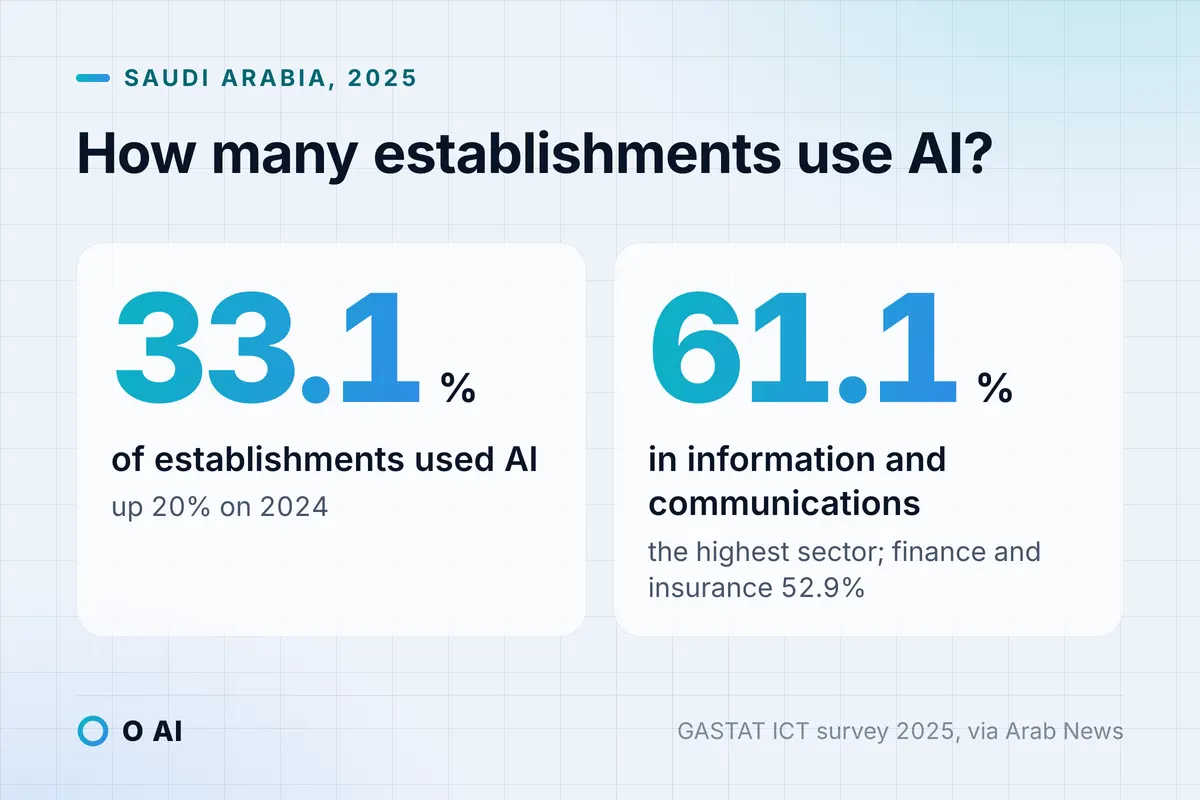
The General Authority for Statistics (GASTAT) found that 33.1% of establishments used AI technologies in 2025, up 20% on 2024, according to its Establishments ICT Access and Usage Survey as reported by Arab News [6]. Use was highest in information and communications (61.1%), financial and insurance activities (52.9%) and education (51%), followed by transportation and storage (44.4%) and professional activities (43.9%) [6].
National projects show the Kingdom building its own capability as well as buying it:
- ALLaM: a series of Arabic and English language models developed by the National Center for Artificial Intelligence at SDAIA; one 7-billion-parameter version is published openly [7].
- HUMAIN Chat: an Arabic chat app launched on 25 August 2025 by HUMAIN, a company owned by the Public Investment Fund. It runs on the ALLaM 34B model, supports several Arabic dialects and, according to Saudipedia, is hosted on HUMAIN's infrastructure inside the Kingdom [8].
Illustrative examples. The uses below are hypothetical; they show how the same techniques appear in ordinary Saudi businesses.
| Sector | Task AI helps with | What a person still decides |
|---|---|---|
| Retail and e-commerce | Recommends products and flags orders that look fraudulent | Whether to cancel an order or refund a customer |
| Logistics | Predicts delivery delays and suggests routes | Which customers to call and what to promise them |
| Healthcare | Sorts appointment requests and drafts reminders | Every medical judgement |
| Manufacturing | Detects when a pump or motor is likely to fail | When to stop the line for maintenance |
| Finance and accounting | Reads invoices and matches them to orders | Approving payments and posting to the ledger |
| Professional services | Summarises long contracts and tenders | The advice given to the client |
In each case, AI handles the repetitive reading, sorting or forecasting, and a person keeps the decision that carries consequences.

Why artificial intelligence matters
For the Kingdom. The National Strategy for Data and AI sets targets that include ranking among the top 15 countries in AI, building a workforce of more than 20,000 data and AI specialists and attracting about SAR 75 billion of investment in data and AI, in phases that run to 2030 [9]. SDAIA reports that 66 of the 96 objectives of Vision 2030 relate directly or indirectly to data and AI [10].
For companies. Stanford's 2026 AI Index reports that organisational adoption of AI reached 88% [11]. SDAIA's framework lists what entities gain: automating routine administrative work, shorter processing times, better use of resources by predicting risks and needs, and decisions supported by data from several sources [2]. For a small business, the practical gain is usually hours returned to staff on reading, typing and sorting.
For people. The same AI Index reports that 4 in 5 university students now use generative AI [11]. Knowing what these tools can and cannot do is becoming a basic work skill, like using a spreadsheet.
What AI cannot do, and the rules that apply in Saudi Arabia
AI is powerful within limits, and the limits matter as much as the capabilities.
- It does not understand like a person. All available AI is narrow AI [5]; it finds patterns, and a system that is excellent at one task can fail badly at a neighbouring one.
- It can be confidently wrong. SDAIA warns that generative models may produce "facts" that are complete fiction, and that users are responsible for verifying generated content [12].
- It repeats the faults in its data. SDAIA's ethics principles ask that training data be checked for bias and be representative of the people affected [3].
SDAIA's AI Ethics Principles apply to all segments of society in the Kingdom, including public, private and non-profit entities [12]. They set seven principles: fairness; privacy and security; humanity; social and environmental benefits; reliability and safety; transparency and explainability; and accountability and responsibility [3]. They also sort AI systems by risk [3]:
- Little or no risk, such as spam filters: no restrictions, though ethical compliance is recommended.
- Limited risk: the ethics principles apply.
- High risk to basic rights: assessments before and after deployment, plus the relevant statutory requirements.
- Unacceptable risk, such as social profiling or exploiting children: not allowed.
Personal data used by AI also falls under the Personal Data Protection Law. This section is general information; for a specific case, check SDAIA's guidance or ask a licensed advisor. If you want to gauge how ready your company is, our guide to the SDAIA AI Adoption Framework translates it into steps for smaller firms.
Your next step
Write down three tasks in your company that involve a lot of reading, typing, sorting or forecasting, and note how many hours each takes per week. That list, not a vendor's demo, is where artificial intelligence earns its place. Our guide on how AI can help your business shows how to pick one task and test it in a short trial before you spend. You can also read about O AI, a software and AI company in Al Khobar, on our home page.
Frequently asked questions
What is artificial intelligence in simple words?
Artificial intelligence is software that learns from examples instead of following only rules a programmer wrote. Shown thousands of past invoices, photos or messages, it learns the patterns in them and then applies those patterns to new cases: it recognises a face, predicts next month's sales, sorts an email or drafts a reply. It does not think like a person; it is very good at specific tasks and needs people to check results that matter.
What are the main types of artificial intelligence?
There are two common classifications. By capability, AI is narrow, general or super; only narrow AI, which handles a specific task or set of tasks, exists today, while general and super AI remain theoretical. By technique, the branches include machine learning, deep learning, natural language processing, computer vision, speech processing, robotics and generative AI. Most business products combine several branches, for example language processing to read a message and generative AI to draft the reply.
What is the difference between AI, machine learning and deep learning?
Artificial intelligence is the broad field of systems that perform tasks needing human-like intelligence. Machine learning is the part of AI that learns patterns from data instead of following hand-written rules. Deep learning is the part of machine learning that uses many-layered neural networks, which handle complex data such as images, speech and text. Today's generative AI models, such as those behind chat assistants, are built with deep learning.
What are examples of artificial intelligence in Saudi Arabia?
GASTAT reports that about a third of Saudi establishments used AI in 2025, led by information and communications, finance and insurance, and education. National examples include ALLaM, the Arabic and English language models developed at SDAIA's National Center for AI, and HUMAIN Chat, an Arabic chat app built on ALLaM. In everyday business, AI sorts customer messages, reads invoices, forecasts demand, detects fraud and inspects products on production lines.
Why is artificial intelligence important?
For Saudi Arabia, AI is a pillar of the National Strategy for Data and AI, and SDAIA links most Vision 2030 objectives to data and AI. For companies, it cuts the time spent on repetitive reading, sorting and forecasting, shortens processing times and supports decisions with data. For individuals, knowing how to use AI tools well, and how to check them, is becoming a basic workplace skill across most professions.
Who regulates artificial intelligence in Saudi Arabia?
The Saudi Data and AI Authority (SDAIA) leads national work on data and AI. It has issued AI Ethics Principles that apply to public, private and non-profit entities, guidelines for generative AI, and an AI Adoption Framework. Personal data processed by AI systems is governed by the Personal Data Protection Law, which SDAIA oversees. Sector regulators may add their own rules, so check the authority for your sector or a licensed advisor for a specific case.
How can a small business start using AI?
Start with one repetitive, text-heavy task rather than a big project: answering common customer questions, summarising documents or reading invoices. Use a business account on a tool your company is allowed to use, keep personal data out until you have checked the terms, and have a person review every output during a short trial. Measure the time saved and the errors caught before paying for more seats or a custom system.
How this article was made: Researched from the sources listed below, opened on 14 October 2026. Drafted with AI assistance, then checked against those sources. General information, not professional advice. Images are AI-generated illustrations.
Sources
- OECD AI Principles: definition of an AI system (revised May 2024) (opens in a new tab)OECD.AI Policy Observatory · oecd.ai
- Artificial Intelligence Adoption Framework (2025) (opens in a new tab)Saudi Data and AI Authority (SDAIA) · sdaia.gov.sa
- AI Ethics Principles (2025 edition) (opens in a new tab)Saudi Data and AI Authority (SDAIA) · sdaia.gov.sa
- A Proposal for the Dartmouth Summer Research Project on Artificial Intelligence (1955) (opens in a new tab)McCarthy, Minsky, Rochester and Shannon, Stanford University archive · www-formal.stanford.edu
- Understanding the different types of artificial intelligence (opens in a new tab)IBM · ibm.com
- Saudi AI adoption among businesses rises to 33% in 2025: GASTAT (14 June 2026) (opens in a new tab)Arab News, reporting GASTAT · arabnews.com
- ALLaM-7B-Instruct-preview model card (opens in a new tab)National Center for AI at SDAIA, on Hugging Face · huggingface.co
- HUMAIN Chat application (opens in a new tab)Saudipedia · saudipedia.com
- National Strategy for Data and AI (opens in a new tab)Saudi Data and AI Authority (SDAIA) · sdaia.gov.sa
- Agentic AI: its technologies and national applications (July 2025, in Arabic) (opens in a new tab)Saudi Data and AI Authority (SDAIA) · sdaia.gov.sa
- The 2026 AI Index Report (opens in a new tab)Stanford Institute for Human-Centered AI · hai.stanford.edu
- Generative Artificial Intelligence Guidelines for Public (2025) (opens in a new tab)Saudi Data and AI Authority (SDAIA) · sdaia.gov.sa
About the author
Newsletter
New guides and news by email
New guides and news about O AI, Rushd and Dalni, at most twice a month. No spam.