 AI


NPHIES integration: a guide for Saudi providers and HIS vendors
A practical guide to NPHIES integration in Saudi Arabia: what the platform does and does not do, how providers register, how system vendors get accredited, the FHIR R4 and security rules, coding with ICD-10-AM and SBS, and a readiness checklist.

Key takeaways
- NPHIES validates and routes insurance transactions between providers and insurers; it does not adjudicate claims or back up data.
- A facility registers with its 14-digit unified number from Seha, the NPHIES registration form, NPHIES Academy training and the Unified Portal.
- System vendors need a Saudi headquarters, a Saudi commercial registration and HL7 FHIR skills, then Academy training and system testing.
- NPHIES messages use HL7 FHIR R4 over mutually authenticated HTTPS with X.509 certificates; sessions last at most 60 seconds.
- Claims follow ICD-10-AM diagnoses and Saudi Billing System codes; the NPHIES roadmap lists SBS version 3 in production.
On this page
- What is NPHIES?
- Which transactions go through NPHIES?
- How does a healthcare provider register on NPHIES?
- How does a system vendor get accredited by NPHIES?
- Three ways to connect: which fits your facility?
- What does NPHIES integration require technically?
- A readiness checklist before you start
- What is on the NPHIES roadmap?
- Common mistakes in NPHIES projects
- Your next step
This guide is by O AI, a Saudi software and AI company that builds systems, apps and AI for companies. See what we build
NPHIES integration means connecting a clinic's or hospital's system to NPHIES, the Saudi national platform that carries insurance transactions between providers and insurers. The platform uses HL7 FHIR R4 messages over mutually authenticated HTTPS. A facility registers through Seha and the NPHIES Academy, and its system vendor goes through NPHIES's own vendor accreditation.
What is NPHIES?
NPHIES is the national digital gateway that organises the exchange of health and insurance transactions in Saudi Arabia. It was implemented under the leadership of the Council of Health Insurance, with the National Health Information Center, under the supervision and support of the Ministry of Health [1]. It sits within the Health Sector Transformation Program of Vision 2030 [1].
Its users fall into three groups: healthcare providers, health insurance companies and claims management companies (TPAs) [1][2]. Each connects to the hub, not to each other. The implementation guide puts it plainly: there will no longer be peer-to-peer exchanges [3].
The scale is large. As of October 2026, the NPHIES home page reports more than 382 million claim transactions, more than SAR 184 billion in total claims value and more than 676 million eligibility checks [2].
What NPHIES does, and what it does not do
The NPHIES implementation guide describes the platform as a "smart courier" [3]. That distinction shapes every integration project.
- It does: validate each message against format and coding standards, reject invalid submissions, deliver valid ones in real time or hold them until the recipient is available, and keep copies for disputes and oversight [3].
- It does not: process or adjudicate claims, determine fraud (it flags questionable transactions for the payer to consider) or back up your data [3]. Insurers still decide; providers still design and manage their own records and infrastructure [3].
For a provider this means one thing in practice: your hospital or clinic system remains the source of truth. NPHIES is the channel, not the archive.
Which transactions go through NPHIES?
The NPHIES home page names two headline services: eligibility checks and prior-authorisation management [2]. The registration page adds claims management [4]. The technical guide lists the full message suite, and each one is a separate piece of work for your system [7]:
| Use case | What your system sends or receives |
|---|---|
| Eligibility check | Is this patient covered, and for which services at this facility? |
| Prior authorisation and advanced authorisation | A request for approval before treatment, and the insurer's answer |
| Claim submission and batch claims | The claim for services delivered, singly or in batches |
| Payment reconciliation and payment notification | How the insurer's payments map to your claims |
| Information request and submission | Extra documents an insurer asks for, and your reply |
| Cancellation, error notice, status check, polling | Housekeeping: cancel, report errors, check status, collect queued replies |
A useful planning rule follows from this table. "NPHIES integration" is not one feature. It is about a dozen message flows, and a system can support some of them before others.
How does a healthcare provider register on NPHIES?
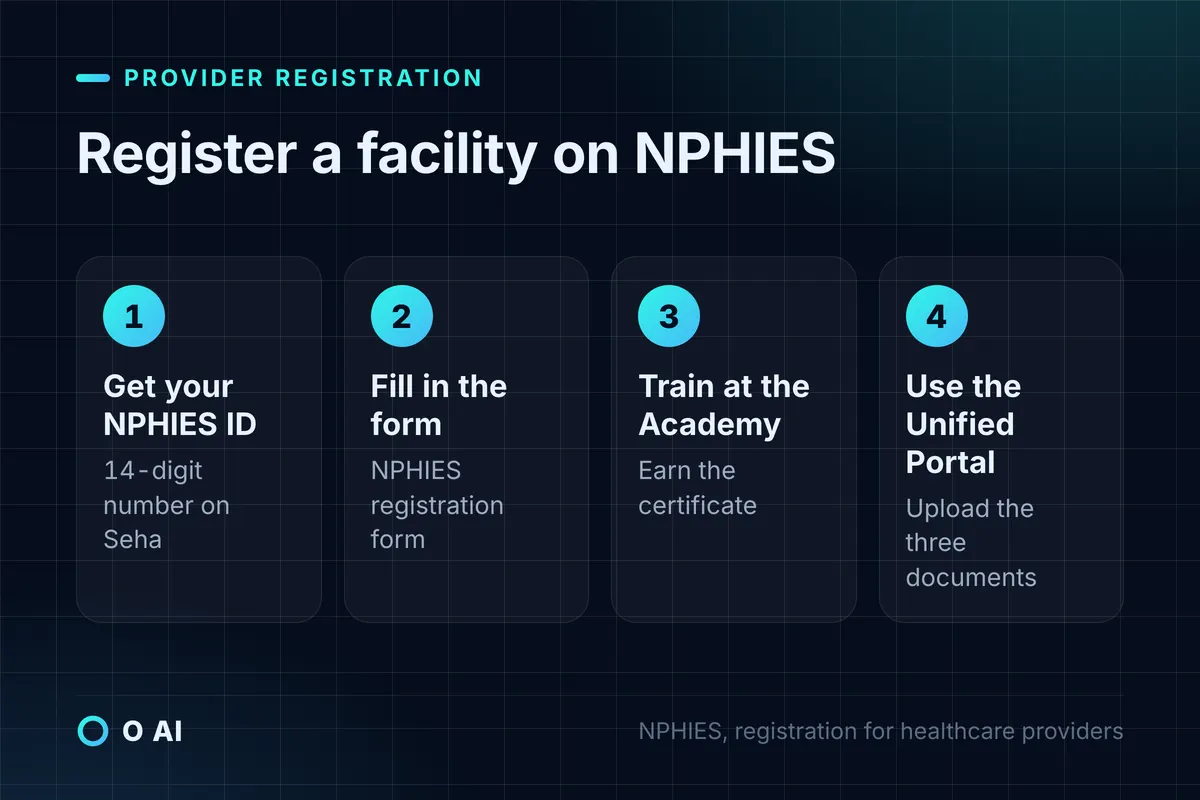
A healthcare facility registers in four steps, as published on the NPHIES providers page (read on 29 October 2026) [5]:
- Get your NPHIES ID from Seha. On the Seha platform, your facility's NPHIES ID is called the unified number and has 14 digits [5].
- Complete the NPHIES registration form linked from the same page [5].
- Complete qualification and training at the NPHIES Academy, which issues an NPHIES Academy certificate [5].
- Register on the Unified Portal and upload the documents: an authorisation form stamped by the Chamber of Commerce, the authorised person's ID and the Academy certificate [5].
The page does not say whether a facility must already have an accredited system to register [5]. Registration and technical connection are separate tracks, so plan both. For questions, NPHIES lists support@nphies.sa and 920033808 [5].
How does a system vendor get accredited by NPHIES?
A software company that wants its hospital or clinic system to talk to NPHIES directly follows a separate path for health tech providers [6]. The published prerequisites are three:
- the company's main headquarters is in Saudi Arabia;
- it holds a Saudi commercial registration number;
- it has working knowledge of HL7 FHIR [6].
The steps are then:
- Submit a joining request through the NPHIES registration form [6].
- Train at the NPHIES Academy: register for the vendor course, answer the readiness survey, complete the course, review the required documents, and complete the two forms (one to sign, one to fill in) [6].
- Confirm readiness: raise technical questions, confirm readiness for testing and start the system-testing phase [6].
NPHIES links to a list of accredited system vendors from this page [6]. Before you sign with any vendor, check that list yourself rather than relying on a sales claim.
Three ways to connect: which fits your facility?
A provider can reach NPHIES in three ways. The first two are common; the third is a fallback that the implementation guide describes [3].
| Path | How it works | Fits when | Watch for |
|---|---|---|---|
| Your system's vendor is accredited | Your hospital information system sends FHIR messages to NPHIES itself | You run a full HIS or clinic system and want claims inside it | Confirm the vendor is on the NPHIES list and which use cases it has passed |
| An accredited intermediary | Your system sends data to an accredited solution that handles the NPHIES messages | Your current or custom system is not accredited yet | Data mapping between the two systems; who fixes rejected claims |
| NPHIES basic claims entry | Staff enter claims in the basic tool NPHIES offers providers without their own system | Very small practices with low volume | Manual entry, no link to your records or billing [3] |
For a custom-built system, the realistic choice is usually the second path at launch, then direct accreditation once volumes justify it. Our guide to custom software or a ready-made system covers that wider decision.
What does NPHIES integration require technically?
NPHIES integration requires a system that can build, send and read HL7 FHIR R4 (version 4.0.1) messages that conform to the NPHIES profiles [7][9]. FHIR is the HL7 standard that assembles health data from modular building blocks called resources [12]. The NPHIES guide is published as "Healthcare Financial Services IG Edition 1", version 1.0.0, a standard for trial use; the copy we read was a draft dated 3 December 2025 [7].
Transport and security
- Mutual TLS. All message exchanges use mutually authenticated HTTPS to the NPHIES endpoint [8].
- Certificates. Each participant obtains X.509 certificates from NPHIES and renews them when they expire. If certificate validation fails, the session closes [8].
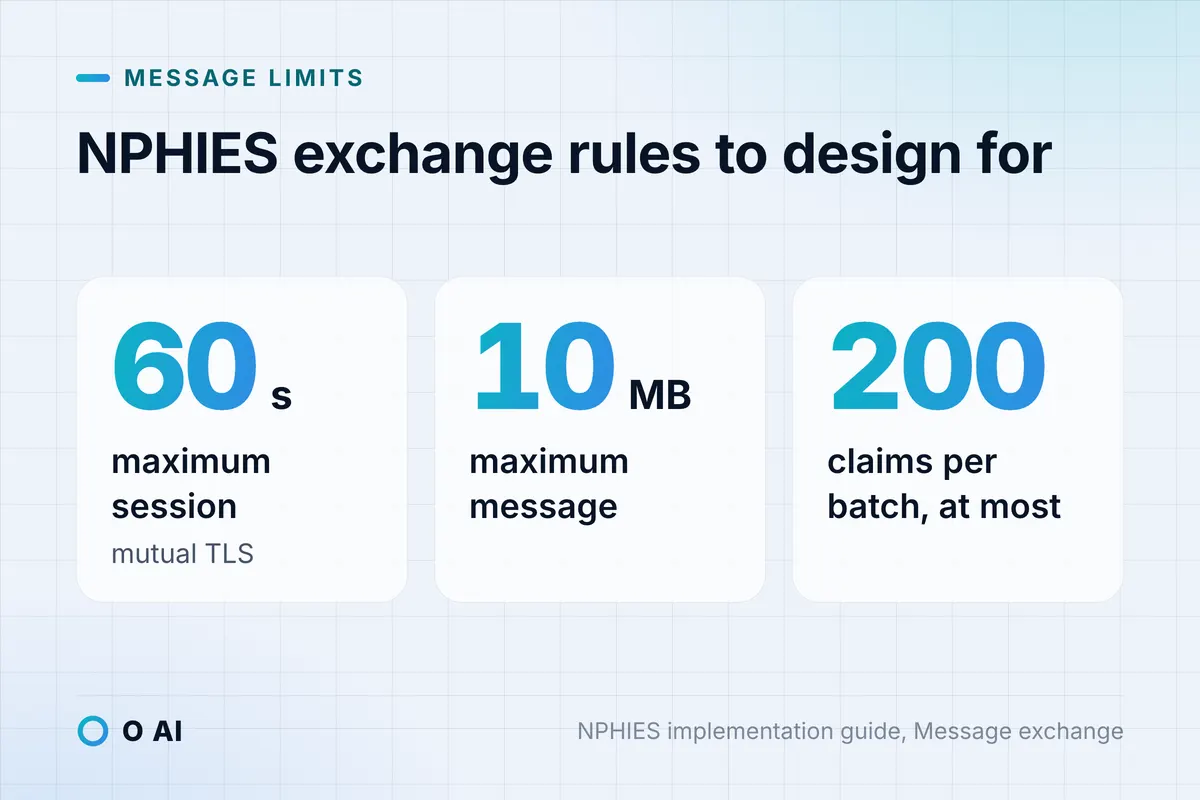
- Session limits. A communication session lasts at most 60 seconds [8].
- Polling. Queued responses are collected by polling, with at most 100 messages per poll [8]. Providers are advised to check daily, or on demand for urgent prior authorisations [8].
- Size. A message may be up to 10 MB, and a claim batch up to 200 claims [8].
- Storage. Real-time-only messages such as polling, eligibility and status checks are not stored for later delivery when the recipient is offline; the sender receives an error instead [8].
Data and coding
The conformance rules say every sender must be able to populate all elements marked "Must Support" in the NPHIES profiles, and should avoid elements and extensions the profiles do not name [9]. The profiles are specific, for example professional, institutional and pharmacy claims [9].
Codes matter as much as structure. The guide names code systems including ICD-10-AM-based diagnoses, Saudi Billing System codes built on ACHI, SFDA medication codes, LOINC and SNOMED CT [9]. Implementers must obtain terminology licences from each code system's owner [9].
The Saudi Billing System (SBS) was developed by the Council of Health Insurance from the Australian ACHI 10th Edition and has 7,947 codes, about 30% more than ACHI [10]. A 2025 study describes it as mandated as the billing standard on NPHIES, and notes that claims follow ICD-10-AM/ACHI/ACS 10th Edition [10]. The NPHIES roadmap lists Saudi Billing System version 3 as in production [2]. Seha also lists a service through which a facility requests the Australian medical coding certificate (10th edition) from the Saudi Health Council [11].
A readiness checklist before you start
Use this checklist in your first meeting with a vendor or your own IT team. Every line comes from the requirements above.
| Area | Question to answer | Source |
|---|---|---|
| Facility registration | Do we have the 14-digit unified number from Seha? | [5] |
| Training | Has our responsible person completed the NPHIES Academy and obtained the certificate? | [5] |
| Documents | Is the authorisation form stamped by the Chamber of Commerce ready? | [5] |
| Connection path | Accredited vendor, accredited intermediary or basic claims entry? | [3][6] |
| Vendor check | Is the vendor on the NPHIES accredited list, for the use cases we need? | [6] |
| Message scope | Which use cases at launch: eligibility, prior authorisation, claims, payment reconciliation? | [7] |
| Coding | Do our records use ICD-10-AM diagnoses and SBS procedure codes, and do we hold the licences? | [9][10] |
| Security | Who manages the X.509 certificates and their renewal dates? | [8] |
| Operations | Who polls for queued replies each day, and who fixes rejected claims? | [8] |
| Records | Where are our own copies kept, given NPHIES is not a backup? | [3] |
Two items are often missed. Certificates expire, so put the renewal date in a shared calendar. And NPHIES rejects invalid messages at the gate [3], so a team has to own rejections from day one.
Patient data in these messages is health data, which Saudi Arabia's Personal Data Protection Law lists as sensitive data [13]. Our guide to personal data transfers out of the Kingdom explains the hosting questions to raise.
What is on the NPHIES roadmap?
The NPHIES home page publishes a roadmap; the version we read was last updated on 25 December 2025 and lists items by quarter without a year [2]. Items relevant to system builders include:
- In production: Saudi Billing System version 3 [2].
- In the OBA test environment: an enhanced NPHIES Academy platform, and phase 2 of National Insurance Center settlements [2].
- In development: diagnosis-related groups, the link with the national prescription, prescription queries, a benefits schedule and improvements to Unified Portal registration [2].
- Not started: a drug dictionary, and claim settlement and verification [2].
Build for change. A system that hard-codes today's message versions will need rework as these items reach production.
Common mistakes in NPHIES projects
- Treating NPHIES as storage. It keeps copies for disputes, but it does not back up your data [3].
- Promising "NPHIES integration" without naming use cases. Agree in writing which messages are in scope.
- Ignoring coding. A well-formed FHIR message with the wrong code system is still rejected [3][9].
- Taking a vendor's word for accreditation. Check the NPHIES list [6].
- Leaving certificates to one person. If they expire, the session fails [8].
This guide is general information, not legal or professional advice. For your facility's case, check with NPHIES support and the Council of Health Insurance.
Your next step
List the use cases your facility needs at launch, then use the checklist above to test each NPHIES integration option against them. If you are planning a hospital or clinic system with these links built in from the start, our page on custom software development explains how O AI scopes such a build. O AI is not an accredited NPHIES vendor.
Frequently asked questions
What is the NPHIES platform used for?
NPHIES is the Saudi national platform for exchanging health insurance transactions. Providers use it to check a patient's eligibility, request prior authorisation, submit claims and receive payment reconciliation from insurers and claims management companies. It validates and routes each message but does not decide claims; the insurer still makes the coverage and payment decision.
Who runs NPHIES?
NPHIES was implemented under the leadership of the Council of Health Insurance, in cooperation with the National Health Information Center, under the supervision and support of the Ministry of Health. It forms part of the Health Sector Transformation Program under Saudi Vision 2030. Support is available at support@nphies.sa and on 920033808.
What is the NPHIES ID and where do I find it?
The NPHIES ID is your facility's identifier on the platform. The NPHIES providers page says it is shown on the Seha platform as the unified number, and it has 14 digits. You need it as the first step of registering your facility before completing the registration form and the NPHIES Academy training.
Does a clinic need its own system to use NPHIES?
Not necessarily. The NPHIES implementation guide says the platform offers a basic claims entry tool for providers that do not have their own system. It suits very small practices, but staff must enter claims by hand and nothing links back to records or billing. Most facilities connect through an accredited system or an accredited intermediary.
What technical standard does NPHIES use?
NPHIES uses HL7 FHIR R4, version 4.0.1, with Saudi profiles published in the NPHIES implementation guide. Messages travel over mutually authenticated HTTPS using X.509 certificates issued by NPHIES. Sessions last at most 60 seconds, messages can be up to 10 MB, and a claim batch can hold up to 200 claims.
How long does NPHIES vendor accreditation take?
NPHIES does not publish a duration. Its health tech providers page lists the steps: a joining request, the vendor course and readiness survey at the NPHIES Academy, two forms, technical questions, and then system testing. The time depends on how many use cases your system covers and how quickly it passes testing, so ask NPHIES support for current timelines.
How this article was made: Researched from the official sources listed below, opened on 29 October 2026. Drafted with AI assistance, then checked against those sources. General information, not legal or professional advice. Illustrations were made for this article.
Sources
- About NPHIES (opens in a new tab)NPHIES · nphies.sa
- Home: services, figures and roadmap (opens in a new tab)NPHIES · nphies.sa
- Healthcare Financial Services IG: Introduction (opens in a new tab)NPHIES · portal.nphies.sa
- Registration (opens in a new tab)NPHIES · nphies.sa
- Registration for healthcare providers (opens in a new tab)NPHIES · nphies.sa
- Registration for health tech providers (system vendors) (opens in a new tab)NPHIES · nphies.sa
- Healthcare Financial Services IG Edition 1 (opens in a new tab)NPHIES · portal.nphies.sa
- Healthcare Financial Services IG: Message exchange (opens in a new tab)NPHIES · portal.nphies.sa
- Healthcare Financial Services IG: Conformance (opens in a new tab)NPHIES · portal.nphies.sa
- The development of the Saudi Billing System supporting national health transformation: methods and justification (opens in a new tab)BMC Health Services Research · pmc.ncbi.nlm.nih.gov
- Seha health services platform (opens in a new tab)Seha · seha.sa
- FHIR R4 (4.0.1) summary (opens in a new tab)HL7 · hl7.org
- Personal Data Protection Law (Royal Decree M/19 of 9/2/1443H, as amended) (opens in a new tab)Bureau of Experts at the Council of Ministers · laws.boe.gov.sa
About the author
Newsletter
New guides and news by email
New guides and news about O AI, Rushd and Dalni, at most twice a month. No spam.