 AI


Planning an e-learning platform in Saudi Arabia: parts, cost and licence
A practical guide to planning an e-learning platform in Saudi Arabia: course platform or LMS, when the National eLearning Center requires a licence, Moodle, hosted or custom, the parts every platform needs, what drives the cost, and PDPL and e-invoicing duties.


Key takeaways
- NELC's Executive Rules require entities that deliver e-learning in the Kingdom and grant a completion certificate to obtain a licence before starting.
- NELC decides a licence application within no more than 5 working days, and licensed e-learning certificates are equivalent to in-person ones.
- An individual trainer may offer paid e-learning only through a licensed entity, which shares responsibility for it.
- Moodle is open source under the GNU GPL with no licensing fees, but hosting, setup and support still cost money.
- For learners under the age of capacity, a legal guardian consents to processing and the platform must verify the guardianship.
On this page
- What is e-learning, and what is an educational platform?
- Types of educational platforms and who they suit
- Does an e-learning platform need an NELC licence?
- The e-learning system: parts every platform needs
- Ready-made, Moodle or custom?
- Educational platform cost: what drives the price
- Protecting learner data and handling payments
- Steps to launch an e-learning platform
- Common mistakes when building an e-learning platform
- Your next step
This guide is by O AI, a Saudi software and AI company that builds systems, apps and AI for companies. See what we build
An e-learning platform is the website or app where learners register, take courses, sit assessments and receive certificates. In Saudi Arabia, building one means choosing between ready-made software, open source such as Moodle or a custom build, planning the cost drivers, and checking whether the National eLearning Center (NELC) requires a licence before you start.
This guide is for training centres, academies, schools, Quran memorisation circles and companies that want their own platform. It explains what e-learning means in Saudi rules, the types of educational platform, the NELC licence and standards, the parts a platform needs, what drives the cost and how to protect learner data. It is current as of October 2026 and is general information, not legal advice: check the official texts or a licensed adviser for your case.
What is e-learning, and what is an educational platform?
NELC's Executive Rules treat e-training as part of e-learning, and regulate three modes: technology-enhanced learning, blended learning and distance learning, with distance learning covering both live (synchronous) and self-paced (asynchronous) delivery [2]. In plain terms, e-learning is any education or training delivered wholly or partly through digital channels.
An educational platform is the software that delivers it. A course platform sells or offers courses to the public. A learning management system (LMS) runs courses, enrolment, assessment and reporting inside an institution. Many platforms combine both: a public catalogue in front, an LMS behind.
Types of educational platforms and who they suit
| Type | What it does | Suits | Typical starting point |
|---|---|---|---|
| Course platform | Public catalogue, payment, video lessons, certificates | Trainers, academies, training centres selling courses | Hosted course software or a custom build |
| Learning management system (LMS) | Enrolment, classes, assignments, grades, reports | Schools, universities, corporate training | Moodle or a commercial LMS |
| School or academy system | LMS plus attendance, timetables and parent communication | Private schools, kindergartens, Quran circles | Custom build or school software |
| Corporate training portal | Mandatory courses, completion tracking, internal certificates | Companies training their own staff | LMS with single sign-on |
| Mobile learning app | Lessons and quizzes on the phone, notifications | Short courses, language and Quran learning | Companion app to one of the above |
Decide which row you are before you talk to any vendor. A school that needs parent messages and timetables will not be served by a course-selling tool, and a trainer selling three courses does not need a full LMS.
Does an e-learning platform need an NELC licence?
The E-Learning Regulation was adopted by NELC's Board of Directors by decision (46/17/6) dated 11/5/1446H, on the basis of NELC's organisational framework issued by Council of Ministers decision (35) dated 13/1/1439H [1]. It applies to government, private and non-profit entities, local and international, that carry out e-learning and training in the Kingdom (Article 3), and Article 5 requires entities offering e-learning courses or programmes to obtain the licences set out in the Executive Rules [1].
The Executive Rules, approved by the same board decision, set the detail [2]:
- Who needs a licence (Article 7): entities that deliver education or training by e-learning inside the Kingdom and grant a completion certificate must obtain a licence before starting the activity.
- Licence types (Article 8): a licence for a blended programme or course, or for a distance programme or course, each for education or for training.
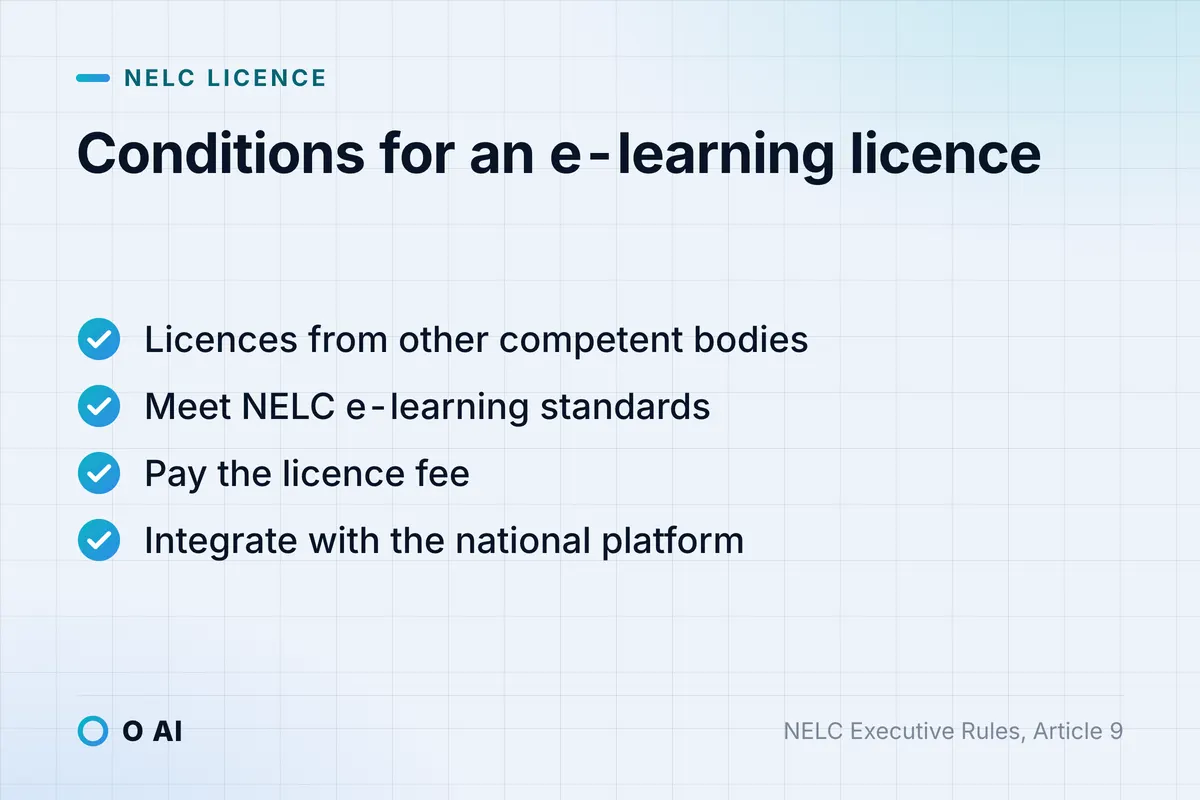
- Conditions (Article 9): the licences required by other competent Saudi authorities, meeting NELC's e-learning standards through the national platform, paying the fee, and technical integration and data sharing with the national platform.
- Decision time (Article 10): NELC decides within no more than 5 working days, with reasons if it refuses.
- Individual trainers (Article 14): an individual may offer paid e-learning only through a licensed entity, which shares responsibility.
- Platform providers (Articles 18 and 19): companies that provide platforms, assessment or content development are accredited by NELC rather than licensed, and accreditation requires an officially licensed Saudi entity.
Article 6 adds that certificates of licensed e-learning programmes are equivalent to in-person certificates, may not be distinguished from them, and may not state the mode of learning [2]. The pages we read do not state the fee amount or the licence duration, so confirm both with NELC. As of October 2026, NELC's home page reports more than 3,530 licensed programmes [5].
NELC e-learning standards
NELC's E-Learning Standards set 8 dimensions with 41 standards: leadership, curriculum design and planning, digital teaching and learning, assessment, technology, learner and guardian support, teacher support, and evaluation and continuous improvement [3]. The leadership dimension includes AI governance [3]. Read the technology and assessment standards before you write a requirements document, because a licence depends on meeting them [2].
Learning management system licences in education
Separately, NELC's National Licences Policy covers educational and training entities that use LMS platforms and the providers that operate them in the Kingdom. It requires the provider to obtain the necessary licences from NELC before offering or operating an LMS, asks entities to coordinate with NELC before developing or buying one, and gives priority to cloud hosting over internal hosting [4].
The e-learning system: parts every platform needs
Most platforms share the same core, whatever the type:
- Accounts and roles: learner, trainer, administrator and, for schools, guardian; sign-in by email, phone or single sign-on.
- Catalogue and enrolment: course pages, prerequisites, cohorts and waiting lists.
- Content delivery: video with protected streaming, documents, live sessions and self-paced units.
- Assessment: quizzes, assignments, question banks and integrity controls.
- Certificates: generated automatically on completion, with a verification link.
- Payments and invoices: card and local payment methods, discount codes and tax invoices.
- Reports: progress, completion, attendance in live sessions and revenue.
- Arabic first: right-to-left layouts, Arabic search and Western or Arabic digits as you choose.
- Accessibility: WCAG 2.2, a W3C Recommendation of 12 December 2024, defines levels A, AA and AAA; level AA is a common target [7].
- Integration: data sharing with NELC's national platform where a licence requires it [2].
Ready-made, Moodle or custom?
Moodle is an open-source LMS distributed under the GNU General Public License; its documentation says it is free with no licensing fees and can be adapted for commercial projects, while hosting, MoodleCloud and partner services cost money [6]. Commercial course software is faster to start, and a custom build gives full control.
| Question | Hosted course software | Moodle | Custom build |
|---|---|---|---|
| Time to launch | Shortest | Medium (setup, theme, plugins) | Longest |
| Fit for Arabic and your workflow | Limited to the vendor's options | Good, with configuration | Built to your process |
| Running costs | Subscription, often per learner or per sale | Hosting, updates and support | Hosting, maintenance and a team |
| Who owns the code and data | The vendor hosts both | You host it; the code is open source | You, if the contract says so |
| Best for | Testing a course idea | Schools and training centres with standard needs | Academies with unique models, scale or integrations |
A common path is to start on hosted software or Moodle, prove demand, then build custom parts where the ready-made tool limits you. For the trade-offs, see our guide to custom software or a ready-made program.
Educational platform cost: what drives the price
There is no single price for building an educational platform, and figures quoted without a scope are not comparable. The cost depends on these drivers:
| Driver | Lower cost | Higher cost |
|---|---|---|
| Starting point | Hosted software or Moodle with a theme | Custom build from scratch |
| Content | Recorded video and PDF | Live classes, interactive units, question banks |
| Users | One trainer, one language | Many institutions, roles and languages |
| Apps | Responsive web only | Native iPhone and Android apps |
| Integrations | Payment only | Payment, e-invoicing, single sign-on, NELC data sharing |
| Compliance work | Few personal data items | Minors' data, sensitive data, impact assessments |
| Operation | Vendor hosting | Your own hosting, monitoring, support and updates |
Ask every vendor to price the same written scope, and to separate the build from the yearly running cost. Freelancers can be cheaper for a first version; our comparison of a freelance developer or a company covers ownership, support and risk.
Protecting learner data and handling payments
The Personal Data Protection Law (Royal Decree M/19 dated 9/2/1443H, amended by M/148 dated 5/9/1444H) applies to learner accounts, grades, recordings and payment data [8]. Its Implementing Regulations matter most for schools and children's courses:
- Learners under the age of capacity: the legal guardian may consent to processing on their behalf, and the controller must take appropriate steps to verify the guardianship (Article 13) [9].
- Records of processing: the controller keeps a record of processing activities for the processing period plus five years (Article 33) [9].
- Breaches: a breach that could harm learners is reported to the authority within 72 hours (Article 24) [9].
- Privacy policy: learners must be able to read it when their data is collected (Law, Article 12) [8].
If you sell courses and are registered for VAT, your platform's invoices fall under ZATCA e-invoicing: the generation phase has applied since 4 December 2021, and the integration phase has been rolled out in waves since 1 January 2023 [10]. Choose a payment and invoicing setup that issues compliant invoices from the start.
Steps to launch an e-learning platform
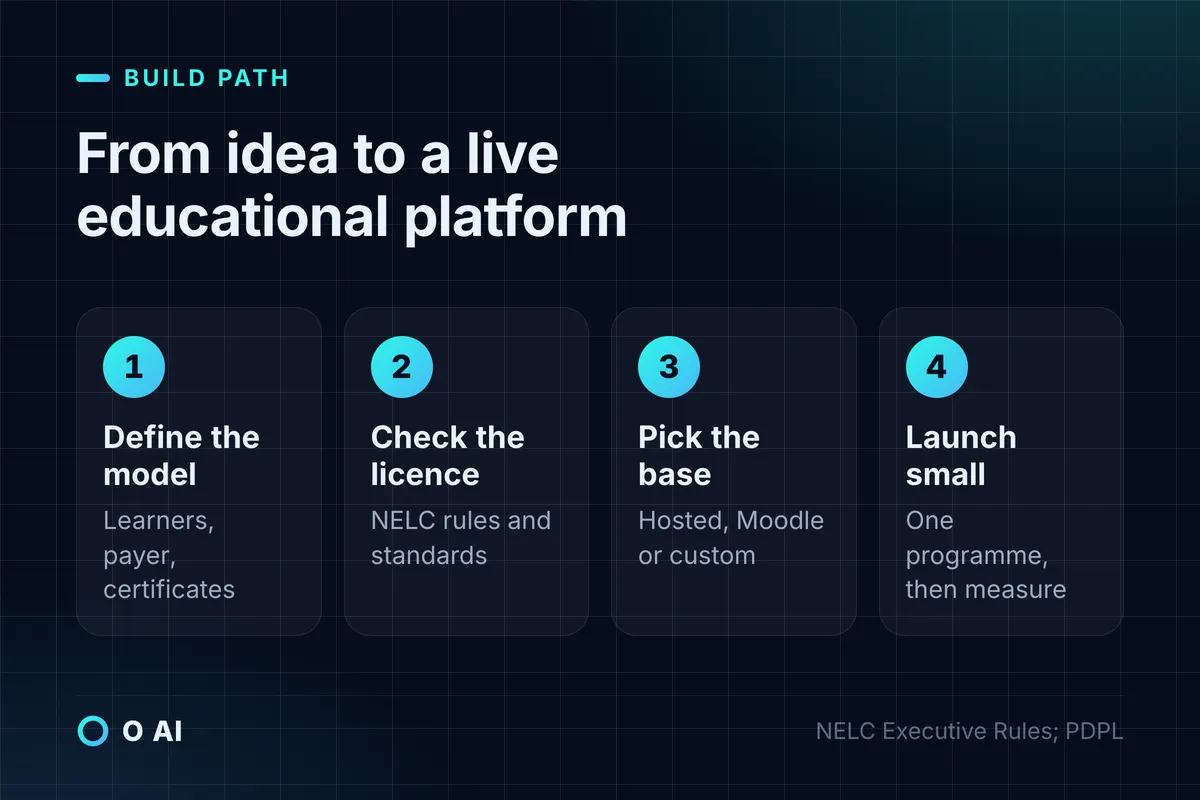
- Define the model. Who are the learners, who pays, do you grant certificates, and is it education or training?
- Check the licence. If you grant completion certificates in the Kingdom, plan the NELC licence and its standards from day one [2].
- Write the scope. List roles, course types, assessments, payments, reports and integrations, using the parts above.
- Choose the starting point. Hosted software, Moodle or custom, using the comparison table.
- Design for Arabic and mobile. Test right-to-left layouts and phone screens with real learners before building everything.
- Build privacy in. Map the personal data, write the privacy policy and plan guardian consent for minors [8][9].
- Launch small, then measure. Start with one programme, track completion and support requests, and improve.
Common mistakes when building an e-learning platform
- Buying features before choosing the model. A school system and a course shop are different products.
- Ignoring the licence until launch. Licensing conditions include meeting NELC standards and integrating with the national platform, which affect the build [2].
- No plan for video. Unprotected video links get shared; budget for secure streaming and storage.
- English-first templates. Arabic needs right-to-left layouts, Arabic fonts and search that handles Arabic spelling variants.
- Collecting children's data like adults' data. Guardian consent and verification are required [9].
- Separating payment from invoicing. VAT-registered sellers need compliant e-invoices [10].
Your next step
Write one page that answers four questions: who learns, who pays, whether you grant certificates, and which of the five platform types you are. Read NELC's licence conditions with that page in hand, then ask two or three vendors to price the same scope. If you need a platform built around your own model, O AI's page on custom software development explains how such a build is planned, and the O AI home page describes the company behind it.
Frequently asked questions
What is e-learning?
E-learning is education or training delivered wholly or partly through digital channels. Saudi Arabia's National eLearning Center regulates three modes: technology-enhanced, blended and distance learning, where distance learning can be live or self-paced. E-training falls under the same rules, so a training company that delivers courses online is also doing e-learning.
How much does it cost to build an educational platform?
There is no fixed price. Cost depends on the starting point (hosted software, Moodle or a custom build), the type of content, the number of roles and languages, whether you need native apps, the integrations such as payment and e-invoicing, and the yearly running cost. Ask several vendors to price the same written scope, and compare the build and the running cost separately.
Do I need a licence to run an e-learning platform in Saudi Arabia?
Under NELC's Executive Rules, government, private and non-profit entities that deliver education or training by e-learning in the Kingdom and grant a completion certificate must obtain a licence before starting. Conditions include licences from other competent authorities, meeting NELC's standards, paying the fee and integrating with the national platform. Check the current requirements with NELC.
What is the difference between a course platform and an LMS?
A course platform presents a public catalogue of courses, takes payment and delivers lessons and certificates to anyone who signs up. A learning management system runs learning inside an institution: enrolment, classes, assignments, grades and reports. Many projects combine the two, with a public course catalogue in front and an LMS behind it.
Is Moodle free to use?
Moodle is open-source software distributed under the GNU General Public License, and its documentation describes it as free with no licensing fees, including for commercial projects. You still pay for hosting, setup, themes, plugins, updates and support, or for the hosted MoodleCloud service and partner services.
Can an individual trainer sell online courses in Saudi Arabia?
Under NELC's Executive Rules, an individual may offer paid e-learning programmes or courses only through a licensed education or training entity, and that entity shares responsibility with the individual. A trainer who wants to sell certified courses therefore usually works with a licensed academy or training centre.
How this article was made: Researched from the official sources listed below, opened on 29 October 2026. Drafted with AI assistance, then checked against those sources. General information, not legal or professional advice. Illustrations were made for this article.
Sources
- E-Learning Regulation (opens in a new tab)National eLearning Center (NELC) · nelc.gov.sa
- Executive Rules of the E-Learning Regulation (opens in a new tab)National eLearning Center (NELC) · nelc.gov.sa
- E-Learning Standards (opens in a new tab)National eLearning Center (NELC) · nelc.gov.sa
- National Licences Policy (opens in a new tab)National eLearning Center (NELC) · nelc.gov.sa
- Home page (opens in a new tab)National eLearning Center (NELC) · nelc.gov.sa
- About Moodle (Moodle 4.5 documentation) (opens in a new tab)Moodle · docs.moodle.org
- Web Content Accessibility Guidelines (WCAG) 2.2 (opens in a new tab)World Wide Web Consortium (W3C) · w3.org
- Personal Data Protection Law (Royal Decree M/19 dated 9/2/1443H, amended by Royal Decree M/148 dated 5/9/1444H) (opens in a new tab)Bureau of Experts at the Council of Ministers · laws.boe.gov.sa
- Implementing Regulations of the Personal Data Protection Law (opens in a new tab)Saudi Data and AI Authority (SDAIA) · dgp.sdaia.gov.sa
- What is e-invoicing (opens in a new tab)Zakat, Tax and Customs Authority (ZATCA) · zatca.gov.sa
About the author
Newsletter
New guides and news by email
New guides and news about O AI, Rushd and Dalni, at most twice a month. No spam.