 AI


Electronic medical record in Saudi hospitals: requirements and cost
What an electronic medical record is, how it differs from an EHR and a hospital information system, and what a Saudi hospital system must plan for: NPHIES and FHIR, ICD-10-AM and SBS coding, Seha tasks, PDPL health data rules, e-invoicing, a requirements checklist and the drivers of cost.

Key takeaways
- An EMR is the clinical record of patients within one facility; a hospital information system adds reception, billing, insurance, pharmacy, lab and HR.
- NPHIES insurance messages use HL7 FHIR R4, and NPHIES does not back up data, so the hospital system stays the source of truth.
- Claims use ICD-10-AM-based diagnoses and Saudi Billing System codes; the SBS has 7,947 codes built on ACHI 10th Edition.
- The PDPL lists health data as sensitive, and Article 23 calls for access to medical files to be limited to the fewest staff needed.
- A hospital system's cost follows its modules, branches, NPHIES scope, coding, integrations, migration, hosting and support model.
On this page
- What is an electronic medical record?
- What does a hospital's electronic medical file contain?
- Saudi requirements a hospital system must plan for
- A requirements checklist for your hospital system
- What drives the cost of a hospital system?
- Ready-made system or a custom build?
- How a hospital system is built in phases
- Common mistakes with an electronic medical record project
- Your next step
This guide is by O AI, a Saudi software and AI company that builds systems, apps and AI for companies. See what we build
An electronic medical record (EMR) is the digital file of each patient's care inside a facility, and it is the core of any hospital or clinic system. In Saudi Arabia, the system around it must also send insurance messages to NPHIES, use the coding NPHIES expects and protect health data under the PDPL. Its cost follows scope, not a fixed price.
What is an electronic medical record?
An electronic medical record is the structured digital record of a patient's visits, diagnoses, orders, results, medicines and notes within one healthcare facility. Doctors, nurses, the lab and the pharmacy read and write the same record instead of passing paper files.
Three terms are often mixed up, and buyers should keep them apart:
| Term | What it covers | Typical owner |
|---|---|---|
| EMR (electronic medical record) | The clinical record of patients in one facility | The hospital or clinic |
| EHR (electronic health record) | A record shared across facilities over time | Several providers or a national exchange |
| HIS (hospital information system) | The whole system: EMR plus reception, billing, insurance, pharmacy, lab, HR and reports | The hospital |
When a hospital says it wants "a medical record system", it usually means an HIS with a strong EMR at its centre. The rest of this guide uses that wider meaning, because the cost and the Saudi requirements sit mostly outside the clinical record itself.
What does a hospital's electronic medical file contain?
A hospital's electronic medical file brings together data from every department. A practical module list for scoping:
- Registration and appointments: patient identity, insurance details, booking and queues.
- Clinical record: history, vital signs, diagnoses, doctor's orders, nursing notes and discharge summaries.
- Outpatients, inpatients and emergency: each with its own workflow and forms.
- Laboratory and radiology: orders, results and images. Medical images follow DICOM, the standard recognised as ISO 12052 and built into most X-ray, CT, MRI and ultrasound equipment [8].
- Pharmacy and medical stock: prescriptions, dispensing and inventory.
- Billing and insurance: eligibility, prior authorisation, claims and payment reconciliation.
- Administration: users and permissions, audit logs, HR and shifts, finance and dashboards.
Each module adds screens, rules, tests and training. That is the first reason two "hospital systems" can differ so much in effort.
Saudi requirements a hospital system must plan for
The Saudi requirements are what turn a generic medical record into a system a Saudi facility can run. Plan each one in the scoping phase, not after launch.
Insurance transactions through NPHIES
NPHIES is the national platform for health insurance transactions, implemented under the leadership of the Council of Health Insurance with the National Health Information Center, under the supervision of the Ministry of Health [1]. Providers and payers connect to the NPHIES hub rather than to each other [2].
For your system this means:
- Message standard: NPHIES exchanges use HL7 FHIR R4 [2][4]. FHIR is the HL7 standard that builds health data from modular "resources" [5].
- Must Support data: senders must be able to fill every element the NPHIES profiles mark "Must Support" [4].
- Your records stay yours: NPHIES does not adjudicate claims and does not back up your data, so the hospital system remains the source of truth [2].
- Facility registration: the facility registers with the 14-digit unified number from Seha, the NPHIES form, NPHIES Academy training and the Unified Portal [3].
Our separate guide on NPHIES covers the connection paths in detail. In short, a system either goes through NPHIES vendor accreditation or sends claims through an accredited solution.
Medical coding: ICD-10-AM and the Saudi Billing System
NPHIES lists code systems including ICD-10-AM-based diagnoses and Saudi Billing System codes built on ACHI, and implementers must obtain terminology licences from each code system's owner [4]. The Saudi Billing System was developed by the Council of Health Insurance from ACHI 10th Edition and has 7,947 codes [6]. Seha also lists a service through which a facility requests the Australian medical coding certificate (10th edition) from the Saudi Health Council [7].
The practical requirement: coding must be built into the clinical workflow, so that a diagnosis entered by a doctor already carries the code a claim will need.
Seha services: sick leave and electronic prescriptions
Seha, the health services platform approved by the Ministry of Health, lets health facilities register sick leave electronically, and lets private facilities and telemedicine apps register electronic prescriptions and link them with community pharmacies [7]. Decide early which of these tasks staff will do in the Seha portal and which, if any, your system should link to. Do not assume a link exists; confirm the path with the platform operator for your facility.
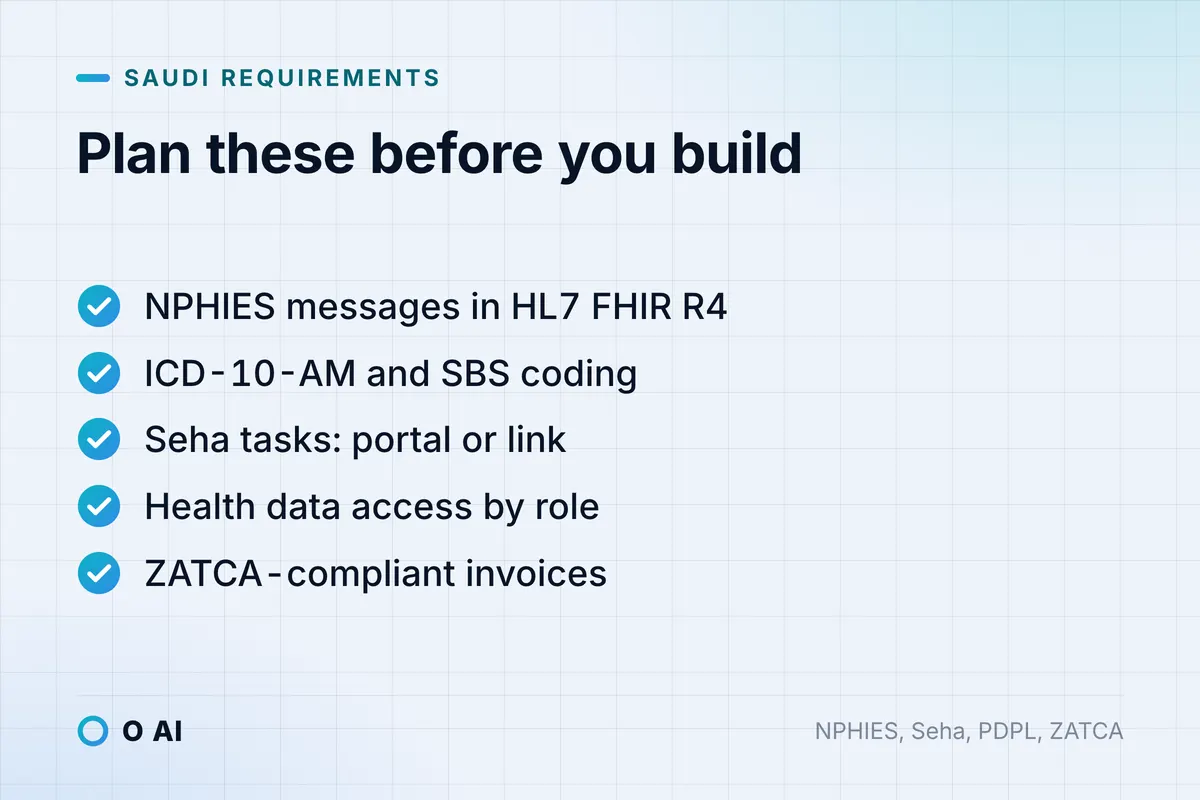
Health data under the Personal Data Protection Law
Saudi Arabia's Personal Data Protection Law (Royal Decree M/19 of 9/2/1443H, amended by Royal Decree M/148 of 5/9/1444H) defines health data as any personal data about a person's physical, mental or psychological health, or about the health services they receive [9]. Health data is listed among sensitive data [9].
Article 23 requires the regulations to limit access to health data, including medical files, to the fewest staff possible, and only as far as needed to provide health services [9]. For a system, that becomes role-based access, an audit log of who opened which file, and reports that let managers review access.
Article 29 restricts transfers of personal data outside the Kingdom to set cases and conditions [9]. So the hosting location of the system, its backups and any cloud service it calls are requirements, not technical details.
Cybersecurity and e-invoicing
- Cybersecurity: the National Cybersecurity Authority publishes the Essential Cybersecurity Controls, current version ECC 2-2024, for national entities [10]. Check whether your facility is in scope; even where it is not, the controls are a useful baseline. Our guide to the NCA Essential Cybersecurity Controls explains who must comply.
- E-invoicing: ZATCA's Phase 1 has applied since 4 December 2021, and Phase 2 (integration with the Fatoora platform) has rolled out in waves since 1 January 2023, with at least six months' notice to each taxpayer [11]. A hospital's billing module must issue compliant invoices; our ZATCA-compliant accounting software checklist lists what to check.
This section is general information, not legal advice; for your facility's case, read the official texts and ask a licensed lawyer.
A requirements checklist for your hospital system
Use this list as the skeleton of a requirements document. Every line ties back to a section above.
| Area | Requirement to write down |
|---|---|
| Scope | Facility type, branches, departments and the modules needed at launch |
| Users | Roles, number of users per role, and who may see which patient files |
| Clinical record | Forms per department, order sets, results, discharge summaries |
| Coding | ICD-10-AM diagnoses and SBS procedure codes inside the workflow, with licences |
| Insurance | Which NPHIES use cases at launch: eligibility, prior authorisation, claims, reconciliation |
| Seha tasks | Which tasks stay in the Seha portal and which need a link |
| Imaging and lab | DICOM viewer or PACS link; lab device interfaces |
| Privacy | Access by role, audit log, retention, hosting location and backups |
| Billing | ZATCA-compliant invoices for the facility's Phase 2 wave |
| Migration | Old paper files and data from any current system |
| Operations | Training, support hours, uptime target and who fixes rejected claims |
What drives the cost of a hospital system?
The cost of a hospital system is set by its scope, its integrations and how it is run after launch. No honest supplier can quote before these are known. These are the drivers that move the effort most:
| Cost driver | Why it raises effort |
|---|---|
| Number of modules | Each module adds screens, rules, tests and training |
| Branches and departments | Different workflows, permissions and reports per site |
| NPHIES scope and path | More use cases mean more FHIR profiles, testing and error handling |
| Coding depth | Mapping ICD-10-AM and SBS into forms and claims takes clinical input |
| Other integrations | Lab devices, PACS, accounting, HR and any Seha link |
| Data migration | Cleaning and moving old records, or digitising paper files |
| Hosting and security | In-Kingdom hosting, backups, audit logs and security testing |
| Languages and apps | Arabic and English interfaces, and a patient or doctor mobile app |
| Support model | Support hours, response times and who maintains the system |
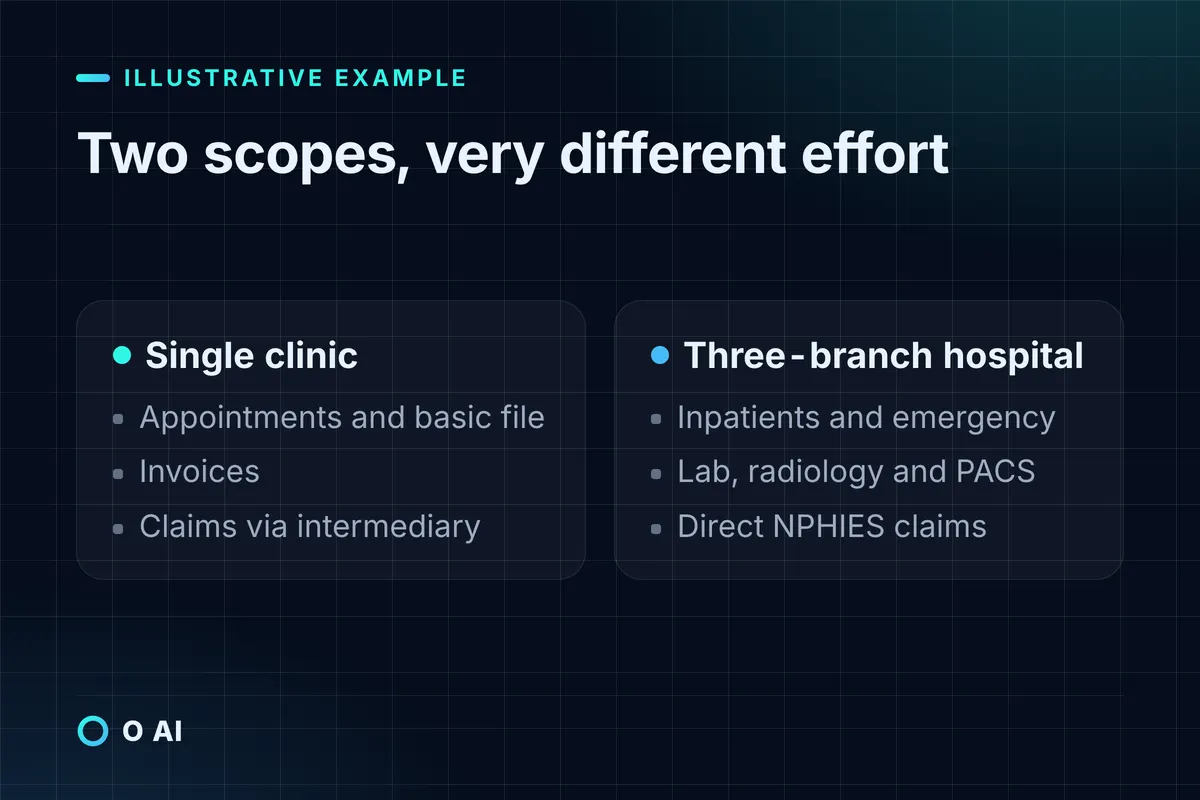
Illustrative example: two scopes, very different effort
A single dental clinic wants appointments, a basic electronic medical file, invoices and insurance claims through an accredited intermediary. A 120-bed hospital with three branches wants inpatients, emergency, lab and radiology with PACS, pharmacy, direct NPHIES claims, HR and dashboards. Both are "a medical record system", but the second has several times the modules, integrations, users and tests. The example is illustrative and does not describe a real project.
Ready-made system or a custom build?
A ready-made hospital or clinic product is often enough for a small facility with standard workflows, especially if its vendor already appears on the NPHIES accredited-vendor list. A custom build makes sense when you run several branches with their own workflows, need to link an existing ERP, want an Arabic-first patient app, or want to own the code. Our guide to custom software or a ready-made system sets out the trade-offs.
Either way, ask the same questions from the checklist above. A product demo does not answer where your data is hosted or which NPHIES use cases are live.
How a hospital system is built in phases
- Scoping and requirements: fill in the checklist with each department.
- Integration map: NPHIES path, Seha tasks, ZATCA, PACS and lab devices.
- Prototype one module: usually registration and appointments, tested with real staff.
- Phased build and testing: clinical record, billing and insurance, then the rest.
- Launch, training and support: department by department, with a named owner for rejected claims and access reviews.
Starting with one clinic or one department lowers risk and shows early whether the design fits how staff actually work.
Common mistakes with an electronic medical record project
- Buying screens, not workflows. Map how a patient moves through the facility before choosing a system.
- Leaving coding to billing staff. If diagnoses are not coded at entry, claims fail later [4].
- Treating NPHIES as a backup. It is not one; keep and protect your own records [2].
- Open access to files. The PDPL expects access to health data limited to those who need it [9].
- Ignoring migration. Old records and paper files take time and money to bring across.
Your next step
Turn the checklist above into a short requirements document for your facility, one page per department, and mark the NPHIES use cases and Seha tasks you need at launch. With that in hand, any supplier can estimate an electronic medical record system on the same basis. If you are weighing a custom system, our page on custom software development explains how O AI scopes and builds such systems.
Frequently asked questions
What is the difference between an EMR and an EHR?
An electronic medical record (EMR) is the clinical record of patients within one facility, used by its own doctors, nurses, lab and pharmacy. An electronic health record (EHR) is a record designed to follow the patient across facilities over time. A hospital system normally contains an EMR and may later exchange data with other providers or national platforms.
How much does a hospital system cost in Saudi Arabia?
There is no fixed price. The cost depends on the number of modules, branches and users, the NPHIES use cases and connection path, coding depth, other integrations such as PACS and lab devices, data migration, hosting and security, and the support model. Write a requirements document first so that every quote is based on the same scope.
Does a hospital system have to connect to NPHIES?
NPHIES is the national hub for health insurance transactions between providers and insurers, so a facility that treats insured patients needs a way to reach it. The system can go through NPHIES vendor accreditation or send claims through an accredited solution. Very small practices can also use the basic claims entry tool NPHIES offers.
Is patient data sensitive data under Saudi law?
Yes. The Personal Data Protection Law lists health data among sensitive data and defines it as personal data about a person's physical, mental or psychological health or the health services they receive. Article 23 calls for access to health data, including medical files, to be limited to the fewest staff needed to provide care.
Can we start with one clinic or one department?
Yes, and it is often the safer route. Start with a module such as registration and appointments in one clinic, test it with real staff, then add the clinical record, billing and insurance in phases. This shows early whether the design fits the facility's workflow and spreads the cost and training over time.
Which coding standards does a Saudi hospital system need?
Insurance claims through NPHIES use ICD-10-AM-based diagnosis codes and Saudi Billing System procedure codes, which the Council of Health Insurance built on the Australian ACHI classification. NPHIES also names SFDA medication codes, LOINC and SNOMED CT. Licences must be obtained from each code system's owner, and Seha lists a service for requesting the Australian medical coding certificate.
How this article was made: Researched from the official sources listed below, opened on 29 October 2026. Drafted with AI assistance, then checked against those sources. General information, not legal or professional advice. Illustrations were made for this article.
Sources
- About NPHIES (opens in a new tab)NPHIES · nphies.sa
- Healthcare Financial Services IG: Introduction (opens in a new tab)NPHIES · portal.nphies.sa
- Registration for healthcare providers (opens in a new tab)NPHIES · nphies.sa
- Healthcare Financial Services IG: Conformance (opens in a new tab)NPHIES · portal.nphies.sa
- FHIR R4 (4.0.1) summary (opens in a new tab)HL7 · hl7.org
- The development of the Saudi Billing System supporting national health transformation: methods and justification (opens in a new tab)BMC Health Services Research · pmc.ncbi.nlm.nih.gov
- Seha health services platform (opens in a new tab)Seha · seha.sa
- About DICOM (opens in a new tab)DICOM (NEMA) · dicomstandard.org
- Personal Data Protection Law (Royal Decree M/19 of 9/2/1443H, as amended) (opens in a new tab)Bureau of Experts at the Council of Ministers · laws.boe.gov.sa
- Essential Cybersecurity Controls (ECC 2-2024) (opens in a new tab)National Cybersecurity Authority · nca.gov.sa
- E-invoicing roll-out phases (opens in a new tab)ZATCA · zatca.gov.sa
About the author
Newsletter
New guides and news by email
New guides and news about O AI, Rushd and Dalni, at most twice a month. No spam.