 AI


Attendance system in Saudi Arabia: types, labour rules and choosing one
An attendance system records clock-ins, breaks and absences and turns them into hours and overtime. This guide maps the Saudi Labor Law articles it should follow, compares fingerprint, face, card and app attendance, and explains the PDPL rules for biometric data.


Key takeaways
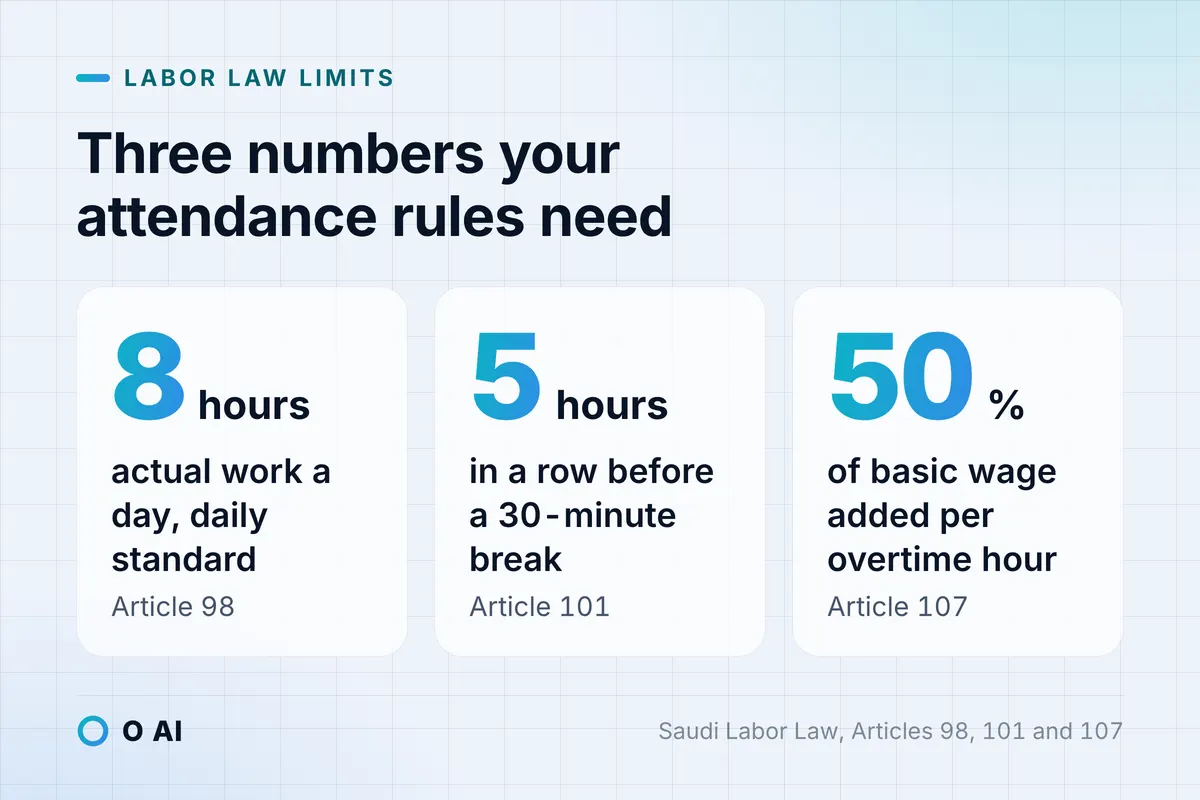
- The Saudi Labor Law allows 8 actual working hours a day or 48 a week, and 6 a day or 36 a week for Muslims in Ramadan (Article 98).
- No one may work more than 5 consecutive hours without a break of at least 30 minutes, and breaks are not working hours (Articles 101 and 102).
- Overtime is the hourly wage plus 50% of the basic wage; since 19 February 2025 paid compensatory leave may replace it with the worker's consent.
- Under the amended PDPL, biometric data that identifies a person is sensitive data, so collect it only where needed and assess the risk in writing.
- A lateness penalty must appear in the approved work regulations, and fines may not exceed five days' wage per violation or per month.
On this page
- What is an attendance system?
- What the Saudi Labor Law expects from attendance records
- Types of attendance systems compared
- Fingerprints, faces and location under the PDPL
- Attendance software features worth paying for
- Illustrative example: overtime from attendance records
- Linking attendance to payroll and HR
- Common mistakes when rolling out an attendance system
- Your next step
This guide is by O AI, a Saudi software and AI company that builds systems, apps and AI for companies. See what we build
An attendance system records when each employee starts and ends work, their breaks and absences, and turns those records into hours, overtime and lateness reports. In Saudi Arabia it also helps an employer meet the Labor Law's limits on working hours and rest, and it must handle fingerprints, faces and locations under the Personal Data Protection Law.
This guide explains what an attendance system does, which Labor Law articles it should reflect, how fingerprint, face, card and mobile app attendance compare, and what the Personal Data Protection Law (PDPL) means for biometric data. It is current as of October 2026. It is general information, not legal advice: for a specific case, read the official text and ask a licensed lawyer or the Ministry of Human Resources and Social Development (HRSD).
What is an attendance system?
An attendance system is software, usually with a device or an app, that captures each clock-in and clock-out, applies the company's shift and break rules, and produces the hours worked per employee and per day. The captured event is the raw data; the rules turn it into overtime, lateness and absence.
In Arabic search, the same thing appears under three names. «نظام حضور وانصراف» and «برنامج حضور وانصراف» both mean the full system with its rules and reports, while «تطبيق حضور وانصراف» means the phone app employees use to check in. A useful setup usually has all three layers:
- Capture: a fingerprint reader, face terminal, card reader or mobile app.
- Rules: shifts, grace periods, breaks, weekly rest, Ramadan hours and approvals.
- Output: timesheets, exception reports and a clean export to payroll.
What the Saudi Labor Law expects from attendance records
The Labor Law was issued by Royal Decree M/51 dated 23/8/1426H. We read the consolidated text on the Bureau of Experts site, which includes the amendments of Royal Decree M/44 dated 8/2/1446H, in force from 20/8/1446H [1], that is 19 February 2025 [2]. The law does not name an "attendance system", but several articles only work if hours are recorded accurately.
Article 17 requires the employer to keep at the workplace the records, statements and files that the regulations specify, and to post a schedule of working hours, rest periods, the weekly rest day and shift start and end times [1]. Article 9 makes Arabic the language of records and files [1]. Under Article 13, every employer must prepare internal work regulations following the ministry's model, and Article 12 says the model covers violations and disciplinary penalties, which is where lateness and absence rules are written [1].
| Labor Law rule | What it says | What the system should do |
|---|---|---|
| Article 98 | No more than 8 actual working hours a day (daily standard) or 48 a week (weekly standard); for Muslims in Ramadan, 6 a day or 36 a week [1] | Hold a daily or weekly standard per employee group, with a Ramadan calendar |
| Article 101 | No more than 5 consecutive hours without a break of at least 30 minutes, and no more than 12 hours a day at the workplace [1] | Flag shifts with no break and days over 12 hours on site |
| Article 102 | Breaks for rest, prayer and meals are not working hours [1] | Deduct breaks from worked time |
| Article 104 | Friday is the paid weekly rest day, at least 24 consecutive hours; the employer may substitute another day for some workers after notifying the labour office [1] | Set the rest day per employee |
| Article 107 | Overtime is paid at the hourly wage plus 50% of the basic wage; with the worker's consent, paid compensatory leave may replace it; all hours on holidays and Eid are overtime [1] | Calculate overtime and track compensatory leave balances |
| Article 80(7) | Dismissal without award is possible after more than 30 days' unexcused absence in a contract year or more than 15 consecutive days, after a written warning at 20 or 10 days [1] | Count unexcused absence and alert HR before the warning points |
Two more limits matter for lateness penalties. Article 66 lists the permitted penalties, from a warning to a fine, and Article 70 caps a fine for one violation at five days' wage and the monthly deduction for fines at five days' wage [1]. Under Article 67, no penalty may be imposed unless it appears in the law or the work regulations [1]. An attendance system can calculate lateness, but the penalty must follow the approved regulations.
Remote and field employees
Since Royal Decree M/134 of 1440H, the law defines a worker as anyone working for an employer under their management or supervision for a wage "even if away from their supervision" [1]. Remote and field staff are covered by the same hours and overtime rules, which is why many companies add a mobile app with location check-in for them.
Types of attendance systems compared
There is no single right device. The choice depends on the site, the number of employees, how many work outside the office and how much personal data you want to hold.
| Method | How it works | Strengths | Watch out for |
|---|---|---|---|
| Fingerprint reader | Employee scans a finger at a fixed terminal | Hard to clock in for a colleague; familiar | Biometric data is sensitive under the PDPL; dust and worn fingers in workshops |
| Face recognition terminal | A camera matches the face at the entrance | Contactless; fast at shift change | Sensitive data; lighting and masks; needs a strong privacy notice |
| Card or badge | Employee taps an RFID card | No biometric data; cheap to replace | Cards can be lent; needs a second check for high-risk sites |
| Mobile attendance app | Check-in from the phone, often with location or a site QR code | Suits field, sales and remote staff; no hardware | Location tracking must be limited to work hours and purpose; phones can be shared |
| Web check-in | Employee clicks in a browser | Simple for office staff | Weak proof of presence; use only where trust is high |
Attendance app with location check-in
A mobile attendance app usually lets the employee check in only inside a defined area around the site, a "geofence", or by scanning a QR code displayed at the site. This suits construction, maintenance, sales and delivery teams. The design question is how much location data to keep: recording the location at check-in and check-out is usually enough, and tracking all day goes beyond what most attendance purposes need, and the PDPL limits collection to the minimum the purpose requires [3].

Fingerprints, faces and location under the PDPL
The Personal Data Protection Law was issued by Royal Decree M/19 dated 9/2/1443H and amended by Royal Decree M/148 dated 5/9/1444H [3]. In the amended definition, sensitive data includes "biometric data that identifies" a person, alongside health, genetic and other categories [3]. The amended definition no longer lists location data, but location remains personal data.
What this means in practice for an attendance system, based on the law and its Implementing Regulations:
- Minimum data. Collect only what is directly needed for the purpose (Law, Article 11) [3]. SDAIA's guideline on minimum data gives an employer example: collecting a sensitive item from every employee when only some roles need it is not justified [5].
- Explicit consent where consent is the basis. Article 11(2) of the Implementing Regulations requires explicit consent when processing includes sensitive data [4].
- Impact assessment. Article 25 requires a written, documented assessment of risks to individuals for processing such as sensitive data [4].
- Privacy policy and retention. Employees must be able to read the privacy policy when their data is collected (Law, Article 12), and data is destroyed without delay once the purpose ends (Article 18), unless a legal reason requires keeping it [3].
- Breach notification. A breach that could harm individuals must be reported to the authority within 72 hours of becoming aware of it (Implementing Regulations, Article 24) [4].
- Cloud hosted abroad. If the vendor stores data outside the Kingdom, the transfer rules apply, and a risk assessment is required before a transfer that relies on safeguards or exemptions rather than an adequacy decision, and before sensitive data is transferred outside the Kingdom on an ongoing basis or at large scale [6].
A practical alternative is a card or a site QR code for most staff, with biometrics only where the risk of buddy punching is real.
Attendance software features worth paying for
Most attendance software can record a fingerprint. The differences are in the rules and the reports. Before you buy, check that the system can:
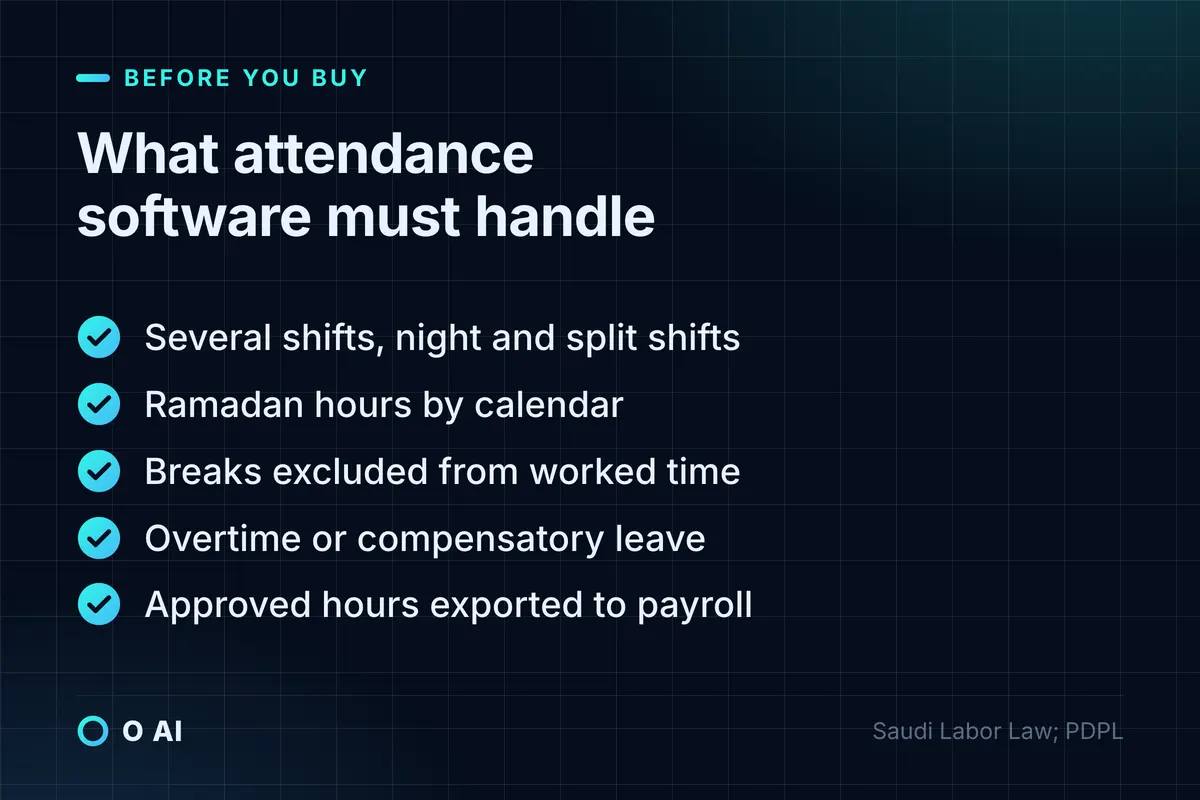
- hold several shift patterns, split shifts and night shifts, with grace periods;
- switch to Ramadan hours by calendar, for the employees they apply to;
- treat breaks as non-working time and warn when an employee works more than 5 hours without one;
- calculate overtime on the weekly or daily standard, and offer compensatory leave instead of pay;
- route corrections, missed punches and permissions through a manager approval with an audit trail;
- export approved hours to payroll in a fixed format, with Arabic employee names;
- delete or anonymise attendance data when the retention period ends.
Illustrative example: overtime from attendance records
Illustrative example. A company uses the daily standard of 8 hours. In one week, an employee's approved records show 10 hours on Sunday and Monday and 8 hours on the other working days, with breaks already deducted. That is 4 overtime hours.
Assume the employee's hourly wage is SAR 40 and the basic part of it is SAR 30 an hour. Under Article 107, each overtime hour is paid at SAR 40 plus 50% of SAR 30, so SAR 55, and 4 hours cost SAR 220 [1]. If the employee agrees, the company may grant paid compensatory leave instead [1]. The attendance system's job is to produce the 4 approved hours; payroll applies the wage.
How the hourly wage is derived from the monthly wage depends on the contract and the regulations, so check it with HRSD guidance or an adviser.
Linking attendance to payroll and HR
Attendance data is only useful when it reaches payroll without retyping. A common flow is capture, then manager approval, then a monthly lock, then export to payroll. Our guide to payroll calculation in Saudi Arabia explains what happens to the hours after that, including GOSI deductions.
If you already have, or plan, an HR system, attendance is normally one of its modules; see what an HR system for Saudi companies should include. Small teams that run HR by hand can start with the basics in HR management for small businesses.
Common mistakes when rolling out an attendance system
- Starting with the device, not the rules. Write the shifts, breaks, grace periods and penalties into the work regulations first, then configure the system to match.
- Penalising lateness outside the regulations. Under Article 67, a penalty that is not in the law or the approved regulations cannot be imposed [1].
- Counting breaks as work. Article 102 excludes rest, prayer and meal breaks from working hours [1].
- Collecting fingerprints from everyone by default. Biometric data is sensitive; use it where it is needed and document why [3][5].
- Forgetting Ramadan. The 6-hour and 36-hour limits apply to Muslim employees during Ramadan [1].
- No audit trail. Every manual correction should show who changed what and when, because the records may be reviewed in a labour dispute.
Your next step
Write down your shifts, break rules, rest days and lateness rules as they appear in your work regulations, and list which employees work outside the office. Then test two or three attendance systems against that list, and pick the capture method that collects the least personal data for your risk. If off-the-shelf tools do not fit your shifts or need to connect to an existing ERP, O AI's page on ERP and business systems explains how a custom module can be built around your rules.
Frequently asked questions
What is an attendance system?
An attendance system records when employees start and finish work, their breaks and their absences, and turns those records into hours worked, overtime, lateness and absence reports. It combines a capture method, such as a fingerprint reader, face terminal, card or mobile app, with the company's shift rules and an export to payroll.
Is a fingerprint attendance system legal in Saudi Arabia?
Fingerprint attendance is used widely, but under the amended Personal Data Protection Law biometric data that identifies a person is sensitive data. The employer should collect only what it needs, give a clear privacy notice, obtain explicit consent where consent is the legal basis, assess the risks in writing and protect the data. Many companies use cards or QR codes for most staff and keep biometrics for sites with real misuse risk.
How many working hours does the Saudi Labor Law allow?
The Labor Law allows up to 8 actual working hours a day if the employer uses the daily standard, or 48 hours a week under the weekly standard. During Ramadan, Muslim employees work no more than 6 hours a day or 36 hours a week. Breaks for rest, prayer and meals are not counted as working hours.
How is overtime calculated in Saudi Arabia?
Overtime is paid at the employee's hourly wage plus 50% of the basic wage. Under the weekly standard, hours beyond the weekly limit are overtime, and all hours worked on holidays and Eid days are overtime. Since February 2025, the employer may, with the employee's consent, give paid compensatory leave instead of overtime pay.
Can an employer deduct pay for lateness?
Only within the penalties set in the Labor Law and the company's approved work regulations. A fine for one violation may not exceed five days' wage, and fines deducted in one month may not exceed five days' wage. Before any penalty, the employee must be told in writing what they are accused of and be heard. An attendance system can measure lateness, but the penalty must follow the regulations.
What is the difference between an attendance app and an attendance program?
An attendance app is the phone application an employee uses to check in, often with location or a QR code at the site. An attendance program or system is the whole solution behind it: shift rules, approvals, reports and the payroll export. A company can use an app alone for a small field team, but most need the full system.
How this article was made: Researched from the official sources listed below, opened on 29 October 2026. Drafted with AI assistance, then checked against those sources. General information, not legal or professional advice. Illustrations were made for this article.
Sources
- Labor Law (Royal Decree M/51 dated 23/8/1426H), consolidated text with amendments up to Royal Decree M/44 dated 8/2/1446H (opens in a new tab)Bureau of Experts at the Council of Ministers · laws.boe.gov.sa
- Saudi Labor Law amendments 2025: guide to common questions (opens in a new tab)Ministry of Human Resources and Social Development · hrsd.gov.sa
- Personal Data Protection Law (Royal Decree M/19 dated 9/2/1443H, amended by Royal Decree M/148 dated 5/9/1444H) (opens in a new tab)Bureau of Experts at the Council of Ministers · laws.boe.gov.sa
- Implementing Regulations of the Personal Data Protection Law (opens in a new tab)Saudi Data and AI Authority (SDAIA) · dgp.sdaia.gov.sa
- Guideline for determining the minimum personal data (opens in a new tab)Saudi Data and AI Authority (SDAIA) · dgp.sdaia.gov.sa
- Regulation on Personal Data Transfer outside the Kingdom (opens in a new tab)Saudi Data and AI Authority (SDAIA) · dgp.sdaia.gov.sa
About the author
Newsletter
New guides and news by email
New guides and news about O AI, Rushd and Dalni, at most twice a month. No spam.