 AI


Inventory management for small businesses: methods and when you need a system
Know what you hold, what it cost and when to reorder. This guide covers ABC analysis, reorder points, FEFO, cycle counts, FIFO and weighted average costing, ZATCA's VAT rules on lost stock, a spreadsheet-or-system table and dated prices.


Key takeaways
- Reorder point = average daily sales × lead time in days + safety stock; an item selling 12 a day with a 5-day lead time and 24 in reserve reorders at 84.
- IAS 2 measures stock at the lower of cost and net realisable value, with FIFO or weighted average for interchangeable items; Saudi SMEs use IFRS for SMEs.
- Per ZATCA's retail guideline, lost or stolen stock normally needs no VAT adjustment, but the loss must be recorded and ZATCA may ask for evidence.
- Count A items weekly, B monthly and C each quarter or half-year, and record the reason for every difference while it is fresh.
- Move to a system when you have several locations, hundreds of items, expiry dates, several staff or POS sales that must cut stock automatically.
On this page
- Inventory management for small businesses: what it covers
- Inventory management in the supply chain
- Inventory methods that work at small scale
- Valuing stock: FIFO or weighted average
- What Saudi VAT rules mean for your stock records
- Spreadsheet or inventory system: a decision table
- What inventory software costs (prices checked 14 October 2026)
- A monthly inventory routine for a small team
- Your next step
Inventory management for small businesses means knowing what you hold, what it cost and when to reorder. Start with a clean item list, a reorder point for your fast sellers and a regular counting routine. Move from a spreadsheet to a system when you add branches, hundreds of items, expiry dates or POS sales that must update stock automatically.
This guide is for owners of shops, trading businesses, pharmacies, cafés and workshops in Saudi Arabia who carry stock and run it themselves or with a small team. It covers the methods that work at small scale, how stock is valued in the accounts, what Saudi VAT rules mean for your stock records, and the signs that a spreadsheet is no longer enough. Rules and prices were checked on official pages on 14 October 2026. It is general information, not accounting or tax advice.
Inventory management for small businesses: what it covers
"Small" has an official meaning in Saudi Arabia. Monsha'at classes a micro enterprise as 1 to 5 full-time employees with revenue up to SAR 3 million, and a small enterprise as 6 to 49 employees with revenue above SAR 3 million and up to SAR 40 million; where the two measures disagree, the higher category applies [1]. In businesses of that size, stock can be one of the largest sums the owner has paid out, and yet nobody's full-time job.
Inventory management answers four questions every day:
- What do we have? Quantity on hand per item and per location.
- What did it cost? The cost of each item, so you know your margin and the value of the stock.
- What is coming and going? Purchase orders on the way, sales, returns, transfers and write-offs.
- When do we reorder, and how much? Before you run out of fast sellers, without filling the storeroom with slow ones.
Get these four right in a notebook and you are managing inventory. Get them wrong in expensive software and you are not.
Inventory management in the supply chain
Inventory is the buffer in your part of the supply chain. Goods leave a supplier, travel for a lead time, are received and checked, wait on a shelf, and leave as a sale or a return. Supply chain management looks at the whole route; inventory management is your share of it, and it is where the delays and mistakes of everyone upstream turn into either empty shelves or cash tied up in boxes.
Three supply-chain facts shape your stock levels more than any software:
- Lead time: the days between placing an order and having the goods on the shelf. A local wholesaler may deliver tomorrow; an importer may need weeks.
- Reliability: a supplier who is sometimes late forces you to hold extra stock as insurance.
- Minimum order size: a carton of 48 when you sell 6 a week means eight weeks of stock with every order.
Write these three numbers down for each main supplier. They feed the reorder point below, and they are the first thing to negotiate when stock ties up too much cash.

Inventory methods that work at small scale
You do not need every technique in the textbook. These five cover most small businesses.
ABC analysis: spend your attention where the money is
Rank your items by sales value over the last 12 months and split them into three groups. "A" items are the few that bring most of the value; "C" items are the many that bring little.
Illustrative example. A building-materials shop in Dammam has 400 items. Ranked by last year's sales, 40 items bring about 70% of sales value (A), the next 100 bring about 20% (B), and the remaining 260 bring about 10% (C). The owner counts A items every week, B items every month and C items twice a year, and sets reorder points carefully only for A and B items.
Reorder point and safety stock
The reorder point is the quantity at which you place the next order:
Reorder point = average daily sales × lead time in days + safety stock
Illustrative example. A pharmacy sells an average of 12 packs a day of a common item. The wholesaler delivers in 5 days, and is sometimes 2 days late, so the owner keeps 2 days of sales as safety stock (24 packs). The reorder point is 12 × 5 + 24 = 84 packs. When the system or the shelf card shows 84, the order goes out.
Recalculate reorder points every quarter, and before seasons that change demand, such as Ramadan or the start of the school year.
FIFO and FEFO on the shelf
First in, first out (FIFO) means selling the oldest stock first. For food, cosmetics and medicines, use first expired, first out (FEFO): the item with the nearest expiry date goes to the front, whatever date it arrived. FEFO needs the expiry date recorded at receiving, which is one of the strongest reasons to move from a spreadsheet to a system with batch tracking.
Min and max levels for the long tail
For C items, a simple rule is enough: a minimum below which you reorder and a maximum you never exceed. It keeps rarely sold items available without anyone calculating anything.
Counting: cycle counts beat one big annual count
A full count once a year tells you the damage after it is done. Cycle counting spreads the work: a few items every day or week, chosen by ABC group, so every A item is counted often. Count before opening or after closing, record the difference, and find the reason while it is still fresh: a receiving error, an unrecorded return, a wrong item scanned, damage or theft.

Valuing stock: FIFO or weighted average
The quantity on the shelf is half the picture; the accounts need its cost. Under IAS 2, the international standard on inventories, stock is measured at the lower of cost and net realisable value. Cost includes the purchase price and the other costs of bringing goods to their present location and condition, and any write-down to net realisable value is an expense in the period it occurs [2].
For interchangeable items, IAS 2 lists two cost formulas: first-in, first-out (FIFO) and weighted average. Items that are not interchangeable, such as a made-to-order piece, use the specific cost of each item [2]. In Saudi Arabia, small and medium entities are required to use the IFRS for SMEs Accounting Standard as endorsed in the Kingdom, or full IFRS if they choose to apply it in full [3], so ask your accountant which formula your financial statements use and set the same one in your system.
Illustrative example: one month, two methods
Illustrative example. A trading business in Riyadh starts the month with no stock of an item, buys 100 units at SAR 20 on the 1st and 100 units at SAR 23 on the 15th, and sells 120 units.
| FIFO | Weighted average | |
|---|---|---|
| Cost per unit used | First 100 at SAR 20, next 20 at SAR 23 | (SAR 2,000 + SAR 2,300) ÷ 200 = SAR 21.50 |
| Cost of goods sold | SAR 2,000 + SAR 460 = SAR 2,460 | 120 × SAR 21.50 = SAR 2,580 |
| Closing stock (80 units) | 80 × SAR 23 = SAR 1,840 | 80 × SAR 21.50 = SAR 1,720 |
When purchase prices are rising, FIFO shows a lower cost of sales and higher closing stock than weighted average; here the gap is SAR 120 on one item in one month. Neither is "better": what matters is applying one method consistently, and making sure the system and the accountant use the same one.
One number to watch: days of stock
Days of stock = stock value at cost ÷ cost of goods sold for the period × days in the period. If you hold SAR 90,000 of stock at cost and your cost of goods sold last month was SAR 60,000, you hold about 45 days of stock. Track it monthly by category: a rising figure in one category usually points to slow movers or over-ordering there.
What Saudi VAT rules mean for your stock records
Stock decisions have tax consequences, and ZATCA's retail guideline sets out the main ones. This is general information; for a specific case, check ZATCA's guidance or ask a licensed advisor.
- Input VAT on stock bought for resale can be deducted in the VAT return for the period in which it was incurred, provided you intend to resell the goods. You do not have to have sold them first [4].
- Lost, stolen or damaged stock normally has no VAT consequence, and you do not adjust the input VAT you claimed. But the loss must be recorded in your accounting records, and ZATCA may ask for evidence such as a police report or insurance claim documents [4]. A count difference you never wrote down is the hardest one to explain later.
- Records that support your VAT, including issued and received tax invoices and accounting records, must be kept for at least six years [4].
- Returns and corrections go through credit or debit notes: under the e-invoicing rules, an issued invoice cannot be deleted or changed, and a cancellation is made by issuing a credit note [5]. Your stock system should reverse quantities through the same documents, not by editing past sales.
E-invoicing also changes the timing of system decisions. ZATCA's Wave 25 covers taxpayers whose VAT-taxable revenue exceeded SAR 187,500 in any of 2022, 2023, 2024 or 2025; they must integrate their e-invoicing solutions with the Fatoora platform by 1 February 2027 [6]. If you are replacing your POS or accounting software for that deadline, choose one where stock moves with every sale and purchase, rather than adding a separate tool later.
Spreadsheet or inventory system: a decision table
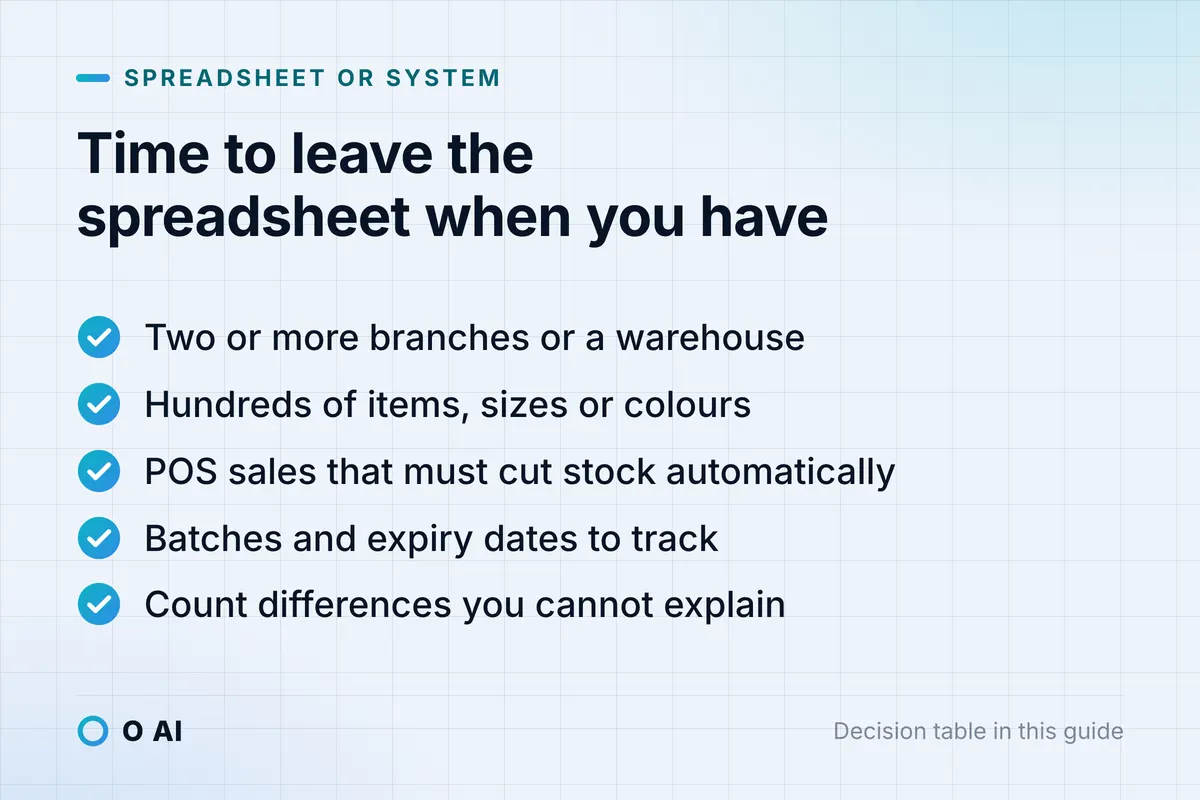
A well-built spreadsheet is a sound start: one row per item with code, name, unit, cost, selling price, quantity, reorder point, main supplier and lead time. Its limit is that someone must update it after every sale, delivery and return. The table shows when that limit arrives.
| Signal | A spreadsheet can cope | Time for a system |
|---|---|---|
| Locations | One shop and one storeroom | Two or more branches, or a warehouse feeding shops |
| Items | Dozens of items the team knows by heart | Hundreds of items, or variants by size, colour or pack |
| Sales | Few, manual sales you can total daily | A POS or online store whose sales must cut stock automatically |
| Batches and expiry | No expiry dates | Food, cosmetics or medicines that need FEFO and batch records |
| People | One person updates the sheet | Several staff receive, sell and transfer stock |
| Accuracy | Count differences are small and explained | Differences you cannot explain, or recurring stock-outs of A items |
If two or more signals in the right-hand column apply, price the hours your team spends keeping the spreadsheet correct and compare them with a year's subscription.
What inventory software costs (prices checked 14 October 2026)
Inventory tools come in two broad shapes: a standalone inventory app that connects to your POS and accounts, or stock management built into a POS or accounting system. Two dated examples, not recommendations:
| Example | Model | Price shown on 14 October 2026 | Notes from the vendor page |
|---|---|---|---|
| Zoho Inventory (Saudi Arabia page) [7] | Standalone inventory app | Free plan; paid plans from SAR 59 per organisation a month billed annually (Standard), then SAR 139, SAR 219 and SAR 399 | Excludes VAT. Standard: 500 orders a month, 2 users, 2 locations. Batch tracking from Professional; stock counting and barcode generation from Premium. Extra location SAR 36 a month |
| Rewaa [8] | POS and accounting with inventory | From SAR 275 a month billed annually | Excludes VAT. Entry plan lists products and inventory, purchases, a cashier app and ZATCA Phase 2 integration |
The useful comparison is not the headline price but what each plan includes that you need: number of locations, batch and expiry tracking, users, and whether the tool shares one item list with the system that issues your e-invoices. A standalone app that does not talk to your POS brings back the double entry you were trying to remove.
A monthly inventory routine for a small team
Use this checklist as-is, and give each line an owner.
- Receive against the purchase order. Check quantity, item and expiry before stock enters the system.
- Record every movement on the day. Sales, returns, transfers between branches and damaged goods.
- Cycle-count A items weekly, B items monthly and C items each quarter or half-year.
- Investigate every difference and record the reason; write off damage and theft with evidence [4].
- Review reorder points for A and B items against the last three months of sales and current lead times.
- List slow movers: items with no sale in 90 days, for a promotion, a return to supplier or a write-down.
- Check days of stock by category and compare with last month.
- Reconcile with the accounts. Stock value in the system should match the inventory balance your accountant reports.
Your next step
This week, export last year's sales by item and sort them into A, B and C groups. Set a reorder point for your top 20 items using real lead times from your suppliers, and count those 20 items before opening on one morning. The differences you find will tell you whether your problem is method or system. For the purchase invoices and delivery notes that still arrive as scans, our guide to Arabic OCR explains how to turn them into data you can trust, and our guide on how AI can help your business shows how to test one repetitive task, such as matching deliveries to orders, before you spend. You can read more about O AI, a software and AI company in Al Khobar, on our home page. Our ERP and business systems page lists inventory among the operations one system can bring together.
Frequently asked questions
What is the best inventory method for a small business?
There is no single best method; most small businesses combine a few simple ones. Use ABC analysis to decide which items deserve close attention, a reorder point with safety stock for your fast sellers, min and max levels for the long tail, FEFO for anything with an expiry date, and cycle counts instead of one big annual count. In the accounts, use the cost formula your accountant applies, FIFO or weighted average, and keep it consistent.
How do I calculate the reorder point?
Multiply average daily sales by the supplier's lead time in days, then add safety stock. For example, an item selling 12 units a day with a 5-day lead time and 24 units of safety stock has a reorder point of 84 units. Base the daily sales on recent months, take the lead time from actual deliveries rather than promises, and recalculate before seasons that change demand, such as Ramadan.
Can I manage inventory in Excel?
Yes, while you have one location, a limited number of items and one person keeping the sheet up to date. Build one row per item with code, cost, price, quantity, reorder point, supplier and lead time. The sheet becomes risky when several staff sell and receive stock, when a POS must reduce stock automatically, or when you need to track batches and expiry dates; at that point, compare the hours the sheet takes each month with the cost of a system.
What is the difference between inventory management and supply chain management?
Supply chain management covers the whole route goods take, from suppliers and transport to delivery to the customer. Inventory management is the part inside your business: how much you hold, where, at what cost and when you reorder. The two meet at lead time, supplier reliability and minimum order sizes, which decide how much safety stock you must carry.
Do I adjust VAT when stock is stolen or damaged?
According to ZATCA's retail guideline, there are normally no VAT consequences when stock is lost, stolen or damaged, and you do not adjust the input VAT already claimed on the purchase. You must, however, record the loss in your accounting records, and ZATCA may ask for supporting evidence such as a police report or insurance documents. For a specific case, check ZATCA's guidance or a licensed tax advisor.
How often should a small shop count its stock?
Count the items that matter most more often. One workable pattern is weekly counts for the A items that bring most of your sales value, monthly counts for B items, and quarterly or half-yearly counts for the long tail of C items, plus a full count at year end for the accounts. Count before opening or after closing, and record the reason for every difference while it is fresh.
How this article was made: Researched from the sources listed below, opened on 14 October 2026. Drafted with AI assistance, then checked against those sources. General information, not professional advice. Images are AI-generated illustrations.
Sources
- SME definition (opens in a new tab)Monsha'at (General Authority for Small and Medium Enterprises) · monshaat.gov.sa
- IAS 2 Inventories (opens in a new tab)IFRS Foundation · ifrs.org
- Use of IFRS Accounting Standards by jurisdiction: Saudi Arabia (profile updated 28 July 2022) (opens in a new tab)IFRS Foundation · ifrs.org
- Guideline for the Retail Sector under VAT Provisions, Issue 3 (May 2026) (opens in a new tab)Zakat, Tax and Customs Authority (ZATCA) · zatca.gov.sa
- Detailed Guidelines for E-Invoicing, Version 2 (May 2023) (opens in a new tab)Zakat, Tax and Customs Authority (ZATCA) · zatca.gov.sa
- ZATCA determines the criteria for selecting the targeted taxpayers in Wave 25 of the e-invoicing integration phase (24 July 2026) (opens in a new tab)Zakat, Tax and Customs Authority (ZATCA) · zatca.gov.sa
- Zoho Inventory plans and pricing (Saudi Arabia) (opens in a new tab)Zoho · zoho.com
- Rewaa pricing (in Arabic) (opens in a new tab)Rewaa · rewaa.com
About the author
Newsletter
New guides and news by email
New guides and news about O AI, Rushd and Dalni, at most twice a month. No spam.