 AI


E-commerce ideas in Saudi Arabia: what the data shows and how to start
Six e-commerce ideas for Saudi Arabia, each tied to a cited demand signal from CST's Saudi Internet 2025 report or the Ministry of Commerce, plus an honest per-order profit test, a startup checklist, common rule-breaking mistakes and free ways to learn e-commerce.


Key takeaways
- In CST's Saudi Internet 2025 report, 87.7% of online shoppers bought apparel and footwear, 46.2% cosmetics and 41.8% groceries.
- The Ministry of Commerce counted 52,259 e-commerce registrations at the end of Q3 2026, up 25% in a year, so competition is growing too.
- Demand is not profit: what remains of each order after product, shipping, fees, returns and advertising decides whether a store pays.
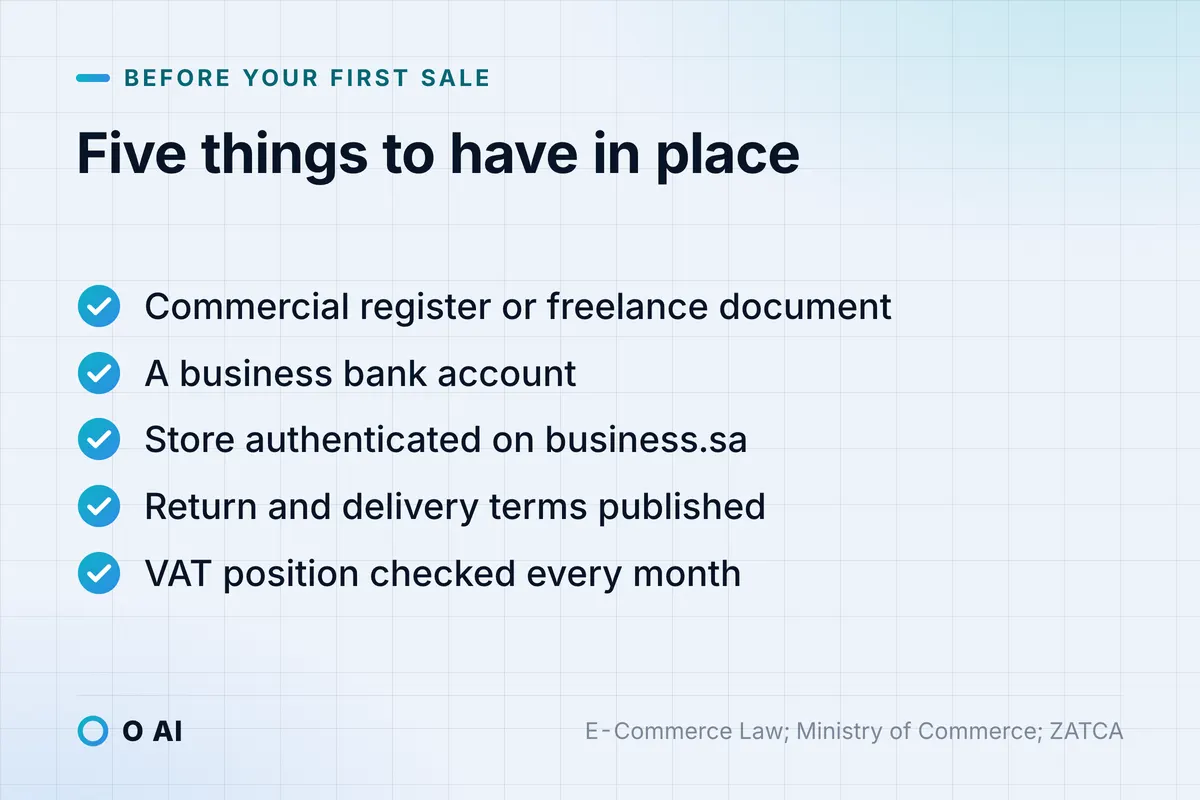
- Before selling you need a commercial register or freelance document, a business bank account and store authentication on business.sa.
- Monsha'at Academy offers free Arabic training programmes for entrepreneurs, with certificates signed electronically through SDAIA.
On this page
- What the numbers say about e-commerce in Saudi Arabia
- Six e-commerce ideas with a demand signal for each
- Is e-commerce profitable? Do the math per order
- How to test an e-commerce idea in four weeks
- A startup checklist for an e-commerce project in Saudi Arabia
- Common mistakes the official rules point to
- How to learn e-commerce for free
- Your next step
The e-commerce ideas in Saudi Arabia with the clearest demand signals sit where online shoppers already spend: apparel and footwear, cosmetics, groceries, electronics and travel, plus services for the growing number of online sellers. Demand is not profit, though: test one narrow product, cost every order, and register before you sell.
The market is large and crowded at the same time. The Communications, Space and Technology Commission (CST) put internet penetration in the Kingdom at 99.6% and the share of online shoppers at 76.9% in its Saudi Internet 2025 report [1]. On the supply side, the Ministry of Commerce counted 52,259 existing commercial registrations for e-commerce at the end of the third quarter of 2026, up 25% from 41,682 a year earlier [2]. Customers are online, and so are your competitors. This guide picks ideas from that data, shows how to test whether one can make money, and lists what to have in place before the first sale. It is general information, not legal or financial advice.
What the numbers say about e-commerce in Saudi Arabia
CST asked online shoppers what they had bought. Five categories led [1]:
| Category bought online | All online shoppers | Men | Women |
|---|---|---|---|
| Apparel and footwear | 87.7% | 84.1% | 91.6% |
| Cosmetics | 46.2% | 15.9% | 79.1% |
| Groceries | 41.8% | 42.6% | 41% |
| Computers and smartphones | 36.9% | 43.2% | 30.1% |
| Travel services | 36.5% | 46.2% | 25.9% |
Three more signals from the same report and the ministry's bulletin help read the table:
- Local stores win trust. 95.3% of online shoppers had bought from local websites, against 55.4% from international ones [1].
- The big apps are already here. The most downloaded shopping apps in the report were led by Trendyol, SHEIN, noon, Amazon and Haraj [1]. A general clothing or electronics store competes with them directly.
- Sellers cluster in three regions. Riyadh had 23,061 e-commerce registrations, Makkah 13,177 and the Eastern Province 7,792, followed by Madinah with 2,198 and Al Qassim with 1,659 [2].
A high share of buyers tells you a category has demand. It does not tell you the margin, the return rate or how much it costs to win a customer. That is why the ideas below are narrow.
Six e-commerce ideas with a demand signal for each
| Idea | Demand signal | Check before you start | Main risk |
|---|---|---|---|
| A narrow apparel or footwear niche, such as modest workwear, school shoes or hard-to-find sizes | 87.7% of online shoppers bought apparel and footwear [1] | Size guides and an exchange process; customers may cancel within 7 days of receiving an unused item [3] | Competing with the largest shopping apps on price |
| Cosmetics and personal care for one defined customer | 46.2% of online shoppers, and 79.1% of women shoppers, bought cosmetics [1] | Cosmetics establishments fall under the Saudi Food and Drug Authority's supervision; check its requirements before listing [5] | Regulated products and fakes in the market |
| Specialty food and groceries, including home-made products | 41.8% bought groceries online [1] | Food is also supervised by the Saudi Food and Drug Authority [5]; plan delivery times your product survives | Short shelf life and delivery costs |
| Phone and computer accessories | 36.9% bought computers and smartphones [1] | Warranty details belong in the information shown before purchase [3] | Thin margins against large electronics retailers |
| Travel products such as luggage, organisers and travel kits | 36.5% bought travel services online [1] | Products follow the usual return rules; accommodation, transport and catering services are excluded from the 7-day cancellation right [3] | Seasonal demand |
| Services for online sellers: product photography, packaging supplies, Arabic product copy, store set-up | 52,259 e-commerce registrations, up 25% in a year [2] | A freelance document is issued per occupation, and one person can hold up to five in different occupations [4] | Small sellers' budgets |
What each idea has in common: one clearly described customer, a product you can explain in a sentence, and a reason someone would buy from you rather than from a large app, such as fit, speed, specialist advice or a local brand.

Is e-commerce profitable? Do the math per order
E-commerce can be profitable, but neither the market data nor a platform guarantees it. Profit is decided order by order: what is left of the price after the product, packaging, shipping, payment fees, returns and the cost of winning that customer. Run the numbers before you buy stock.
Illustrative example: a phone-accessories store in Dammam
Illustrative example. Apart from the VAT rate and the platform fee, every figure below is an assumption; replace each one with your own quotes. A seller prices a charging kit at SAR 100 before VAT. If the seller is VAT-registered, the customer pays SAR 115 and the SAR 15 goes to ZATCA at the 15% rate [6].
| Per order | Amount |
|---|---|
| Price before VAT | SAR 100 |
| Product cost (assumed) | − SAR 40 |
| Packaging (assumed) | − SAR 4 |
| Shipping, offered free to the customer (assumed) | − SAR 22 |
| Card payment fee (assumed) | − SAR 3 |
| Allowance for returns (assumed) | − SAR 4 |
| Advertising cost to win one order (assumed) | − SAR 15 |
| Left per order | SAR 12 |
Fixed costs come on top. An entry paid plan costs SAR 990 a year on Salla Plus or Zid Launch billed annually [7][8]; add an assumed SAR 1,010 for product photos and a domain, and the year's fixed costs reach SAR 2,000. At SAR 12 an order, the store needs about 167 orders a year just to cover them, before paying the owner anything.
Now change one assumption. If advertising costs SAR 25 an order instead of SAR 15, only SAR 2 is left per order, and covering the same SAR 2,000 takes 1,000 orders. The lesson: the advertising cost per order and the return rate decide more than the product does. Measure both on a small test before you scale.

How to test an e-commerce idea in four weeks
A short, cheap test answers the profit question better than any market report. One way to run it:
- Week 1: describe and build. Write down who the customer is and what problem the product solves. Build ten product pages on a free store plan, with your own photos and full delivery and return terms, but do not sell yet.
- Week 2: register and get quotes. Settle the commercial register or freelance document, open the business bank account and start authentication. Ask suppliers for prices at small quantities and ask two carriers for delivery prices to the cities you will serve, then redo the per-order table above with real numbers.
- Week 3: sell a small batch. Buy only what a modest test budget allows and promote it to people who match your customer description. Record every order, question and return.
- Week 4: decide with three numbers. The amount left per order after all costs, the advertising cost per order and the share of orders returned. If the first is positive and holds steady, add products. If not, change one thing, such as the price, the product or the channel, and run another short test, or stop.
The law's duties apply from the first order, not from the first big month, so the test store needs the same disclosures, policies and invoices as a full one [3].
A startup checklist for an e-commerce project in Saudi Arabia
| Item | What it involves | Source |
|---|---|---|
| Legal form | A commercial register, or a freelance document for Saudi nationals aged 18 or over with an active Absher account, valid for one year with no fee currently charged | [3][4] |
| What a freelance document cannot do | Open a shop, recruit workers, or import in commercial quantities | [4] |
| Business bank account | Required, with the register or document, to authenticate the store | [9] |
| Store authentication | On the Business Platform (business.sa), which replaced Maroof in March 2023 | [9] |
| Product permissions | Regulated products, such as food and cosmetics, under the Saudi Food and Drug Authority; licensed professions must show licence details | [3][5] |
| Platform and payments | Free plans exist on Salla and Zid; card payments appear in paid plans | [7][8] |
| Store details and policies | Name, contact details and register number; privacy policy and complaints procedure; return, delivery and invoice terms | [3][11] |
| VAT | Each month, check sales over the previous 12 months against the mandatory registration threshold, and apply within 30 days if exceeded | [10] |
| Customer data | Keep it only as long as needed, do not use it without consent, and report a breach within 3 days | [3][11] |
Common mistakes the official rules point to
- Promising delivery you cannot keep. Unless you agree another period with the customer, they may cancel and get a refund when delivery is more than 15 days late, except in force majeure [3]. Products shipped from abroad need delivery times stated before purchase.
- Collecting payments in a personal account. Authentication requires a business bank account [9].
- Importing stock on a freelance document. The freelance platform says the document does not allow importing in commercial quantities; individual imports in limited quantities follow customs rules [4].
- Borrowing brand names or overselling. The law bans misleading offers and trademarks you have no right to use, and makes online adverts binding on the seller [3].
- Hiding the return rules. The 7-day cancellation right applies unless an exception fits, so say clearly which products are excluded and why [3].
- Reusing customer data for marketing. The law forbids using customers' personal data for unauthorised purposes or disclosing it without consent [3].
How to learn e-commerce for free
- Monsha'at Academy. Monsha'at, the SME authority, offers free training programmes online and in person, in Arabic, with certificates signed electronically through SDAIA; you sign in with an Absher account [12].
- Monsha'at's e-commerce programmes. They connect sellers with payment, digital-marketing and store-platform providers, and require a freelance document or a commercial register [13].
- The primary texts. The E-Commerce Law has 26 articles [3], and its Implementing Regulations are published by the Ministry of Commerce [11]. Reading both takes an evening and answers most "is this allowed?" questions.
- A free store as a practice lab. Build a test catalogue on a free plan to learn product pages, shipping settings and checkout before you spend [7][8].
When orders grow, customer questions grow with them; our guide to WhatsApp chatbots for business covers what an automated assistant can answer. If your idea needs a model no platform supports, such as a marketplace or subscriptions, our guide to custom software development in Saudi Arabia explains when building pays off.
Your next step
Pick one idea from the table and describe its customer in a single sentence. List ten products, build them on a free store plan, and cost one order with the worked example above, using real quotes for shipping and stock. Before the first sale, settle the commercial register or freelance document, the business bank account and authentication. Testing e-commerce ideas in Saudi Arabia this way costs little and tells you early whether the margin is there. When the test works and you want your own store, O AI's websites and online stores page describes the bilingual sites and stores we build.
Frequently asked questions
Is e-commerce profitable in Saudi Arabia?
It can be, but nothing guarantees it. Demand is real: CST's Saudi Internet 2025 report puts the share of online shoppers at 76.9%. Competition is real too, with 52,259 e-commerce registrations by the third quarter of 2026. Profit depends on what remains of each order after product cost, shipping, payment fees, returns and advertising. Work out that figure on a small test before you buy stock in quantity.
Which products do people in Saudi Arabia buy most online?
In CST's Saudi Internet 2025 report, 87.7% of online shoppers had bought apparel and footwear, 46.2% cosmetics, 41.8% groceries, 36.9% computers and smartphones, and 36.5% travel services. The pattern differs by gender: 79.1% of women shoppers bought cosmetics, against 15.9% of men. Large shopping apps already serve these categories, so a narrow niche usually has a better chance.
Can I start e-commerce without a commercial register?
Yes. The E-Commerce Law covers sellers without a commercial registration, and a freelance document, available to Saudi nationals aged 18 or over, can be used to authenticate a store together with a business bank account. The document has limits: it does not allow opening a shop, recruiting workers or importing in commercial quantities, and some platforms ask for a commercial register before connecting card payment gateways.
How can I learn e-commerce for free?
Start with Monsha'at Academy, which offers free Arabic training programmes online and in person, with certificates signed electronically through SDAIA. Read the E-Commerce Law and its Implementing Regulations, which are short and answer most rule questions. Then build a practice store on a free plan from Salla or Zid to learn product pages, shipping and checkout before spending money.
Can I sell products shipped from abroad, such as through dropshipping?
The E-Commerce Law does not single out this model, and its duties apply in full: show the total price and delivery terms before purchase, issue an invoice, and accept cancellation with a refund if delivery is more than 15 days late unless you agreed another period. Long shipping times are the usual problem. A freelance document does not allow importing in commercial quantities.
How much money do I need to start an online store?
The software can start at nothing on Salla's or Zid's free plans, and an entry paid plan cost SAR 990 a year billed annually on 14 October 2026. The larger amounts usually go to stock, packaging, shipping, product photos and advertising. Work out the cost of one order first, then set a test budget for a small first batch of stock rather than a full range.
Where are most e-commerce businesses in Saudi Arabia registered?
By the end of the third quarter of 2026, Riyadh had 23,061 commercial registrations for e-commerce, Makkah 13,177, the Eastern Province 7,792, Madinah 2,198 and Al Qassim 1,659, according to the Ministry of Commerce. Fewer sellers in a region can mean less local competition, but customers order from anywhere, so delivery speed and service matter as much as location.
How this article was made: Researched from the sources listed below, opened on 14 October 2026. Drafted with AI assistance, then checked against those sources. General information, not professional advice. Images are AI-generated illustrations.
Sources
- Saudi Internet 2025 (opens in a new tab)Communications, Space and Technology Commission (CST) · cst.gov.sa
- Business Sector Bulletin, Q3 2026 (in Arabic) (opens in a new tab)Ministry of Commerce · mc.gov.sa
- E-Commerce Law (in Arabic) (opens in a new tab)Bureau of Experts at the Council of Ministers · laws.boe.gov.sa
- Frequently asked questions (in Arabic) (opens in a new tab)Freelance platform (freelance.sa) · freelance.sa
- E-services for cosmetics establishments (opens in a new tab)Saudi Food and Drug Authority (SFDA) · sfda.gov.sa
- Value Added Tax Law, with amendments (in Arabic) (opens in a new tab)Bureau of Experts at the Council of Ministers · laws.boe.gov.sa
- Salla plans (in Arabic) (opens in a new tab)Salla · salla.com
- Pricing (opens in a new tab)Zid · zid.sa
- E-stores can now be registered via Business Platform instead of Maroof (opens in a new tab)Ministry of Commerce · mc.gov.sa
- VAT Implementing Regulations (opens in a new tab)Zakat, Tax and Customs Authority (ZATCA) · zatca.gov.sa
- Implementing Regulations of the E-Commerce Law (in Arabic) (opens in a new tab)Ministry of Commerce · mc.gov.sa
- Training services (Monsha'at Academy) (in Arabic) (opens in a new tab)Monsha'at · monshaat.gov.sa
- E-commerce programmes and services (in Arabic) (opens in a new tab)Monsha'at · monshaat.gov.sa
About the author
Newsletter
New guides and news by email
New guides and news about O AI, Rushd and Dalni, at most twice a month. No spam.