 AI


Real estate website design: the features Saudi property offices need
What a Saudi property office website must show and do: the listing details REGA's 2026 advertising regulation requires, the office-site versus platform distinction, footer disclosures, search and speed, privacy-safe enquiry forms, a feature checklist and a worked listing example.

Key takeaways
- Since 1 May 2026, REGA's Real Estate Marketing and Advertising Regulation governs property adverts on websites, social media and every other channel.
- Each listing needs its own advertising licence and must show the advertised rights, property details, contact, advertiser, licence number, expiry and FAL number, or the licence number with a QR code.
- A site that lets other advertisers post listings is a real estate platform: it must link to REGA, verify users through Nafath and host its server in the Kingdom.
- The E-commerce Law requires the site to show the business name, address, contacts, commercial registration and licence details.
- Adverts must come down as soon as the licence expires or the unit is sold or let, so the site should unpublish them automatically.
On this page
- What the rules require on a property office website in 2026
- The listing page: fields every property advert must show
- Search, maps and filters that buyers and tenants use
- Enquiry forms, WhatsApp and personal data
- Hosting, security and who owns the site
- Feature checklist for real estate website design
- Common mistakes on Saudi property websites
- Your next step
Real estate website design for a Saudi property office starts with compliance and ends with usability. Every listing needs a valid REGA advertising licence and the details the 2026 regulation requires, the site must show who you are and how you are licensed, and visitors need fast Arabic-first search, honest listing pages and an enquiry form that respects their data.
This guide is for brokerage offices, developers' sales teams and property managers planning a new site or reviewing an old one. It covers the rules first, because they decide what every listing page must contain, then the features buyers and tenants actually use. The rules were read on REGA, Umm Al-Qura and Bureau of Experts pages on 14 October 2026. It is general information, not legal advice; for a specific case, check REGA or ask a licensed advisor.
What the rules require on a property office website in 2026
Three sets of rules meet on a property website: real estate advertising, e-commerce and personal data.
Real estate advertising. REGA's board approved the Real Estate Marketing and Advertising Regulation, and it took effect when it was published in the official gazette on 1 May 2026 [1][2]. It covers all real estate marketing and advertising, including social media, print and broadcast media, exhibitions, electronic real estate platforms and billboards, and it replaced REGA's 2021 advertising controls and its standards for licensing electronic platforms [1].
The Brokerage Law already treats brokerage through websites and social media as brokerage [3], and it requires a broker to state its name and licence number in any advert or post about a property [3]. The Executive Regulations require an advertising licence for each advert, issued after the fee is paid [4]. REGA describes this licence as covering visual, audio, print and electronic adverts, including platforms and social media [5].
To obtain an advertising licence, the advertiser provides its details and capacity, the title deed number (except for property under government supervision), the rights being advertised, and an effective way to reach the advertiser [1]. REGA can revoke the licence if the information was wrong or if the published advert differs from it [1].
E-commerce. A business that advertises or offers services online must show on its site its name, address, contact details, and the name and number of its commercial registration [6]. Because brokerage is a licensed profession, the site must also show the licensing body and the licence details [6]. Online adverts must not contain false or misleading claims, or trademarks the business has no right to use [6].
Personal data. Any form that collects a visitor's details needs a privacy policy available when the data is collected, stating the purpose, the data, how it is stored and destroyed, and the visitor's rights [7].
Office website or real estate platform: why the difference matters
The regulation defines electronic real estate platforms as licensed apps or websites that let advertisers publish or market property adverts [1]. A site that shows only your own office's listings is advertising; a site that lets other offices or owners post listings is a platform, and Article 8 applies to it [1].
| Office website (your listings only) | Real estate platform (others can post) | |
|---|---|---|
| Advertising licence per listing | Yes [4] | Yes; unlicensed adverts may not be published [1] |
| Data shown on each listing | The Article 5 details, or the licence number and a QR code [1] | Data retrieved through the technical link with REGA's systems [1] |
| Registration with REGA | Your FAL licence | Registration and technical link with REGA, after documentation with the Saudi Business Center [1] |
| Advertiser accounts | Not applicable | Verified through Nafath, the National Single Sign-On [1] |
| Complaints page | Good practice | Required, with a form, reference number, date, actions and processing time [1] |
| Server location | No specific rule in the regulation; check personal data rules | Hosted in the Kingdom [1] |
If you are unsure which side of the line your design falls on, for example because you plan to let developers or owners upload units themselves, ask REGA before you build.
The listing page: fields every property advert must show
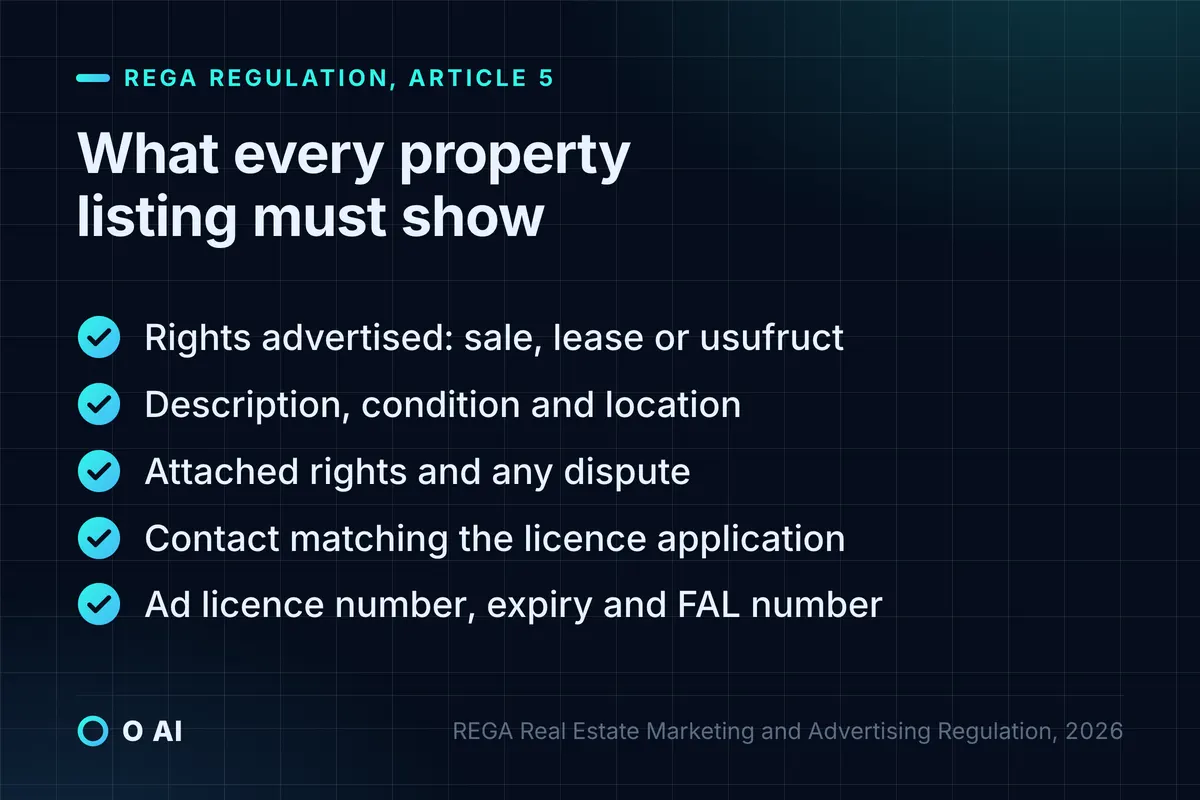
Article 5 of the regulation lists the details an advert must carry, except adverts on electronic platforms, which show the data retrieved from REGA's systems [1]. Design the listing template around them, so no agent can publish without them.
| Required by Article 5 [1] | Where it goes on the page |
|---|---|
| The rights advertised (sale, lease, usufruct) | A clear label at the top, beside the price |
| Description, condition, data and location, including anything that affects value or the buyer's decision | Details section, photos, floor plan and map |
| Services and rights attached to the property, including any existing dispute | A "property status" block |
| A contact method matching the licence application | The call and WhatsApp buttons, wired to that number |
| The advertiser's name | Under the listing title |
| The advertising licence number and its expiry date | A compliance strip near the price |
| The licensee's practice licence number | The same strip, and the site footer |
An advert may instead show only the advertising licence number and a QR code that leads to these details [1]. That suits printed material and short social posts; on your own site, showing the details on the page is more useful to the visitor.
Two behaviours belong in the content management system, not in a staff memo. The licensee must remove an advert as soon as its purpose ends or its licence expires, whichever comes first [1], so the system should unpublish a listing automatically on the expiry date and let staff close it when the unit is sold or let. And the site should not let anyone change a published advert's details in ways that no longer match its licence, because a mismatch is a ground for revoking it [1].
Failing to show the licensee's name or licence number in an advert is a listed violation: the Executive Regulations' table starts with a warning, then fines from SAR 200 to SAR 2,000 depending on the category and on repetition [4]. The Brokerage Law allows fines of up to SAR 200,000 for violations of its provisions [3].
Search, maps and filters that buyers and tenants use
Once compliance is built into the template, the design work is about helping a visitor find the right unit quickly, mostly on a phone.
- Arabic first, English second: right-to-left layout designed for Arabic, not mirrored from English, with a language switch that keeps the same listing.
- Filters that match how people search: city and district, sale or rent, property type, price range, area and number of rooms.
- A map view: listings on a map, with the district boundaries visitors know.
- Listing pages that answer questions: real photos, a floor plan, the full rental or sale terms and the information that affects value, which Article 5 requires anyway [1].
- Saved searches and alerts: by email or WhatsApp, for visitors who are not ready yet.
Speed matters as much as layout. Google recommends good Core Web Vitals: the largest content element loading within 2.5 seconds, responses to interaction under 200 milliseconds, and visual stability (a layout shift score below 0.1) [8]. Property sites are heavy with photos, so ask the developer how images are resized and loaded.
Accessibility helps every visitor and is easy to build in from the start. The W3C's WCAG 2.2, a Recommendation since December 2024, asks for text alternatives for images and a minimum size for touch targets, among other criteria [9]. Describing each photo ("living room with two windows facing the street") also helps search engines understand the listing.

Enquiry forms, WhatsApp and personal data
The enquiry form is where a visitor becomes a lead, and where most privacy mistakes happen. Keep it short: name, phone, preferred contact time and the listing reference. Link the privacy policy beside the button, and state what you will do with the details [7]. Under the e-commerce law, a business may keep a customer's personal data and communications only as long as the dealing requires, and must protect them while it does [6].
The regulation also bans publishing fake data to collect the details of visitors or the public [1]. Bait listings for units that do not exist, published to gather phone numbers, break it directly.
Many Saudi visitors prefer WhatsApp to a form. A click-to-chat button wired to the number on the advertising licence keeps the contact details consistent, which the regulation requires [1]. If you plan to answer those chats with an assistant, our guide to a WhatsApp chatbot for business explains what it can handle and what must go to an agent.
Hosting, security and who owns the site
A platform's server must be hosted in the Kingdom [1]. For an office site showing only its own listings, the regulation sets no hosting rule, but enquiry forms collect personal data, and sending it to servers abroad is a transfer under the Personal Data Protection Law. Our guide to data residency in Saudi Arabia explains the conditions.
Whatever the hosting, make sure the company, not the developer or a former employee, owns the domain name, the hosting account and the administrator logins. Ask for separate user roles for agents and managers, a log of who published or changed each listing, daily backups and HTTPS on every page.
Feature checklist for real estate website design
| Feature | Priority | Why |
|---|---|---|
| Licence fields required before publishing, with automatic unpublishing at expiry | Must-have | Article 5 details and removal at expiry [1] |
| Footer with commercial registration, FAL licence and contact details | Must-have | E-commerce Law and Brokerage Law disclosures [6][3] |
| Arabic-first layout with an English version | Must-have | Most visitors search in Arabic |
| Search filters and map view | Must-have | How buyers and tenants narrow choices |
| Fast mobile pages and optimised photos | Must-have | Core Web Vitals and mobile visitors [8] |
| Enquiry form with privacy notice | Must-have | Personal Data Protection Law [7] |
| User roles and a change log | Must-have | Accountability for every published advert |
| WhatsApp button and saved-search alerts | Useful | Faster follow-up and repeat visits |
| Floor plans and video or 3D tours | Useful | Fewer wasted viewings |
| Connection to your CRM | Useful | Leads reach the right agent with the listing attached |
| Mortgage calculator, chatbot, separate mobile app | Optional | Worth it only at scale or with a clear use |
Illustrative example: one listing from licence to removal
Illustrative example. A brokerage office in Al Khobar is instructed to let a three-bedroom apartment.
- The agent applies to REGA for an advertising licence with the deed number, the right advertised (a lease) and the office's main phone number [1].
- In the site's back office, the listing form will not publish until the licence number and expiry date are entered, along with the Article 5 details.
- The listing goes live with the compliance strip beside the price. The office posts it on Instagram and in a WhatsApp status with the same licence number and phone number.
- The apartment is let three weeks later. The agent marks it as let; the site unpublishes the listing and keeps an internal record, and the social posts are taken down.
- Had the licence expired first, the site would have unpublished the listing automatically on the expiry date.
Common mistakes on Saudi property websites
- Listings without a licence number, or with one that belongs to a different unit.
- Expired adverts left online because removal depends on someone remembering.
- A contact number on the page that differs from the licence application, which the regulation forbids [1].
- Using REGA's name or logo as decoration or as a "trust badge" without a legal basis, which the regulation also forbids [1].
- Stock or borrowed photos that suggest something the property is not.
- Bait listings to collect phone numbers [1].
- Forms without a privacy policy, and leads sitting in a shared inbox with no owner.
Your next step
Before you brief a designer, write a one-page specification: the listing fields from the Article 5 table above, the automatic expiry rule, the footer disclosures, your search filters and where enquiries should go. Send the same page to every candidate and ask how each requirement will be built and tested. Our guide on choosing a software or app development company in Saudi Arabia lists the questions to ask before you sign for real estate website design. You can read about O AI, a software and AI company in Al Khobar, on our home page. Our websites and online stores page describes the bilingual sites and stores we build.
Frequently asked questions
Does every listing on my own website need a REGA advertising licence?
Yes. The Executive Regulations of the Brokerage Law require an advertising licence for each advert, and the 2026 Real Estate Marketing and Advertising Regulation applies to all real estate marketing, including websites and social media. The exception is an advertiser already licensed to market an entire project under other rules, such as off-plan sales, real estate contributions or auctions. Each listing should show its licence number and expiry date.
Can a listing show only the licence number and a QR code?
Yes. The regulation allows an advert to carry only the advertising licence number and a QR code that leads to the required details: the rights advertised, the description and location, attached rights and disputes, the contact method, the advertiser's name, the licence expiry and the practice licence number. On your own website it is usually better to show those details on the page as well, because visitors look for them.
Does a real estate website have to be hosted in Saudi Arabia?
An electronic real estate platform, meaning a site that lets other advertisers publish listings, must host its server in the Kingdom under the 2026 regulation. The regulation sets no hosting rule for an office site that shows only its own listings. Enquiry forms still collect personal data, though, and sending it abroad is subject to the Personal Data Protection Law's transfer conditions, so check them before choosing a host.
What must appear in the footer of a property office website?
Under the E-commerce Law, show the business name, address, contact details, and the name and number of its commercial registration. Because brokerage is a licensed profession, also show the licensing body and the licence details, which here means your REGA FAL licence. The Brokerage Law separately requires your name and licence number in every advert, so repeat the licence number on each listing.
What happens when an advertising licence expires?
The licensee must remove the advert as soon as its licence expires or its purpose ends, whichever comes first, for example when the unit is sold or let. Leaving expired adverts online is a breach of the regulation. The safest design is a website that unpublishes the listing automatically on the expiry date stored with it, and keeps an internal record rather than deleting it.
Can I post the same listings on social media and WhatsApp?
Yes, but the same rules apply there. The 2026 regulation covers social media platforms and any other means REGA's board decides, so each post needs the licence details or the licence number with a QR code. The contact number in every post must match the one given in the licence application, and posts must be removed when the licence expires or the unit is no longer available.
Do I need a mobile app as well as a website?
Usually not at first. Most visitors reach a property office through search, social media or a shared link, and a fast mobile website serves them without a download. An app makes sense when you have many repeat users, such as tenants using a portal for payments and maintenance, or buyers who follow many listings. Get the website's compliance and speed right before you spend on an app.
How this article was made: Researched from the sources listed below, opened on 14 October 2026. Drafted with AI assistance, then checked against those sources. General information, not professional advice. Images are AI-generated illustrations.
Sources
- Real Estate Marketing and Advertising Regulation (in Arabic) (opens in a new tab)Real Estate General Authority (REGA) · rega.gov.sa
- Approval of the Real Estate Marketing and Advertising Regulation (in Arabic) (opens in a new tab)Umm Al-Qura official gazette · uqn.gov.sa
- Real Estate Brokerage Law (in Arabic) (opens in a new tab)Bureau of Experts at the Council of Ministers · laws.boe.gov.sa
- Executive Regulations of the Real Estate Brokerage Law, Jumada II 1444H (in Arabic) (opens in a new tab)Real Estate General Authority (REGA) · rega.gov.sa
- Frequently asked questions: FAL licences and the real estate advertising licence (in Arabic) (opens in a new tab)Real Estate General Authority (REGA) · rega.gov.sa
- E-commerce Law (in Arabic) (opens in a new tab)Bureau of Experts at the Council of Ministers · laws.boe.gov.sa
- Personal Data Protection Law, with amendments (in Arabic) (opens in a new tab)Bureau of Experts at the Council of Ministers · laws.boe.gov.sa
- Understanding Core Web Vitals and Google search results (opens in a new tab)Google Search Central · developers.google.com
- Web Content Accessibility Guidelines (WCAG) 2.2 (opens in a new tab)W3C · w3.org
About the author
Newsletter
New guides and news by email
New guides and news about O AI, Rushd and Dalni, at most twice a month. No spam.