 AI


Etimad for suppliers: registration, tenders and the 2026 law
Etimad is Saudi Arabia's unified government procurement portal. This guide explains how suppliers register, which documents to keep valid, how a tender runs from bid to final guarantee, and how the new 1448H Government Tenders and Procurement Law compares with the M/128 law still in force.


Key takeaways
- Etimad is the unified electronic portal for government procurement, run by the National Center for Government Resource Systems under Ministry of Finance supervision.
- Companies register through Etimad Business with Nafath or Saudi Business Center details; a subscription cannot move to another commercial registration.
- The new tenders law (Royal Decree M/76 of 27/2/1448H) takes effect 120 days after publication; tenders launched earlier stay under the M/128 law.
- Under the new law, the initial guarantee is 1% to 2% of the bid, the final guarantee 5% of the contract, and bids stay valid 90 working days.
- Under the new law, a grievance against an award is filed during the standstill period, and one against an earlier decision within 5 working days.
On this page
- What is the Etimad platform?
- Which law governs government tenders in October 2026?
- Registering on the Etimad platform, step by step
- How a government tender runs on Etimad
- Old law and new law: what changes for suppliers
- Framework agreements under the tenders law
- Small and medium enterprises in government tenders
- Common mistakes suppliers make on Etimad
- Your next step
Etimad is Saudi Arabia's unified electronic portal for government procurement. Suppliers use it to see tenders, submit encrypted bids and follow contracts and payments with government entities. A company registers through the Etimad Business login with the owner's or an authorised user's account, and its first login inside the Kingdom goes through Nafath.
This guide covers what the platform is, how registration works, how a tender runs from announcement to contract, and what the new Government Tenders and Procurement Law approved in 2026 changes for suppliers. It is current as of October 2026 and is general information, not legal advice: for a specific tender, read the official text and the tender documents, and speak to a licensed lawyer.
What is the Etimad platform?
The Etimad platform is the electronic portal that the Government Tenders and Procurement Law calls "the Portal": a unified electronic portal for government procurement under the supervision of the Ministry of Finance [4]. It is run by the National Center for Government Resource Systems (NCGR), an independent government centre created by a Council of Ministers decision dated 4 Rajab 1442H (16 February 2021) [2].
NCGR describes Etimad as a platform that connects government entities, the private sector, financial institutions and individuals, and lists services such as government tenders and procurement, contracts, invoice registration and payment orders [1]. For a supplier, the practical point is simple: public tenders are announced on the Portal and bids are submitted through it [4].
| Question | Answer |
|---|---|
| What it is | The unified electronic portal for government procurement [4] |
| Who runs it | National Center for Government Resource Systems (NCGR) [2] |
| Who uses it on the business side | Establishments, through "Etimad Business" [3] |
| When you need it | To see and bid on government tenders, sign contracts and follow payments [1] |
| How you log in | Nafath, or the owner's or authorised user's Saudi Business Center details [3] |
| Official address | https://portal.etimad.sa |
Which law governs government tenders in October 2026?
Two texts matter right now, and the answer depends on when a tender was launched.
The law in force today is the Government Tenders and Procurement Law issued by Royal Decree No. M/128 dated 13/11/1440H. The Etimad FAQ on that law says it took effect on 1 December 2019 and applies to every government entity [6].
A new Government Tenders and Procurement Law has now been approved by Royal Decree No. M/76 dated 27/2/1448H, based on Council of Ministers Decision No. 199 dated 21/2/1448H [5]. We read the text published on the Umm Al-Qura portal, dated 22/3/1448H (4 September 2026). It has 101 articles, replaces the M/128 law (Article 100) and takes effect 120 days after publication in the Official Gazette (Article 101) [4]. By our count that falls in early January 2027; confirm the exact date with the Ministry of Finance.
The royal decree sets the transition [5]:
- Tenders launched while the M/128 law was in force stay under that law. The Minister of Finance may apply some provisions of the new law to them through a mechanism he sets, without touching steps already completed.
- Requests to extend contracts, and delays in execution that arose before the new law takes effect, are handled under the M/128 law.
- Existing exemptions granted to government entities under the old law continue.
Amendments to the Government Tenders and Procurement Law in 2026
The full text of the new law, published in the Umm Al-Qura Gazette, shows changes that reach procurement planning, contracting methods, direct purchase, standstill periods, authorities and grievances; the comparison table below sets out the points suppliers ask about most [4].
The implementing regulations of the M/128 law also changed in 2026. Minister of Finance Decision No. 257 dated 29/3/1448H, published on 25 September 2026, amended Article 113 of those regulations [7]. If you hold a contract signed under the old law, check whether that amendment applies to your case.
Registering on the Etimad platform, step by step
Registration on Etimad is tied to your establishment's identity, so it starts from the Saudi Business Center and Nafath rather than from a separate sign-up form. The Etimad login page and its FAQ describe the path [3]:
- Open the Etimad login page and choose "Etimad Business" (the private-sector option).
- Log in with Nafath, or with the details of the owner or an authorised user from the Saudi Business Center. Users inside the Kingdom must make their first login through Nafath.
- Confirm your contact details. Etimad then sends the username and password by text message.
- Open the confirmation link that Etimad sends to the email address registered on the platform.
- Add further users, if you need them, by authorising them through the Saudi Business Center (business.sa). An establishment may authorise more than one user.
Two limits catch new suppliers. A subscription cannot be moved from one commercial registration to another, even when both belong to the same owner [3]. And the platform reads your registration data, so a lapsed commercial registration will hold you up; our guide to commercial registration in Saudi Arabia explains the 2025 rules.
Foreign suppliers without a commercial registration
A foreign entity without a Saudi commercial registration creates an account through the "supplier without a registration" option and then logs in through the business option. Etimad can be used from outside Saudi Arabia [3]. Under the new law, a government entity that deals with a licensed foreign person for work inside the Kingdom must first confirm that there is not more than one qualified licensed person inside the Kingdom able to provide it (Article 3) [4].
Documents to keep valid before you bid
The law leaves the detailed eligibility conditions to the regulations (Article 18) [4], and each tender lists what it needs. As one example, the Ministry of Health's supplier FAQ asks for [8]:
- a valid commercial registration;
- a bank-certified form showing the IBAN;
- an authorisation for the company's representative, certified by the Chamber of Commerce;
- a valid Saudization certificate and a GOSI registration certificate;
- a valid Chamber of Commerce membership certificate, where membership is compulsory;
- a valid zakat and tax certificate;
- a classification certificate where the work requires classification, and Saudi Council of Engineers membership for engineering work;
- a valid investment licence, if you have one.
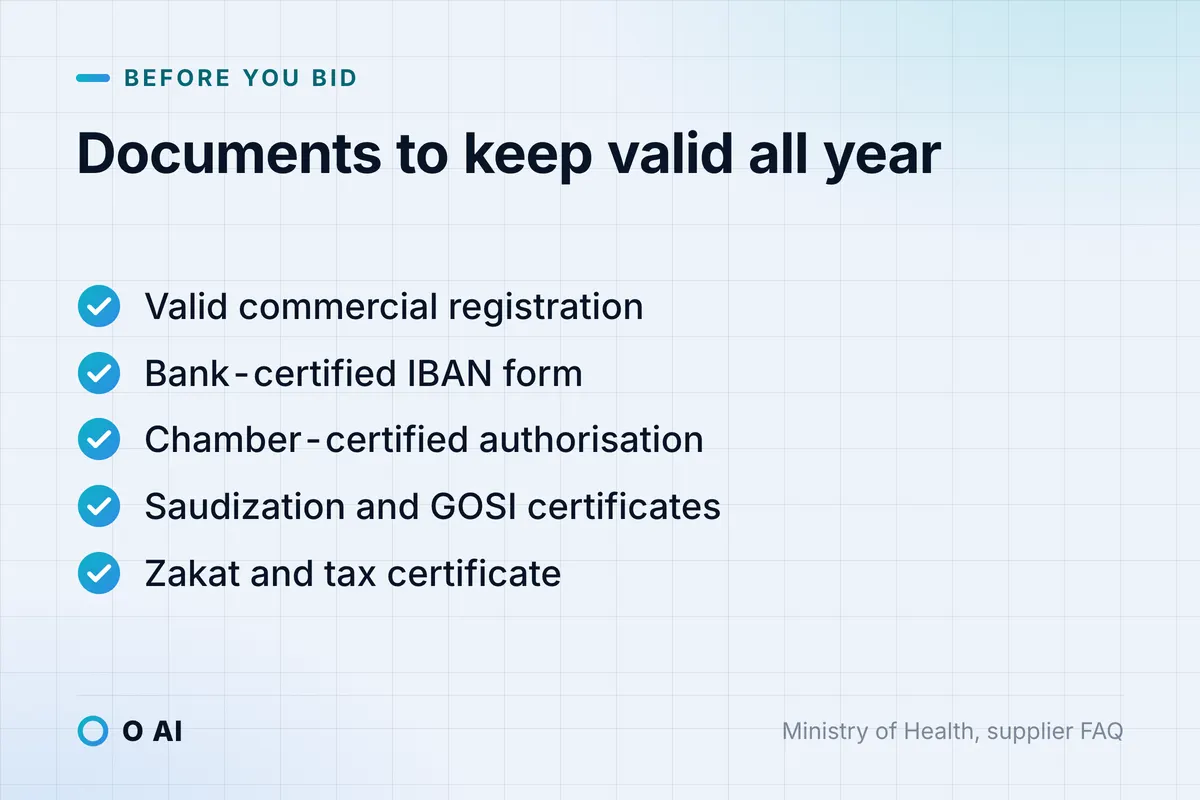
Keep these current all year, not only when a tender appears. Bids are accepted only within the period the tender sets [4], and a certificate that expires during that window can cost you the bid. If you need to confirm your own VAT details first, see how to verify a VAT number on ZATCA.
How a government tender runs on Etimad
Government tenders follow the same path on the Portal. The numbers below are from the new law as published in September 2026 [4]; for tenders launched before it takes effect, the M/128 rules apply.
- Planning. Each government entity publishes its works and procurement plan at the start of the fiscal year (Article 12). Publishing a plan does not oblige the entity to buy.
- Announcement. A public tender is announced on the Portal (Article 29).
- Bids. Bids are submitted encrypted through the Portal and only within the set period. Sealed paper bids are allowed only when the Portal cannot be used for technical or national-security reasons (Article 36).
- Initial guarantee. Each bid carries an initial guarantee of 1% to 2% of its value; a bid without it is not accepted (Article 41).
- Validity. Bids stay valid for 90 working days from the bid-opening date (Article 39).
- Award and standstill. After the award decision is announced, a standstill period of 3 to 10 working days follows, during which the contract cannot be signed (Article 50).
- Final guarantee. The winner provides a final guarantee of 5% of the contract value after being told of the award (Article 59).
Contracting methods other than public tender include limited competition, two-stage competition, direct purchase and reverse auction (Articles 30 to 33) [4].
Old law and new law: what changes for suppliers
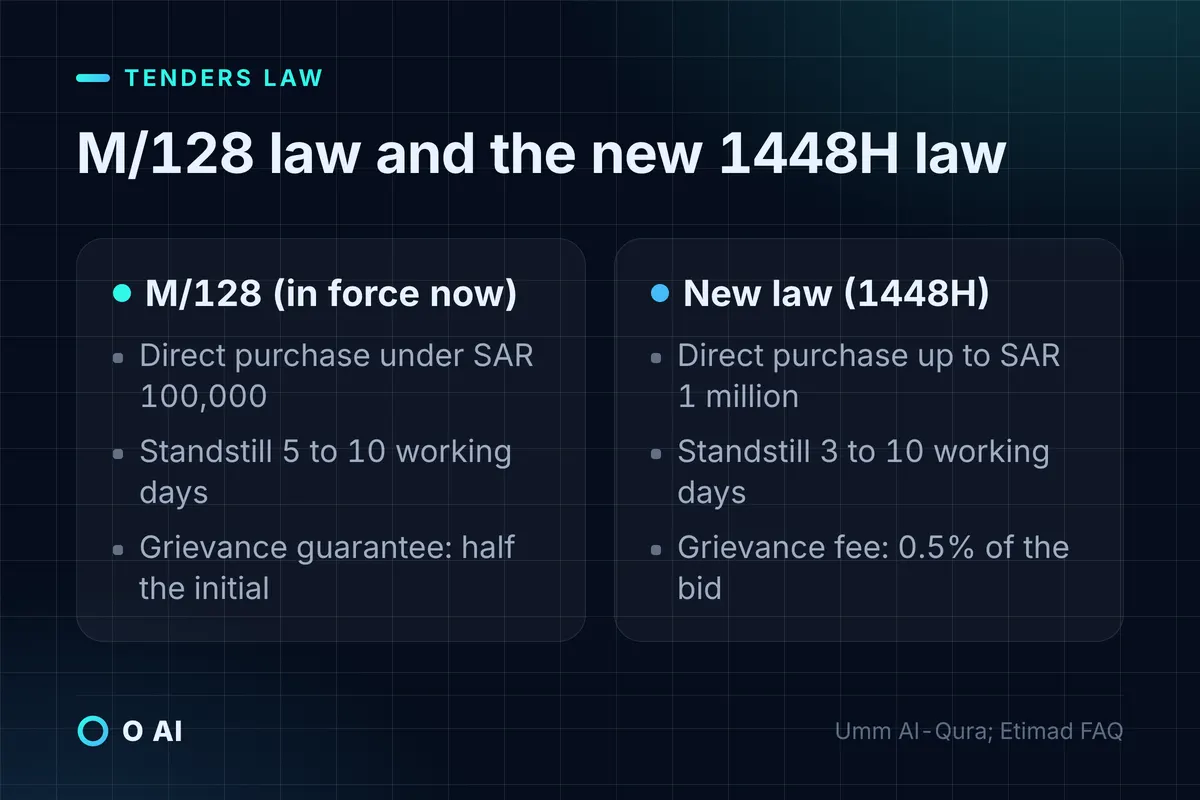
This is the comparison most suppliers ask for. The left column is the M/128 regime, which still governs tenders launched before the new law takes effect; the right column is the new law.
| Topic | M/128 law (in force now) | New law (approved 1448H) |
|---|---|---|
| Direct purchase by value | Allowed below SAR 100,000 [6] | Allowed up to SAR 1 million, with priority to local SMEs (Art. 32) [4] |
| Standstill after award | 5 to 10 working days [6] | 3 to 10 working days (Art. 50) [4] |
| Grievance to the entity | During the standstill; entity decides within 15 days [6] | Award decision: during the standstill; earlier decisions: within 5 working days of the decision. Entity decides within 15 working days; silence counts as rejection (Art. 85) [4] |
| Escalation to the committee | Within 3 days, with a guarantee of half the initial guarantee [6] | Within 3 working days; fee of 0.5% of the bid value, or SAR 15,000 for a prequalification grievance, refunded if the grievance succeeds (Arts. 84–85) [4] |

The new law also caps delay penalties at 6% of the value of a supply contract and 15% of other contracts (Article 70). A violation can lead to a ban on dealing with government entities for up to five years, a lower classification, or a fine of up to 10% of the bid value instead of a ban (Article 87) [4].
Framework agreements under the tenders law
A framework agreement is an agreement between a government entity and one or more suppliers that sets the terms of contracts awarded during a set period (Article 1 of the new law) [4]. Under Article 58, an entity may conclude one with the winning bidder when it cannot fix the quantities, volumes or timing in advance [4].
Under the M/128 regulations, the Etimad FAQ explains two types [6]:
- Open agreement: new suppliers may join; its term may not exceed 4 years.
- Closed agreement: no new suppliers may join; its term may not exceed 3 years.
When a need arises, the entity invites only the parties to the agreement to bid and chooses the lowest price [6]. For a supplier, winning a place on a framework agreement means repeat orders without a new public tender each time, so read its duration and its pricing terms closely.
Small and medium enterprises in government tenders
The new law gives priority to local small and medium enterprises, local content and listed companies (Article 9) [4]. Local SMEs are exempt from the initial guarantee (Article 42), but an exempt bidder that causes a forfeiture pays a fine of 2% of its bid value [4].
Under the M/128 regime, the Etimad FAQ adds two points [6]. SMEs are not exempt from the final guarantee. And an SME that withdraws its bid early, or fails to provide the final guarantee after an award, pays a fine equal to the initial guarantee; if it does not pay within 60 days it is barred from dealing with government entities for one year. Funding the guarantee itself is a separate question, covered in our guide to small business financing in Saudi Arabia.
Common mistakes suppliers make on Etimad
These come straight from the rules above:
- Bidding on documents that expire mid-tender. Bids are accepted only within the set period [4], and the tender reviews the certificates you attach.
- Missing the grievance window. Under the new law a grievance against an award must reach the entity during the standstill period, and one against an earlier decision within 5 working days of it; you then have 3 working days to escalate to the committee [4].
- Assuming the new law already applies. Until it takes effect, and for tenders launched before then, the M/128 law governs [5].
- Leaving the bid guarantee to the last day. A bid without its initial guarantee is not accepted, unless you fall within an exemption such as local SMEs [4].
- Registering under the wrong commercial registration. An Etimad subscription cannot be moved to another registration [3].
Your next step
Before the next tender in your field opens, log in to the Etimad platform with Nafath, check that your establishment's details and users are right, and list the expiry date of every certificate a buyer may ask for. Start with the registration itself: our guide to the annual confirmation of a commercial registration explains how to keep it active.
Frequently asked questions
What is the Etimad platform used for?
Etimad is the unified electronic portal for government procurement in Saudi Arabia. Government entities announce public tenders on it, and suppliers submit encrypted bids, follow awards, sign contracts and track invoices and payments through it. It is run by the National Center for Government Resource Systems under the supervision of the Ministry of Finance.
How do I register my company on Etimad?
Choose the Etimad Business option on the login page and sign in with Nafath, or with the owner's or an authorised user's Saudi Business Center details. Your first login inside the Kingdom must be through Nafath. After you confirm your contact details, the username and password arrive by text message, and a confirmation link goes to your registered email.
Can a foreign company without a Saudi commercial registration use Etimad?
Yes. Etimad offers a "supplier without a registration" option for foreign entities, after which they log in through the business option, and the platform can be used from outside Saudi Arabia. Whether a foreign supplier can win a given contract is a separate matter that depends on the law's rules on foreign persons and on the tender conditions.
When does the new Government Tenders and Procurement Law take effect?
The new law takes effect 120 days after its publication in the Official Gazette. The text on the Umm Al-Qura portal is dated 4 September 2026, which by our count points to early January 2027. Tenders launched before then remain under the law issued by Royal Decree M/128, so check the date of each tender.
How much is the bid guarantee in a government tender?
Under the new law, the initial guarantee is between 1% and 2% of the bid value, and a bid without it is not accepted. The winner then provides a final guarantee of 5% of the contract value. Local small and medium enterprises are exempt from the initial guarantee, but not from the final guarantee under the current regime.
What is a framework agreement in the tenders law?
A framework agreement is a contract between a government entity and one or more suppliers that fixes the terms of orders placed during a set period. Under the current regulations, an open agreement may last up to four years and admits new suppliers, while a closed agreement may last up to three years and admits none.
How this article was made: Researched from the official sources listed below, opened on 29 October 2026. Drafted with AI assistance, then checked against those sources. General information, not legal or professional advice. Illustrations were made for this article.
Sources
- Etimad platform (opens in a new tab)National Center for Government Resource Systems · ncgr.gov.sa
- About the centre (home page) (opens in a new tab)National Center for Government Resource Systems · ncgr.gov.sa
- Login page and frequently asked questions (opens in a new tab)Etimad · login.etimad.sa
- Government Tenders and Procurement Law (1448H) (opens in a new tab)Umm Al-Qura Gazette · uqn.gov.sa
- Royal Decree No. M/76 dated 27/2/1448H (opens in a new tab)Umm Al-Qura Gazette · uqn.gov.sa
- Frequently asked questions on the new Government Tenders and Procurement Law (1440H law) (opens in a new tab)Etimad · etimad.sa
- Minister of Finance Decision No. 257 dated 29/3/1448H (opens in a new tab)Umm Al-Qura Gazette · uqn.gov.sa
- Frequently asked questions for suppliers (opens in a new tab)Ministry of Health · moh.gov.sa
About the author
Newsletter
New guides and news by email
New guides and news about O AI, Rushd and Dalni, at most twice a month. No spam.