 AI


Salla vs Zid, Shopify or a custom store: how to choose
Salla vs Zid, Shopify or a custom build: a decision table for Saudi merchants, each platform's plans as shown on 29 October 2026, a worked example of Shopify's third-party payment fee, the costs a subscription leaves out, and how to move platforms safely.

Key takeaways
- For standard products sold inside Saudi Arabia, Salla or Zid usually fits; Shopify suits cross-border sellers; a custom store fits unusual pricing or ordering.
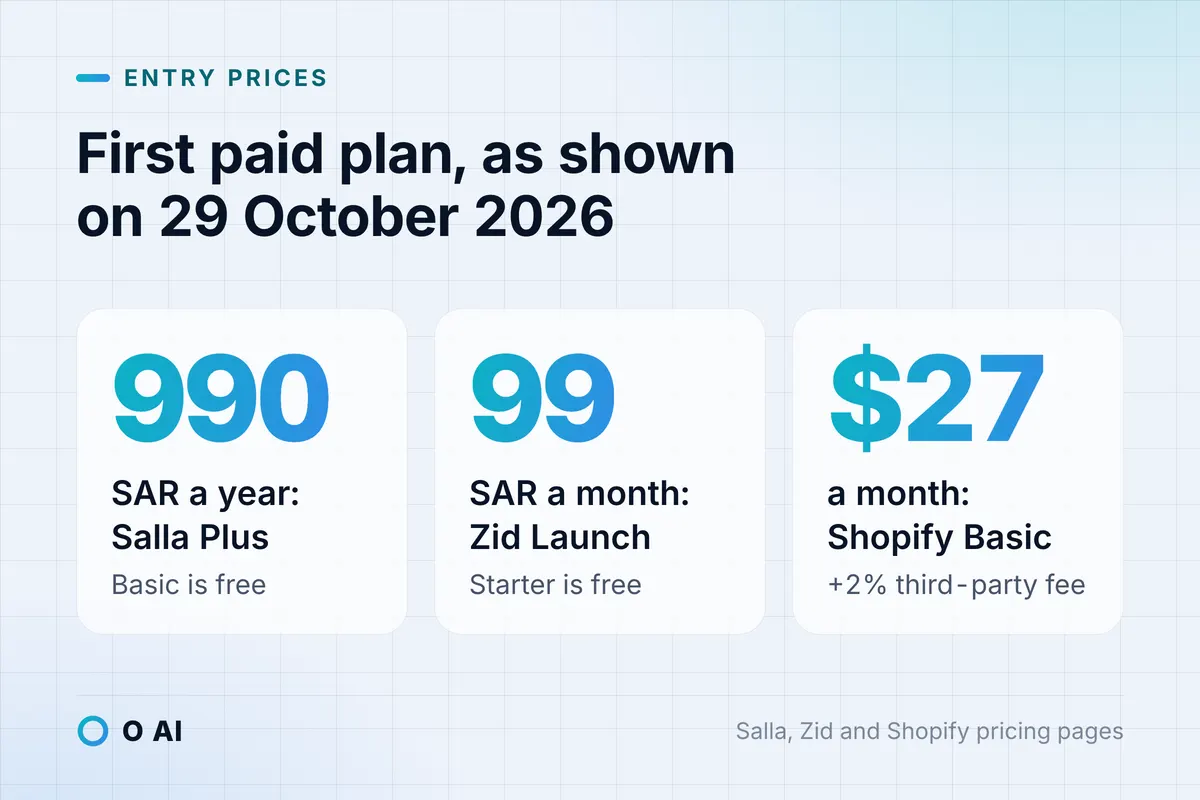
- Salla's Basic plan is free; online payments and a custom domain are listed from Plus, shown at SAR 990 a year on 29 October 2026.
- Zid's Starter plan is free with unlimited products; Launch is SAR 99 a month and Growth SAR 299 a month, as shown on 29 October 2026.
- Shopify Payments is not offered in Saudi Arabia, so Shopify adds a fee on third-party payments: 2% on Basic, 1% on Grow, 0.6% on Advanced.
- Whatever the platform, the seller remains responsible for legal status, ZATCA e-invoicing and PDPL consent for marketing messages.
On this page
- Which platform fits which store?
- What is the Salla platform, and what do its plans include?
- What does the Zid platform offer?
- Shopify in Saudi Arabia: what changes?
- Salla vs Zid vs Shopify: what the subscription leaves out
- When a custom-built store makes sense
- Data, rules and lock-in: questions to ask any platform
- Moving from one platform to another
- Your next step
Salla vs Zid is the first comparison most Saudi merchants make, and for a store selling standard products inside Saudi Arabia either one usually fits: both are Saudi platforms with Arabic stores and local payments and shipping. Shopify suits cross-border sellers who can accept US-dollar pricing and an extra payment fee. A custom store fits only when your selling model breaks a standard checkout.
Which platform fits which store?
The right platform depends on where your customers are, what you sell and how much you need to change the checkout. No platform is right for every store, so start from your model, not from the brand. This table summarises the fit as of October 2026, based on each platform's own pages.
| Option | Fits when | Watch for |
|---|---|---|
| Salla | You sell to customers in Saudi Arabia and want payments, shipping and an app store ready to use [1][2] | Online payments, a custom domain and international shipping are listed from the paid Plus plan up [2] |
| Zid | Similar fit, and you want a free starter plan with unlimited products, or a listing on Zid's Mazeed marketplace [3] | The free plan has no custom domain and only bank transfer and cash on delivery [3] |
| Shopify | You sell across borders, or rely on its range of add-on apps [4] | Prices in US dollars, and Shopify Payments is not offered in Saudi Arabia, so a third-party payment fee applies [4][5] |
| Custom-built store | Your pricing, ordering or fulfilment does not fit a standard product page and cart | You pay for the build and for years of maintenance and security |
Is there a single best platform to create an online store?
No. A platform that fits a perfume brand selling in Riyadh may not fit a B2B supplier with contract prices or a store selling to the whole Gulf. Compare by task, total cost and how easily you can leave, and treat any ranking that crowns one winner with caution.
What is the Salla platform, and what do its plans include?
Salla is a Saudi hosted e-commerce platform: you rent the store software, and Salla runs the hosting, checkout and updates. On its home page Salla says it serves more than 68,000 active stores in Saudi Arabia and the UAE, links to more than 100 shipping and delivery companies and lists over 550 apps in its app store [1]. Those are the company's own figures.
Salla's plans page lists four plans [2]:
| Salla plan | Price shown on 29 October 2026 | What it adds |
|---|---|---|
| Basic | Free | Unlimited products, orders and customers; discount coupons; customer reviews; discounted Salla shipping rates |
| Plus | SAR 990 a year | Online payments, local and international shipping, a custom domain, all product types, in-store selling with the Salla Point app |
| Pro | SAR 2,990 a year | Immediate VAT activation, staff accounts, design changes with CSS and JavaScript, accounting integrations |
| Special | Priced on request | A success manager, flexible payment fees, branch and warehouse management, ERP integration |
Salla says the yearly price includes a 16% discount compared with paying monthly [2]. Prices change; check the plans page before you subscribe.
What does the Zid platform offer?
Zid is the other large Saudi hosted platform, with a similar model: Arabic storefronts, local payment methods and shipping-company integrations. Its pricing page lists four plans [3]:
| Zid plan | Price shown on 29 October 2026 | Key limits and additions |
|---|---|---|
| Starter | Free | One team member; unlimited products, orders and customers; bank transfer and cash on delivery; no custom domain; listing on the Mazeed marketplace |
| Launch | SAR 99 a month | Custom domain, advanced payment methods, chat support; one team member |
| Growth | SAR 299 a month | Five team members, invoice and tax settings, CSS customisation |
| Professional | Contact sales | Up to 20 team members |
All Zid plans include invoice and shipping-label printing, the Zid Wallet and a cashier app for phones and tablets [3]. The pricing page asks whether there is a commission on sales but did not show the answer when we opened it, so confirm payment and sales fees with Zid in writing.
Shopify in Saudi Arabia: what changes?
Shopify is a global platform with a large app and theme market. Merchants in Saudi Arabia can use it, but two things change the maths. First, its prices for Saudi Arabia are in US dollars: Basic is $27 a month, or $19 a month billed yearly, and Grow is $72, or $54 billed yearly [4]. Second, Shopify Payments, its own payment service, is available in the UAE but not in Saudi Arabia [5]. Stores that use another payment provider pay Shopify an extra fee: 2% on Basic, 1% on Grow and 0.6% on Advanced [4].
Illustrative example. A Jeddah store on Shopify Basic sells SAR 40,000 a month through a local payment gateway. On top of the subscription and the gateway's own fees, Shopify's third-party fee is 2% of SAR 40,000, which is SAR 800 a month, or SAR 9,600 a year. On the Grow plan the same fee would be 1%, SAR 400 a month. Run this sum with your own sales before you compare subscription prices.
Salla vs Zid vs Shopify: what the subscription leaves out
The plan price is rarely the full cost. Before you compare Salla, Zid and Shopify, add these lines to the first-year estimate:
- Payment fees: each card, mada or buy-now-pay-later transaction carries a fee charged by the payment provider, and on Shopify the third-party fee above [4].
- Shipping: rates depend on the carrier, the city and the weight; the platform's discounted rates help, but you still pay per shipment [2].
- Apps: reviews, loyalty, advanced filters and accounting links are often paid add-ons from the app store.
- Themes and design: a free theme is enough to start; a paid theme or design work is an extra cost.
- Team seats: Zid's plans limit team members (one, five or 20) [3], and Salla adds staff accounts on Pro [2].
- Your own time: product photos, descriptions and customer service cost more than the software for most small stores.
When a custom-built store makes sense
A custom store is software built for your business and hosted by you or your developer. It is rarely the right first step, but it becomes sensible when the platform forces daily workarounds. Typical signs:
- Pricing a cart cannot express: contract prices per business customer, quotes before orders, or prices that depend on measurements.
- Ordering tied to operations: stock from several warehouses with your own allocation rules, or orders that must flow into an existing ERP in real time.
- A product that is not a product page: bookings, subscriptions with unusual terms, configurators or marketplaces with many sellers.
- Full control of data and code: you need your own hosting, your own customer database, or features that the platform's apps cannot reach.
There is also a middle path. Salla offers developers merchant APIs for orders, products and customers, webhooks and OAuth apps through Salla Partners [6], and Zid lets developers build public, private, shipping and subscription apps; a private app on Zid needs the Professional or Enterprise plan or activated API access [7]. Many "custom" needs can be met with a private app on top of a hosted store, at a fraction of a full build. Saudi software companies such as O AI build both private apps and full custom stores; the choice should follow your model.
Data, rules and lock-in: questions to ask any platform
Whichever platform you choose, the legal obligations stay with you as the seller. Ask these questions before you commit:
| Question | Why it matters |
|---|---|
| What is my legal status as a seller? | You sell under a commercial registration or, for approved professions, a freelance document from the Ministry of Human Resources and Social Development, which is free as of October 2026 [8]. Our guide to e-commerce authentication covers the steps |
| Who issues my tax invoices? | If you are VAT-registered, invoices must meet ZATCA's e-invoicing rules, in force since 4 December 2021, with integration in waves from 1 January 2023 [9][10]. Check whether the platform's invoices meet them or link a ZATCA-compliant accounting system; ZATCA's list of solution providers is guidance, not a requirement [11] |
| May I message my customers? | Under the Personal Data Protection Law, marketing messages need the person's consent and a clear way to stop them (Article 25) [12]; the Implementing Regulations add that consent is documented so it can be verified later and that stopping messages is easy and simple (Articles 28 and 29) [13] |
| Where is customer data stored? | Transfers of personal data outside the Kingdom must meet SDAIA's transfer regulation, such as an adequacy list or safeguards like standard contractual clauses [14] |
| Can I take my data with me? | Check that you can export products, customers and orders in a standard file, and whether the platform offers an API to do it [6][7] |
This is general information, not legal or tax advice; for a specific case, check the official source or ask a licensed advisor.
Moving from one platform to another
Many stores start on a free plan and move later, either between Salla and Zid or to Shopify or a custom build. A move is safer when you plan it in this order:
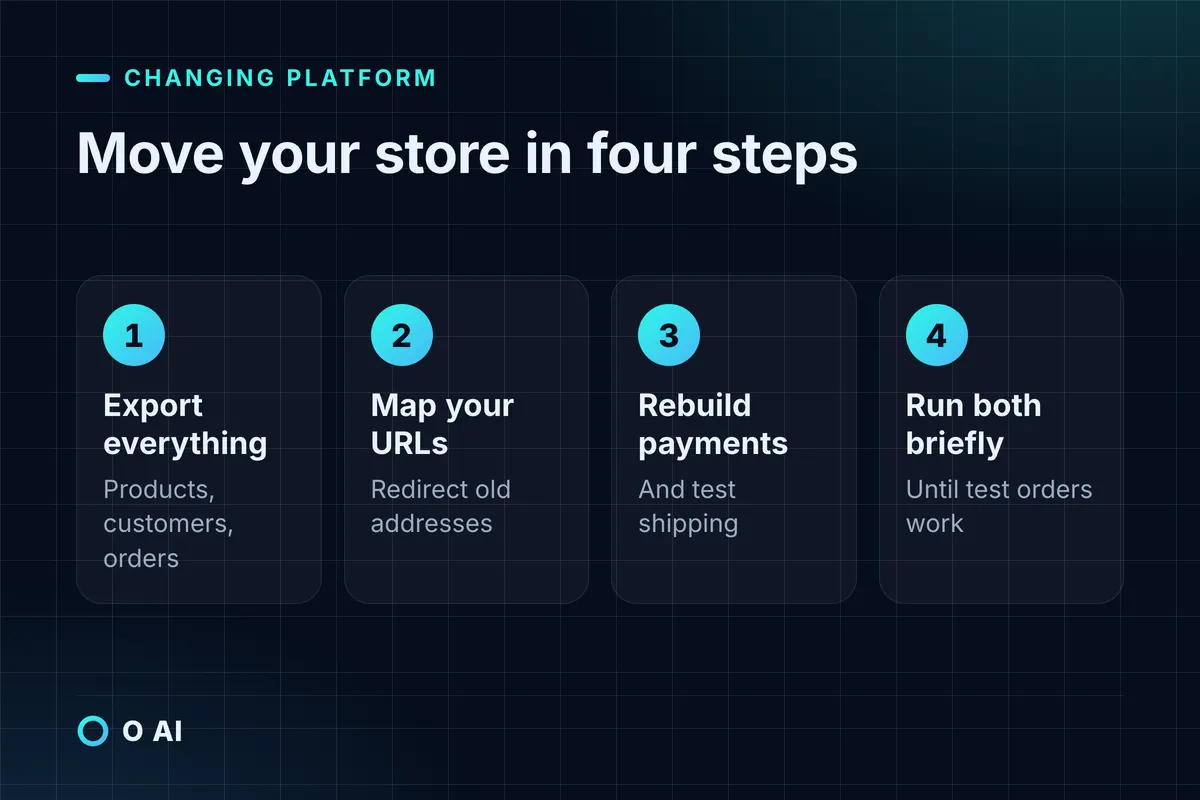
- Export everything first: products with images and variants, customers, past orders and discount codes.
- Map your URLs: list each product and category address on the old store so you can redirect it to the new one and keep search traffic.
- Rebuild payments and shipping: open the new payment account early, because approval can take time, and test every city and method you sell to.
- Run both for a short overlap: keep the old store live until test orders, invoices and customer logins work on the new one.
Customer data you move is still personal data, so keep the consent records with it [12].
Your next step
Write down three things: where your customers are, which payment methods they use, and anything your product needs that a normal cart cannot do. If the answers are "Saudi Arabia, mada and cards, nothing unusual", start a free Salla or Zid store and test it with real products this week; if the third answer is long, compare a private app with a custom build. For the registration and launch steps, read our guide to creating an online store in Saudi Arabia, and for what a custom build involves, see our page on website and e-commerce store development.
Frequently asked questions
Is a Salla store free?
Salla's Basic plan is free and includes unlimited products, orders and customers. Online payments, a custom domain and international shipping are listed from the Plus plan, shown at SAR 990 a year on 29 October 2026. Many merchants test the free plan first and upgrade once they are ready to take card payments.
What is the difference between Salla and Zid?
Both are Saudi hosted platforms with Arabic stores, local payments and shipping. The differences are in the plans: Zid's free plan includes cash on delivery and bank transfer and a Mazeed marketplace listing, while Salla's free plan focuses on catalogue and coupons. Compare team seats, design control, app choice and payment fees for your own store.
Does Shopify work in Saudi Arabia?
Yes, merchants in Saudi Arabia can open a Shopify store, priced in US dollars. Shopify Payments is not offered in Saudi Arabia, so stores use a third-party payment provider and pay Shopify an extra fee on each sale: 2% on Basic, 1% on Grow and 0.6% on Advanced, on top of the provider's own fees.
Do I need a commercial registration to open a store on Salla or Zid?
You need a legal basis to sell online. That is usually a commercial registration, or, for professions on the approved list, a free freelance document for Saudi nationals aged 18 or over with an active Absher account. Check what the platform asks for before you activate payments, and complete the store's e-commerce authentication.
Can I move my store from Salla to Zid or Shopify later?
Yes, but plan it. Export products, customers and orders first, map every old product address to its new one, set up payments and shipping on the new platform, and keep the old store running until test orders work. Moving consent records with customer data keeps your marketing lists compliant.
What is the best website to create an online store in Saudi Arabia?
There is no single best website for every store. For local sales of standard products, Salla and Zid are the usual starting points; Shopify suits cross-border selling; a custom build fits unusual pricing or ordering. The best choice for you is the one whose total first-year cost and exit options fit your model.
How this article was made: Researched from the official sources listed below, opened on 29 October 2026. Drafted with AI assistance, then checked against those sources. General information, not legal or professional advice. Illustrations were made for this article.
Sources
- Salla home page (in Arabic) (opens in a new tab)Salla · salla.com
- Salla plans (in Arabic) (opens in a new tab)Salla · salla.com
- Pricing (in Arabic) (opens in a new tab)Zid · zid.sa
- Pricing (Saudi Arabia) (opens in a new tab)Shopify · shopify.com
- Shopify Payments supported countries (opens in a new tab)Shopify Help Center · help.shopify.com
- Salla developer documentation (opens in a new tab)Salla · docs.salla.dev
- Zid developer documentation (opens in a new tab)Zid · docs.zid.sa
- Freelance platform: frequently asked questions (in Arabic) (opens in a new tab)Ministry of Human Resources and Social Development · freelance.sa
- E-Invoicing (opens in a new tab)Zakat, Tax and Customs Authority (ZATCA) · zatca.gov.sa
- Roll-out phases (opens in a new tab)Zakat, Tax and Customs Authority (ZATCA) · zatca.gov.sa
- Solution Providers Directory (opens in a new tab)Zakat, Tax and Customs Authority (ZATCA) · zatca.gov.sa
- Personal Data Protection Law (opens in a new tab)Saudi Data and AI Authority (SDAIA) · dgp.sdaia.gov.sa
- Implementing Regulations of the Personal Data Protection Law (opens in a new tab)Saudi Data and AI Authority (SDAIA) · dgp.sdaia.gov.sa
- Regulation on Personal Data Transfer outside the Kingdom (opens in a new tab)Saudi Data and AI Authority (SDAIA) · dgp.sdaia.gov.sa
About the author
Newsletter
New guides and news by email
New guides and news about O AI, Rushd and Dalni, at most twice a month. No spam.