 AI


Saudization of HR jobs: the quotas, the roles and the steps for employers
HRSD's April 2026 decision on administrative support occupations restricts 30 HR roles to Saudis at entity level. This guide lists every code, explains how compliance is checked and how it differs from Nitaqat, with a worked example and seven steps for employers.


Key takeaways
- Ministerial decision 132249 of 5 April 2026 restricts 30 HR occupations to Saudis at 100%, measured across the whole entity.
- The HR clerk, employee relations manager and labour affairs manager roles applied at once; the other 27 HR roles followed on 4 October 2026.
- Compliance is checked automatically from occupational titles in GOSI's records, and the Ministry also looks at the work actually done.
- The rule applies regardless of the Nitaqat band, so an entity in a green band can still breach it on a single HR role.
- Qiwa's Nitaqat calculator covers the entity ratio for 6 to 50,000 employees; occupation rules need a role-by-role check.
On this page
- What the decision on HR occupations says
- Which HR occupations are covered
- Other administrative roles in the same decision
- How the Ministry measures compliance
- Saudization of HR jobs and Nitaqat: two different tests
- Saudization calculator: checking both tests
- Steps for employers
- Mistakes to avoid
- Your next step
Saudization of HR jobs is now complete for the listed roles. Ministerial decision 132249 of 5 April 2026 restricts 30 HR occupations, from HR clerk to HR manager titles, to Saudis at the level of the whole entity. Three applied from the day the decision was issued; the other 27 followed when a six-month grace period ended on 4 October 2026.
This guide lists the HR occupations covered, explains how the Ministry of Human Resources and Social Development (HRSD) measures compliance, sets the rule beside Nitaqat, and gives employers a step-by-step check. Every figure comes from HRSD, Qiwa and Mudad documents checked on 14 October 2026. It is general information, not legal advice: for a specific case, check the official source or ask a licensed advisor.
What the decision on HR occupations says
HR roles were not localised by a stand-alone decision. They sit inside HRSD's decision on administrative support occupations, number 132249 dated 5 April 2026, which approved an updated procedural guide for those occupations [1].
The core rules in the guide are short [2]:
- The ratio is 100%. Work in the listed occupations is restricted to Saudis, measured at the level of the entity, which means all branches of the same economic activity owned by one establishment.
- It applies to every private-sector establishment in the Saudi market that employs at least one worker in a listed occupation, whatever its size.
- The highest ratio wins. If an earlier or later decision targets one of these occupations with a different ratio, the higher ratio applies.
- Some roles applied at once, others after a grace period. Nineteen of the 69 occupations in the decision applied from the date of issue; the other 50 had six months, until 4 October 2026.
Which HR occupations are covered
The HR family in the decision has 30 occupations: 16 manager titles with codes beginning 1212, 13 specialist titles beginning 2423, and the HR clerk, 441601 [2]. The English titles below are our translation; the official list is in Arabic.
| Code | Occupation | Restricted to Saudis from |
|---|---|---|
| 441601 | HR clerk | 5 April 2026 |
| 121208 | Employee relations manager | 5 April 2026 |
| 121211 | Labour affairs manager | 5 April 2026 |
| 121201 | HR operations manager | 4 October 2026 |
| 121202 | Workforce planning manager | 4 October 2026 |
| 121203 | Occupational classification manager | 4 October 2026 |
| 121204 | Recruitment manager | 4 October 2026 |
| 121205 | Compensation manager | 4 October 2026 |
| 121206 | Talent manager | 4 October 2026 |
| 121207 | HR development manager | 4 October 2026 |
| 121209 | Overseas recruitment office manager | 4 October 2026 |
| 121210 | Labour office manager | 4 October 2026 |
| 121212 | Civil service office manager | 4 October 2026 |
| 121213 | Organisational development manager | 4 October 2026 |
| 121214 | Administrative organisation manager | 4 October 2026 |
| 121215 | Administrative investigation manager | 4 October 2026 |
| 121216 | HR manager, cybersecurity | 4 October 2026 |
| 242301 | Employee engagement specialist | 4 October 2026 |
| 242302 | HR operations specialist | 4 October 2026 |
| 242303 | Job and occupational classification specialist | 4 October 2026 |
| 242304 | Recruitment specialist | 4 October 2026 |
| 242305 | Compensation specialist | 4 October 2026 |
| 242306 | Career guidance specialist | 4 October 2026 |
| 242307 | Labour investigator | 4 October 2026 |
| 242308 | Labour committee member | 4 October 2026 |
| 242309 | Workforce planning specialist | 4 October 2026 |
| 242310 | HR monitoring specialist | 4 October 2026 |
| 242311 | Overseas recruitment specialist | 4 October 2026 |
| 242312 | HR consultant | 4 October 2026 |
| 242313 | HR expert | 4 October 2026 |
As of 14 October 2026, all 30 are in force. A title that sounds like HR but is not on the list may still be covered by another decision, so check the exact code, not just the name.

Other administrative roles in the same decision
HR teams usually manage the hiring for the rest of the back office, so the other 39 occupations in the decision matter too. They include secretaries, executive secretaries and administrative assistants, receptionists and hotel receptionists, data-entry clerks and typists, translators and interpreters, public relations specialists and managers, government relations clerks, cashiers, storekeepers, shipping and customs agents, and security guards [2].
More decisions of this kind are coming. HRSD's list of procedural guides also includes, for example, the localisation of project management occupations at 70% from 14 February 2027 [3]. Checking the guides list every quarter is part of HR planning.
How the Ministry measures compliance
Compliance is tracked automatically. The system applies the ratio using the occupational titles held in GOSI's database, then checks wages and professional accreditation through technical links with the supervising bodies [2].
Three points in the guide matter most for employers [2]:
- Title and actual work both count. The decision applies to the occupations as classified in the Saudi Unified Classification of Occupations, issued by the General Authority for Statistics, and to the work the employee actually does.
- Renaming a role does not help. Assigning any task of a localised occupation to a non-Saudi, directly or indirectly, under another job title triggers the Saudization penalties set by ministerial decisions 75913 (19/05/1445H) and 44558 (03/04/1446H), as amended.
- Your Nitaqat band does not protect you. The occupation rule is applied regardless of the establishment's Nitaqat band, and the band does not change how the HR occupation ratio is calculated.
Saudization of HR jobs and Nitaqat: two different tests
Nitaqat and occupation-based Saudization run side by side, and passing one does not mean passing the other.
| Nitaqat | Saudization of HR occupations | |
|---|---|---|
| What it measures | The Saudi share of all employees in the entity [4] | Who holds each listed occupation [2] |
| Target | A minimum ratio per band that depends on the economic activity and the number of employees [4] | 100% Saudi in every listed occupation [2] |
| Result | A band: red, low green, medium green, high green or platinum [4] | Compliant, or a violation |
| What happens if you fall short | Services shrink by band; in red, no new visas, work permits, renewals or transfers in [4] | Penalties under the ministerial decisions on Saudization violations [2] |
| How to check | Qiwa's Nitaqat calculator [5] | Match each employee's occupation code to the list |
Saudization calculator: checking both tests
Qiwa's Nitaqat calculator analyses an establishment's current or expected position. You choose the economic sub-activity and enter the numbers of Saudi and non-Saudi employees, and it works for entities with 6 to 50,000 employees [5]. Under the developed Nitaqat programme, the Saudization ratio is the sum of average Saudi employees divided by the sum of average Saudi and non-Saudi employees, multiplied by 100 [4].
The HR occupation rule needs no formula: every listed occupation must be held by a Saudi.
Illustrative example. A contracting company in Riyadh has 40 employees, 14 of them Saudi. Its Saudization ratio for Nitaqat is 14 ÷ 40 × 100 = 35%, and whether that is green depends on the thresholds for its activity and size. Its HR team has three people: a Saudi HR operations manager, a Saudi HR clerk and a non-Saudi recruitment specialist.
| Check | Result on 14 October 2026 |
|---|---|
| Nitaqat band | Depends on the activity's thresholds; check in Qiwa's calculator |
| HR operations manager (121201), Saudi | Compliant |
| HR clerk (441601), Saudi | Compliant |
| Recruitment specialist (242304), non-Saudi | Not compliant since 4 October 2026, whatever the Nitaqat band |
The company may hold a green band and still be in breach on one HR role. Moving the specialist into a different title while keeping the same recruitment tasks would not fix it, because the guide counts the actual work.
Steps for employers
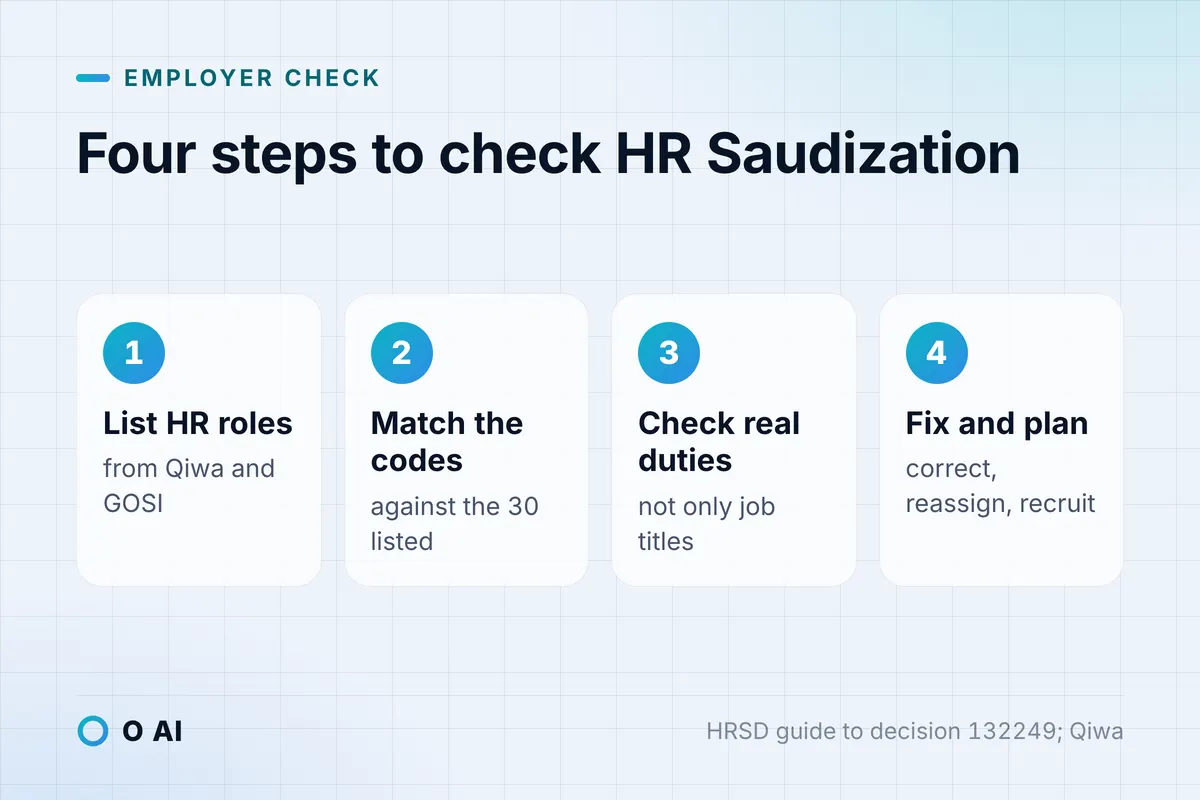
- List every HR role. Export the employee list with occupations from Qiwa and compare it with the GOSI contributor list.
- Match each role to a code. Flag anyone whose registered occupation, or actual duties, falls under one of the 30 HR codes or the other 39 administrative occupations.
- Check actual duties. Look for non-Saudi staff who do recruitment, payroll administration or employee relations under titles such as coordinator or assistant.
- Correct occupations in Qiwa. Qiwa's occupation service shows a compliance indicator against the Saudi Unified Classification of Occupations, and lets the establishment correct or change an employee's occupation [6].
- Plan Saudi hiring and training. The guide promises support with recruitment, training, employment and retention, and priority access to the Saudization support programmes [2].
- Keep wage protection clean. Continued non-compliance in the Wage Protection System can stop HRSD from issuing the Saudization certificate, among other services [7].
- Re-run the Nitaqat calculator after every change, so the entity-level band and the occupation rule are both covered [5].
Mistakes to avoid
- Treating a green band as a pass. Nitaqat and the HR occupation rule are separate tests [2].
- Checking titles only. The decision looks at the work done, not just the title on the contract [2].
- Missing the second date. Roles with the six-month grace period, including HR specialists and most HR manager titles, have been restricted since 4 October 2026 [2].
- Assuming an older or newer decision is irrelevant. Where two decisions overlap, the higher ratio applies [2].

Your next step
This week, export your employee list from Qiwa, mark every role that falls under the 30 HR codes, and list who does recruitment, payroll and employee relations in practice. Where a role is held by a non-Saudi, decide now whether to reassign tasks, correct the occupation or recruit, and record the decision. If your HR records cannot show each employee's official occupation code, our guide on custom software development in Saudi Arabia explains when to adapt a ready-made system and when to build. Getting the Saudization of HR jobs right is easier when the data is clean. You can read more about O AI, a software and AI company in Al Khobar, on our home page. Our ERP and business systems page covers HR records alongside accounting and inventory.
Frequently asked questions
Which HR jobs are restricted to Saudis?
Thirty HR occupations in HRSD's decision on administrative support occupations: the HR clerk, 16 manager titles such as HR operations, recruitment, compensation, talent and HR development managers, and 13 specialist titles such as HR operations, recruitment, compensation and workforce planning specialists, HR consultants and HR experts. The ratio is 100% at the level of the entity. Check each employee's exact occupation code, because the decision follows the Saudi Unified Classification of Occupations.
When did the Saudization of HR jobs take effect?
The decision was issued on 5 April 2026. Three HR occupations applied from that date: the HR clerk, the employee relations manager and the labour affairs manager. The other 27 had a six-month grace period that ended on 4 October 2026. As of mid-October 2026, all 30 HR occupations in the decision are in force.
Does a small company with one HR employee have to comply?
Yes. The decision applies to every private-sector establishment that employs at least one worker in a listed occupation, regardless of the number of employees. A company with a single HR person in a listed role needs that person to be Saudi, even if the rest of the workforce is mostly non-Saudi and the company sits comfortably in its Nitaqat band.
Is the HR Saudization decision the same as Nitaqat?
No. Nitaqat measures the Saudi share of the whole entity and places it in a band from red to platinum, with thresholds that depend on activity and size. The HR occupation decision looks at each listed role and requires it to be held by a Saudi. The guide says the occupation rule applies regardless of the Nitaqat band, so an establishment can be green in Nitaqat and still breach the HR rule.
Can a non-Saudi do HR tasks under a different job title?
No. The guide says that giving any task of a localised occupation to a non-Saudi, directly or indirectly, under another job title triggers the penalties for Saudization violations. The Ministry also checks actual work, not only the registered title, so renaming a recruitment role as a coordinator does not solve the problem.
How do I use a Saudization calculator?
Qiwa's Nitaqat calculator is the official tool for the entity-level ratio: choose the economic sub-activity, enter the numbers of Saudi and non-Saudi employees, and see the band now or after planned changes. It works for entities with 6 to 50,000 employees. For occupation-based decisions such as HR, there is nothing to calculate: list each employee in a covered occupation and confirm that every one of them is Saudi.
How this article was made: Researched from the sources listed below, opened on 14 October 2026. Drafted with AI assistance, then checked against those sources. General information, not professional advice. Images are AI-generated illustrations.
Sources
- Procedural guide to the decision localising administrative support occupations: decision page (in Arabic) (opens in a new tab)Ministry of Human Resources and Social Development (HRSD) · hrsd.gov.sa
- Procedural guide to the decision localising administrative support occupations, April 2026 (PDF, in Arabic) (opens in a new tab)HRSD · hrsd.gov.sa
- Procedural guides list (in Arabic) (opens in a new tab)HRSD · hrsd.gov.sa
- Procedural guide to the developed Nitaqat programme, 2026 (PDF, in Arabic) (opens in a new tab)HRSD · hrsd.gov.sa
- Nitaqat calculator (in Arabic) (opens in a new tab)Qiwa · qiwa.sa
- Occupation management service (in Arabic) (opens in a new tab)Qiwa · qiwa.sa
- Frequently asked questions: Wage Protection System (in Arabic) (opens in a new tab)Mudad · mudad.com.sa
About the author
Newsletter
New guides and news by email
New guides and news about O AI, Rushd and Dalni, at most twice a month. No spam.