 AI


How to transfer a commercial registration: cases, steps and fees
Only a sole proprietorship's commercial registration can be transferred directly in Saudi Arabia. This guide covers the cases, the conditions that block a transfer, the seller's and buyer's steps, the fees for each route, and the zakat and VAT points to agree in writing.


Key takeaways
- Only a sole proprietorship's commercial registration has a direct transfer service; on 14 October 2026 the Ministry of Commerce listed SAR 500 and up to 72 hours.
- The buyer must be at least 18, not a government employee and not already own a sole proprietorship; a trade name that is the seller's personal name must be changed first.
- The buyer signs an undertaking to take over all of the establishment's obligations, so zakat, VAT and staff commitments belong in the written sale agreement.
- Company ownership changes through the articles of association, listed at SAR 1,500 plus SAR 100 for the registration update and 15% VAT.
- After a transfer, changes to registered data must be updated within 15 days, and licences for newly added activities obtained within 90 days.
On this page
- What the 2025 Commercial Register Law changed for transfers
- Which cases count as a transfer, and which route fits yours?
- Conditions that block a commercial registration transfer
- Steps to transfer a sole proprietorship registration
- What a commercial registration transfer costs: a worked example
- The trade name: keep it, change it or sell it separately
- Zakat, VAT and data: what to settle in the sale agreement
- When the owner has died: transfer or continue
- Common mistakes when you transfer a commercial registration
- Your next step
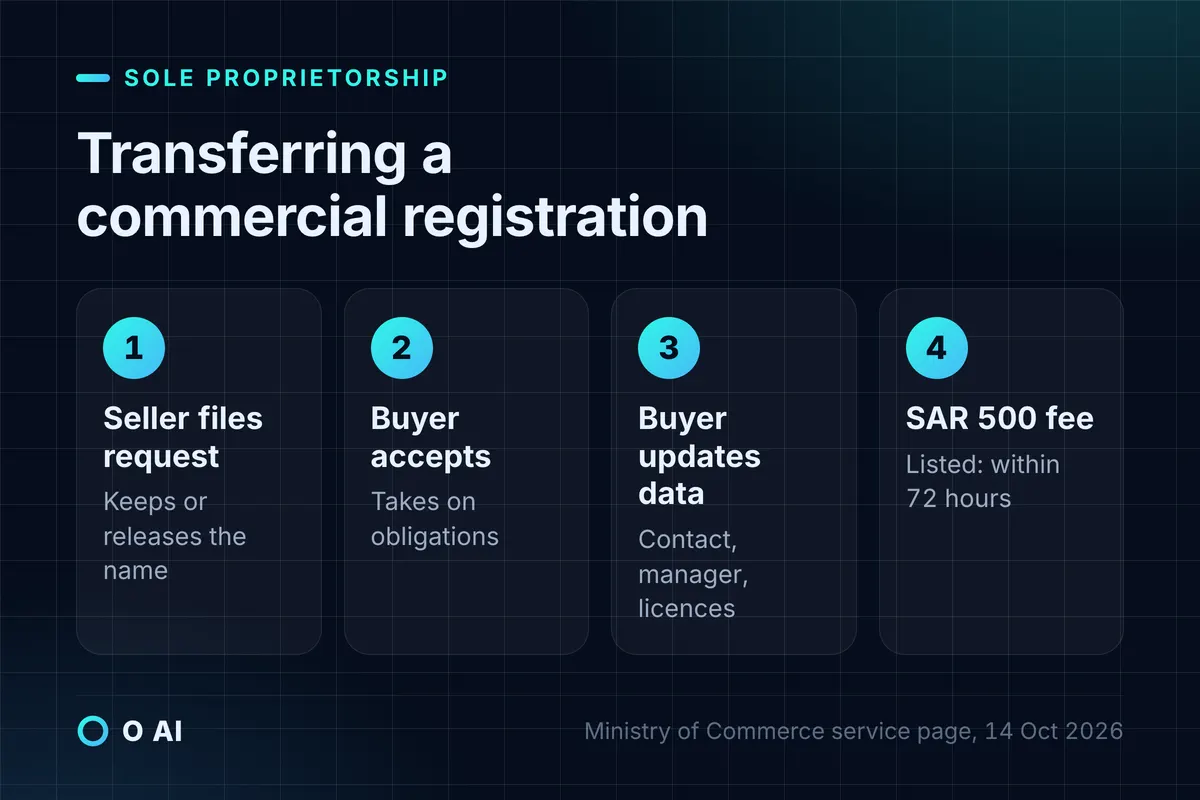
You can transfer a commercial registration directly only when it belongs to a sole proprietorship. The current owner files the request on the Business Platform, the buyer accepts it and takes on the establishment's obligations, and the Ministry of Commerce lists a fee of SAR 500 and up to 72 hours. Companies change hands through their partners instead.
This guide covers the cases the Ministry of Commerce's services allow as of 14 October 2026, the conditions that block a transfer, the steps for the seller and the buyer, the fees for each route, and the zakat and VAT points to settle in the sale agreement. It is general information, not legal advice; for a specific deal, check the official service page or ask a licensed advisor.
What the 2025 Commercial Register Law changed for transfers
The Commercial Register Law issued by Royal Decree M/83 dated 19/3/1446H, and its Implementing Regulations, took effect on 3 April 2025 and replaced the 1416H law [1][2]. Three changes shape how a transfer works today:
- One registration per trader. The Implementing Regulations state that a trader is registered once, however many activities and branches it has (Article 6) [3]. The Ministry announced that the law keeps a single registration for each business across the Kingdom and stopped issuing new sub-registrations for establishments and companies [1].
- Annual confirmation instead of renewal. A trader confirms the registered data every year (Article 11 of the law) [2]. A registration that misses the confirmation for 90 days after its due date is suspended (Article 15) [2].
- A 15-day update duty. Any change to registered data must be updated within 15 days of the change (Article 10) [2].
The first rule ties in with the most common refusal: the transfer service requires that the buyer does not already own a sole proprietorship registration [4].
Which cases count as a transfer, and which route fits yours?
"Transferring a commercial registration" covers several situations, and each one goes through a different service. The table maps them, with the fees the Ministry lists on 14 October 2026.
| Your situation | Service to use | Fee listed | Time listed |
|---|---|---|---|
| Selling a sole proprietorship to one person | Transfer of ownership of a sole proprietorship's registration | SAR 500 [4] | Within 72 hours [4] |
| The owner has died and the heirs sell the establishment | The same transfer service, with the heirs' documents | SAR 500 [4] | Within 72 hours [4] |
| Bringing in partners rather than selling outright | Converting the sole proprietorship into a company | SAR 1,600 (joint stock or simplified joint stock), SAR 1,200 (LLC) or SAR 1,000 (general or limited partnership), plus SAR 500 publication and 15% VAT [5] | Within 72 hours [5] |
| A partner joins or leaves an LLC or a partnership | Amending the articles of association | SAR 1,500 for the articles, plus SAR 100 for the registration update and 15% VAT [6] | Immediate [6] |
| Selling only the trade name | Assigning a sole proprietorship's trade name | SAR 100 [7] | Within 72 hours [7] |
A company's registration is never "transferred" in the same way. The company stays the registered trader, and what changes is who owns it, through the articles of association or a shareholder resolution [6]. The direct transfer service on the platform is listed only for sole proprietorships, and the business.sa listing shows it for Saudi and GCC beneficiaries [8].
Conditions that block a commercial registration transfer
The Ministry's service page lists these conditions for a sole proprietorship [4]:
- The commercial registration is active.
- The new owner does not already own a sole proprietorship registration.
- The new owner is not a government employee and is at least 18 years old.
- The registration's trade name is not the personal name of the person assigning it.
- If the owner has died: the deed listing the heirs, a guardianship deed if any heir is a minor, a sharia power of attorney from all heirs stating that they assign the establishment, and a sale and assignment contract from the heirs that shows the registration's details.
"Active" matters more than it looks. The Ministry's FAQ states that a suspended registration cannot be amended [9], so a registration suspended for a missed annual confirmation has to be restored before anything else happens. Lifting a suspension requires the annual confirmation plus the fee and the fine (Article 15 of the law) [2].
Steps to transfer a sole proprietorship registration
The transfer has two halves: the seller starts it and the buyer completes it, each from their own account on the Business Platform, logged in through the National Single Sign-On or the investor login for those without a Saudi ID or residence permit [4].
What the current owner does
- Open the service: Business operations > Ministry of Commerce > transfer of ownership of a sole proprietorship's commercial registration [4].
- Select the registration to transfer, read the conditions and accept them.
- Choose whether to keep the trade name.
- Enter the new owner's details: mobile number, email, national address, and a copy of their ID.
- Review the summary, confirm that the data is correct, submit, and enter the verification code sent to your mobile [4].
What the new owner does
- Open the platform's inbox and the request under procedures [4].
- Sign the undertaking to take over all obligations attached to the current owner, then accept the request [4].
- Update the establishment's data where needed: activities, licences, e-commerce details, capital, the trade name, the national address, contact details and the manager. Most of these fields are optional at this stage [4].
- Review the summary, confirm the declaration and submit [4].
The undertaking in step 2 is the point a buyer should read twice. It means the establishment's obligations come with it, which is why the sale agreement and the checks before signing carry so much weight.
After the transfer: the 15-day and 90-day rules
Once the buyer owns the registration, two deadlines apply. Any later change to the registered data must be updated within 15 days (Article 10 of the law) [2]. If the buyer adds an activity that needs a licence, the licence must be obtained within 90 days of registering that activity, or the registrar removes the activity from the registration; the registrar may extend that period (Article 4 of the Implementing Regulations) [3].
Missing an update is a listed violation. The violations table in the Implementing Regulations sets a fine of SAR 500 for not updating data [10], within the law's ceiling of SAR 50,000 per violation, which may be doubled for repetition within three years (Article 21) [2].
What a commercial registration transfer costs: a worked example
The Ministry's fees are modest; the real cost of a transfer usually sits in the price of the business and in the obligations that come with it. Here is how the official fees add up in two common cases.
Illustrative example: a sole proprietorship in Dammam
Illustrative example. Fahad owns a small electrical supplies shop in Dammam, registered as a sole proprietorship whose trade name is his own full name. He agrees to sell it to Majed, who has never owned an establishment.
| Step | Service | Fee | Time listed |
|---|---|---|---|
| 1. Fahad changes the trade name, because the service does not accept a registration whose trade name is the seller's personal name | Amending a sole proprietorship's registration data | SAR 100 [11] | Immediate [11] |
| 2. Fahad files the transfer to Majed | Transfer of ownership | SAR 500 [4] | Within 72 hours [4] |
| 3. Majed accepts, takes on the obligations and updates the contact details and manager | Part of the same request | Included | Same request |
| Total Ministry fees | SAR 600 |
If Majed already owned a sole proprietorship registration, the transfer would not be available to him at all [4]. That check is easy to make from his own account, and it is worth doing before any price is discussed.
Illustrative example: a partner leaves an LLC in Riyadh
Illustrative example. One of three partners in a Riyadh limited liability company sells his share to the other two. The company's registration stays as it is; the articles of association are amended instead. The service lists SAR 1,500 for the amendment and SAR 100 for the registration update, plus 15% VAT [6]. That is SAR 1,600 before VAT, or SAR 1,840 if the 15% applies to both items. The conditions include an active registration that is not suspended, managers who are not government employees, and a new partner or manager who is not suspended [6].

The trade name: keep it, change it or sell it separately
The trade name is a separate decision in every transfer. During the request, the seller states whether the trade name stays with the registration [4]. Since the Trade Names Law took effect in April 2025, a trade name can also be disposed of independently of the establishment [1].
That opens a third option: the seller keeps the business but sells the name, or sells the business and keeps the name. The Ministry's assignment service for a sole proprietorship's trade name lists a fee of SAR 100 and these conditions [7]:
- The name is not a personal name.
- The name is registered on an active commercial registration.
- Both parties are at least 18 and not government employees.
- If the trade name is a family name, the person receiving it carries the same family name.
Zakat, VAT and data: what to settle in the sale agreement
The platform transfers the registration; it does not settle the money between seller and buyer. Three points belong in the written agreement.
- Zakat for the year of sale. ZATCA's Implementing Regulations for zakat collection (1445H) state that if ownership of a sole proprietorship passes to another owner by sale, assignment or similar, zakat is calculated at the end of the zakat year for the whole year, without regard to how long each owner held it (Article 13, paragraph 2) [12]. The agreement should say who bears that year's zakat.
- VAT if the seller stops trading. Under Article 13 of the VAT Implementing Regulations, a taxable person who stops economic activity completely, including through an assignment, must deregister; the application is due within 30 days, and all tax obligations must be settled before ZATCA approves it [13].
- Customer data. If the sale includes customer lists or order histories, those are personal data. Our guide to data residency in Saudi Arabia explains how the Personal Data Protection Law treats data handled by outside tools.
Because the buyer signs an undertaking to take over the establishment's obligations [4], the buyer should ask for proof that returns are filed and paid before signing. For a specific tax question, ZATCA's published rules or a licensed advisor give the definitive answer.

When the owner has died: transfer or continue
Heirs have two routes. Under the law, the death of a trader leads to a mandatory strike-off unless the heirs ask to amend the registration (Article 14) [2]. The Implementing Regulations give any heir 60 days from the death to apply to continue the business, then 180 days from that application to complete the procedures; the registrar may extend that period (Article 13) [3]. If the heirs miss it, the registrar notifies them and strikes the registration off 30 days after the notice [3].
If the heirs would rather sell, the transfer service accepts their documents: the deed listing the heirs, a guardianship deed for minors, a power of attorney from all heirs, and a sale and assignment contract [4].
Common mistakes when you transfer a commercial registration
Most refused or delayed transfers trace back to a handful of rules on the official pages:
- The buyer already owns an establishment. The service requires that the new owner holds no sole proprietorship registration [4].
- The trade name is the seller's personal name. Change it first, or the transfer cannot go through [4][11].
- The registration is suspended. A suspended registration cannot be amended [9]; restore it with the annual confirmation first.
- Treating a company like an establishment. Partners and shareholders change through the articles of association, not the transfer service [6].
- Forgetting the deadlines after the transfer. Updates are due within 15 days [2], and licences for new activities within 90 days [3].
- Leaving zakat and VAT out of the agreement. The zakat year is assessed as a whole [12], and the buyer takes on the establishment's obligations [4].
Your next step
Before you agree a price to transfer a commercial registration, confirm three things on the platform: the registration is active, its trade name is not the seller's personal name, and the buyer owns no other sole proprietorship. Then put the obligations, the zakat year and any VAT deregistration in a signed agreement, and file the request from the seller's account. If the handover includes a point-of-sale, accounting or ordering system, list its accounts and data in the agreement too; you can read about O AI, a software and AI company in Al Khobar, on our home page. Our ERP and business systems page describes the business systems we build.
Frequently asked questions
Can I transfer my commercial registration to another person?
Yes, if it belongs to a sole proprietorship. The Ministry of Commerce's transfer service lets the current owner assign the registration to another person, who accepts the request and signs an undertaking to take over the establishment's obligations. The registration must be active, the new owner must be at least 18, not a government employee and must not already own a sole proprietorship, and the trade name cannot be the seller's personal name. A company's registration is not transferred this way; its partners or shareholders change instead.
How much does it cost to transfer a commercial registration in Saudi Arabia?
On 14 October 2026, the Ministry of Commerce listed SAR 500 for transferring a sole proprietorship's registration. Related steps cost extra: SAR 100 to amend the registration, for example to change a personal trade name first, and SAR 100 to assign a trade name on its own. For a company, amending the articles of association to change partners was listed at SAR 1,500, plus SAR 100 for the registration update and 15% VAT. Check the service page before you pay, because fees can change.
How long does the transfer take?
The Ministry's service page lists the transfer of a sole proprietorship's registration as completed within 72 hours. The clock depends on both parties: the seller files the request, and the buyer then has to accept it from their own account and complete the data. A registration that is suspended for a missed annual confirmation cannot be amended, so restore it first, or the transfer will stall before it starts.
What happens to the establishment's debts and obligations after the sale?
They stay with the establishment. When accepting the transfer, the new owner signs an undertaking to take over all obligations attached to the current owner. That is why buyers should ask for evidence that zakat and VAT returns are filed and paid, review contracts and staff commitments, and write down in the sale agreement who bears what, including the zakat for the year of the sale.
Can heirs transfer a deceased owner's commercial registration?
Yes. The transfer service accepts heirs' requests with the deed listing the heirs, a guardianship deed if any heir is a minor, a sharia power of attorney from all heirs stating the assignment, and a sale and assignment contract. Heirs who want to keep the business instead must apply to continue within 60 days of the death and complete the procedures within 180 days of that request, or the registration is struck off.
How do I change the owners of a company's commercial registration?
Through the company's own documents, not the transfer service. For a limited liability company or a partnership, the Ministry's service for amending the articles of association handles a change of partners; for a joint stock company, the conditions call for a resolution of the extraordinary general assembly or the shareholders. The company keeps its registration, and the registration data is then updated to match.
How this article was made: Researched from the sources listed below, opened on 14 October 2026. Drafted with AI assistance, then checked against those sources. General information, not professional advice. Images are AI-generated illustrations.
Sources
- The Commercial Register and Trade Names laws take effect from today, 3 April 2025 (in Arabic) (opens in a new tab)Ministry of Commerce · mc.gov.sa
- Commercial Register Law, Royal Decree M/83 dated 19/3/1446H (in Arabic) (opens in a new tab)Bureau of Experts at the Council of Ministers · laws.boe.gov.sa
- Commercial Register Law and its Implementing Regulations (in Arabic) (opens in a new tab)Ministry of Commerce · mc.gov.sa
- E-service: transferring ownership of a sole proprietorship's commercial registration (in Arabic) (opens in a new tab)Ministry of Commerce · mc.gov.sa
- E-service: converting a sole proprietorship into a company (in Arabic) (opens in a new tab)Ministry of Commerce · mc.gov.sa
- E-service: amending the articles of association (in Arabic) (opens in a new tab)Ministry of Commerce · mc.gov.sa
- E-service: assigning a sole proprietorship's trade name (in Arabic) (opens in a new tab)Ministry of Commerce · mc.gov.sa
- Transferring ownership of a sole proprietorship's commercial registration (in Arabic) (opens in a new tab)Saudi Center for Competitiveness and Business (business.sa) · scbc.gov.sa
- Frequently asked questions: commercial register (in Arabic) (opens in a new tab)Ministry of Commerce · mc.gov.sa
- Implementing Regulations of the Commercial Register Law, with the fee annex and violations table (PDF, in Arabic) (opens in a new tab)Ministry of Commerce · mc.gov.sa
- E-service: amending a sole proprietorship's commercial registration data (in Arabic) (opens in a new tab)Ministry of Commerce · mc.gov.sa
- Implementing Regulations for Zakat Collection, 1445H (in Arabic) (opens in a new tab)Zakat, Tax and Customs Authority (ZATCA) · zatca.gov.sa
- Implementing Regulations of the VAT Law, tenth edition, April 2025 (in Arabic) (opens in a new tab)Zakat, Tax and Customs Authority (ZATCA) · zatca.gov.sa
About the author
Newsletter
New guides and news by email
New guides and news about O AI, Rushd and Dalni, at most twice a month. No spam.