 AI


Saudi Civil Transactions Law: key articles, limitation and damages
A plain guide to the Saudi Civil Transactions Law (Royal Decree M/191): when it took effect, how its 721 articles are organised, contract rules, liability and compensation, penalty clauses, limitation periods and the 41 general rules.


Key takeaways
- The Civil Transactions Law (Royal Decree M/191) was published on 19 June 2023 and applied 180 days later, in mid-December 2023; it has 721 articles.
- Article 120: every fault that causes harm to another obliges the person who committed it to compensate, including lost gain and moral harm.
- The general limitation rule is 10 years; shorter periods are 5 years for professional fees and rent, and 1 year for traders' claims and wages.
- Agreed damages are not due if no harm occurred, and the court may reduce them if excessive (Article 179).
- The law has no implementing regulations; where no text applies, the 41 general rules of Article 720 apply, then Sharia rulings.
On this page
- What is the Saudi Civil Transactions Law?
- When did the Civil Transactions Law take effect?
- How the 721 articles are organised
- Contracts under the Civil Transactions Law
- Binding force of a contract: "the contract is the law of the parties"
- Liability for harm and compensation
- Penalty clauses and agreed damages
- Limitation periods (التقادم) in the Civil Transactions Law
- Named contracts: sale, lease, contracting, agency and guarantee
- The 41 general rules (Article 720)
- Implementing regulations, the official text and PDF copies
- Your next step
The Saudi Civil Transactions Law (Royal Decree M/191 of 29/11/1444 AH) is the Kingdom's codified general law of contracts, obligations and property. Published on 19 June 2023, it applied 180 days later, in mid-December 2023. Its 721 articles cover contracts, liability for harm, damages, limitation periods, named contracts and ownership, and end with 41 general rules.
This guide is written from the official text listed by the Bureau of Experts at the Council of Ministers and the decree published in Umm Al-Qura, as read on 29 October 2026 [1][2]. It is general information, not legal advice. For a specific contract or dispute, read the official text and speak to a licensed lawyer.
What is the Saudi Civil Transactions Law?
The Saudi Civil Transactions Law is the general law that governs private dealings between people and companies: how a contract is formed and ended, when someone must pay compensation, how debts pass and end, and what ownership allows. It applies unless a special law has its own rule (Art. 1(2)) [1].
Article 1 sets the order a court follows. It applies the law's texts to every matter they cover in wording or meaning; if no text applies, it uses the general rules in the final provisions; if no rule applies, it uses the Sharia rulings most suited to the law [1].
The issuing decree adds three points that matter in practice [2]:
- Commercial dealings: the law and clause 5 apply to commercial transactions where commercial laws have no special text, as far as the nature of the dealing allows (clause 6).
- Earlier facts: the law applies to facts that happened before it took effect, except where a party relies on a conflicting legal text or judicial principle, or where a limitation period started before it applied (clause 5).
- Other laws: it does not affect treaties, the jurisdiction of public or judicial bodies, or registration and licensing formalities (clause 4).
Periods in the law are counted by the Hijri calendar (Art. 2) [1].
When did the Civil Transactions Law take effect?
The law was approved by Council of Ministers decision 820 of 24/11/1444 AH and issued by Royal Decree M/191 of 29/11/1444 AH (18 June 2023) [1][2]. It was published in Umm Al-Qura on 1/12/1444 AH (19 June 2023) and applies 180 days after publication (Art. 721), which by count falls in mid-December 2023 [1][2].
As of October 2026, the Bureau of Experts lists the law as in force, and its page marks no amended article [1]. On the day it took effect, the decree repealed Articles 212 to 217 of the Law of Procedure before Sharia Courts and part of Article 211, Article 25 of the Law of Advocacy (officially the Code of Law Practice), and three definitions in another law. It also amended Article 16(3) of the Commercial Courts Law to cover disputes from the partnership contracts in the new law (clauses 2 and 3) [2][3][4].
| Date | Event | Source |
|---|---|---|
| 24/11/1444 AH | Council of Ministers decision 820 approves the law | [1] |
| 29/11/1444 AH (18 June 2023) | Royal Decree M/191 issues the law | [1][2] |
| 1/12/1444 AH (19 June 2023) | Published in Umm Al-Qura | [2] |
| Mid-December 2023 | Law applies (180 days after publication) | [1] |
How the 721 articles are organised
The law has a preliminary part, three sections and final provisions. The table below gives the article ranges so you can find a rule in the official text quickly; these ranges follow the headings in the Bureau of Experts copy [1].
| Part | Subject | Articles |
|---|---|---|
| Preliminary | Application, persons, things, kinds of rights, use of rights | 1–29 |
| Section 1, Part 1 | Sources of obligation: contract (30–114), unilateral will (115–117), harmful act (118–143), unjust enrichment (144–159), the law (160) | 30–160 |
| Section 1, Parts 2–5 | Effects, conditions and terms, transfer, and extinction of obligations, including limitation | 161–306 |
| Section 2, Part 1 | Contracts on ownership: sale, barter, gift, loan, settlement, competition | 307–406 |
| Section 2, Parts 2–3 | Lease and loan for use (407–460); contracting, employment, agency, deposit, custody (461–527) | 407–527 |
| Section 2, Parts 4–5 | Partnership contracts (528–577); guarantee and insurance (578–607) | 528–607 |
| Section 3 | Real rights: ownership and rights derived from it (608–718); accessory real rights (719) | 608–719 |
| Final provisions | 41 general rules (720); entry into force (721) | 720–721 |
Contracts under the Civil Transactions Law
A contract is formed when an offer is linked to an acceptance to produce a legal effect (Art. 31). Consent can be expressed in words, writing, an understood gesture or by conduct, explicitly or implicitly, unless a law, agreement or the nature of the deal requires otherwise (Art. 33) [1].
Some rules that often come up [1]:
- Silence: silence is not acceptance unless agreed or a presumption shows it, such as an offer tied to earlier dealings between the parties (Art. 37).
- Negotiation: negotiating does not oblige anyone to sign, but a party who negotiates or breaks off in bad faith is liable for the harm caused, excluding the profit expected from the contract (Art. 41).
- Deposit (عربون): paying a deposit gives only the payer the right to withdraw, and he loses the deposit if he does, unless agreed otherwise (Art. 44).
- Standard-form contracts: acceptance is limited to accepting terms set by the offeror without negotiation (Art. 40).
Mistake, coercion and exploitation
A party may ask to annul a contract for a fundamental mistake without which he would not have agreed (Art. 57), or for coercion (Arts. 64 to 67) [1]. If one party exploited the other's evident weakness or pressing need to conclude a contract that caused him gross unfairness (غبن), the court may reduce his obligations, increase the other side's or annul the contract. The claim must be filed within 180 days of the contract (Art. 68) [1].
Unfairness alone is not enough to annul a contract, except for the property of a person who lacks or has limited capacity, or where a law says so, and it cannot be raised against a contract made by auction (Art. 69) [1].
Binding force of a contract: "the contract is the law of the parties"
The idea often quoted as "the contract is the law of the parties" appears in Article 94: once a contract is validly made, it cannot be undone or changed except by agreement or by a legal text, and the rights it creates arise at once [1]. Article 95 adds that it must be performed as written and in good faith, and covers what custom and its nature require [1].
The general rules repeat the point: the basic presumption in contracts and conditions is that they are valid and binding (Art. 720, rule 10) [1].
Hardship, impossibility and termination
The law gives limited relief when circumstances change [1]:
- Hardship (Art. 97): if general, exceptional and unforeseeable events make performance so onerous that the debtor faces a heavy loss, he may call for negotiation without undue delay. He must keep performing meanwhile; if no agreement is reached in a reasonable time, the court may reduce the obligation to a reasonable level. Any agreement against this article is void.
- Impossibility (Art. 110): if performance becomes impossible for a reason beyond the debtor's control, the obligation and the counter-obligation end and the contract is terminated by law.
- Termination for breach (Arts. 107 and 108): after giving notice, the other party may ask for performance or termination, with damages where due. Parties may agree on termination without a court ruling, but notice is still required unless they expressly waive it.
- Effect of termination (Art. 111): the parties return to their position before the contract; for contracts over time, termination has no retroactive effect.
The parties may also agree that the debtor bears the risk of force majeure (Art. 174) [1].
Liability for harm and compensation
Article 120 states the basic rule of tort liability: every fault that causes harm to another obliges the person who committed it to compensate [1]. A person is not liable if the harm came from a cause beyond his control, such as force majeure, a third party's fault or the victim's own fault, unless agreed otherwise (Art. 125) [1].
When the victim shared in causing or increasing the harm, his right to compensation falls in whole or in part, in proportion to his share (Art. 128) [1].
How compensation is measured
Compensation must repair the harm in full, by putting the victim back where he was or would have been without the harm (Art. 136) [1]. It covers the loss suffered and the gain missed, when they are a natural result of the harmful act (Art. 137). Compensation also covers moral harm, such as physical or psychological injury from an attack on a person's body, freedom, honour, reputation or social standing (Art. 138) [1].
A claim for compensation for a harmful act is not heard after three years from the date the victim knew of the harm and of the person responsible, and in all cases not after ten years from the harm (Art. 143) [1].
Penalty clauses and agreed damages
The parties may fix compensation in advance, in the contract or a later agreement, except where the obligation is a sum of money, and no notice is needed to claim it (Art. 178) [1]. This is what Saudi practice calls a penalty clause (الشرط الجزائي).
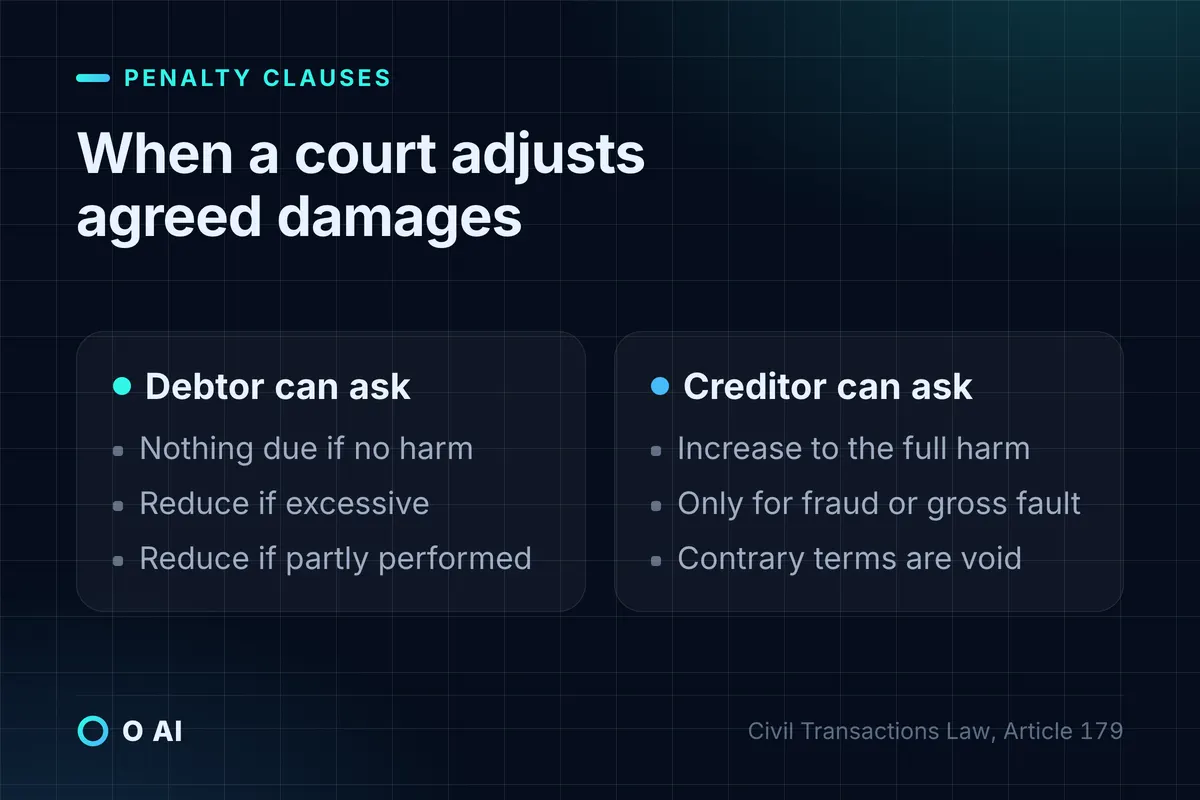
The agreed amount is not due if the debtor proves the creditor suffered no harm. The court may reduce it, at the debtor's request, if it was excessive or the obligation was partly performed, and may raise it, at the creditor's request, to the full harm where the debtor committed fraud or gross fault. Any agreement against these rules is void (Art. 179) [1].
Where no amount is agreed, the court assesses it. For a contractual obligation, a debtor who committed no fraud or gross fault pays only the harm that could normally be foreseen when the contract was made (Art. 180) [1].
Illustrative example: a late fit-out contract
Illustrative example: a fit-out contract worth SAR 400,000 sets agreed damages of SAR 2,000 for each week of delay. The contractor finishes 10 weeks late, so the clause gives SAR 20,000.
- The owner does not need to send notice to claim the SAR 20,000 (Art. 178).
- The contractor can avoid paying only by proving the owner suffered no harm, or ask the court to reduce the sum if it is excessive (Art. 179).
- If the owner's real loss is higher, he can ask for more only by proving fraud or gross fault (Art. 179).
The figures are invented for illustration; the court weighs the facts of each case.
Limitation periods (التقادم) in the Civil Transactions Law
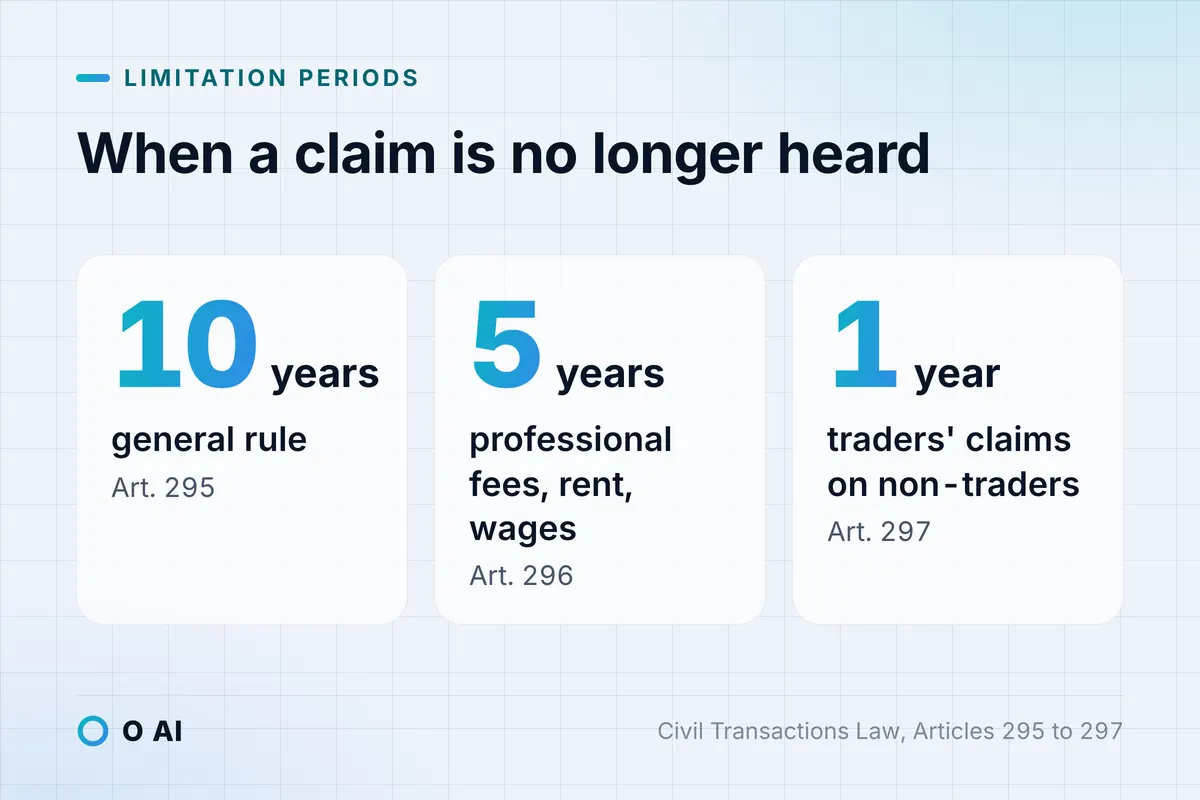
The law does not let rights expire by time; instead, after a set period a claim "is not heard" against a defendant who denies it (Art. 295) [1]. The court applies this only at the request of the debtor or a person with an interest (Art. 306) [1].
| Claim | Period | Article |
|---|---|---|
| General rule for rights | 10 years | 295 |
| Fees of free professions (doctors, lawyers, engineers); periodic rights such as rent and wages | 5 years | 296 |
| Traders' claims for goods and services to non-traders; hotels and restaurants; workers' wages | 1 year | 297 |
| Compensation for a harmful act | 3 years from knowledge, 10 years at most | 143 |
| Hidden defect in a sold item | 180 days from delivery, unless the seller gave longer cover or hid the defect by fraud | 344 |
| Exploitation causing gross unfairness | 180 days from the contract | 68 |
The period runs from the day the right becomes due, unless a text says otherwise (Art. 299). It stops running while an excuse prevents the claim, including good-faith negotiation between the parties at the end of the period or a moral obstacle (Art. 300) [1]. These short periods apply even if the dealings continue, but if a written instrument is made for a professional-fee claim or a 1-year claim, it is heard for 10 years from the instrument (Art. 298) [1].
Named contracts: sale, lease, contracting, agency and guarantee
Section 2 regulates specific contracts in detail, each with its own chapter [1]. Among the most used in business:
- Sale (Arts. 307 to 360): sale transfers ownership of the item for a cash price (Art. 307); a hidden-defect claim has the 180-day limit above.
- Lease (Arts. 407 to 450) and contracting (مقاولة, Arts. 461 to 478): the main contracts for property and construction work.
- Agency (وكالة, Arts. 480 to 505): the principal puts the agent in his place for a legal act (Art. 480).
- Partnership contracts (Arts. 528 to 577): they must be in writing or they are void, though a party cannot use that nullity against third parties (Art. 528).
- Guarantee (كفالة, Arts. 578 to 606): the creditor cannot pursue the guarantor alone before the debtor, or enforce on the guarantor's assets before the debtor's, unless the guarantor is jointly liable; the court applies this only if the guarantor raises it (Art. 591).
Employment and insurance contracts are left to their own special laws (Arts. 479 and 607) [1]. The law has no separate chapter titled ju'ala (reward contract), brokerage or supply; such dealings fall under the general contract rules and any special laws that apply.
Where a contract must be proven in court, the Evidence Law adds its own rule: a transaction above SAR 100,000 must be proven in writing [5].
The 41 general rules (Article 720)
Article 720 lists 41 general legal maxims that courts apply when no text covers a matter, as far as they do not conflict with legal texts [1]. Examples:
- Matters are judged by their purposes (rule 1).
- In contracts, intent and meaning count, not words and form (rule 2).
- Custom is authoritative (rule 3).
- The basic presumption in contracts and conditions is validity and binding force (rule 10).
- No statement is attributed to a silent person, but silence where a statement is needed counts as one (rule 13).
- Harm must be removed (rule 16).
- Gain goes with liability for loss (rule 34).
Implementing regulations, the official text and PDF copies
The Civil Transactions Law has no implementing regulations, and none of its 721 articles calls for them [1]. Instead, the approving decision asked public bodies to review their own laws within 180 days to align them with it, and asked the Ministry of Justice to review the procedure, commercial courts and enforcement laws (clauses 8 and 9) [1]. A new Enforcement Law has since been issued and applies from 28 October 2026 [6].
The reliable copy is the Bureau of Experts page, which offers the text, a print view and the original document; its page lists the text in Arabic [1]. The decree is also on the Umm Al-Qura site [2]. Commentaries and compiled PDFs can help with explanation, but check any article against the official text before you rely on it.
Your next step
Before you sign or enforce a contract, check four points against the law: how and when it can be terminated, whether it has an agreed-damages clause and how a court may adjust it, which limitation period applies to your claim, and what written proof you hold. For software and digital-project contracts, our guide to choosing an app development company in Saudi Arabia lists the questions to settle before signing.

Law firms that track many contracts and claims can record each matter's limitation dates and deadlines in Rushd by O AI, our law-firm software. Once a case is decided, the appeal deadline guide explains the time left to object.
Frequently asked questions
When did the Saudi Civil Transactions Law come into force?
It was published in Umm Al-Qura on 19 June 2023 and applies 180 days after publication, so it came into force in mid-December 2023. It applies to facts that happened before that date too, except where a party relies on a conflicting legal text or judicial principle, or where a limitation period had already started.
How many articles does the Civil Transactions Law have?
It has 721 articles: a preliminary part, three sections on obligations, named contracts and real rights, and final provisions. Article 720 lists 41 general rules for matters no text covers, and Article 721 sets the entry into force. As of October 2026, the Bureau of Experts shows no amended article.
What does Article 120 of the Civil Transactions Law say?
Article 120 states that every fault that causes harm to another obliges the person who committed it to compensate. It is the base of tort liability in the law. Related articles set when liability is excluded, such as force majeure or the victim's own fault, and how compensation is measured.
What is the limitation period in the Civil Transactions Law?
The general rule is that a claim is not heard against a denying defendant after 10 years. Shorter periods apply to some claims: 5 years for professional fees and periodic rights such as rent, 1 year for traders' claims against non-traders and for wages, and 3 years from knowledge for compensation for harm.
Can a court reduce a penalty clause in Saudi Arabia?
Yes. Under the law, agreed damages are not due if the debtor proves no harm occurred, and the court may reduce them at the debtor's request if they are excessive or the obligation was partly performed. The court may raise them to the full harm only for fraud or gross fault, and agreements against these rules are void.
Does the Civil Transactions Law have implementing regulations?
No. None of its articles calls for implementing regulations. The approving decision instead asked government bodies to review their own laws within 180 days to align them with it, and asked the Ministry of Justice to review the procedure, commercial courts and enforcement laws and their regulations.
Does the Civil Transactions Law apply to commercial transactions?
Yes, where the commercial laws have no special text and as far as the nature of the commercial dealing allows. The issuing decree says so in its sixth clause. A specific commercial law, such as one on companies or commercial papers, still takes priority on the points it covers.
How this article was made: Researched from the official sources listed below, opened on 29 October 2026. Drafted with AI assistance, then checked against those sources. General information, not legal or professional advice. Illustrations were made for this article.
Sources
- Civil Transactions Law (Royal Decree M/191 of 29/11/1444 AH) (opens in a new tab)Bureau of Experts at the Council of Ministers · laws.boe.gov.sa
- Royal Decree No. M/191 dated 29/11/1444 AH approving the Civil Transactions Law (opens in a new tab)Umm Al-Qura (Official Gazette) · uqn.gov.sa
- Law of Procedure before Sharia Courts (opens in a new tab)Bureau of Experts at the Council of Ministers · laws.boe.gov.sa
- Commercial Courts Law (opens in a new tab)Bureau of Experts at the Council of Ministers · laws.boe.gov.sa
- Evidence Law (Royal Decree M/43 of 26/5/1443 AH) (opens in a new tab)Bureau of Experts at the Council of Ministers · laws.boe.gov.sa
- Enforcement Law (1447 AH) (opens in a new tab)Bureau of Experts at the Council of Ministers · laws.boe.gov.sa
About the author
Newsletter
New guides and news by email
New guides and news about O AI, Rushd and Dalni, at most twice a month. No spam.