 AI


Qiwa for employers: work permits, permit inquiry and Nitaqat
Qiwa is where Saudi employers issue and renew work permits for non-Saudi staff. This guide covers the Ministry's steps and timing rules, where to run a work permit inquiry, what each Nitaqat band allows, and the 2026 rules on expired permits and the 31 December 2026 correction deadline.


Key takeaways
- A non-Saudi may not work in the Kingdom without a work permit from the Ministry (Labor Law, Article 33); the employer bears its fees (Article 40).
- Issue the first work permit within 90 days of the worker's entry; renewal is allowed once 180 days or less remain.
- A work permit cannot be cancelled after it is issued or renewed, and none can be issued or renewed in the red Nitaqat band.
- The Ministry's correction window for long-expired or never-issued permits runs until 31 December 2026.
- The Ministry extended to 31 December 2026 the grace period to correct permits expired over 12 months and workers without a permit for over 6 months.
On this page
- What is Qiwa?
- Why a work permit in Saudi Arabia is not optional
- How to issue or renew a work permit (رخصة عمل) on Qiwa
- Work permit inquiry (استعلام عن رخص العمل): where to check a permit
- How your Nitaqat band controls Qiwa services
- Expired work permits: the 2026 rules
- Common mistakes employers make on Qiwa
- Keeping permit dates out of spreadsheets
- Your next step
Qiwa is the Ministry of Human Resources and Social Development's platform where employers issue and renew work permits for non-Saudi staff, check each permit's status, transfer workers and track their Nitaqat band. A work permit is issued within 90 days of the worker's entry and can be renewed once 180 days or less remain.
This guide is for business owners and HR staff. It explains what Qiwa does, how the work permit service works, how to run a work permit inquiry, how your Nitaqat band decides what you can do, and the rules on expired permits that applied from July 2026. It is current as of October 2026. It is general information, not legal advice: for a specific case, check the official service page and speak to a licensed adviser.
What is Qiwa?
Qiwa is a government platform under the Ministry of Human Resources and Social Development that connects private-sector employers with the people they employ. The Ministry's services guide describes it as the main digital platform for all services of the Saudi labour system, covering an establishment's journey from founding to expansion [1]. The Ministry's own service pages send employers to Qiwa for work permits [2].
For an establishment, the Ministry's Qiwa services guide lists, among others [1]:
- registering the establishment and managing its business account;
- hiring and managing current employees;
- issuing and renewing work permits for expatriate workers;
- transferring employees between establishments and changing occupations;
- issuing Saudization certificates;
- customised work regulations, and creating and documenting employee contracts electronically.
| Question | Answer |
|---|---|
| What it is | The Ministry of Human Resources and Social Development's labour-market platform [1] |
| Who uses it | Establishments, through their account managers and delegates, and individuals with a national ID or iqama [1] |
| When an employer needs it | Before a non-Saudi starts work, at every permit renewal, and for transfers and occupation changes [2][3] |
| What it depends on | Your Nitaqat band and the validity of your establishment's records [2][4] |
| Help | Ministry line 19911 [2] |
Why a work permit in Saudi Arabia is not optional
The Labor Law is plain on this. A non-Saudi may not work in the Kingdom without a work permit from the Ministry (Article 33), and no other permit or licence from another body replaces it (Article 34) [3]. The worker must have entered the country lawfully and be authorised to work, have skills or qualifications the country needs, and be under contract with an employer and under that employer's responsibility [3].
Three more articles shape what employers do in Qiwa [3]:
- Article 35: the Ministry may refuse to renew a work permit if the employer breaches the job-localisation (Saudization) standards.
- Article 38: the employer may not assign the worker to a job other than the one on the permit.
- Article 40: the employer bears the recruitment fees, the residence (iqama) and work permit fees and their renewal, occupation-change and exit-and-return fees, and the worker's return ticket when the relationship ends, unless the worker is unfit for the work or leaves without a legitimate reason.
The work permit is also one of the conditions for issuing or renewing the worker's residence permit [2]. In practice, a lapsed permit soon becomes an iqama problem as well.
How to issue or renew a work permit (رخصة عمل) on Qiwa
The Ministry's "Issue and renew work license" service is electronic and needs no documents [2]. The steps it publishes:
- Log in and choose your establishment.
- Open the service "Issue and renew work license".
- Search for and add the expatriate workers whose permits you want to issue or renew.
- Select the workers and send the request. A review ticket with a payment number is issued.
- Receive the request number and details by text message.
- Pay through a local bank using the SADAD payment number, then follow the residence permit with the Passports.
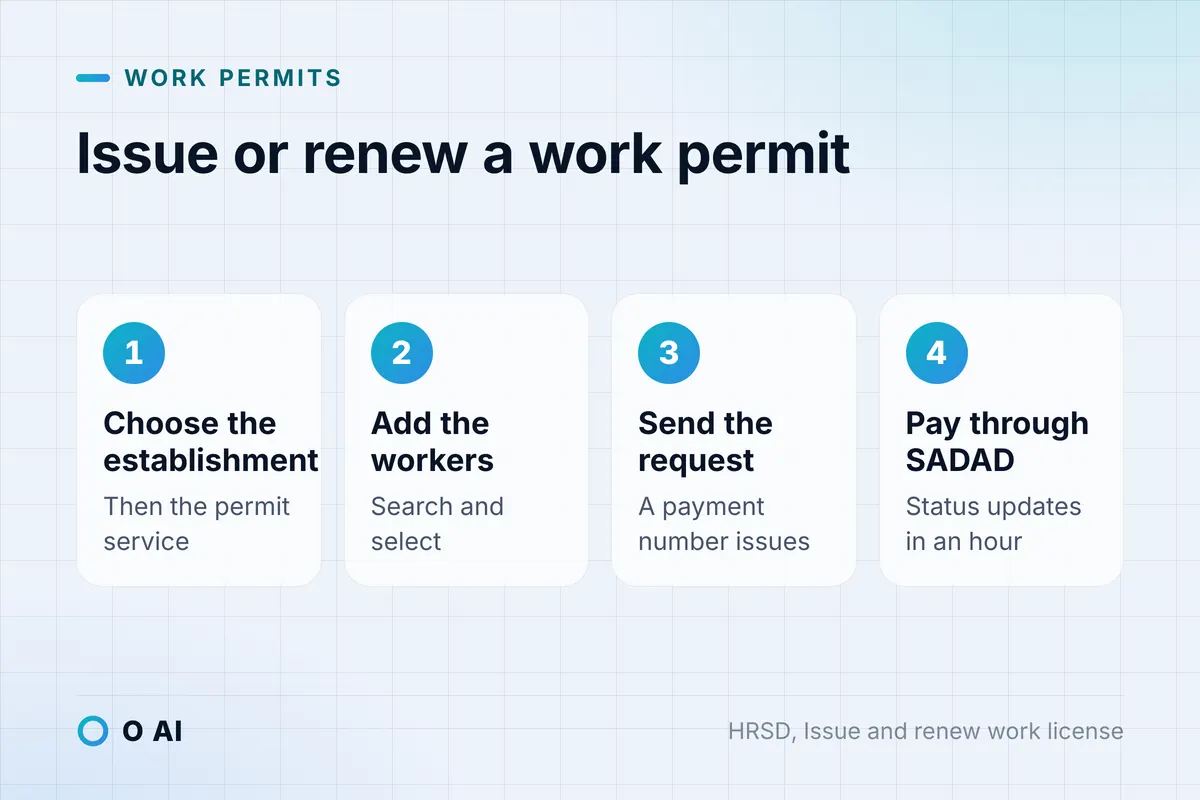
The service page lists a fee of SAR 100, paid through SADAD, and an immediate service time [2]. The total you pay may include other amounts linked to the worker, such as the expat levy where it applies; Qiwa shows the amount before you pay.
Timing rules that matter
The same service page sets the timing [2]:
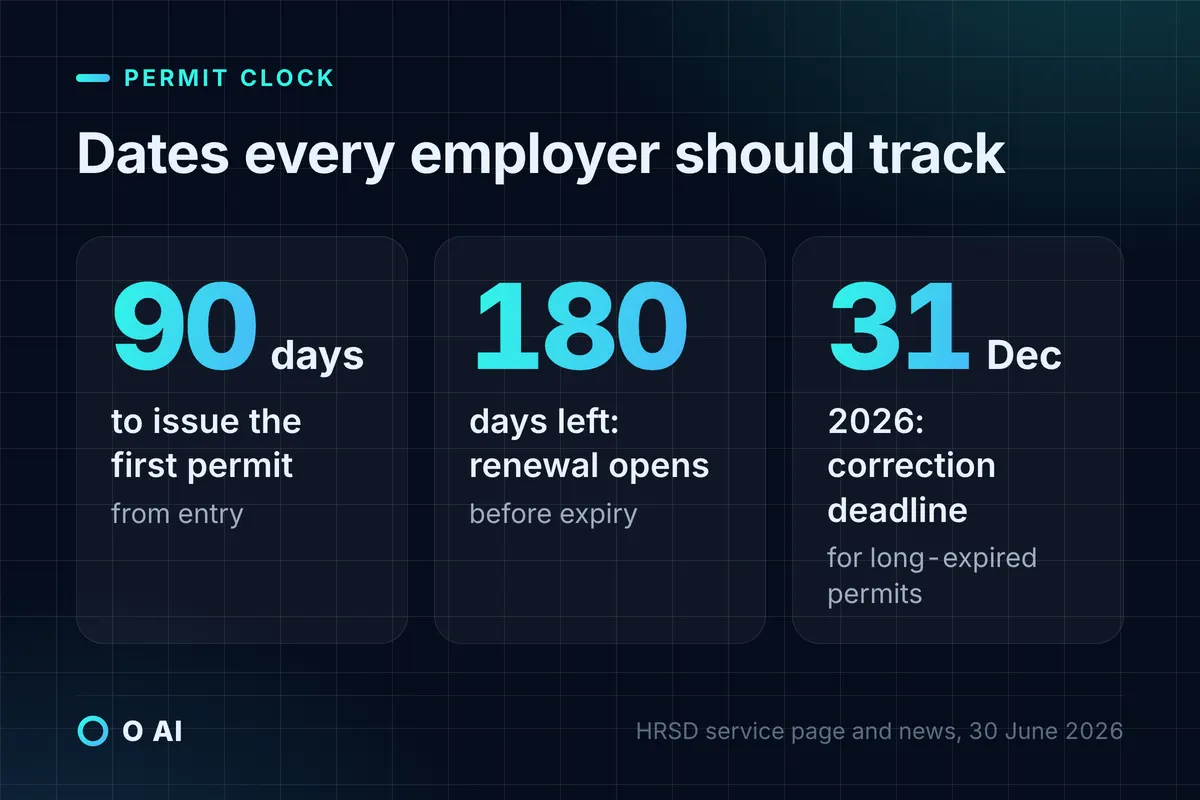
- First permit: issue it within the first 90 days after the worker enters the Kingdom.
- Renewal: allowed when 180 days or less remain before the permit expires.
- After payment: the permit status updates in about one hour, and the payment appears in the Passports systems within 24 hours.
- No cancellation: a work permit cannot be cancelled once it has been issued or renewed.
- Red band: permits cannot be issued or renewed while the establishment is in the red band.
Because a renewed permit cannot be cancelled, check the worker list before you pay. If the worker is about to transfer or leave, renewing first and asking questions later costs money you cannot recover.
Work permit inquiry (استعلام عن رخص العمل): where to check a permit
A work permit inquiry answers one question: is this worker's permit valid, and until when? There are three places to look, depending on who is asking.
| Who is asking | Where | What you see |
|---|---|---|
| The employer | Qiwa business account, employee list and the work permit service | Workers whose permits need issuing or renewal [2] |
| Anyone with the details | Ministry e-services, public inquiries | "Labor office services" inquiry, which covers work licences, transfers and occupation changes; an expatriate employee inquiry [5] |
| The worker | Their own Qiwa individual account | Job offers and contracts to view and approve [1] |
The Ministry's public inquiry page also offers an establishment data inquiry and an establishment Nitaqat inquiry [5]. Use it before you hire a worker from another establishment: a transfer request into a red-band establishment is not allowed [4].
How your Nitaqat band controls Qiwa services
Nitaqat is the Ministry's Saudization programme, first launched in 2011, which places each establishment in a band according to its share of Saudi employees [4]. The Ministry's 2026 procedural guide for the developed Nitaqat programme lists five bands: platinum, high green, medium green, low green and red [4].
What each band allows, according to that guide [4]:
| Band | New visas | Occupation changes | Renew permits of current workers | Transfer workers in |
|---|---|---|---|---|
| Platinum | Yes | Yes | Yes | Yes, from any band |
| High green | Yes | Yes | Yes | Yes, from any band |
| Medium green | Yes | Yes | Yes | Yes, from any band |
| Low green | Stopped | Stopped | Yes | Not listed |
| Red | No | No | No | No |
In the green and platinum bands, the guide allows renewal of current workers' permits regardless of the length of their residence, provided no more than six months remain on the worker's iqama at renewal [4]. In the red band, the guide also bars new work permits for incoming workers [4].

The practical lesson: your band is not a report you read once a year. A drop to red stops renewals for every expatriate worker at once, and Article 35 of the Labor Law gives the Ministry the same power [3]. Watching the Saudization ratio monthly is part of permit management; our guide to HR management for small businesses covers the routine.
Expired work permits: the 2026 rules
An expired permit is not a problem you can leave for later. In 2026 the Ministry set a deadline for the oldest cases, and Qiwa shows each permit's status in the employee list, so check it every month.
A correction window until 31 December 2026. On 30 June 2026 the Ministry extended the grace period to correct the status of two groups: expatriate workers whose permits expired more than 12 months earlier, and workers who joined an establishment more than 6 months earlier without a work permit being issued [6]. The new deadline is 31 December 2026, after which the Ministry says the prescribed regulatory procedures apply [6].
Common mistakes employers make on Qiwa
- Letting the 90-day window pass for a new arrival's first permit [2].
- Renewing a permit for a worker who is leaving. It cannot be cancelled afterwards [2].
- Ignoring the band until renewal day. In the red band no permit can be issued or renewed [2][4].
- Assigning a worker to a different job than the one on the permit; Article 38 forbids it [3].
- Passing permit fees to the worker. Article 40 puts them on the employer [3]; the same goes for payroll deductions, covered in our guide to payroll calculation in Saudi Arabia.
Keeping permit dates out of spreadsheets
Most permit problems are calendar problems: a 90-day window, a 180-day renewal window, a six-month iqama limit and the 31 December 2026 correction deadline. An HR system that reads employee records can hold these dates and send reminders well before each window closes. If you are choosing one, our guide to an HR system for Saudi companies lists the modules to ask about.
Your next step
Log in to Qiwa this week, open the employee list and sort it by work permit expiry. Renew any permit with 180 days or less left, check your Nitaqat band before you pay, and correct any long-expired permit before 31 December 2026. If you want those dates to come from your own HR records rather than a manual check, O AI builds HR and business systems for Saudi companies.
Frequently asked questions
What is the Qiwa platform used for?
Qiwa is the Ministry of Human Resources and Social Development's platform for the private-sector labour market. Employers use it to register their establishment, issue and renew work permits for non-Saudi staff, transfer workers, change occupations, issue Saudization certificates and manage employment contracts. Employees use their own individual accounts to follow their job record.
How much is the work permit fee in Saudi Arabia?
The Ministry's service page for issuing and renewing a work licence lists a fee of SAR 100, paid through SADAD. The amount Qiwa asks for can be higher, because it may include the expat levy and other amounts tied to the worker where they apply. Qiwa shows the full amount before payment, so check it there rather than relying on a single figure.
How do I check a worker's work permit status?
An employer checks it in the Qiwa business account, through the employee list and the work permit service. The Ministry's public e-services also offer a labour office services inquiry that covers work licences, plus an expatriate employee inquiry. Workers can see their own record through a Qiwa individual account.
When can I renew a work permit?
The Ministry allows renewal when 180 days or less remain before the permit expires, and only if the establishment is not in the red Nitaqat band. In the green and platinum bands, renewal is allowed whatever the length of the worker's residence, as long as no more than six months remain on the iqama at renewal.
What happens if a work permit stays expired?
It has to be corrected. The Ministry extended until 31 December 2026 the grace period to correct the status of expatriate workers whose permits expired more than 12 months earlier, and of workers who joined an establishment more than 6 months earlier without a permit. After that date the prescribed regulatory procedures apply, so renew or settle any expired permit as soon as you find it.
Can an establishment in the red band renew work permits?
No. Under the Ministry's 2026 Nitaqat guide, a red-band establishment cannot renew permits for its current expatriate workers, issue permits for new workers, request new visas, change occupations or receive transferred workers. Raising the share of Saudi employees to move back into a green band restores these services.
How this article was made: Researched from the official sources listed below, opened on 29 October 2026. Drafted with AI assistance, then checked against those sources. General information, not legal or professional advice. Illustrations were made for this article.
Sources
- Qiwa services user guide (March 2023) (opens in a new tab)Ministry of Human Resources and Social Development · hrsd.gov.sa
- Issue and renew work license (service page) (opens in a new tab)Ministry of Human Resources and Social Development · hrsd.gov.sa
- Employment of non-Saudis: Labor Law Articles 32–41 (opens in a new tab)Ministry of Human Resources and Social Development · hrsd.gov.sa
- Procedural guide to the developed Nitaqat programme 2026 (opens in a new tab)Ministry of Human Resources and Social Development · hrsd.gov.sa
- E-services: public inquiries (opens in a new tab)Ministry of Human Resources and Social Development · es.hrsd.gov.sa
- The Ministry extends the grace period to correct work permit status (opens in a new tab)Ministry of Human Resources and Social Development · hrsd.gov.sa
About the author
Newsletter
New guides and news by email
New guides and news about O AI, Rushd and Dalni, at most twice a month. No spam.