 AI


GOSI registration for employers: rates, deadlines and certificate
A practical guide to GOSI registration for employers in Saudi Arabia: which Social Insurance Law applies to each employee, how to register the establishment and workers, contribution rates as of October 2026 with a worked example, late-payment fines and how to issue the GOSI certificate.


Key takeaways
- Any private establishment that employs one worker or more must register with GOSI.
- The Social Insurance Law of 1445H applies to new entrants from 3 July 2024; employees with earlier contribution periods stay under the 1421H law.
- From July 2026 a Saudi under the new law costs the employer 12.75% and the employee 10.75% of the contributory wage.
- Non-Saudis are covered only for occupational hazards, at 2% paid by the employer, on a wage capped at SAR 45,000 a month.
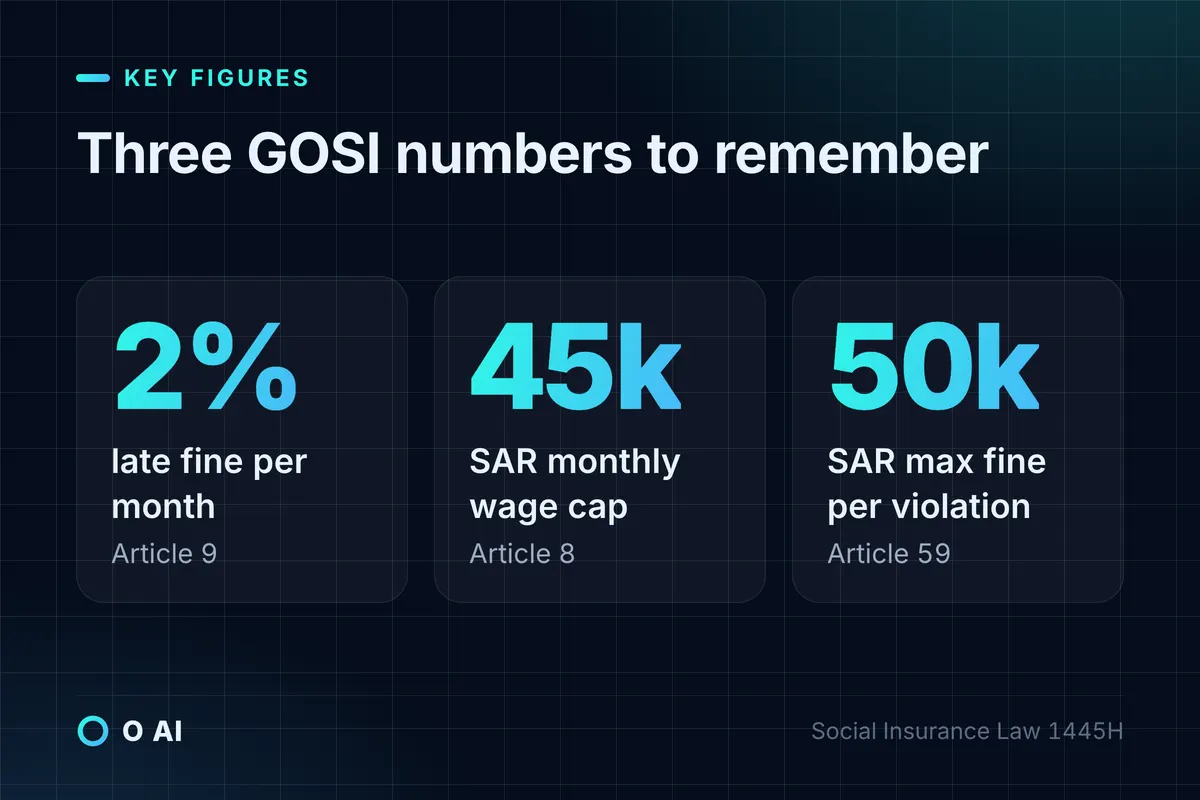
- Late contributions draw a 2% fine for each month or part of a month (Article 9 of the 1445H law).
On this page
- The Social Insurance Law: which version applies to your staff
- Who must register with GOSI
- How GOSI registration works, step by step
- GOSI contribution rates in October 2026
- Contributory wage: what GOSI counts
- Late payment, penalties and suspended coverage
- The GOSI certificate (شهادة التأمينات)
- Common GOSI mistakes employers make
- Your next step
GOSI registration is the employer's duty to register the establishment with the General Organization for Social Insurance (GOSI) and to register every worker, then pay monthly contributions. As of October 2026, a Saudi employee hired under the new law costs the employer 12.75% of the contributory wage, a non-Saudi 2%, and both are capped at SAR 45,000 a month.
The Social Insurance Law: which version applies to your staff
GOSI runs social insurance for workers in the Saudi private sector, and under the 2024 law also for new civilian entrants in the public sector [3]. For an employer, it means three things: registering the establishment, registering each worker and paying the monthly invoice.
Two laws now run side by side, and which one applies depends on the employee, not on the employer:
- The Social Insurance Law of 1445H was approved by Royal Decree No. M/273 and Council of Ministers Decision No. 1022, both dated 26/12/1445H (2 July 2024), and published on 29/12/1445H (5 July 2024). We read its text on laws.boe.gov.sa, where it is listed as in force [1]. GOSI says it applies from 27/12/1445H, which is 3 July 2024 [2].
- The Social Insurance Law of 1421H (Royal Decree No. M/33 of 3/9/1421H) continues to apply to contributors who already had contribution periods before the new law took effect, and to people already receiving pensions [1].
GOSI's own summary is short: the new system covers new entrants to the labour market after 3 July 2024 who have no earlier periods under the civil retirement or social insurance systems [2]. An employee who first registered before that date stays on the old rates, even after changing employer.
The new law has three branches: pensions; occupational hazards and additional compensation; and unemployment insurance, known as SANED [1].
Who must register with GOSI
Any private establishment that employs one worker or more must be registered with GOSI [6]. In practice, register the establishment before the first salary is paid. The law leaves the registration deadlines to its regulation, and a work injury suffered before a worker is registered is compensated only if it happens within that deadline (Article 31) [1].
The two categories of worker are covered differently [4][5]:
| Worker | Branches | Who pays |
|---|---|---|
| Saudi | Pensions, occupational hazards, SANED | Employer and employee share pensions and SANED; employer alone pays occupational hazards |
| Non-Saudi | Occupational hazards only | Employer alone |
Some groups fall under GOSI only on terms the GOSI board sets, including domestic workers, agricultural and grazing workers, seafarers, workers at foreign diplomatic missions, and non-Saudis on a temporary or seasonal work visa of no more than 60 days [1].
How GOSI registration works, step by step
GOSI's employer services run through the establishment's account in GOSI's online services [6]. The sequence for a new employer is:
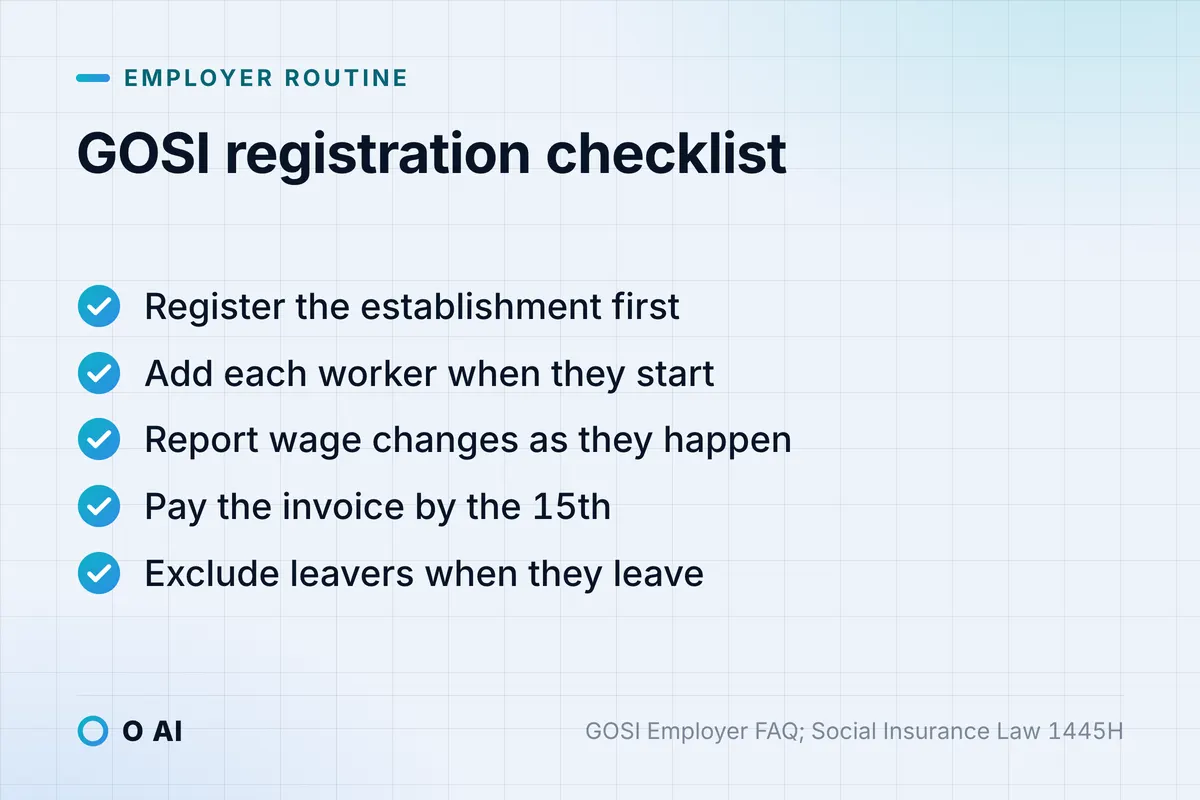
- Register the establishment through GOSI's online services. Anyone applying on the employer's behalf needs the employer's written authorisation [6].
- Register each worker from the establishment account, with the start date and the contributory wage.
- Report every change in the wage as soon as it takes effect, because contributions are calculated on the registered contributory wage [1].
- Exclude leavers when employment ends.
- Pay the monthly invoice within the first 15 days of the following month, through SADAD or the bank channels GOSI lists [4].
Deadlines matter because breaches carry fines. Any breach of the law or its regulation can be fined up to SAR 50,000, doubled for a repeat within three years and counted per contributor (Article 59) [1]. GOSI's employer FAQ adds that contributions for the month a worker joins are collected for the whole month, while none are collected for part of the month in which employment ends, unless it ends on the month's last day [4]. The safe routine is to register a new worker and exclude a leaver in the same month, and to check the current deadlines in the establishment account.
Missed periods can be added retroactively only within limits: GOSI accepts no more than 24 months before the request, and only when both the worker and the employer met the conditions of mandatory coverage at the time [6].
GOSI contribution rates in October 2026
The rates below come from the 1445H law and its royal decree, GOSI's pages and its announcement of the 2025 increase. All percentages are of the contributory wage.
| Branch | Saudi, old law (registered before 3 July 2024) | Saudi, new law, from July 2026 | Non-Saudi |
|---|---|---|---|
| Pensions | 9% employer + 9% employee [4] | 10% employer + 10% employee [1][3] | Not covered |
| SANED | 0.75% employer + 0.75% employee [5] | 0.75% employer + 0.75% employee [1][2] | Not covered |
| Occupational hazards | 2% employer [4] | 2% employer [1] | 2% employer [4] |
| Employer total | 11.75% | 12.75% | 2% |
| Employee total | 9.75% | 10.75% | 0% |
The new-law pension rate rises in steps. Article 15 of the law sets the pension contribution at 22%, split 11% and 11% [1]. The royal decree phases it in: 18% in the first 12 months, then 19%, 20%, 21% and finally 22%, each step starting the month after another 12 months have passed, with the employer and the employee paying half each [1]. GOSI's employer awareness page says the pension share rises gradually from 9% to 11% for each party: the increase is 0.5% a year from the law's second year to its fifth, that the first step was on 1 July 2025, and that it applies only to the pension branch [3]. On that schedule, the rate is 9.5% each from July 2025, 10% each from July 2026, 10.5% from July 2027 and 11% from July 2028.
Two more rules from the law:
- Occupational hazards is 2%, paid by the employer. The GOSI board may, for a set period, raise it up to double for employers who refuse to follow its safety instructions [1].
- SANED under the new law is 2% in Article 44, but Council of Ministers Decision No. 1022, issued with the law, fixes it at 1.5% from the law's start, split equally [1]. GOSI's awareness page gives the same 1.5% [2].

Contributory wage: what GOSI counts
Contributions are calculated on the basic wage plus the housing allowance paid in cash. When the employer provides housing in kind, GOSI values it at two months of basic wage [4]. For new-law contributors, GOSI's employer page adds commissions and percentages of sales or profits to the contributory wage [3].
The cap is SAR 45,000 a month: wages above it attract no extra contributions [1]. Article 8 also says the contributory wage may not fall below the minimum wage set by the competent authority [1].
Illustrative example: a Saudi employee first registered in August 2024 earns a basic salary of SAR 8,000 and a cash housing allowance of SAR 2,000. The contributory wage is SAR 10,000. In October 2026:
| Employee | Employer | |
|---|---|---|
| Pensions (10% each) | SAR 1,000 | SAR 1,000 |
| SANED (0.75% each) | SAR 75 | SAR 75 |
| Occupational hazards (2%) | – | SAR 200 |
| Total | SAR 1,075 | SAR 1,275 |
The employer pays the whole SAR 2,350 to GOSI and deducts the employee's SAR 1,075 from the salary, as Article 9 of the law allows [1]. A colleague on the old law with the same wage costs SAR 975 from salary and SAR 1,175 from the employer. A non-Saudi colleague with the same wage costs the employer SAR 200, with nothing deducted from salary. The Labor Law allows the social insurance deduction without the worker's written consent (Article 92) [7].
Late payment, penalties and suspended coverage
The employer alone is responsible to GOSI for paying the contributions, including the employee's share [1]. The consequences of getting it wrong are set in the law:
- Late payment: a fine of 2% of the contribution due for each month of delay or part of a month (Article 9) [1].
- Unpaid periods: under Article 9, contribution periods stop counting once unpaid periods reach the limit set by the GOSI board, which may not be less than 6 months [1]. GOSI's employer page states that coverage is suspended after 6 months of non-payment and reactivated when the dues and penalties are paid [3].
- Other violations: a fine of up to SAR 50,000, doubled for a repeat within three years and counted per contributor affected (Article 59) [1].
- Fake registrations: registering a person who does not work for you is fined under Article 59 or up to twice the contributions for the registered period, whichever is higher [1].
- Time limit: fines cannot be imposed on violations committed five or more years earlier, though the violation must still be corrected [1].
GOSI can also settle with a violator and waive all or part of the fines [1].
The GOSI certificate (شهادة التأمينات)
The GOSI certificate proves that your establishment is registered and has met its obligations, or that the law does not apply to it. Article 10 of the law obliges government bodies, public institutions and companies more than 50% state-owned to ask for this certificate when an employer [1]:
- collects money owed to it;
- bids in a tender for public works, supply, operation or maintenance;
- applies to amend, renew or strike off its commercial registration;
- applies for a state subsidy;
- is being liquidated;
- applies for a licence or renews one;
- applies to recruit workers from abroad.
You issue it yourself from the establishment's account in GOSI's online services, which also offer e-certificate services and a check of a certificate's validity [6]. A certificate is not issued while a blocking violation is open, and GOSI's services let the employer see the reasons a certificate cannot be issued [6]. Clear unpaid invoices and fines first.
Common GOSI mistakes employers make
- Registering late. A work injury before registration is covered only within the regulation's deadline (Article 31), and breaches can be fined [1].
- Wrong rate for a new hire. The rate depends on whether the employee had any contribution period before 3 July 2024 [2], not on when you hired them. Check the employee's status before you set up payroll [3].
- Forgetting wage changes. A raise or a new housing allowance changes the contributory wage [1]; it also affects the wage protection file, which is checked against GOSI's record.
- Paying after the 15th. Each month or part of a month adds 2% [1][4].
- Leaving a former employee registered. Exclude a leaver when employment ends; GOSI does not collect contributions for part of the month in which employment ends [4].
This guide is general information, not legal or professional advice. For a specific case, read the law on laws.boe.gov.sa, use GOSI's channels or speak to a licensed adviser.
Your next step
Log in to your establishment's GOSI account, compare your worker list with your payroll, and check that each Saudi employee sits on the right rate. Then set a monthly routine: report wage changes, pay the invoice before the 15th and issue a fresh certificate before any tender or licence renewal. If you are still setting up the company, start with our guide to opening a commercial registration. For net pay after GOSI, see payroll calculation in Saudi Arabia, and for the wider monthly checklist, our guide to HR management for small businesses.
Frequently asked questions
How do I register my establishment with GOSI?
Register the establishment through GOSI's online employer services as soon as you employ one worker or more. Anyone who applies on the employer's behalf needs written authorisation. Once the establishment exists, add each worker from the account with the start date and contributory wage, and pay the first invoice in the following month.
What is the deadline to register a new employee with GOSI?
The Social Insurance Law leaves the exact deadline to its regulation, and a work injury before registration is compensated only if it happens within that period. GOSI collects contributions for the whole month in which a worker joins, so the safe practice is to register a new worker in the month they start and to exclude a leaver in the month they leave. Check the current deadline in your establishment account.
How much is the GOSI contribution in 2026?
It depends on the worker. For a Saudi on the old law, the employer pays 11.75% and the employee 9.75%. For a Saudi under the new law, the rates from July 2026 are 12.75% and 10.75%, because the pension share is 10% each. For a non-Saudi, the employer pays 2% for occupational hazards and nothing is deducted from the salary.
Do non-Saudi employees pay GOSI?
No deduction is made from a non-Saudi's salary. Non-Saudi workers are covered only by the occupational hazards branch, which the employer pays at 2% of the contributory wage. They are not covered by the pension branch or by SANED. The employer must still register them and include them in the monthly invoice.
How do I get a GOSI certificate for my company?
Issue it from your establishment's account in GOSI's online services, which also let anyone check a certificate's validity. A certificate is not issued while a blocking violation is open, and the service shows the reasons it cannot be issued, so clear any unpaid invoice or open violation first. Government bodies ask for it in tenders, payments and licence renewals.
What wage does GOSI use to calculate contributions?
GOSI uses the basic wage plus the housing allowance paid in cash. Housing provided in kind is valued at two months of basic wage. For contributors under the new law, commissions and percentages of sales or profits also count. Contributions stop at a contributory wage of SAR 45,000 a month, however much the employee earns above that.
How this article was made: Researched from the official sources listed below, opened on 29 October 2026. Drafted with AI assistance, then checked against those sources. General information, not legal or professional advice. Illustrations were made for this article.
Sources
- Social Insurance Law (Royal Decree No. M/273 of 26/12/1445H) (opens in a new tab)Bureau of Experts at the Council of Ministers · laws.boe.gov.sa
- Awareness platform: who the new system covers (opens in a new tab)General Organization for Social Insurance · awareness.gosi.gov.sa
- Awareness platform: the employer's journey under the new Social Insurance Law (opens in a new tab)General Organization for Social Insurance · awareness.gosi.gov.sa
- Employer FAQ (opens in a new tab)General Organization for Social Insurance · gosi.gov.sa
- Unemployment Insurance (SANED) FAQ (opens in a new tab)General Organization for Social Insurance · gosi.gov.sa
- Contribution services: establishment registration and retroactive periods (opens in a new tab)General Organization for Social Insurance · gosi.gov.sa
- Labor Law (Royal Decree No. M/51 of 23/8/1426H), consolidated text (opens in a new tab)Bureau of Experts at the Council of Ministers · laws.boe.gov.sa
About the author
Newsletter
New guides and news by email
New guides and news about O AI, Rushd and Dalni, at most twice a month. No spam.