 AI


VAT registration in Saudi Arabia: threshold, steps and certificate
When VAT registration in Saudi Arabia becomes mandatory or optional, how to run the look-back and look-ahead tests each month, the ZATCA portal steps, what the registration certificate shows and where to display it, and what registering late costs.


Key takeaways
- Registration is mandatory when taxable supplies exceed SAR 375,000 over the past or next 12 months, and voluntary from SAR 187,500 of supplies or expenses.
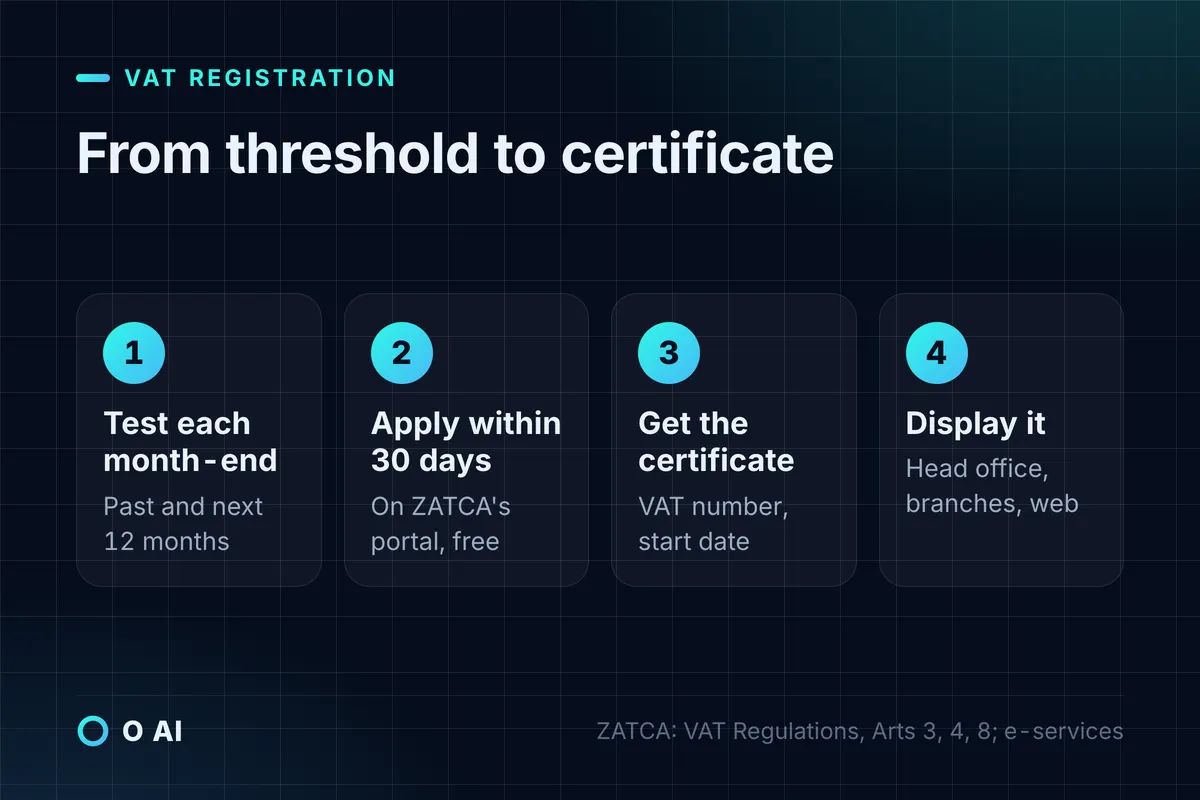
- Run both tests at every month-end and apply within 30 days; the look-ahead test usually catches a growing business first.
- Registering through ZATCA's portal is free; individuals use a separate e-service and log in with Nafath.
- The certificate shows your VAT number and effective date, and must be displayed at the head office, branches and online stores.
- Not applying on time costs SAR 10,000 under Article 41 of the VAT Law, and ZATCA can register you itself from the date you should have registered.
On this page
- Who must register for VAT, and who may?
- How to run the threshold test each month
- VAT registration in Saudi Arabia on the ZATCA portal, step by step
- When registration takes effect, and the VAT you paid before it
- The VAT registration certificate: what it shows and where it goes
- Your first obligations after registration
- What late registration costs
- Tax groups and deregistration in brief
- A checklist before you press submit
- Your next step
VAT registration in Saudi Arabia is mandatory once your taxable supplies over the past 12 months exceed SAR 375,000, or are expected to over the next 12, and optional from SAR 187,500 [1]. You apply online within 30 days of the month-end check, and ZATCA issues a certificate showing your VAT number and effective date [2].
This guide covers the monthly threshold test, the portal steps, the certificate and the first obligations that follow. It is general information, not tax advice: confirm a specific case with ZATCA or a licensed tax adviser.
Who must register for VAT, and who may?
The amounts come from the GCC Unified VAT Agreement, and ZATCA's Implementing Regulations set out how and when to apply [1][2].
| Your situation | What the rules say | Where |
|---|---|---|
| Resident, taxable supplies in the past 12 months above SAR 375,000 | Must register | Regulations, Article 3 |
| Resident, supplies expected to pass SAR 375,000 in the next 12 months | Must register | Article 4 |
| Resident, supplies or expenses of at least SAR 187,500 in the past or next 12 months | May register voluntarily | Article 7 |
| Resident below SAR 187,500 | Not required, and not eligible to register voluntarily | Articles 7 and 8(4) |
| Non-resident that must pay VAT on supplies in the Kingdom | Must register within 30 days of the first such supply, whatever the value | Article 5 |
| Business making only zero-rated supplies | Excepted from mandatory registration, but may register voluntarily | Article 9(1) |
| Related persons running similar or linked activities | ZATCA may add their supplies together and treat the total as each one's turnover | Article 9(2) |
ZATCA's guidance spells out what counts towards the SAR 375,000. Taxable supplies include zero-rated ones, but exclude exempt supplies such as qualifying residential rent, supplies outside the scope of VAT, and proceeds from selling capital assets held for long-term use [1]. Article 6(5) of the regulations makes the same point about capital assets [2].
Individuals who carry on an economic activity in the Kingdom register too; ZATCA runs a separate e-service for them, with the same thresholds [4]. An employee is not carrying on an economic activity for the work done under an employment contract (Article 9(6)) [2].
How to run the threshold test each month
The test is done at the end of every calendar month, and it has two sides [2]:
- Look back (Article 3). Add up your taxable supplies for the 12 months just ended. If the total exceeds the mandatory threshold, apply within 30 days of the month's end. Registration takes effect from the start of the month after the one in which you apply.
- Look ahead (Article 4). Estimate your taxable supplies for the next 12 months, counting signed contracts and firm orders. If the estimate exceeds the threshold, apply within 30 days of the month's end. Registration takes effect from the start of the first month in which supplies are expected to cross it.
On request, ZATCA can move the effective date later, but not beyond the start of the month after the application, or earlier, to a date when you were already eligible (Article 6(2) and (3)) [2].
Illustrative example: a catering kitchen in Dammam
Illustrative example. A catering kitchen in Dammam opened in November 2025. Its monthly taxable sales grew from SAR 25,000 to SAR 45,000. In June 2026 it sold an old delivery van for SAR 40,000, which does not count because it is a capital asset [1].
| Month-end | Sales in the past 12 months (SAR) | Owner's estimate for the next 12 months (SAR) | Result |
|---|---|---|---|
| 31 December 2025 | 53,000 | 360,000 | Below both tests |
| 31 May 2026 | 215,000 | 420,000 | Look-ahead test exceeded: apply by 30 June 2026 |
| 31 August 2026 | 335,000 | 500,000 | Already registered if the business applied in June |
| 30 September 2026 | 380,000 | 520,000 | Look-back test exceeded too |
The look-ahead test is the one that usually catches a growing business first. Here, an owner who only watched the past 12 months would have waited until the end of September 2026 and applied in October, about four months later than the rules required. From the end of May, the kitchen had also passed SAR 187,500, so it could have registered voluntarily even without the estimate.

VAT registration in Saudi Arabia on the ZATCA portal, step by step
Registration is free and done online [3]. ZATCA's user guide sets out the steps for businesses [5]:
- On zatca.gov.sa, open E-Services and choose VAT Registration for Businesses.
- Log in with the username and password for companies and establishments; individuals log in through Nafath, the national single sign-on.
- Enter the verification code sent by SMS to your mobile.
- From the side menu, choose VAT Services, then Register in VAT.
- Complete Taxpayer Details.
- Enter your sales and purchases in Financial Information.
- Attach the supporting documents.
- Complete the Financial Representative section.
- Add optional documents, review the summary and submit.
A window confirms the submission, and ZATCA sends an SMS and email when the application is complete; the output is your VAT number [3][5]. Sole traders and other individuals use the separate VAT Registration for Individuals e-service [4].
What the application must contain
Article 8(2) lists the minimum information: your legal or personal name and personal details, the actual address of your residence or place of business, an email address, any electronic identification number ZATCA has issued, your commercial registration number if you have one, the value of your annual supplies or expenses, and the effective date you are asking for [2]. ZATCA may ask for documents that support these details and must give you at least 20 days to provide them. It may reject an application that is inaccurate, or from someone not entitled to register (Article 8(3) and (4)) [2].
When registration takes effect, and the VAT you paid before it
The effective date matters twice: you charge VAT on your sales from that date, and it sets how far back you can recover VAT on costs.
- Services bought in the six months before the effective date can qualify for input VAT deduction if they were for your taxable business, were not resupplied or fully used before registration, and are not blocked under Article 50 (Article 49(2)) [2].
- Goods bought or imported before registration can qualify if they are for the taxable business and were not resupplied or used before the registration date. For capital assets not yet fully depreciated, the deduction is capped by their net book value on that date (Article 49(3) and (4)) [2].
- Contracts that straddle the date: if you invoiced or were paid before registration but the supply happens afterwards, VAT is due on the date of supply. For a continuous supply, the part delivered before registration is not taxed (VAT Law, Article 21) [7].
The VAT registration certificate: what it shows and where it goes
Once ZATCA accepts the application, it issues a registration certificate that shows the date registration takes effect and your tax identification number (Article 8(5)) [2]. The VAT Law requires a certificate for every registered person (Article 3(3)) [7].
- Display it. A resident registered business must display the certificate where the public can see it, at its head office, its branches and its online stores (Article 8(8)) [2]. For a website or app, that means a page customers can open.
- Reprint it. The certificate is placed on ZATCA's portal when it is issued, and the free Print VAT Certificate e-service lets you download a fresh copy at any time [6].
- Keep it current. Tell ZATCA about any change to the details in your application within 20 days (Article 8(7)) [2].
Suppliers and customers will ask for a copy, so keep the PDF where your finance and sales teams can find it.

Your first obligations after registration
Registration starts several duties at once. Each one has its own rules; this list is a starting point.
- Charge VAT at the standard 15% on taxable supplies from the effective date (VAT Law, Article 2) [7].
- Show your VAT number on tax invoices and in VAT correspondence with ZATCA (Article 57) [2].
- Invoice electronically. ZATCA enforced the first phase of e-invoicing on 4 December 2021 for all resident taxpayers, so your invoices must come from a compliant solution [8].
- File returns. Your tax period is quarterly unless your taxable supplies exceeded SAR 40 million in the previous 12 months; smaller businesses may ask to file monthly (Article 58). Returns and payment are due by the last day of the month after each period (Articles 59 and 62) [2].
- Keep records for at least six years from the end of the tax period (Article 66) [2].
What late registration costs
The VAT Law fines anyone who does not apply within the regulatory period SAR 10,000 (Article 41) [7]. That is only the start:
- ZATCA can register you without an application, with effect from the date set by Articles 3 and 4, so VAT becomes due on your sales from that date (Article 6(1)) [2].
- Where a person failed to register, ZATCA may issue or amend assessments for up to 20 years from the end of the calendar year concerned, instead of the usual five (Article 64(3) and (4)) [2].
- Issuing a tax invoice while unregistered carries a fine of up to SAR 100,000 (VAT Law, Article 44) [7].
Tax groups and deregistration in brief
Two or more legal persons that meet the conditions of Article 10 can register as a VAT group [2]. The group is treated as one taxable person, and every member is jointly and severally liable for the group's VAT for the time it is a member (VAT Law, Article 4) [7].
Deregistration has its own rules in Article 13 [2]. You must apply to cancel within 30 days if you stop your economic activity, or if, as a resident, your supplies or expenses have fallen below the voluntary threshold under the conditions of Article 13(3). You may apply if your supplies in the past 12 months did not exceed the mandatory threshold and are not expected to over the next 12. A voluntary registrant cannot apply in its first 12 months unless it stops trading, and records must still be kept for the full retention period after deregistration.
A checklist before you press submit
Have each item ready before you start the application.
- Past 12 months of taxable supplies, excluding exempt, out-of-scope and capital-asset sales
- Next 12 months estimated from signed contracts and firm orders
- The month-end that triggered the test, and the 30-day deadline that follows
- Commercial registration number, portal login, or Nafath for individuals, and a mobile for the code
- Sales and purchase figures for the Financial Information section
- Financial representative details
- The effective date you will ask for, and the reason
- An Arabic invoice template ready to show your VAT number from day one
Your next step
Take your last month-end and run both tests: the past 12 months of taxable supplies and an honest estimate of the next 12. Write the figures and the date in one place. If either is above SAR 375,000, start your VAT registration in Saudi Arabia on ZATCA's portal this week rather than at the end of the 30 days, so the certificate and your invoicing are ready on the effective date. If your billing system cannot yet print your VAT number or issue compliant e-invoices, our guide to custom software development in Saudi Arabia helps you decide whether to buy, connect or build. O AI is a software and AI company in Al Khobar; more about us on our home page. Our ERP and business systems page describes the business systems we build.
Frequently asked questions
What is the VAT registration threshold in Saudi Arabia?
Registration is mandatory when a resident's taxable supplies exceed SAR 375,000 over the past 12 months, or are expected to over the next 12 months. Voluntary registration is open from SAR 187,500 of supplies or expenses. Exempt supplies, supplies outside the scope of VAT and sales of capital assets are left out of the calculation. Non-residents who must pay VAT on supplies in the Kingdom register whatever the value.
Is VAT registration with ZATCA free?
Yes. ZATCA lists its VAT registration e-services for businesses and for individuals as free, and reprinting the VAT certificate is free too. You apply online through ZATCA's portal: companies and establishments log in with a username and password, and individuals through Nafath. Be wary of anyone charging a fee simply to submit the form; advisers may charge for their time, but ZATCA does not charge for registration.
Can I register for VAT before I reach SAR 375,000?
Yes, if you are resident and your taxable supplies or expenses reached at least SAR 187,500 over the past 12 months, or are expected to over the next 12. Voluntary registration lets you deduct the VAT you pay on costs, which can help a business with large start-up expenses, but it also brings all the duties of a registered person. A voluntary registrant cannot ask to deregister in its first 12 months unless it stops trading.
What does the VAT registration certificate show, and where must I display it?
The certificate shows your tax identification number and the date your registration took effect. A resident registered business must display it where the public can see it, at its head office, its branches and its online stores. The certificate is available on ZATCA's portal once issued, and you can reprint it at any time through the free Print VAT Certificate e-service.
What happens if I register late?
The VAT Law sets a fine of SAR 10,000 for not applying within the period. ZATCA can also register you on its own initiative from the date you should have been registered, which makes VAT due on your sales from that date even if you did not charge it. Where a business failed to register, ZATCA can go back up to 20 years when assessing, instead of the usual five.
Do freelancers and sole traders need to register?
Yes, if they carry on an economic activity and pass the thresholds. ZATCA has a separate e-service for individuals, with the same SAR 375,000 mandatory and SAR 187,500 voluntary thresholds. Work done as an employee under an employment contract is not an economic activity, so a salary alone never triggers registration. A person with both a job and a side business looks only at the side business.
How do I cancel my VAT registration?
Apply to ZATCA within 30 days if you stop your economic activity, or if your supplies fall below the levels set in Article 13 of the regulations. ZATCA approves the cancellation only once your tax obligations are met, and it sets the date it takes effect. After cancellation you still keep invoices and records for the required period, and you remain liable for amounts due before that date.
How this article was made: Researched from the sources listed below, opened on 14 October 2026. Drafted with AI assistance, then checked against those sources. General information, not professional advice. Images are AI-generated illustrations.
Sources
- Guideline on Professional Services under VAT Provisions, third version, May 2026 (registration section) (opens in a new tab)Zakat, Tax and Customs Authority (ZATCA) · zatca.gov.sa
- Implementing Regulations of the VAT Law, official Arabic text, tenth edition, April 2025 (opens in a new tab)Zakat, Tax and Customs Authority (ZATCA) · zatca.gov.sa
- VAT Registration for Businesses (e-service) (opens in a new tab)Zakat, Tax and Customs Authority (ZATCA) · zatca.gov.sa
- VAT Registration for Individuals (e-service) (opens in a new tab)Zakat, Tax and Customs Authority (ZATCA) · zatca.gov.sa
- User guide: VAT Registration for Businesses (opens in a new tab)Zakat, Tax and Customs Authority (ZATCA) · zatca.gov.sa
- Print VAT Certificate (e-service) (opens in a new tab)Zakat, Tax and Customs Authority (ZATCA) · zatca.gov.sa
- Value Added Tax Law, with amendments (in Arabic) (opens in a new tab)Bureau of Experts at the Council of Ministers · laws.boe.gov.sa
- What is e-invoicing? (opens in a new tab)Zakat, Tax and Customs Authority (ZATCA) · zatca.gov.sa
About the author
Newsletter
New guides and news by email
New guides and news about O AI, Rushd and Dalni, at most twice a month. No spam.